



Design the perfect vending solution for your location and customers.

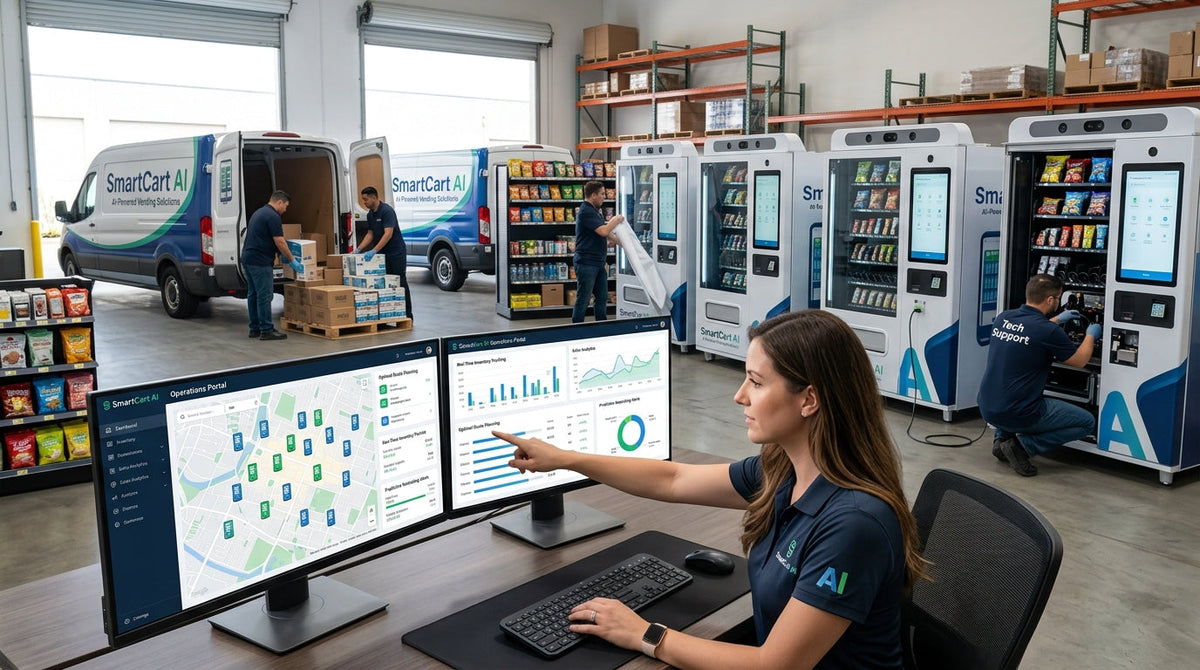
Sales, inventory and alerts for your whole route, from one machine to a fleet.
Answer a few questions about your location, products and budget and get a shortlist.
Estimate revenue, payback period and margin before you buy.
Sales, setup help, warranty and parts from the VMFS USA team.
Join the VMFS newsletter and step into a thriving network dedicated to collective success.
One signup. Endless possibilities.
Scaling an AI vending machine business means expanding your machine fleet, locations, and revenue while your operations, financing, and legal structure grow in parallel — not just installing more units and hoping the math works out. Operators who scale successfully treat every new machine as a data-backed investment: they use performance numbers from existing units to decide where, when, and how fast to expand next. This guide breaks down the operational, financial, and legal framework needed to grow an AI vending machine business from a handful of units to a multi-location fleet, without hitting the failure points that stall most independent operators before they reach ten machines.
Because AI-powered vending machines behave differently from traditional coin-and-coil units, the entire scaling playbook changes too. Remote monitoring, cashless payments, and computer-vision inventory tracking mean a single operator can realistically manage far more locations than legacy vending ever allowed — but only if the underlying systems are built correctly from the start.
Table of Contents
Scaling happens when revenue per location, operating efficiency, and margin all hold steady — or improve — as unit count rises. Adding machines without that discipline just multiplies problems: more routes to drive, more inventory to track, more machines sitting at break-even locations. The distinction matters because AI vending machines remove several traditional bottlenecks (manual restock guessing, cash collection routes, blind pricing) that used to cap how fast a single operator could grow. Machines that report inventory levels and sales data in real time let one person manage a route that would have required a small team under the old model.
Three numbers tell you whether it's time to add units or fix what you already have. If any one of them is missing, expansion amplifies the weak point instead of growing revenue.
Consistent Profitability
Your existing machines hit profitability within a predictable window after installation, not by accident on one lucky location.
A Repeatable Vetting Process
You can explain, in writing, why a location qualifies before the machine ever ships — foot traffic, dwell time, competing options nearby.
Operational Bandwidth
Restocking, repairs, and reporting run on a schedule that doesn't depend on you personally handling every task.
Every location in your existing fleet should be scored against the same benchmarks before you approve a new one. Machines that underperform the ranges below usually indicate a location problem, not a product problem — moving the machine is often more effective than changing the product mix.
| Metric | Healthy Range | Why It Matters |
|---|---|---|
| Sales velocity | Steady daily transactions, not sporadic spikes | Predicts restock frequency and route planning |
| Break-even timeline | Consistent across similar location types | Confirms your location criteria actually work |
| Stock-out frequency | Low, with alerts triggering restock in advance | Every stock-out is lost revenue you can't recover |
| Service downtime | Machine reporting and repairs resolved quickly | Downtime compounds fast once you're managing multiple sites |
Before adding a second, fifth, or twentieth machine, lock in a single software system for monitoring, payments, and inventory reporting across every location. Fragmented systems — one dashboard for machine A, a spreadsheet for machine B — are the single biggest reason operators stop scaling around unit five or six. Understanding how an AI vending machine works at the software level, and reviewing what AI vending machine software actually needs to do, makes it far easier to compare platforms before you're locked into one across a growing fleet. It's also worth putting your growth assumptions in writing early — a documented AI vending machine business plan forces you to define unit economics before capital is committed, not after.
Not every location calls for the same machine. Matching the right format to the right environment is what keeps sales velocity high across a growing fleet instead of averaging out to mediocre.
| Machine Type | Best Fit | Product Focus |
|---|---|---|
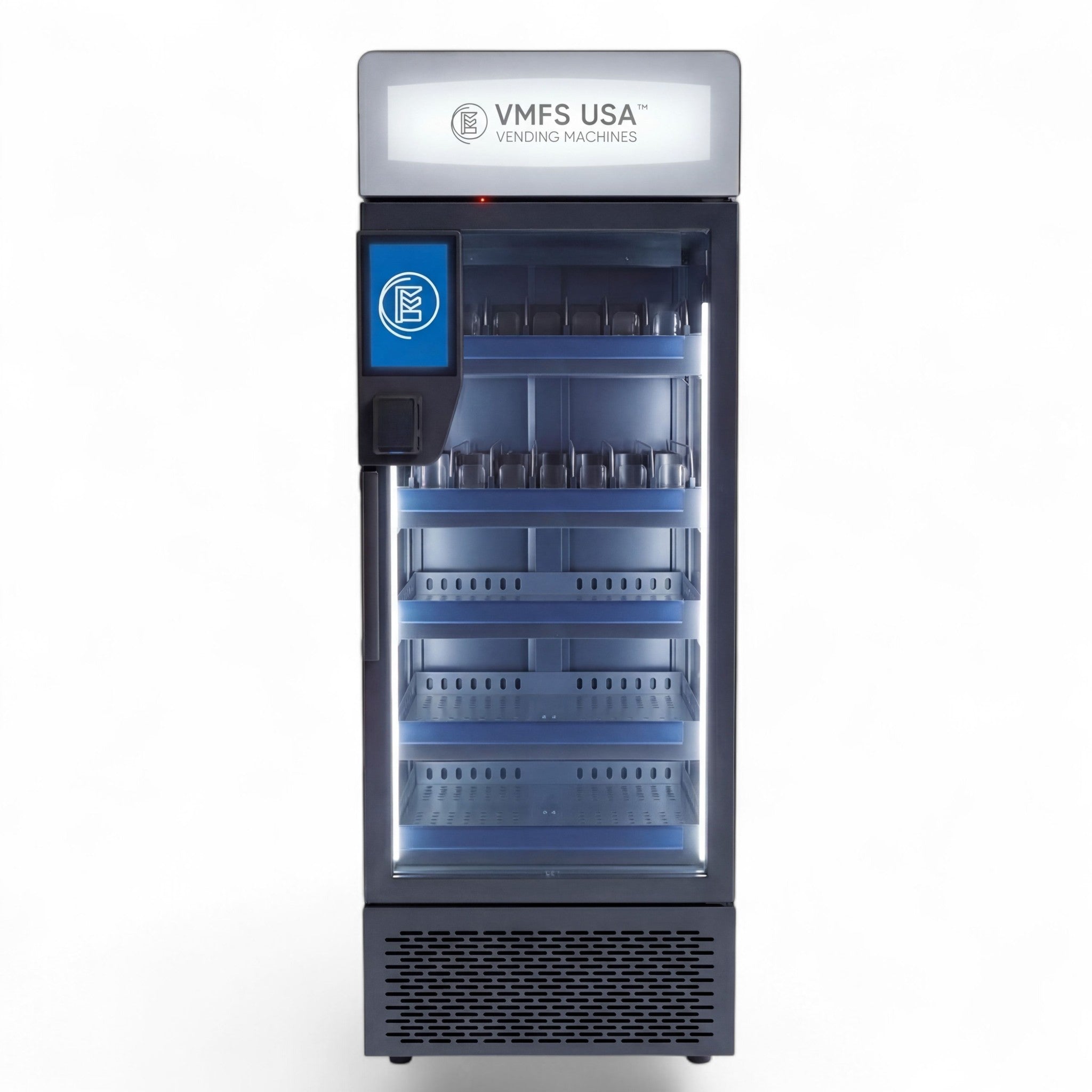
| Smart Fridge | Offices, gyms, break rooms | Fresh food, beverages, grab-and-go meals |
| Smart Cooler | High-traffic retail, lobbies | Cold beverages, snacks, compact footprint |
| Smart Combo | Multi-purpose locations, campuses | Mixed snacks and beverages in one unit |
Compare the machine formats built for each environment:
Standardizing on two or three machine formats — rather than a different configuration for every site — simplifies parts inventory, repair training, and supplier ordering as your fleet grows. Before committing to a lineup, work through a full AI vending machine buyer's guide and review AI vending machine manufacturers in the USA so replacement units and parts stay available as you scale, rather than sourcing one-off machines that create supply gaps later.
Location quality determines scaling speed more than any other factor because a strong location shortens the break-even timeline, which frees up capital for the next machine sooner. Foot traffic alone isn't enough — dwell time, existing food and beverage options, and hours of building access all shape whether a machine performs. Every agreement should be documented from day one using a proper AI vending machine placement contract template, since verbal handshake deals fall apart the moment a property changes management or a location gets more valuable than expected.
Cold outreach to property managers is slow and inconsistent. Platforms built specifically for AI vending machine placement shorten that cycle by connecting operators with property owners who are already looking for a vending partner, and the process for finding a location for an AI vending machine is far more efficient when both sides are opting in rather than being cold-pitched. On the property side, the mechanics are simple: a location owner shares their space details and requirements, gets matched with qualified operators, compares interested parties, and gets vending set up without chasing operators down themselves.
Know a property owner who wants vending on-site? Point them here:
List a Location on VPlacedPer-unit cost drops as you standardize suppliers and negotiate volume pricing on machines, parts, and inventory, but total capital outlay still rises with every new location. A realistic AI vending machine cost breakdown should separate one-time hardware spend from recurring costs — restocking, software subscriptions, connectivity, and maintenance — because recurring costs are what actually strain cash flow once you're running ten or more machines at once.
| Cost Category | Type |
|---|---|
| Machine hardware | One-time, per unit |
| Installation and setup | One-time, per location |
| Inventory and restocking | Recurring, scales with fleet size |
| Software and connectivity | Recurring, usually per-machine subscription |
| Maintenance and repair | Recurring, variable by usage |
Because break-even timelines differ by location type, ROI should be modeled per machine category rather than averaged across the whole fleet. Reviewing AI vending machine ROI benchmarks by location type before expansion helps you allocate capital toward the categories that pay back fastest, instead of spreading investment evenly and diluting returns.
Business formation decisions made at one or two machines often need to be revisited once a fleet crosses into multiple states or income brackets, because liability exposure and tax treatment both change with scale. Getting entity structuring right early — LLC formation, EIN registration, and proper state business registrations — avoids a costly restructure later.
| Entity Type | Typically Best For |
|---|---|
| Sole Proprietorship | A single operator testing one or two machines |
| LLC | Most growing multi-location operators |
| Partnership | Two or more owners sharing capital and routes |
| Limited Partnership | Bringing in investors without giving up control |
| LLP | Multi-owner operations wanting shared liability protection |
| S-Corporation / C-Corporation | Larger fleets with significant revenue or outside investment |
Every new location adds a new contract, and every contract is a place where an unclear clause becomes an expensive problem. Location agreements, vendor and supplier contracts, liability protection documentation, and revenue-sharing or partnership agreements all need to hold up across dozens of sites — not just the first one you signed by hand. A registered agent becomes a practical necessity once you're operating across multiple states, since it's how legal and compliance notices actually reach you on time.
Get your vending business legally structured before you scale further:
Sales tax registration and setup requirements shift from state to state, and a vending-specific tax filing structure prevents the compliance gaps that surface during an audit. Building a solid tax compliance foundation while your fleet is still small is far cheaper than untangling multi-state filings after you've already expanded past a handful of locations. If you're still deciding how to structure the business itself, a full walkthrough of how to start an AI vending machine business covers formation and tax setup together from the ground up.
Remote monitoring is what separates a scalable fleet from a route that requires daily physical visits. Because sensors report stock levels and machine status automatically, restocking becomes scheduled rather than reactive — a direct result of how modern AI vending hardware and software work together.
Downtime hurts more as fleet size grows, since a broken machine in a strong location is lost revenue that compounds daily. Lining up reliable AI vending machine repair services before you need them, and understanding the AI vending machine parts breakdown well enough to stock common replacement components, keeps average downtime short even as the number of machines you're responsible for climbs.
Consolidating inventory purchases with fewer, larger suppliers reduces per-unit product cost and simplifies restocking logistics once routes span multiple locations. Formal vendor and supplier contracts also protect against price volatility, which matters more once a single price swing affects twenty machines instead of two.
Because AI vending machines track item-level sales automatically, product mix can be tuned per location instead of guessed at fleet-wide. Reviewing which products perform best in AI vending machines by location type — office versus gym versus retail lobby — turns each restock into a small optimization rather than a repeat of last week's order.
Sales lift when pricing responds to demand patterns rather than staying static across every machine. Learning how AI-powered vending machines optimize sales shows why identical pricing across a growing fleet leaves revenue on the table, especially between high-traffic and low-traffic sites.
A QR code promotion or first-purchase discount at a single site rarely needs a big budget — it just needs to be visible at the point of use. Because each location has its own foot traffic pattern, small local pushes at launch typically drive adoption faster than broad brand advertising ever would for an individual machine.
Consistent machine wraps, app experience, and payment flow across every location build recognition that compounds as the fleet grows — a person who used your machine at their gym trusts it faster at their office. That consistency also makes it easier to pitch new property owners, since you can point to an established, recognizable presence rather than a one-off installation.
Most operators don't fail because vending is a bad business — they fail because a fixable operational gap gets multiplied across too many locations at once.
| Mistake | Why It Hurts Growth | Fix |
|---|---|---|
| Expanding before profitability is proven | Multiplies an unproven model instead of a working one | Hit consistent break-even on current units first |
| Mixing machine brands and software | Creates fragmented reporting and repair complexity | Standardize hardware and software early |
| Skipping written placement contracts | Leaves locations vulnerable to sudden termination | Use a standardized placement agreement every time |
| Delaying proper business formation | Personal liability grows with every new location | Formalize entity structure before adding machines |
A single supplier relationship works fine for two or three machines, but a growing fleet needs manufacturer partners who can guarantee consistent lead times, parts availability, and support as order volume increases. Vetting AI vending machine manufacturers in the USA before you're under pressure to order quickly protects your rollout timeline when a strong new location becomes available on short notice.
Location selection is rarely obvious from traffic counts alone, which is why documented examples matter more than assumptions. A detailed case study on finding the sweet spot for AI vending machines shows how the same evaluation criteria play out differently across real locations, and broader coverage of the AI vending machine experiment reshaping smart retail gives useful context for where the category is headed as more operators scale.
Demand for unattended, cashless retail keeps expanding into new environments — offices, campuses, transit hubs, residential buildings — because AI vending removes the staffing overhead that limited traditional retail in those spaces. Tracking the AI vending machine market size and growth trajectory helps operators time expansion into emerging location categories before they become competitive, rather than entering once every good spot is already taken.
Scaling an AI vending machine business ultimately comes down to sequencing: prove profitability, standardize systems, formalize the legal structure, then expand location by location using the same criteria every time. Operators who skip steps to move faster almost always end up slower, since fixing a fragmented fleet takes longer than building it correctly from the start.
Ready to Scale Your Vending Fleet?
Browse the AI vending machines built for offices, gyms, retail lobbies, and multi-site growth.
Buy AI Vending Machine
Compartir:
How a Protein Shake Vending Machine Works: The 2026 Operator Guide
How to Get Food From a Vending Machine: A Complete Step-by-Step Guide