




Design the perfect vending solution for your location and customers.

Join the VMFS newsletter and step into a thriving network dedicated to collective success.
One signup. Endless possibilities.
The best AI vending machine is the one whose cabinet, recognition method and fee structure fit your location and the products you plan to sell, not the one with the longest feature list. For most US operators that means choosing the format first (compact cooler, combo, full-size cooler or high-capacity fridge), then checking accuracy, payments, connectivity, total monthly fees and the seller's support before price.
This buyer's guide covers both halves of the decision: how to compare machines, and how to actually buy one, step by step. It uses current VMFS prices and published fees as working examples, flags the US rules that apply to camera-checkout coolers, and ends with a pre-purchase checklist and answers to the questions buyers ask most.
The best AI vending machine for your site is the one that fits the physical space, keeps your products at the right temperature, recognizes them reliably, and carries a fee structure your expected sales can support. Price matters, but a cheap cabinet in the wrong placement loses more money than a more expensive one in the right placement earns back.
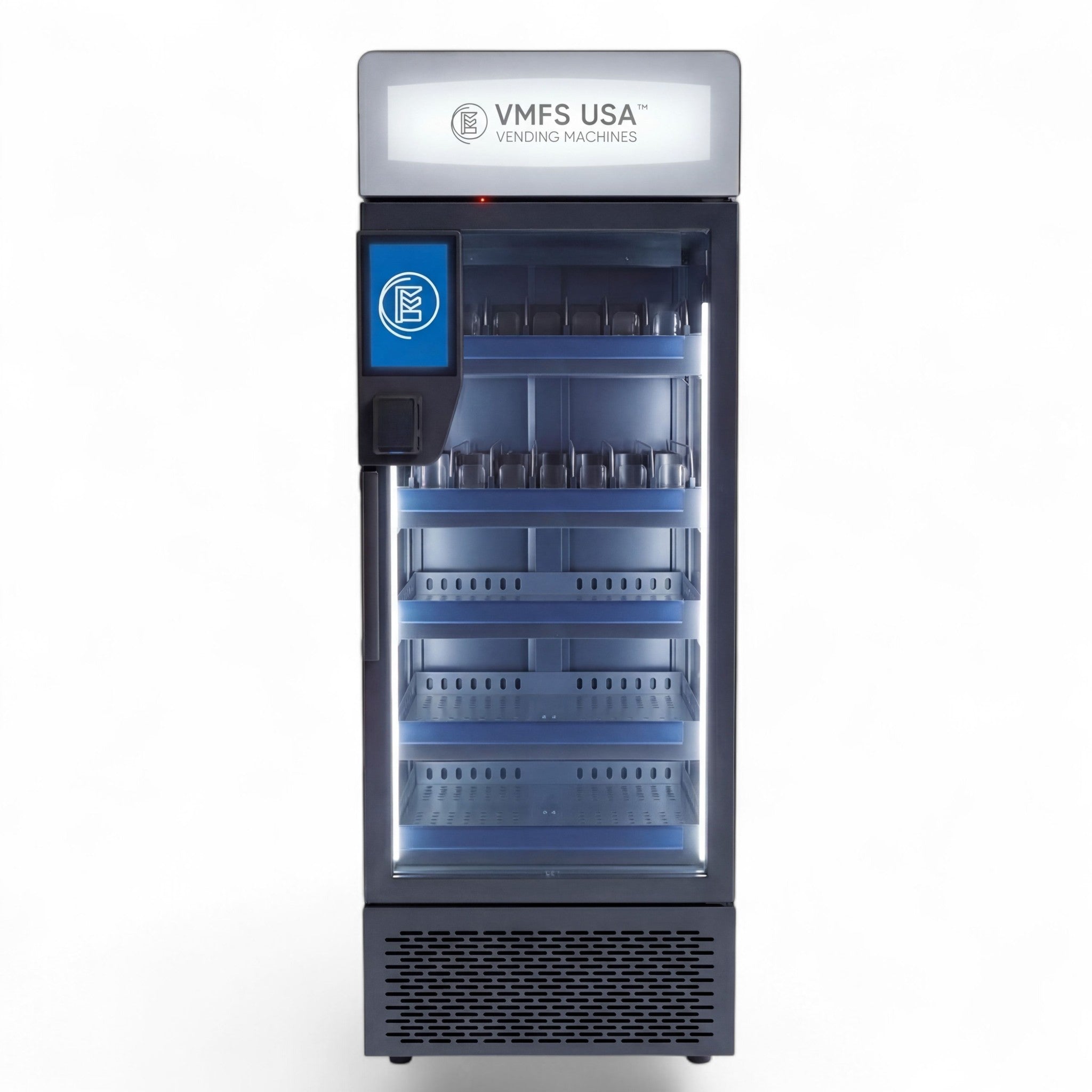
An AI vending machine is a locked glass-door cooler that opens only after a shopper taps a card or phone. Cameras, and on some models shelf weight sensors, record what leaves the shelves, and the card is charged for exactly those items when the door closes. If you want the sensor-by-sensor explanation before you shop, read how AI vending machines work. For a buyer, the practical point is that you are purchasing a system: the cabinet, the recognition model, the payment layer and the cloud software that reports sales and stock. A weak link in any of the four shows up as lost sales or disputed charges.
The format is gaining ground fast. In the 2026 State of the Industry report from Vending Market Watch, more than half of responding operators said they run smart coolers, and smart coolers made up 33.5% of the equipment respondents had deployed, nearly matching traditional glass-front machines. The commercial reason is basket size. Cantaloupe's 2026 Micropayment Trends Report put the average Smart Store transaction at $4.49 in 2025, against an average vend of $2.01 across vending. A shopper who can open the door, pick up three items and put one back simply spends more per visit than one who keys in a single selection.
That upside only arrives when the basics are right. If you are new to buying equipment of any kind, start with our general vending machine buying guide, which covers machine types, new versus used, and how to judge a supplier. This guide focuses on what is different about camera-checkout machines.
AI vending machines come in four main formats: compact coolers, combo coolers, full-size smart coolers and high-capacity fridges or freezers. They share the same tap, open, take and close flow, so the choice comes down to footprint, capacity, temperature range and the product mix the location will buy.
A compact cooler is the easiest AI machine to get approved, because it fits through standard doors and into break-room corners where a full-size machine would be refused. It suits offices, small gyms, clinics and residential lobbies where traffic is steady but not heavy. The trade-off is fewer facings, so it needs tighter product selection and more frequent restocks at busy sites.
A combo cooler carries drinks, packaged snacks and fresh items in one cabinet, which makes it the safe first machine for a site with mixed demand. Offices, coworking spaces, apartment buildings and manufacturing break rooms often buy across categories in one visit, and the combo lets one placement serve all of it. Where those sites also want fresh hot drinks, pair the combo with one of our coffee vending machines.
A full-size smart cooler is built around refrigerated food and beverages with retail-style presentation. It is a strong fit for hospitals, hotels, gyms and campuses where fresh meals, protein drinks and dairy drive repeat purchases. Expect a taller, heavier cabinet and, on some models, extra payment options such as face recognition, which carries its own legal obligations (covered below).
A high-capacity fridge holds more items and more SKUs per visit, which matters at busy sites where a smaller machine would sell out between restocks. Frozen versions open frozen meals and ice cream to the grab-and-go format. These are the most expensive cabinets, so they make sense only where traffic and ticket size are proven.
Because every format is cashless, AI machines are not the right answer everywhere. Cantaloupe's 2026 report found 78% of vending sales were cashless in 2025, which still leaves a share of buyers paying with coins and bills. Where cash matters, or where the placement is semi-public and hard to supervise, read traditional vs AI vending machines before you commit.
Where AI machines earn their cost
Where they struggle
The right pick depends on the job: the smallest cabinet for tight sites, a combo for mixed demand, a full-size cooler for fresh food, and a high-capacity fridge or freezer for proven high-traffic locations. The cards below map each job to an active model in the VMFS AI vending machine lineup, with list prices checked in October 2026 (before freight, tax and options).
Best first machine for tight spaces
AI Grab & Go Cooler, $2,950. 23.6 in wide, about 294 items, 32°F to 86°F, card reader included.
Best for mixed snacks and drinks
AI Smart Combo, $3,950. Five shelves, about 200 to 300 items, camera recognition for multi-category sites.
Best for fresh food and premium sites
AI Smart Cooler, $4,950. About 265 items, 32°F to 50°F, weight sensing plus AI vision, face payment listed.
Best for high volume or frozen
AI Smart Fridge, $9,950 (fridge) or $12,650 (frozen). Up to about 360 items on 30 pickup trays, 10-inch touchscreen.
Best for a tailored build
Build Your AI Vending Machine, from $3,950. Choose slot configuration, refrigeration, payments and branding.
The AI Grab & Go Cooler is the lowest-priced model in the AI range and the only one in the range that lists the card reader as included. Its product page states a charge lands about 15 seconds after the door shuts and that new products are trained remotely in about two hours. At 76.8 inches tall and about 233.7 lbs, two people and a dolly can place it, which makes relocation realistic if the first site underperforms.
The AI Smart Combo costs $1,000 more but adds shelf space for a broader mix, which is why it suits offices and residential buildings that buy snacks and drinks together. The AI Smart Cooler combines weight sensing with AI vision, lists up to 99% recognition accuracy, and adds face-recognition payment alongside cards and mobile wallets. The AI Smart Fridge is the capacity play, and its frozen variant is the route to grab-and-go frozen meals.

| Model (active VMFS product) | Price | Capacity | Recognition | Card reader | Best placement |
|---|---|---|---|---|---|
| AI Grab & Go Cooler | $2,950 | About 294 items, 6 trays | AI vision, 99% listed | Included | Break rooms, small gyms, lobbies |
| AI Smart Combo | $3,950 | About 200 to 300 items, 5 shelves | AI camera recognition | +$450 upgrade | Offices, apartments, mixed-use |
| AI Smart Cooler | $4,950 | About 265 items, 5 shelves / 15 trays | Weight sensing + AI vision, up to 99% listed | +$450 upgrade | Hospitals, hotels, gyms, campuses |
| AI Smart Fridge (fridge / frozen) | $9,950 / $12,650 | Up to about 360 items, 30 trays | Visual recognition + weight sensing | +$450 upgrade | High-traffic sites, frozen meals |
| Build Your AI Vending Machine | From $3,950 | Small, double or triple slot builds | AI vision, up to 99% listed | Configured per build | Sites with specific product or brand needs |
Every product page also lists a $95 4G module (SIM not included), a $650 custom wrap and an extended warranty option, so price those into the quote if the site needs them.
The features that matter most are the recognition method, how accuracy is measured and disputes are settled, payment coverage, connectivity, and the quality of the cloud software. Screens, lighting and branding help, but they do not rescue a machine that mischarges customers or goes offline unnoticed.
Camera-only machines identify products by appearance, which lets you place items anywhere on a shelf but struggles when a hand blocks the view or two packages look almost identical. Weight sensors under each shelf confirm how much left and from where, which counts multiples cleanly but requires assigned shelves and occasional calibration. Fusion uses both. A peer-reviewed study in Frontiers in Built Environment tested this on a replica convenience-store shelf with 85 items from 33 products: combining vision and weight reached up to 92.6% item-identification accuracy, against 91.5% for weight signals alone, in a lab setting with no vendor tuning. That is a useful reality check on marketing claims.
Ask the seller what the accuracy figure measures. A rate per item, per session or per shelf event are three different numbers. Ask how the machine handles look-alike flavors of one brand, how long it takes to add a new product, and what happens when the system is unsure. Then ask to see a session record. VMFS describes pre-authorizing the card before the door unlocks and recording the session until the door closes, so a disputed charge can be checked against the log rather than argued about. If a seller cannot show you how a dispute is resolved, assume you will be refunding blind.
Credit and debit cards, Apple Pay and Google Pay should be standard, with QR payments a useful extra. Confirm how large the pre-authorization hold is, because customers sometimes mistake a pending hold for a double charge. Processing rates also differ for AI sessions, which our explainer on card processing for AI machines walks through.
The machine needs a stable Wi-Fi or cellular connection at the exact placement spot for sessions, stock counts and alerts. The software is the half of the product you use every day: live sales by product, slot-level stock, low-stock and temperature alerts, remote price changes and exportable reports. VMFS Cloud works with every VMFS machine, with plans starting at $7.99 per machine per month; AI machines run on the VMFS AI Cloud plan at $39.99 per machine per month.
Check the temperature range against your products, the door type (an anti-fog heated door matters in humid lobbies), power draw and dimensions. Ask whether the cabinet carries a safety listing from a nationally recognized lab. UL 751 covers payment-accepting vending machines, and its scope points refrigerated vending to UL 541, so a listing to the relevant standard is a fair question for any refrigerated machine, especially imports.
An AI vending machine costs its purchase price plus options and freight up front, then a fixed monthly software and connectivity bill, a per-sale recognition fee, card processing and the host's commission. At VMFS, active AI machines run from $2,950 to $12,650 before options, and the recurring fees are published on the payment system page.
| Cost line | Amount | Paid to | Notes |
|---|---|---|---|
| Machine | $2,950 to $12,650 | VMFS | Active AI models, October 2026 |
| Card reader | $0 to $450 | VMFS | Included on AI Grab & Go Cooler; upgrade on other models |
| 4G module / custom wrap | $95 / $650 | VMFS | Optional; SIM not included |
| Extended warranty | $250 (2 years) or $400 (3 years) | VMFS | Per the warranty page; verify on the product page |
| VMFS AI Cloud | $39.99 per month | VMFS | Platform, alerts, updates, machine management |
| AI recognition fee | $0.07 per completed sale | VMFS | +$0.03 per sale if weight sensors are enabled |
| SIM / cellular data | $15 per month | Third party | Skip it if site Wi-Fi is stable |
| Card reader service | About $10 per month | Third party | Reader service typically $7.95 to $18.95 per month by plan |
| Card processing | About 3% to 6% of sales | Processor | Plans such as ~2.5% + $0.10 or ~5.95% flat |
| Location commission | Typically 5% to 25% of sales | Host | Negotiated per site |
The per-sale recognition fee is why ticket size matters more on AI machines than on coil machines. Seven cents on the industry's $2.01 average vend is about 3.5% of the sale; on a $4.49 Smart Store basket it is about 1.6%. VMFS's own guidance on its AI build page puts the sweet spot for AI-machine products between $5 and $20, where fees take a small share and shoppers still buy without hesitation. Stock fresh meals, protein drinks and premium snacks, not only $1.50 chips.
Illustrative month, not a forecast: assume 15 paid sessions a day at a $6 average basket, or 450 sessions and $2,700 in sales. Fixed fees are $39.99 (AI Cloud) + $10 (reader) + $15 (SIM) = $64.99. Recognition adds $31.50, or $45.00 with weight sensors. At 5.95% processing and a 10% commission, card fees are about $160.65 and the host takes $270. That totals roughly $527, or $541 with weight sensors, before product cost. Run your own numbers with your site's traffic.
Product cost, spoilage on fresh items and your time on restocks come on top. For payback math by site type, read our guide to AI vending machine ROI, or plug your own prices and traffic into the ROI calculator. The previous version of this guide published payback periods by location type; we removed them because they were not tied to verifiable data, and any payback figure is only as good as the traffic estimate behind it.
Compare AI Machines Side by Side
See current prices, capacities and options across the full VMFS AI lineup.
Browse AI Vending MachinesChoose the location first, because traffic, floor space, power and connectivity at the site decide which formats are viable and whether any AI machine will pay off. Buying a cabinet and then searching for a home for it is the most common way first-time buyers end up with the wrong machine.
Strong AI placements share a repeat customer base, limited nearby food options, card-comfortable shoppers and a supervised indoor spot. Offices, hospitals, gyms, hotels, residential buildings and campuses fit that profile; a busy but transient corridor often does not, because AI baskets depend on people who return and trust the machine. Our guide to AI vending machine locations ranks site types, and the hub on how to scout and pitch a vending location covers the host conversation and the agreement. If you would rather be matched with vetted sites, VPlaced runs a placement network for operators and property owners.
Measure the doorway height as well as the width on the delivery path, the elevator, and the clearance in front of the machine for the door to swing fully open. A 23.6-inch-wide cooler clears most interior doors; the 83.5-inch-tall AI Smart Fridge may not clear some. Confirm a standard 110 to 120V outlet within cord reach, and test the Wi-Fi or cellular signal at the exact spot, not just somewhere in the building.
Most AI coolers are indoor machines, and the VMFS warranty states that using an indoor model in an outdoor or semi-outdoor environment voids it. Plan for accessibility too. The 2010 ADA Standards require that where vending machines are provided, at least one of each type complies with the operable-parts rules, which set an unobstructed forward reach range of 15 to 48 inches and a maximum operating force of 5 pounds. Mount the card reader and screen within that range.
Buying an AI vending machine runs through seven steps: secure the location, define the product mix, set a full budget, shortlist formats, get an itemized quote and verify specs, arrange payment or financing, then schedule delivery and the first restock. Doing them in this order prevents the mismatches that delay installs.
Get the host's agreement in writing before you order, covering placement spot, access hours, commission, power and network access, and removal rights. Note foot traffic and peak hours.
Product mix follows the location. Drinks and packaged snacks suit almost any site; fresh meals need a site with steady daily demand to avoid spoilage. Our list of the best products for an AI vending machine helps here, and the temperature needs of your mix narrow the formats.
Budget for the machine, options, freight, opening inventory, permits, insurance and the first months of fees, not only the sticker price. Buyers who fund only the machine routinely run short on everything around it.
Compare two or three formats against the site's space and product mix rather than against marketing claims. If you are also weighing an unattended store, see our comparison of an AI vending machine vs a micro market.
Ask for a written quote that separates machine, options, software subscription, freight and any installation, so offers can be compared line by line. Match the dimensions, power and connectivity requirements against your measurements before you sign.
Decide whether to pay in full or finance, and set up your card processing account so the reader is live on day one. The financing section below compares the options.
Book delivery only once power and connectivity are confirmed live at the spot. VMFS AI machines are described as plug-and-play: plug into a standard outlet, connect your payment account, load products and set prices. Stock a slightly wider range in the first weeks than you plan to keep, so the sales data shows what this site actually buys before you narrow the mix.
| Stage | What happens | Typical timing |
|---|---|---|
| Location and product mix | Host agreement, site measurements, product list | Depends on the host |
| Quotes and financing | Itemized quote, spec check, financing decision | VMFS financing partners typically decide within 24 to 48 hours |
| Shipping, in-stock unit | Freight with appointment scheduling | 7 to 10 days per the VMFS shipping policy |
| Shipping, custom build or wrap | Configuration, wrap, special builds | Around 45 days per the VMFS shipping policy |
| Setup and first restock | Power, payment account, products and prices | Same day once power and network are live |
Product pages sometimes list their own shipping windows, so treat the VMFS shipping policy as the default and confirm the date on your quote.
AI vending machines fall under the same business licensing, sales tax and food rules as any vending machine, plus privacy rules if the machine uses face recognition, and federal disclosure rules if a seller promises you locations. Check them before the order, because some decide which model you can use.
Start with a business license, a sales tax permit and, if you sell food, any local health permit; requirements vary by state, county and city, as our guide to vending permits in the United States explains. At the federal level, FDA's vending labeling rule applies to operators who own or operate 20 or more vending machines, and glass-front machines may rely on front-of-package calorie labeling if the calorie declaration is at least 150% of the size of the net weight declaration on the package.
Face-recognition payment needs care. Illinois' Biometric Information Privacy Act treats a scan of face geometry as a biometric identifier, requires written notice and a written release before collection, requires a published retention policy, and allows liquidated damages of $1,000 per negligent violation and $5,000 per intentional or reckless one. California's CCPA can also apply once a business crosses its thresholds, including annual revenue above $26,625,000 since January 1, 2025. If you operate in a state with biometric rules, ask the seller whether face pay can be switched off and how biometric data is stored. Card payments bring PCI DSS into scope for anyone who stores, processes or transmits cardholder data, which is one reason to use an established processor rather than a homemade setup.
Watch for turnkey promises: if a seller offers to provide locations for your machines as part of the deal, the FTC Business Opportunity Rule (16 CFR 437) generally requires a written disclosure document at least seven calendar days before you sign or pay, and earnings claims must be substantiated in writing. A seller that cannot produce either is a red flag.
Paying cash avoids interest and keeps accounting simple, while financing preserves working capital and lets you place a second machine sooner. Neither is better in general; the right choice depends on how much cash you hold after inventory, fees and a reserve for slow first months.
| Option | Advantages | Trade-offs |
|---|---|---|
| Pay in full | No interest or payment obligation; you own the machine outright from day one | Ties up capital that could fund inventory or a second machine |
| Third-party financing | Lower upfront cash; can place several machines in parallel; payments go toward ownership | Interest or fees on top of the base price; credit check; insurance may be required |
VMFS does not lend in-house; its financing options run through PayPal, Klarna and Clicklease, with terms typically from 6 to 48 months. Clicklease advertises approvals down to a 500 FICO score, amounts up to $30,000 and no time-in-business requirement, and the financing page notes that decisions typically come within 24 to 48 hours. Compare the total cost over the full term, not the monthly payment, and ask about early payoff. Our vending machine financing guide compares loans, leases and SBA options in depth.
Two more points belong in the decision. Lenders and many hosts expect insurance, so price property and general liability coverage using our vending machine insurance guide. On taxes, the IRS notes permanent 100% bonus depreciation for qualified property acquired after January 19, 2025, and a Section 179 expensing limit of $2,500,000, which can let a business deduct equipment in the year it is placed in service. Confirm how that applies to you with a tax professional.
New is the safest path for a first AI machine, used can save money if the software and parts are still supported, and custom makes sense when a site has specific branding or product needs. The deciding factor is support, not the price tag.
A used AI machine is only as good as its recognition software, cloud account and parts supply. Before buying second-hand, confirm the seller can transfer the cloud account, that the manufacturer still updates the model, that cameras and weight sensors pass a test with your own products, and that replacement parts are available. A used cooler that cannot get software updates is a refrigerator with a lock. Our guide to buying a used vending machine includes an inspection checklist.
Custom builds suit corporate, hospitality and branded placements. The Build Your AI Vending Machine configurator starts at $3,950 and lets you choose slot configuration, refrigeration settings, payments and exterior branding. Wraps and custom configurations lengthen lead times, so raise them before you order; the VMFS custom build team can quote larger or fleet builds.
Evaluate the seller on warranty terms, parts availability, support location and hours, software ownership and how transparently fees are disclosed. Those factors decide how fast a broken machine returns to service, and a machine offline for two weeks waiting for a part erases a lot of margin.
Read the written warranty rather than the headline. The VMFS warranty policy provides a 1-year parts warranty on every machine, with extensions available on some models, and lists exclusions such as vandalism, cosmetic wear, power surges and outdoor use of indoor models. Ask where parts are stocked, whether support is US-based, and whether the seller writes its own software or licenses it, since that decides whether bugs get fixed and features get added. If you can, see the machine running: VMFS invites buyers to its Miami showroom in person or on Zoom.
Avoid three mistakes that derail purchases. The first is choosing the machine before the location. The second is assuming connectivity because the building has Wi-Fi. The third is comparing bundled quotes, which hides whether one seller is cheap on hardware and expensive on software. For a wider view of who builds these machines domestically, see the overview of AI vending machine manufacturers in Related Reading below.
Confirm every item below in writing with the seller and the host before you pay. Each unanswered item is a likely source of delay or unexpected cost after the order.
Run the Numbers Before You Buy
Enter your product costs, prices and expected daily sessions to see payback against machine cost and monthly fees.
Open the ROI Calculator
Share:
How Do AI Vending Machines Work? A Step by Step Guide and the Best Models
How AI Vending Machines Boost Sales - Data, Pricing, and Inventory