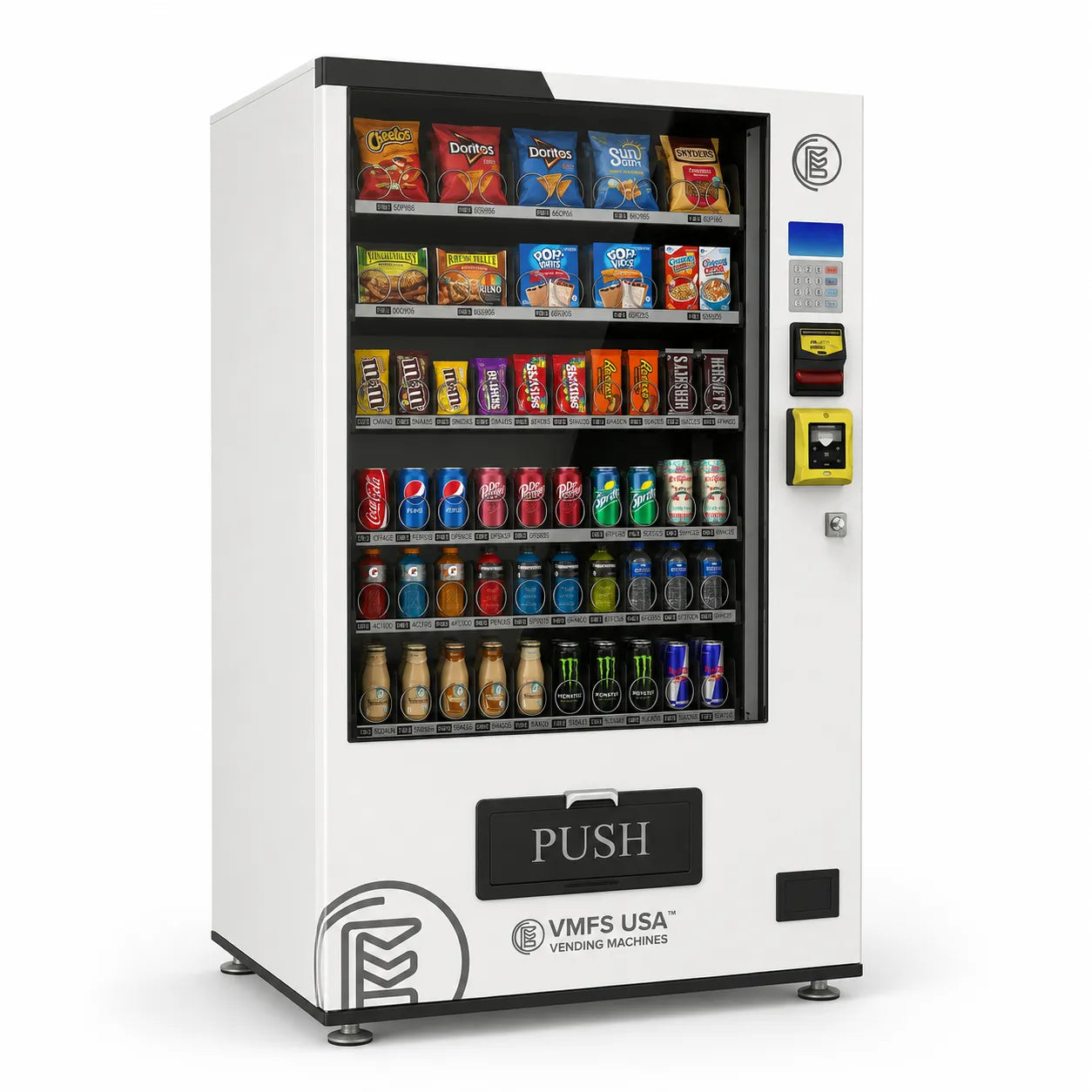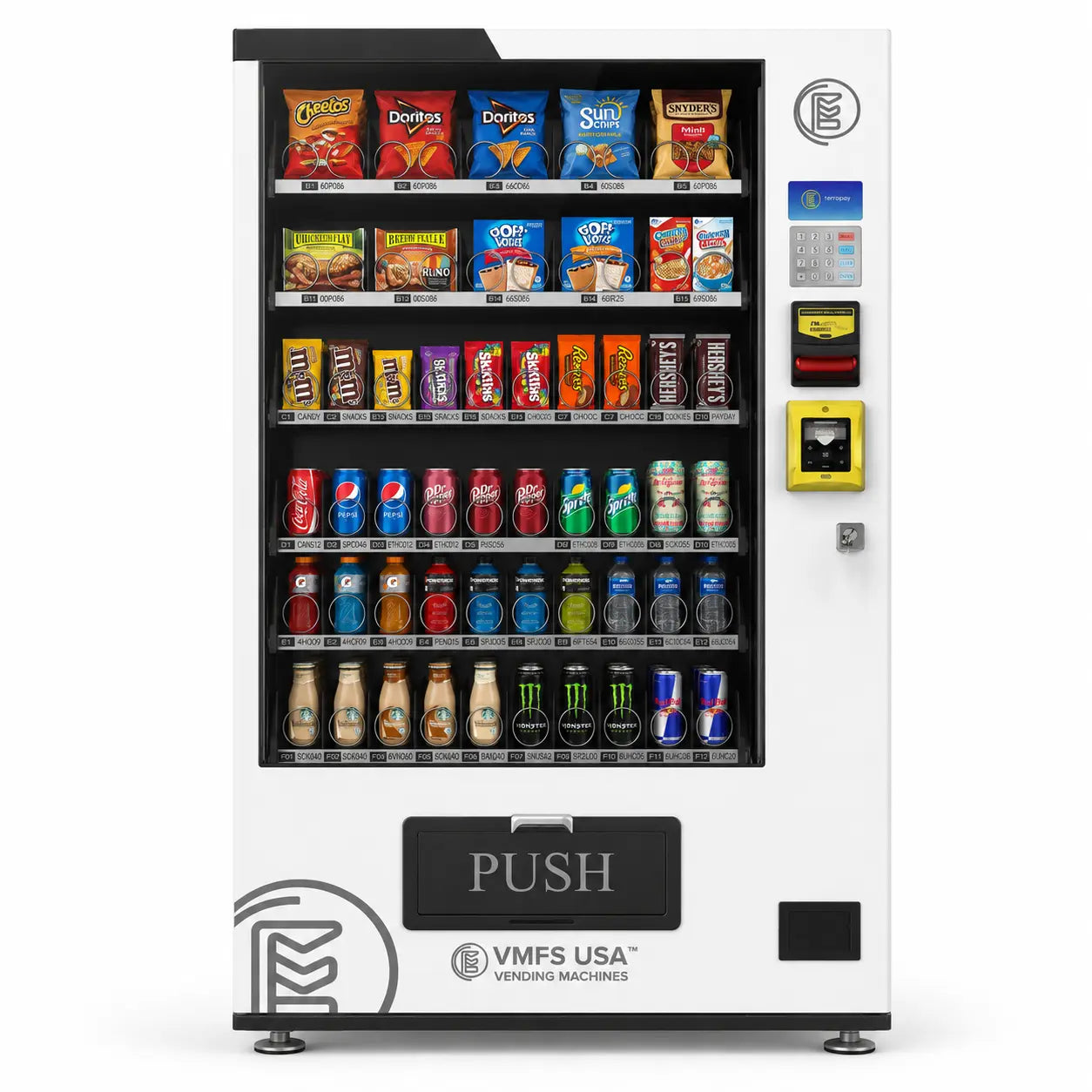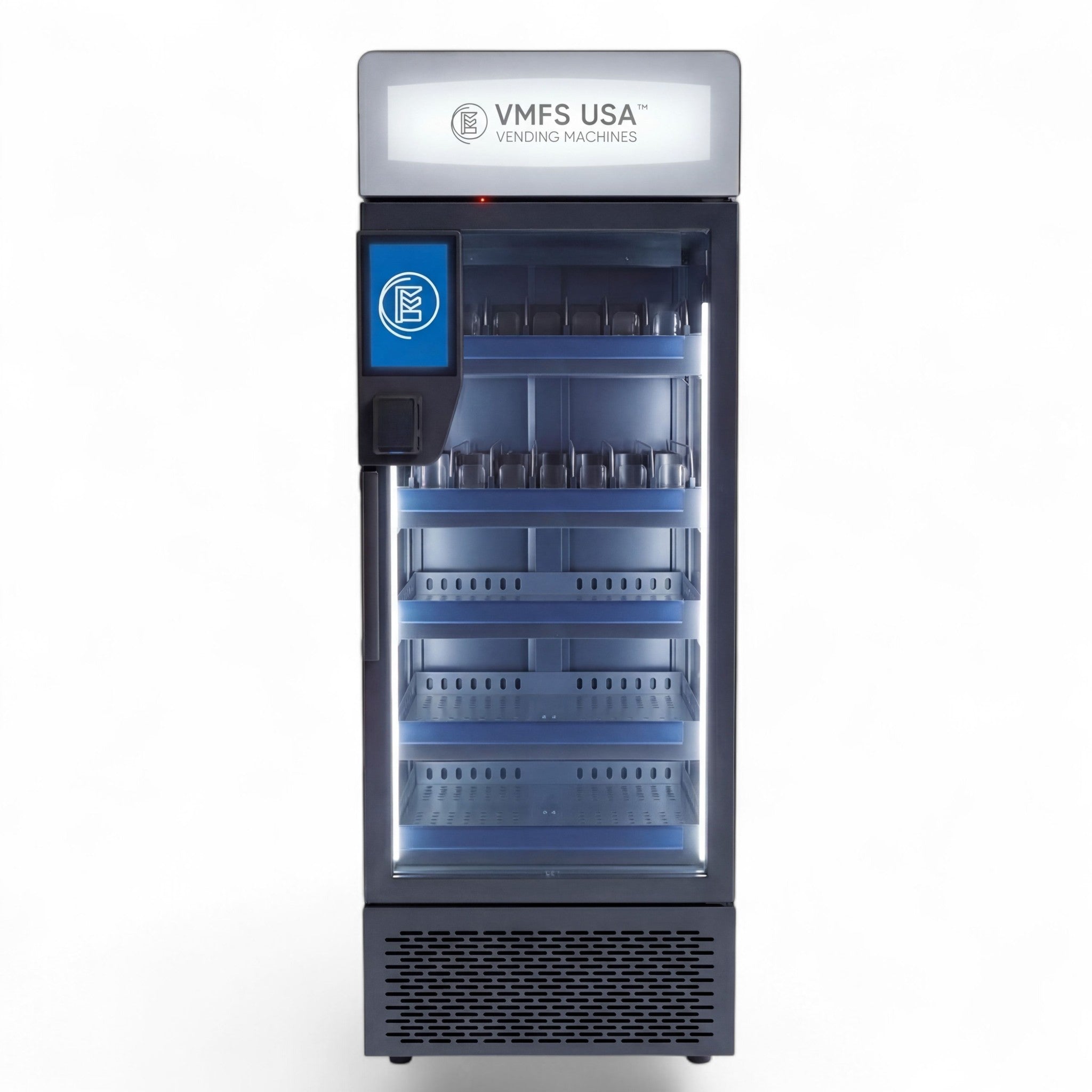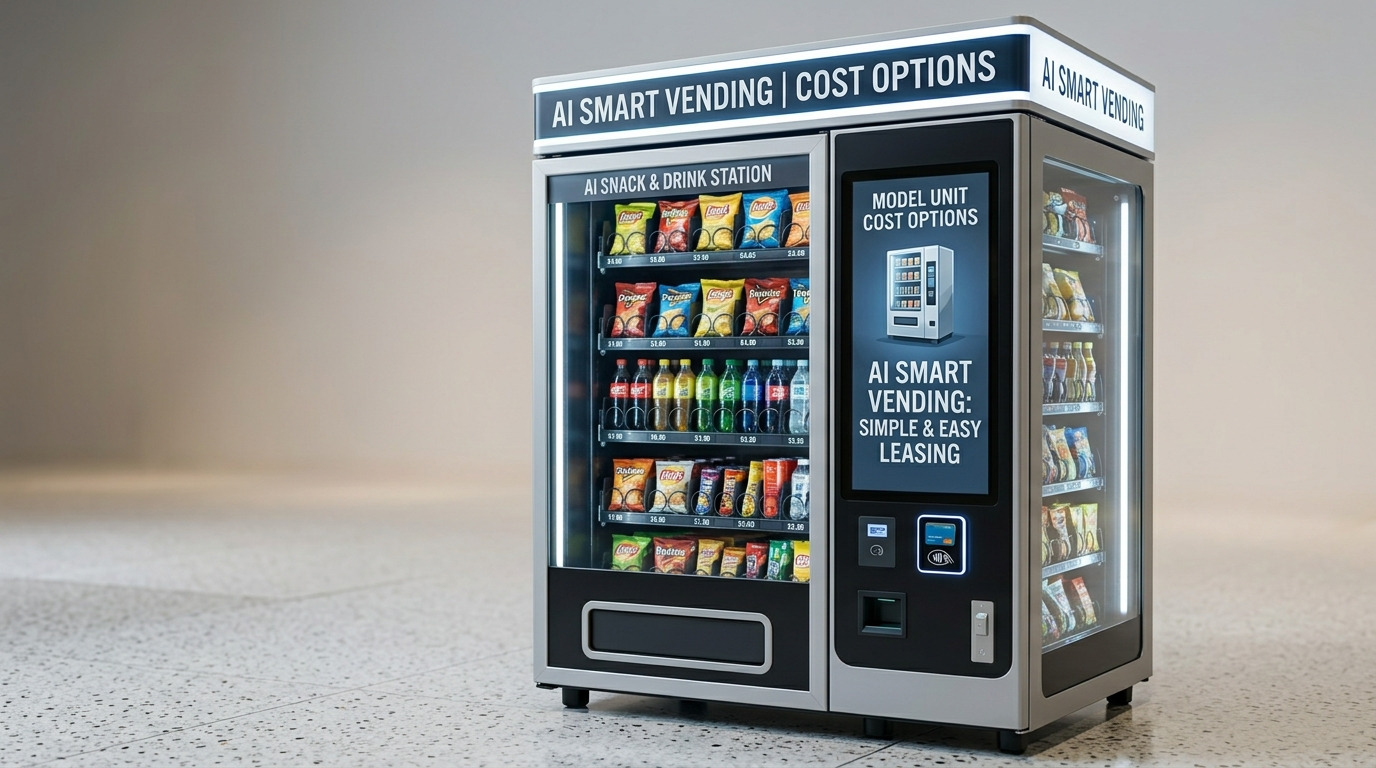
AI vending machines for independent operators range from $3,950 for an entry-level smart combo unit to $16,880 for a premium AI-powered frozen food machine. The broader market includes budget units from overseas manufacturers starting under $1,500, but those are not designed for commercial U.S. deployment. The hardware purchase is only the starting point. Cloud software, AI recognition fees, location commissions, electricity, and insurance all determine what running a profitable machine actually costs per month.
Operators who calculate hardware price alone consistently underestimate their real break-even timeline. This guide breaks down every cost category across every machine tier, so you can build an accurate investment model before committing capital.
What is an AI vending machine? An AI vending machine is a self-service retail kiosk that uses computer vision, weight sensors, and machine learning to identify products and charge customers automatically, without any staff. Customers tap a card or phone to unlock the machine, take what they want, and walk away. The AI identifies every item removed and charges the card instantly, with leading commercial models reaching 99 percent transaction accuracy.
In This Guide
- AI Vending Machine Market Price Ranges
- What an AI Vending Machine Price Actually Includes
- AI Vending Machine Prices by Machine Type
- What Drives AI Vending Machine Price Variation
- Ongoing Operating Costs
- Total Cost of Ownership in Year One
- Is an AI Vending Machine Worth the Price
- Frequently Asked Questions
AI Vending Machine Market Price Ranges
The AI vending machine market is not a single category. It spans four distinct price tiers, each built on different technology, manufactured to different commercial standards, and designed for fundamentally different operator profiles. The $600 entry-level unit and the $16,880 commercial frozen machine are both called AI vending machines. They share very little beyond that label.
Budget Tier: $600 to $1,500
This range covers basic smart fridges manufactured primarily for export from overseas markets. These units use single-camera recognition systems without weight-sensing verification and are typically listed on wholesale platforms like Alibaba. Transaction accuracy on these units runs lower than commercial models, typically 85 to 90 percent, which generates more disputed charges and customer friction at the point of sale.
Warranty support for budget-tier machines is either absent or limited to manufacturer returns without U.S.-based service. Power configurations may require adaptation for U.S.-standard 110V outlets. Cloud software, if included, is often a basic mobile app without the analytics infrastructure commercial operators need to manage multiple machines efficiently. These units suit proof-of-concept testing in low-stakes environments. They are not the right starting point for an operator building a vending route.
Mid-Market Tier: $1,500 to $3,500
Mid-market AI vending machines offer improved recognition systems over budget units but remain below the commercial-grade threshold most U.S. operators require. Some units in this range use single-camera AI without weight sensing. Others include basic cloud platforms with limited reporting depth. Warranty terms and U.S.-based support vary significantly by supplier and are not always transferable if the machine changes hands.
Operators considering this tier should confirm camera count, recognition accuracy specifications, cloud platform capabilities, warranty scope, and whether a U.S.-based support team is available before purchasing. The gap between a $3,000 mid-market unit and a $3,950 commercial-grade machine is often smaller than operators expect when total three-year ownership cost is compared.
Commercial-Grade Tier: $3,950 to $7,940
This is the operating range for purpose-built, commercially supported AI vending machines designed for U.S. deployment. Units in this tier include dual-camera or multi-sensor recognition systems, commercial-grade refrigeration, cloud management platforms with real-time inventory and sales reporting, one-year warranties covering compressor, refrigeration, and electronics, U.S.-based support teams, and pre-configured cashless payment terminals compatible with U.S. payment infrastructure.
This is the tier that generates consistent, documented operator ROI data. It is also the range where the break-even math works across mid-traffic locations without requiring premium placements to justify the investment. Browse the full commercial range of AI vending machines for sale to compare models within this tier side by side.
Premium Cold-Chain Tier: $8,000 to $20,000 and Above
This range covers AI frozen food machines, dual-zone temperature systems, and high-capacity enterprise units. The price reflects the engineering complexity of maintaining consistent frozen or cold-chain conditions while processing touchless AI transactions at commercial volume without staff. The gross margin per transaction at this tier is substantially higher than standard snack vending, which justifies the longer break-even timeline for operators serving the right locations.
Operators evaluating AI vending machines for a U.S. commercial deployment should plan on the $3,950 to $16,880 range depending on machine type, and should treat anything significantly below that as either a budget import or a machine without the support infrastructure needed to run a reliable, profitable operation.
What an AI Vending Machine Price Actually Includes
AI vending machines are not priced the same way as traditional coil vending machines. A standard snack machine is hardware only: a cabinet, coil mechanism, coin acceptor, and payment terminal. An AI vending machine is a complete system, and the purchase price covers several layers of technology that do not exist in conventional units.
Every commercial AI vending machine purchase includes the physical cabinet with commercial-grade refrigeration or ambient storage, an onboard edge processor that runs the AI vision software locally without depending on constant internet connectivity, a cloud management dashboard for remote inventory monitoring and sales analytics, and a cashless payment terminal supporting credit cards, debit cards, Apple Pay, and Google Pay.
Understanding how AI vending machines work at the technology level makes the price difference easier to evaluate against the operational benefits you are buying. The system replaces mechanical dispensing, manual cash handling, and physical stock checks with automated alternatives that reduce labor overhead and remove the transaction friction that costs traditional machines sales every day.
For operators weighing the cost of switching from a traditional machine, the full financial comparison is in our AI vending machine vs traditional vending machine breakdown, which covers three-year operating costs across both formats.
AI Vending Machine Prices by Machine Type
The commercial AI vending machine market divides into four product categories. Each serves a different operator profile, location type, product mix, and revenue target. Choosing the wrong tier for your location is the most expensive mistake a first-time operator can make. The financial case for each tier is built on different variables entirely.
| Machine Type | Price | Capacity | Best Location Fit | Est. Break-Even |
|---|---|---|---|---|
| AI Smart Combo | $3,950 | 300 items, 6 slots | Offices, gyms, small campuses | 6 to 10 months |
| AI Smart Fridge | $5,950 | 265 items, 15 slots | Corporate dining, hospitals | 3 to 6 months |
| Smart Fridge (Large) | $7,940 | 360 items, 30 slots | Malls, universities, high traffic | 8 to 14 months |
| AI Frozen Food Machine | $16,880 | 264 items, 5 slots | Cold-chain, frozen meal locations | 12 to 20 months |
AI Smart Combo Vending Machine: $3,950
The AI Smart Combo Vending Machine is the entry point into commercial AI vending. At $3,950, it holds up to 300 items across 6 product slots with refrigerated temperature control. Customers tap to unlock the door, take what they want, close it, and checkout completes automatically. Ships within three days, which matters for operators with a location secured and a launch timeline in motion.
This model suits offices with 30 to 80 daily users, small gyms, apartment buildings, and community spaces where a larger unit would not fit. Optional upgrades at checkout include a credit card reader at $450, a custom exterior wrap at $600, and a two-year extended warranty at $250. The base machine operates without any of those if the location already has compatible payment infrastructure in place.
A machine placed in a mid-traffic location generating $1,200 to $1,800 in monthly gross sales recovers the $3,950 hardware cost within six to eight months. At premium placements with higher daily foot traffic, that timeline compresses to four to five months.
AI Smart Fridge Vending Machine: $5,950
The AI Smart Fridge Vending Machine carries a 4.83 out of 5 rating across 18 verified operator reviews. It holds 265 items across 15 configurable slots under consistent refrigeration. The jump from 6 slots to 15 slots is not a luxury upgrade. It is the difference between a machine that sells out between service visits and one that sustains revenue consistently across a full service cycle.
Operator-reported revenue on this model runs $800 to $1,600 per month, with an estimated ROI payback of three to six months based on VMFS USA deployment data. Financing is available from $166 per month for operators who want to preserve capital. Lead time runs six to twelve weeks depending on availability, so operators should factor that into their location negotiation and launch timeline rather than treating it as a same-week purchase.
The 360-degree frost-free cooling maintains 32°F to 50°F across all shelves. An optional heating module extends the range to 77°F for locations that need ambient and refrigerated product capability from a single footprint.
Smart Fridge Vending Machine (Large): $7,940
The large Smart Fridge Vending Machine at $7,940 holds 360 items across 30 product slots. That capacity is the right choice when location traffic is high enough that smaller models would sell out between service visits and lose revenue permanently. Those revenue gaps are invisible in a spreadsheet but they are real in practice and compound over months.
Operators running a 15-slot model in high-traffic locations consistently find that the incremental cost of upgrading to 30 slots pays back within the first two months through avoided stockout losses alone. This model suits shopping malls, large corporate campuses, university buildings, and transport hubs with 150 or more daily visitors at the placement point. The 30 slots also allow operators to run category variety, mixing beverages, fresh food, snacks, and premium items from one machine rather than deploying two smaller units side by side.
For operators scaling to multiple locations, understanding how AI vending machines optimize sales through dynamic pricing and demand forecasting becomes especially valuable at this capacity level, where the financial upside of getting the product mix right is meaningfully larger per machine.
AI Powered Frozen Food Vending Machine: $16,880
The AI Powered Frozen Food Vending Machine is the premium tier at $16,880. The price reflects the engineering complexity of cold-chain automated retail. Maintaining stable frozen conditions continuously while processing touchless AI transactions requires significantly more hardware than a standard refrigerated grab-and-go unit.
This machine uses dual 1080p cameras alongside weight-sensing shelves for 99 percent recognition accuracy across frozen products. The frost-free refrigeration operates between 32°F and 59°F with 360-degree air circulation to prevent cold spots throughout the cabinet. It supports facial recognition checkout alongside standard card and mobile payment, which represents the most frictionless transaction experience available in any commercial vending format today.
The monthly operating fee structure for this machine is fully disclosed: $39.99 per month for VMFS AI Cloud, $10 per month for the card reader, and an optional $15 per month SIM card fee if on-site WiFi is not available. The AI recognition fee is $0.07 per completed transaction, with an additional $0.03 per transaction when weight sensing is enabled. At 300 monthly transactions, recognition fees run $21 to $30 per month. These numbers belong in every operator's cost model before purchase, not after.
The break-even on a $16,880 machine is longer than on commercial refrigerated units. At $1,200 monthly gross profit after commission and processing, hardware recovery takes 14 months. That timeline is justified by the margin profile of frozen meal vending, where average transaction values run three to four times higher than standard snack vending and the customer base is less price-sensitive per transaction.
What Drives AI Vending Machine Price Variation?
Within each market tier, several specific factors push prices up or down. Understanding them helps operators compare supplier quotes accurately and avoid paying for capability their location does not need.
Camera count and resolution. Entry-level commercial machines use one or two wide-angle cameras covering the full cabinet interior. Higher-tier models add multiple camera positions at different angles, including overhead and shelf-level views, to eliminate recognition blind spots and handle products that look similar from a single angle. More cameras raise unit cost but also raise accuracy and reduce disputed transactions at the operator level.
Weight sensor configuration. Camera-only recognition systems achieve 85 to 92 percent accuracy in standard conditions. Adding weight-sensing shelves that cross-verify every camera reading against a measured weight change pushes accuracy to 99 percent. That accuracy difference matters commercially. A machine processing 500 transactions per month at 90 percent accuracy generates approximately 50 disputes. At 99 percent accuracy, that drops to five. Weight sensing adds to the machine cost but reduces the operational burden of dispute resolution significantly across the life of the unit.
AI recognition fee structure. This is the line item most operator guides never mention. The AI vision system charges $0.07 per completed transaction, with an additional $0.03 when weight sensing is active, for a maximum of $0.10 per transaction. A machine completing 600 transactions per month generates $42 to $60 in monthly AI recognition fees that are separate from the hardware purchase price. Confirm this number with any supplier before signing a purchase agreement.
Refrigeration system complexity. A standard single-zone refrigerated grab-and-go unit maintains one temperature. A frozen food machine maintains sub-freezing conditions continuously while still allowing touchless door-open transactions, which requires more robust insulation, a higher-output compressor, and a more sophisticated thermal management system. Each layer of complexity adds manufacturing cost that flows through to the purchase price.
Cabinet build specification and warranty scope. Commercial-grade steel construction, insulated tempered glass, foam-molded interior liners, and PVC-insulated door seals cost more than the materials used in budget-tier machines. A one-year warranty on compressor, refrigeration, and electronics reflects the manufacturer's confidence in that build and protects the operator from the most expensive early-failure scenarios.
Ongoing Operating Costs for an AI Vending Machine
Hardware price is only one part of the investment. Seven recurring cost categories determine what running a profitable AI vending machine actually costs each month. Most published guides cover two or three of them. This section covers all seven with real numbers.
Inventory and Product Margins
Inventory is the largest recurring cost for any vending operator. Snacks and beverages sourced through wholesale distributors typically cost $0.50 to $1.50 per unit depending on product category and order volume. Sold at standard retail pricing of $2.50 to $5.00 per unit, gross margin per transaction runs 40 to 60 percent. Fresh or premium items carry higher average transaction values and support wider margins at the right locations.
The AI cloud dashboard tracks which specific products sell fastest at each machine location. That data drives better restocking decisions and eliminates the dead stock problem that affects operators who manage inventory by memory. Operators who act on sales data from their dashboard consistently run leaner inventories and generate higher per-machine profit than those who manage stock by visual inspection during route visits. See how this data advantage scales across a fleet in our guide on how AI vending machines optimize sales through data, pricing, and inventory management.
Location Commission
Venue owners charge a commission of 10 to 25 percent of gross sales in exchange for hosting the machine. Offices and gyms tend toward the lower end. Premium placements in malls, airports, and corporate campuses push commissions to 20 to 25 percent. Some venue owners prefer a flat monthly fee of $100 to $300 rather than a revenue percentage. Flat fee structures benefit operators in high-volume months and should always be negotiated where the venue owner is open to the conversation.
A machine producing $2,000 per month in gross sales at a 15 percent commission pays $300 per month to the venue before any other costs. Operators who want pre-vetted, high-traffic placements without cold outreach can work with a vending machine placement service that handles venue sourcing, agreement structuring, and logistics. That approach reduces location-finding time significantly, particularly for operators entering new markets or scaling to multiple machines.
AI Cloud Software and Platform Fees
The VMFS AI Cloud platform costs $39.99 per month per machine. This covers real-time inventory tracking, live sales reporting by product and location, fault alerts, remote pricing controls, and performance analytics. The cloud platform is what separates a passive machine from an actively managed retail asset. Operators managing a fleet of five or more machines consistently report that cloud monitoring reduces unnecessary service trips by 30 percent or more compared to manual route management.
The card reader fee runs $10 per month. If the location has no on-site WiFi, an optional SIM card module adds $15 per month. Operators who connect the machine to existing location WiFi eliminate the SIM cost entirely and reduce monthly platform overhead to $49.99.
AI Transaction Recognition Fees
The per-transaction AI recognition fee is the cost most operators discover only after receiving their first monthly statement. The standard rate is $0.07 per completed transaction. When weight sensing is enabled alongside camera recognition, an additional $0.03 applies, bringing the maximum to $0.10 per completed sale. These fees only apply when a transaction completes. They do not apply during idle periods.
At 400 monthly transactions with full weight sensing enabled, recognition fees run $40 per month. At 800 transactions they run $80. Build this number into your monthly cost model from the beginning. It is not a hidden charge, but suppliers rarely disclose it in their published pricing guides.
Payment Processing Fees
Cashless payment processors charge 2.5 to 3 percent per transaction. On a $5.00 product sale, that is $0.13 to $0.15. A machine processing 500 transactions at an average $5.00 sale pays $62 to $75 in monthly processing fees. These fees are unavoidable on cashless systems. They are offset by the higher transaction volume that cashless payment acceptance generates relative to cash-only machines in comparable locations, particularly in venues serving younger demographics who do not carry cash.
Electricity
Refrigerated AI vending machines draw more power than traditional ambient snack machines. Budget $20 to $40 per month for electricity on standard refrigerated models. The AI Frozen Food Machine with continuous sub-freezing operation runs higher, typically $40 to $70 per month depending on ambient temperature and door-open frequency at the placement location. Frost-free refrigeration systems with 360-degree air circulation are more energy-efficient than older compressor designs and keep electrical costs toward the lower end of these ranges across most deployments.
Insurance
General liability insurance for a single commercial AI vending machine typically runs $35 to $70 per month depending on location type, product category, and policy scope. This cost is absent from most first-time operator budgets and shows up as an unexpected line item at launch. The higher the machine purchase price, the more important comprehensive coverage becomes. A $16,880 frozen food machine without insurance coverage is a significant unprotected business asset in a location the operator does not own or control.
Business Setup, Permits, and Legal Costs
First-time operators need to budget for business formation, local vending permits, and location agreements before the machine generates revenue. LLC registration and EIN setup typically runs $100 to $500 depending on state. Local vending permit requirements and fees vary significantly by municipality. Location agreements should be reviewed before signing. Commission structures, exclusivity clauses, liability allocation, and early termination terms all affect long-term placement profitability.
For guidance on vending permits, contracts, and legal setup specific to the vending industry, operators can access resources built around the compliance requirements that vary across U.S. states and municipalities. Getting this right at the start prevents the kind of permit violations and contract disputes that force operators to pull machines from locations prematurely.
Total Cost of Ownership in Year One
Here is what a realistic year-one cost model looks like for a single AI Smart Combo machine at $3,950 in a mid-traffic office location generating $1,500 in monthly gross sales. This is the number most buyers never see before committing capital.
- Hardware: $3,950
- Credit card reader upgrade: $450
- Initial inventory load: $400 to $600
- Business setup and permits: $200 to $400
- Location commission at 15% on $1,500 monthly gross: $2,700 annually
- Payment processing at 2.75% on $1,500 monthly gross: $495 annually
- VMFS AI Cloud platform: $39.99/month = $480 annually
- Card reader monthly fee: $10/month = $120 annually
- AI recognition fees at $0.10 per transaction, 400 monthly: $480 annually
- Electricity: $30/month average = $360 annually
- Insurance: $50/month = $600 annually
Total year-one cost including hardware and all setup: $10,235 to $10,635
Now the revenue side. A machine generating $1,500 in monthly gross sales at 50 percent gross margin produces $750 in monthly gross profit. After deducting a 15 percent location commission of $225, payment processing fees of $41, VMFS AI Cloud and card reader fees of $50, and AI recognition fees of $40, net monthly profit lands at approximately $394.
At $394 net monthly profit, the $3,950 hardware cost recovers in approximately ten months. High-traffic placements generating $2,500 or more in monthly gross sales push net monthly profit to $650 to $800 and compress hardware recovery to five to six months.
Year-two economics improve substantially. Hardware, card reader, setup, and permit costs drop out entirely. Year two runs only on cloud software, recognition fees, processing, commission, electricity, and insurance costs against full revenue. Net annual profit per machine in year two at the same sales volume runs approximately $4,728, representing a 120 percent return on the original $3,950 hardware investment. That compounding dynamic is why operators who build to multiple machines consistently report that the second and third machines in a route outperform the first in lifetime ROI even when placed at locations with lower raw traffic.
Is an AI Vending Machine Worth the Price?
At the $3,950 entry point, an AI vending machine is among the most accessible automated retail investments available to independent operators today. The grab-and-go model eliminates mechanical failure points, removes the need for staff at every transaction, and generates real-time sales data that makes every subsequent business decision more accurate. Those three advantages compound over time in ways that a standard coil machine never can.
The investment performs best when three conditions are met. The placement location has genuine returning foot traffic of at least 50 to 80 daily visitors at the specific machine placement point. The operator uses the cloud dashboard to match restocking timing to actual sales velocity rather than a fixed schedule. The product mix reflects what that location's specific customers actually buy, informed by transaction data rather than operator assumption.
The investment underperforms when location quality is low, product selection is made without data, or the machine is serviced only when visibly empty. An AI vending machine in a low-traffic venue averaging $400 per month in gross sales takes 24 to 30 months to recover hardware cost at the $3,950 entry level. That outcome has nothing to do with machine quality. The AI system cannot generate sales from foot traffic that does not exist. Location selection is the single variable that drives more revenue outcome variance than any other factor, including machine tier.
Operators who approach AI vending machine price as an ROI question consistently make better decisions than those who treat it as a sticker price comparison. The right question is never which machine costs less to buy. The right question is which machine, at which location, generates the fastest return on total capital deployed.
Operators ready to compare models can browse the complete range of new vending machines for sale across all categories. Those who want a full evaluation framework before purchasing can read the complete AI vending machine buyer's guide covering machine selection, location strategy, and financial modeling from first purchase through multi-machine scaling.
As a vending machine supplier serving independent operators and commercial accounts across the United States, VMFS USA ships every AI unit with a one-year parts warranty, U.S.-based support, and VMFS Cloud access included in the purchase price. Operators with questions about machine selection, placement strategy, or financing can reach the team directly through the VMFS USA website.
This guide was produced by the VMFS USA editorial team using operator-reported deployment data, live product pricing verified as of April 2026, and current market research across the U.S. commercial AI vending market. VMFS USA has supplied and supported AI vending machine deployments across the United States. For placement guidance specific to your location and business goals, contact the VMFS USA team directly.
Frequently Asked Questions
How much does an AI vending machine cost?
Commercial AI vending machines for independent operators range from $3,950 for an AI Smart Combo grab-and-go unit to $16,880 for a premium AI Powered Frozen Food Machine. The AI Smart Fridge costs $5,950 and the large Smart Fridge costs $7,940. Budget-tier units from overseas manufacturers start under $1,500 but are not built for commercial U.S. deployment in terms of warranty, support, or recognition accuracy. Every commercial-grade unit includes AI vision software, cloud management, and cashless payment integration built into the purchase price.
What is the difference between an AI vending machine and a regular vending machine?
A regular vending machine uses mechanical coils to dispense products one at a time through a fixed selection process. An AI vending machine uses computer vision cameras, weight sensors, and machine learning to identify products and process payments automatically without staff. Customers tap a card or phone to unlock the door, take what they want freely from the open shelves, close the door, and the AI charges them only for what they took. There are no coils, no dispensing motors, no manual transaction steps, and no mechanical failure points of the kind that generate service calls on traditional machines.
How does an AI vending machine checkout work without staff?
Customers tap a credit card, debit card, Apple Pay, or Google Pay to authenticate and unlock the machine door. Premium models also support face-scan checkout. Once the door opens, the customer takes whatever products they want from the open shelves. When they close the door, AI cameras and weight sensors cross-verify exactly which items were removed and charge the card instantly. No scanning, no button pressing, no staff involvement at any point. The entire transaction takes under 30 seconds.
What are the monthly operating costs of an AI vending machine?
Monthly operating costs for a single commercial AI vending machine include the cloud platform at $39.99, a card reader fee at $10, an optional SIM at $15 if no on-site WiFi is available, AI recognition fees of $0.07 to $0.10 per completed transaction, payment processing at 2.5 to 3 percent of gross sales, location commission of 10 to 25 percent of gross sales, electricity at $20 to $70 depending on machine type, and insurance at $35 to $70. Total monthly operating costs typically run $400 to $700 for a single machine excluding inventory restocking.
What locations work best for AI vending machines?
AI vending machines perform best in locations with steady, returning foot traffic where the same customers visit regularly: office break rooms, corporate campuses, university buildings, apartment complexes, gyms, hospitals, and factory floors. High-volume public locations like airports and transit hubs also perform well for operators with premium placements. The minimum viable foot traffic for a profitable single-machine deployment is typically 50 to 80 daily visitors at the specific machine placement point, not just the broader facility.
What is the ROI on an AI vending machine?
On a $3,950 AI Smart Combo machine generating $1,500 monthly gross sales at 50 percent margin and 15 percent location commission, net monthly profit runs approximately $394 and hardware cost recovers in roughly ten months. High-traffic placements generating $2,500 or more per month compress break-even to five to six months. The AI Smart Fridge at $5,950 reports operator-estimated revenue of $800 to $1,600 per month with a three to six month payback. Year-two returns improve significantly once hardware, setup, and permit costs are fully recovered.
Are AI vending machines profitable?
Yes, when placed in the right location with the right product mix. Gross margins on snacks and beverages run 40 to 60 percent above wholesale cost. After location commissions, payment processing, AI platform fees, and recognition fees, net margins typically land between 25 and 40 percent per transaction. The real-time sales data from the AI cloud dashboard helps operators optimize their product mix continuously, which sustains those margins across every service cycle rather than eroding over time.
How long does it take to recoup the cost of an AI vending machine?
Break-even timelines vary by machine tier and location quality. The AI Smart Combo at $3,950 typically recovers hardware cost in six to ten months at a mid-traffic placement. The AI Smart Fridge at $5,950 runs three to six months at higher-volume locations per operator data. The large Smart Fridge at $7,940 runs eight to fourteen months. The AI Frozen Food Machine at $16,880 runs twelve to twenty months depending on average transaction value and location traffic. Break-even timelines shorten significantly when operators secure a strong, verified location before the machine arrives rather than searching for placement after purchase.


Share:
ID Scanner for Business: How They Work, What Types Exist, and Which One Your Business Actually Needs
How to Start a High-Margin Vape Vending Machine Business in 2026 (Step-by-Step Guide)