




Design the perfect vending solution for your location and customers.

Join the VMFS newsletter and step into a thriving network dedicated to collective success.
One signup. Endless possibilities.
Choose a traditional coil machine when the site needs cash acceptance, the lowest per-sale overhead and simple one-item purchases; choose an AI grab-and-go machine when the site is indoors, card-friendly and able to sell multi-item baskets, fresh food or odd-shaped packages. At VMFS USA, active AI units start at $2,950 and Seaga traditional machines start at $2,489, so the hardware gap is smaller than most operators expect.
The real differences sit in monthly and per-transaction fees, payments, shrink, product range and location fit. This guide compares both formats line by line with current VMFS prices and published fees, then gives you an ROI method and a low-risk migration path from a traditional route to a mixed fleet.
Traditional vending machines sell one item at a time from coils behind locked glass, while AI vending machines let a verified customer open the door, take several items and get charged automatically for what left the shelf. That single design difference drives almost every other trade-off: what you can sell, how customers pay, how losses happen, what software you pay for and which sites will approve the machine.
Neither format is outdated. Coil machines still win at sites with cash-paying customers, weak connectivity, harsh or semi-public settings and low-ticket impulse buys. Grab-and-go units win where shoppers want to browse, where fresh or irregular products matter, and where a host such as a corporate facility manager or hotel GM sees the machine as an amenity rather than a box in the corner. Industry data shows the market has already moved to running both: in the 2026 State of the Industry survey published by Vending Market Watch, more than half of responding operators said they run smart coolers, and smart coolers made up 33.5% of the equipment respondents had deployed, roughly level with traditional glass-front machines.
Pick traditional when
Cash still matters, connectivity is unreliable, products are standard packaged snacks and drinks, or the site is semi-public and harder to supervise.
Pick AI grab-and-go when
The site is indoors with controlled access, shoppers pay by card or phone, and you want baskets, fresh food or products that will not survive a coil drop.
Run both when
You have anchor sites that justify AI fees and a long tail of moderate sites where a coil machine earns steadily with less overhead.
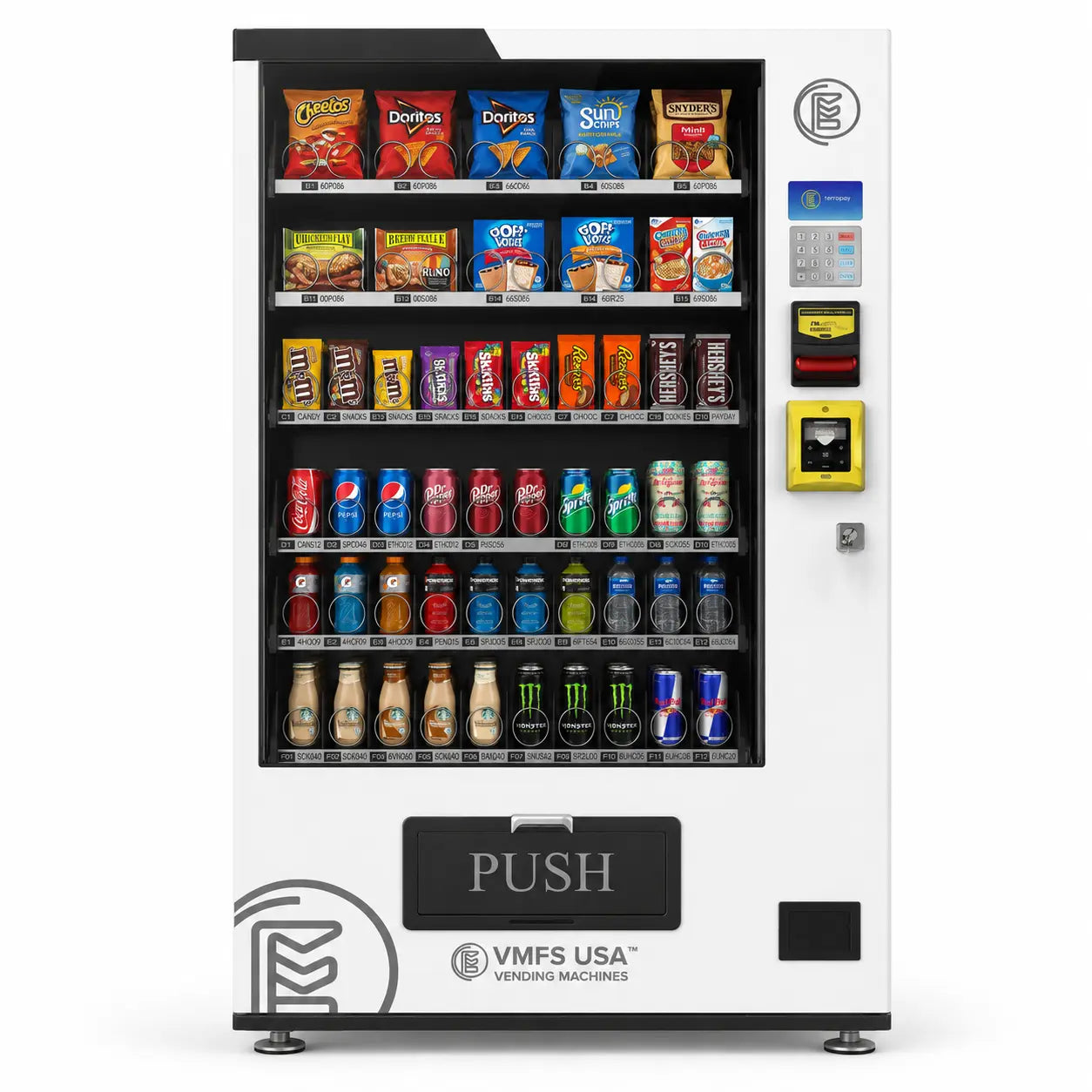
A traditional vending machine stores products in spirals or on trays, takes a selection on a keypad and drops the item into a delivery bin after payment. The customer never touches the inventory until it is paid for, which is why the format tolerates public, lightly supervised placements. The Seaga ENV5C Combo Merchandiser is a good reference point: up to 371 items across 36 selections, a refrigerated drink section, guaranteed-vend infrared sensors that confirm each product actually dropped, a backlit Braille ADA-compliant keypad, and standard 115V power, according to its VMFS product page.

Payment on a coil machine is modular. Every VMFS machine ships MDB-ready, and MDB (Multi-Drop Bus) is the industry protocol that lets bill validators, coin mechanisms and card readers plug into the machine controller. NAMA maintains the standard, and its version 4.3 release in 2019 revised the section on cashless devices. In practice this means you can start a Seaga machine with coins and bills, then add a card reader later without replacing the machine. The ENV5C page notes that the base machine ships with mechanical coin operation and that bill and card hardware are listed as upgrades, so price those into the quote.
The weakness is visibility. A coil machine without telemetry only tells you what sold when someone opens the door. A jammed spiral, a bill validator that stops taking $20 notes or a sold-out top seller stays invisible until the next service visit, and those hours of lost sales are not recovered. Adding a networked card reader or VMFS Cloud telemetry closes much of that gap, which is why many operators modernize their Seaga vending machines before they buy any AI unit.
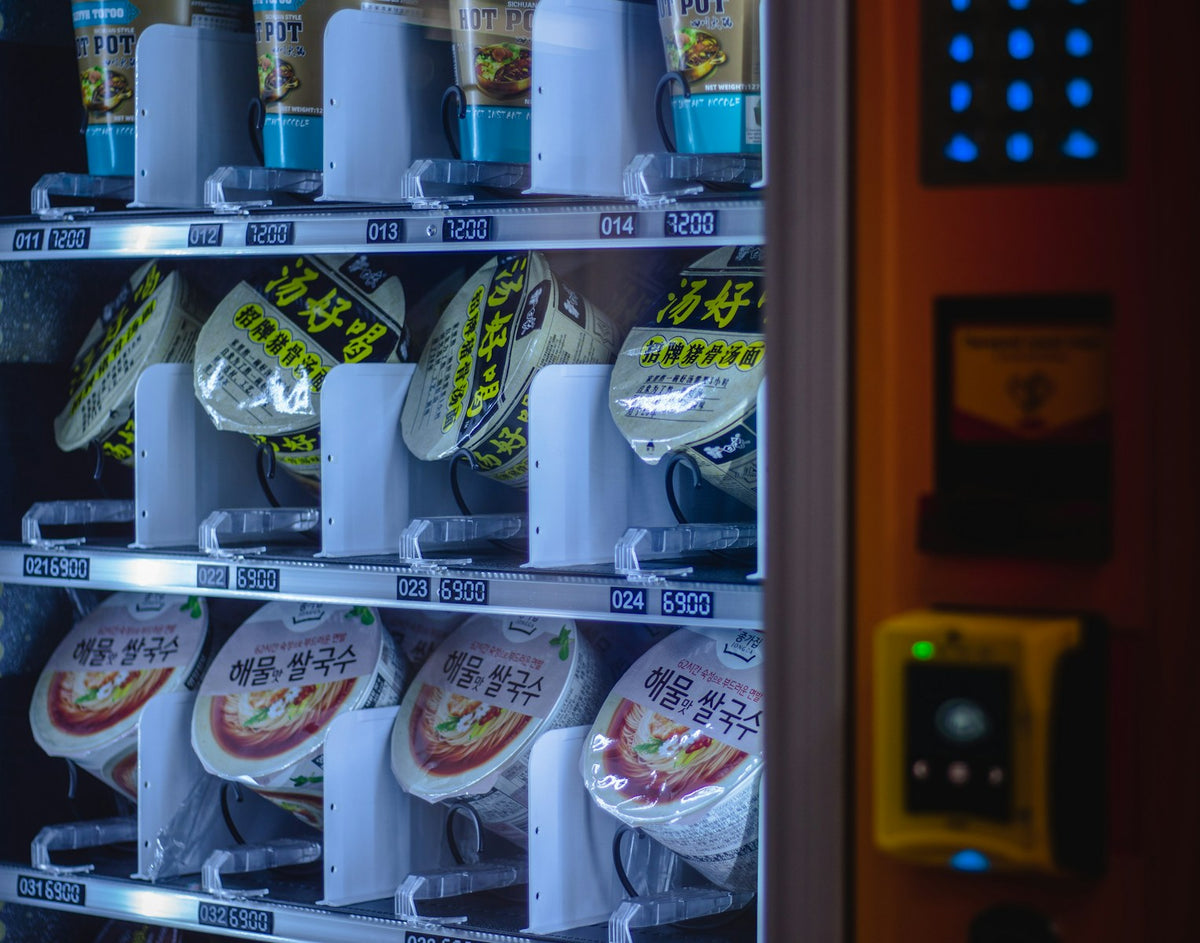
An AI vending machine is a locked, refrigerated cabinet with open shelves that unlocks only after the customer taps a card or phone, then uses cameras and, on some models, weight sensors to work out what was taken and bill it when the door closes. There are no coils, no keypad selection and no delivery bin. The customer shops the shelves the way they would shop a store cooler, puts items back if they change their mind, and walks away with a receipt.

VMFS lists up to 99% recognition accuracy on its AI Smart Cooler, which combines weight sensing with AI vision, and the AI Grab & Go Cooler page describes checkout completing in about 15 seconds. Behind the cabinet sits a cloud layer that records each session, keeps per-product stock counts and raises alerts for low stock, temperature, door and connectivity problems. Because the session is tied to a payment method before the door opens and every visit leaves a recognition record, a disputed charge can be checked rather than argued about.
The trade-off is dependency. AI units need careful product setup so the system recognizes every SKU, they need a stable Wi-Fi or cellular connection, and they are cashless by design. If you want the full sensor, camera and edge-computing explanation, read how AI vending machines work step by step. If you are weighing a touchscreen smart machine with spirals against a true grab-and-go unit, the smart vending machine vs AI vending machine guide covers that middle category, which this article treats as an upgraded traditional machine.
The table below compares the two formats on the factors that decide a purchase, using active VMFS products and the fees VMFS publishes. Prices were checked on October 13, 2026 and exclude freight, tax, wraps and optional upgrades.
| Factor | Traditional (coil) vending machine | AI grab-and-go vending machine |
|---|---|---|
| How a sale happens | Keypad selection, item drops into a bin, one selection per vend | Tap to unlock, take any number of items, charged on door close |
| VMFS price range (active products) | $2,489 (Seaga SM1600 countertop) to $6,495 (Seaga ENV5C full-size combo); outdoor ENV5C $7,950 | $2,950 (AI Grab & Go Cooler) to $9,950-$12,650 (AI Smart Fridge, fridge or frozen variant) |
| Typical capacity | About 330 items (QB2200) to 371 items in 36 selections (ENV5C) | About 265 (AI Smart Cooler), 294 (AI Grab & Go Cooler), 200 to 300 (AI Smart Combo), up to 360 (AI Smart Fridge) |
| Product range | Packaged items that fit a spiral and survive a drop | Anything that fits a shelf and can be recognized: fresh packaged food, irregular packages, multi-packs |
| Payments | Coins, bills and optional MDB card reader with tap and mobile wallets | Cashless only: cards, mobile wallets, QR; face recognition listed on the AI Smart Cooler |
| VMFS software | VMFS Cloud Basic $7.99 per machine per month | VMFS AI Cloud $39.99 per machine per month |
| Per-transaction VMFS fee | None listed | AI Recognition Fee $0.07 per completed transaction, plus $0.03 if weight sensors are enabled (per /pages/payment-system) |
| Third-party fees | Card reader monthly fee and processing percentage | SIM data $15/month if not on Wi-Fi; card reader service about $10/month; processing |
| Main loss risks | Vandalism, cash theft, jams and mis-vends | Recognition errors and product swaps, limited by a verified payment gate and session record |
| Connectivity | Runs without a network; reader can carry its own 4G | Needs Wi-Fi or cellular data for sessions, stock and alerts; the AI Grab & Go Cooler lists a $95 4G module |
| Warranty (VMFS) | 1 year standard, extendable to 3 years | 1 year standard, extendable to 3 years on the AI Smart Combo |
Two rows surprise most buyers. First, AI hardware is not automatically the expensive option: the AI Smart Combo lists at $3,950 against $6,495 for a full-size ENV5C. Second, the cost difference moves from the purchase price to the monthly and per-sale fees, which is why the ROI section below models them separately.
An AI machine at VMFS costs about the same to buy as a traditional machine, but it carries higher fixed software fees and a per-sale recognition fee that a coil machine does not. On the traditional side, the Seaga SM1600 countertop unit is $2,489, the slim Seaga QB2200 snack and soda machine is $2,999, and the full-size ENV5C is $6,495. On the AI side, the AI Grab & Go Cooler is $2,950, the AI Smart Combo is $3,950, the AI Smart Cooler is $4,950, and the AI Smart Fridge runs $9,950 to $12,650 depending on the fridge or frozen variant.
VMFS publishes its cloud plans per machine per month: Cloud Basic at $7.99, Advertising Cloud at $16 and AI Cloud at $39.99. AI Cloud adds computer-vision stock and misplaced-product detection, customer behavior analytics, operator-set dynamic pricing rules, remote diagnostics and product recognition training on top of the lower tiers. A traditional machine can run on Basic, or on the card reader provider's own dashboard, because readers from Nayax and Cantaloupe include their own telemetry. The VMFS payment system page lists reader monthly fees of $7.95 to $14.95 per device for Nayax and roughly $9.95 to $18.95 for Cantaloupe.
The VMFS payment system page lists an AI Recognition Fee of $0.07 per completed transaction, charged only when the AI system processes a sale, plus a $0.03 weight sensor add-on per transaction if the machine is configured for weight sensing. Outside VMFS, every card sale on either format also pays the processor; the same page puts most processing fees between 3% and 10% per transaction depending on provider and setup, with examples such as about 5.95%, or 2.5% plus $0.10, for Nayax.
Because the recognition fee is a flat amount per completed sale, basket size decides how heavy it feels. On a $2.00 single-item purchase, $0.07 is 3.5% of the sale. On a $4.00 basket it is 1.75%, and with weight sensors enabled ($0.10 total) it is 2.5%. That is the arithmetic case for stocking AI machines with multi-item and higher-priced products rather than using them as expensive spiral replacements.
Price the add-ons: The ENV5C and AI Smart Combo pages list a credit card reader as a paid upgrade, while the AI Grab & Go Cooler includes the reader and lists a $95 4G module for sites without Wi-Fi. Put payment hardware, connectivity and any wrap in the quote before you compare machines.
The AI pricing guide in Related Reading breaks costs down further by model and configuration. If you are spreading the cost, the AI Smart Combo page shows financing from $110 per month, and VMFS vending machine financing covers both machine types.
Compare AI grab-and-go models side by side
See capacity, temperature range, payment options and current prices for every AI unit VMFS sells.
Browse AI Vending MachinesTraditional machines can serve every customer, including cash payers, while AI machines serve only customers with a card, phone wallet or QR-capable app. For most indoor sites that is a small and shrinking group. Cantaloupe's 2026 Micropayment Trends report found that 78% of vending sales were cashless in 2025, up from 73% the year before, and that 85% of cashless vending sales were contactless.
The remaining cash share still matters at certain sites. Roughly one vending sale in five was paid in cash in that dataset, and it is rarely spread evenly across a route. Sites such as laundromats, transit areas and some shift-work break rooms can rely on cash far more than a corporate office does, and your card reader data will show which ones. If a placement depends on those buyers, a coil machine with a bill validator keeps sales that an AI machine would never see.
Ticket size points the other way. The same report puts the average cashless vending ticket at $2.45 against $1.57 for cash, the average vend at $2.01, the average micro market ticket at $3.02, and the average Smart Store ticket at $4.49, the highest of any self-service format it tracked. Smart Stores are not identical to AI coolers, but the pattern is consistent: the more freely a shopper can browse and pick, the larger the purchase. That is the revenue mechanism behind grab-and-go, and it is also why a host who currently runs a micro market or wants one without staff often accepts an AI unit quickly.
On security and compliance, both formats rely on certified card hardware and processors. PCI DSS applies to any entity that stores, processes or transmits cardholder data, so use a reputable vending reader and processor rather than improvised payment setups. Our guide to cashless payment systems compares readers, fees and setup for traditional machines.
Traditional machines protect inventory with a physical barrier, while AI machines protect it with a payment gate and a recognition record, so the two formats lose money in different ways. A coil machine's losses come from forced entry, cash-box theft, jams and mis-vends that trigger refunds or complaints. An AI machine has no cash box and no coils to jam, but it opens fully to anyone with a valid card, so its losses come from recognition errors, product swaps and items placed where the system cannot see them.
Shrink across vending is usually modest. In the Vending Market Watch 2026 operator survey, nearly two-thirds of respondents reported shrink below 5%, while 12.5% reported shrink above 10%. For context, the National Retail Federation's 2023 security survey put the average shrink rate for US retailers at 1.6% in fiscal 2022. Those figures do not split vending shrink by format, so treat any vendor claim of dramatic reductions with caution and measure your own sites.
What changes with AI is accountability. VMFS describes AI grab-and-go as shifting loss prevention from a mechanical lock to a verified payment gate plus an accurate recognition record, and its AI Smart Fridge page notes that every transaction has a video record. Placement still decides most outcomes: an AI unit in a badge-access office or a staffed hotel lobby behaves very differently from one in an unsupervised public corridor. Coil machines remain the safer choice for semi-public, overnight or outdoor sites; the outdoor ENV5C exists for exactly that reason.
Privacy note: Cameras record every AI session, and some models offer face recognition as a payment option. The FTC adopted a policy statement on biometric information in May 2023, and, as summarized by law firm Kelley Drye, it treats failing to assess foreseeable harms before collection and surreptitious or unexpected collection of biometric data as practices it may weigh under the FTC Act. Post clear signage, tell the host how video is used, and leave face payment off unless customers actively opt in.
Traditional machines usually hold more units and more distinct selections per dollar, while AI machines hold a wider variety of product types in fewer, more flexible spaces. The ENV5C carries up to 371 items in 36 selections and the QB2200 about 330 items, all sized for spirals and drops. AI units trade fixed slots for adjustable shelves: about 265 items in roughly 15 pickup zones on the AI Smart Cooler, about 294 items across 16.1 cubic feet on the AI Grab & Go Cooler, approximately 200 to 300 on the AI Smart Combo and up to 360 on the AI Smart Fridge, depending on product size.
The bigger difference is what can go on the shelf. A coil cannot reliably vend a salad bowl, a sandwich wedge, a glass bottle of cold-pressed juice, a family-size snack bag or a boxed meal. An open shelf can. That is why AI units suit fresh and better-for-you menus; the same Vending Market Watch survey found jerky, protein bars and fresh food among the leading better-for-you sellers. Temperature range matters too: the AI Smart Cooler is adjustable from 32°F to 50°F, while the AI Grab & Go Cooler runs from 32°F to 86°F so the same cabinet can hold cold drinks, fresh packaged items or ambient snacks. For frozen menus, the AI Smart Fridge has a frozen variant, and the Big Freezer Vending Machine covers mixed frozen inventory.
Fresh food raises the stakes on rotation. AI stock counts and temperature alerts make dated items easier to manage, but they do not remove the need to pull expired product on schedule. Our list of the best products for an AI vending machine covers margin, shelf life and planogram ideas.
AI machines suit indoor, controlled-access sites with steady card-paying traffic and demand for fresh or premium products, while traditional machines suit cash-heavy, semi-public, lower-ticket or connectivity-poor sites. Use the table as a starting point, then confirm with a site visit and the host's own traffic data.
| Location type | Better fit | Why |
|---|---|---|
| Small office or break room | Traditional, or a compact AI cooler if staff ask for fresh food | Low volume favors low fixed fees; a narrow AI unit fits where a full-size machine will not |
| Large corporate campus | AI grab-and-go | Badge access, card-paying staff, demand for lunch items and multi-item baskets |
| Hospital staff areas and lobbies | AI grab-and-go, with a coil machine in public waiting areas | Around-the-clock shifts want fresh food; public areas need cash and harder cabinets |
| Hotel lobby or market corner | AI grab-and-go | Guests pay by card, staff presence deters misuse, premium items carry margin |
| Gym or fitness center | Either; AI for protein and recovery drinks | Irregular packaging and higher-priced items suit open shelves |
| Apartment or condo amenity room | AI grab-and-go | Controlled residents-only access and a store-like amenity for the property |
| Manufacturing or warehouse floor | Traditional, often several machines | Shift crowds, some cash use, standard products, connectivity can be weak |
| Laundromat, car wash, transit area | Traditional | Cash-heavy, semi-public, low-ticket impulse purchases |
| Outdoor or unsupervised public site | Traditional outdoor-rated machine | Open-door format is exposed; a locked coil cabinet is built for it |
The host's view counts as much as yours. Facility managers who would say no to another glass-front snack machine often approve a modern grab-and-go cooler as an employee or resident amenity, and the commission conversation changes when the host sees fresh food and a branded wrap. Before you pitch, read our playbook on how to find and pitch vending locations.
The machine with better ROI is the one whose contribution per sale, multiplied by realistic monthly sales, covers its fixed fees and pays back its purchase price fastest at that specific site. The SBA's break-even formula works for both formats: fixed costs divided by price minus variable costs gives the number of sales needed to break even. The difference is what goes into each bucket.
For a traditional machine, variable cost per sale is product cost, the location commission and card processing on cashless sales. Fixed monthly costs are telemetry or cloud fees and the reader's monthly fee. For an AI machine, variable cost adds the $0.07 recognition fee (or $0.10 with weight sensors), and fixed monthly costs rise to the $39.99 AI Cloud plan, plus SIM data and reader service if you use them. AI also tends to raise shrink exposure on fresh food through spoilage, so build a waste allowance into your product cost if you carry perishables.
The example below uses round, hypothetical assumptions to show the method, not a forecast. It assumes a 50% product cost, a 10% commission and 6% processing for both machines, 500 single-item vends at $2.00 for the coil machine, and 350 AI sessions at a $4.00 average basket.
| Illustrative line item | Seaga ENV5C ($6,495) | AI Smart Combo ($3,950) |
|---|---|---|
| Sales per month (assumed) | 500 vends at $2.00 = $1,000 | 350 sessions at $4.00 = $1,400 |
| Variable cost per sale | $1.00 product + $0.20 commission + $0.12 processing = $1.32 | $2.00 product + $0.40 commission + $0.24 processing + $0.07 AI fee = $2.71 |
| Contribution per sale | $0.68 | $1.29 |
| Monthly contribution | $340.00 | $451.50 |
| Fixed monthly fees | $7.99 Cloud Basic + $10 reader fee = $17.99 | $39.99 AI Cloud + $10 reader service + $15 SIM = $64.99 |
| Sales needed to cover fixed fees | About 27 vends | About 51 sessions |
| Net before labor, per month | $322.01 | $386.51 |
| Months to recover hardware price | About 20 | About 10 |
Change the assumptions and the answer changes. Cut the AI unit to 150 sessions a month and its net falls to about $129, which stretches payback past two and a half years, while the coil machine at the same site might still sell its 500 low-ticket vends to cash payers. That sensitivity is the point: AI rewards basket size and steady card traffic, and punishes low-volume sites through fixed fees. Labor also differs. AI stock counts let you service by need rather than by calendar, and there is no cash to count, but fresh menus usually require more frequent visits.
Run your own numbers with the VMFS ROI calculator, and see AI vending machine ROI by venue type for payback scenarios across offices, hospitals, gyms and hotels. For the wider business case, our guide on whether vending machines are profitable covers income, margins and operating costs for traditional routes.
The lowest-risk way to move into AI vending is to keep your profitable coil machines, upgrade their payments and visibility, and add AI units one anchor site at a time. Replacing a working route wholesale throws away machines that still earn and bets every site on a format that only some sites support.
Capital goes further this way. At current VMFS prices, roughly $20,000 buys three ENV5C machines ($19,485), five AI Smart Combos ($19,750), or a mixed set of two of each ($20,890) that lets you match format to site. A shared dashboard helps: VMFS Cloud runs combo, slim, coffee, elevator and AI grab-and-go machines from one login, so a mixed fleet does not mean two back offices. Operators planning a larger build-out can shortlist combo vending machines for the traditional side and AI vending machines for anchor sites.
AI grab-and-go advantages
AI grab-and-go limitations
Maintenance shifts rather than disappears. Coil machines need spiral, motor, validator and coin mechanism care; AI units need clean camera views, accurate product setup and software updates, and the AI Cloud plan includes remote diagnostics. Our guides to vending machine maintenance and AI vending machine common issues cover both sides. When you are ready to price a full fleet, VMFS supplies both formats as vending machines with US-based support.
Run the numbers for your site
Enter your traffic, prices and fees to see payback for a traditional machine, an AI unit or both.
Open the ROI Calculator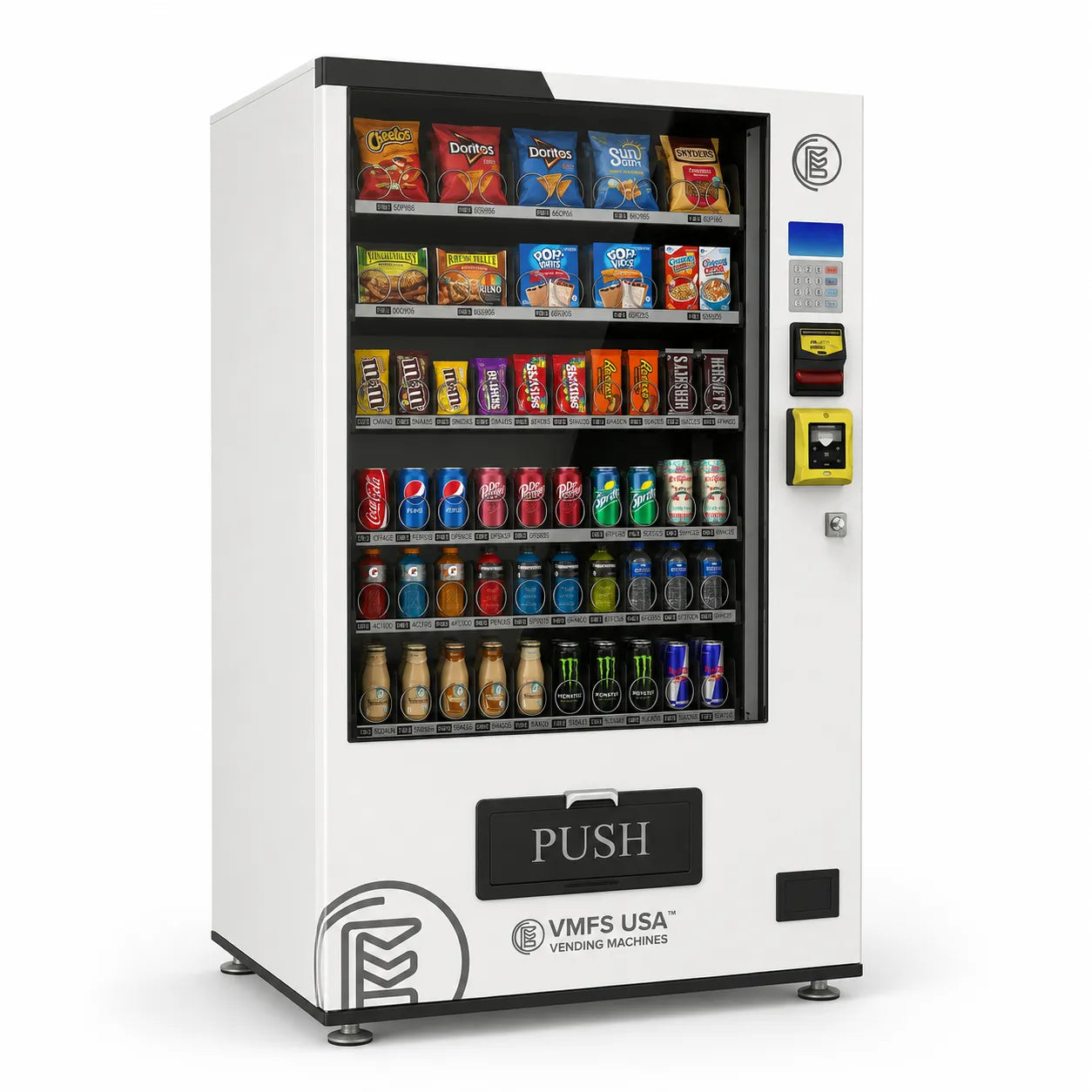
Share:
VMFS USA Brings Seaga and Elevator Vending Machines to LATAM
VMFS USA Brings Seaga and Elevator Vending Machines to LATAM