




Design the perfect vending solution for your location and customers.

Join the VMFS newsletter and step into a thriving network dedicated to collective success.
One signup. Endless possibilities.
AI vending machine software is the cloud platform that turns raw sensor and camera data into transaction records, inventory levels, and restocking alerts an operator can act on from a phone or browser. The hardware — cameras, weight sensors, payment terminals — only produces raw signals; the software layer is what interprets those signals into a confirmed sale, updates the inventory count in real time, and pushes a notification when a slot needs attention. A machine with excellent hardware and weak software still underperforms, because the entire operational advantage of AI vending over legacy coin-op equipment comes from what the software does with the data the hardware collects.
This guide breaks down the core software components every AI vending platform includes, how cloud and edge processing split the workload, what separates strong platforms from weak ones, and what to evaluate before committing to a machine and its accompanying software.
Table of Contents
Every AI vending machine software stack is built from five functional layers regardless of manufacturer: the recognition engine that interprets camera or sensor data, the transaction and payment layer, the inventory and analytics engine, the alerting and notification system, and the operator-facing dashboard that ties everything together. These layers communicate constantly — a completed transaction updates inventory, which feeds analytics, which can trigger a restocking alert, all within seconds of a customer closing the machine door.
| Software Layer | Function | Runs On |
|---|---|---|
| Recognition engine | Identifies products from camera/sensor data | Onboard device or cloud |
| Transaction/payment layer | Processes and confirms checkout | Onboard, synced to cloud |
| Inventory/analytics engine | Tracks stock levels, sales velocity | Cloud |
| Alerting system | Sends low-stock, error, and temperature alerts | Cloud |
| Operator dashboard | Displays data, manages fleet | Web app / mobile app |
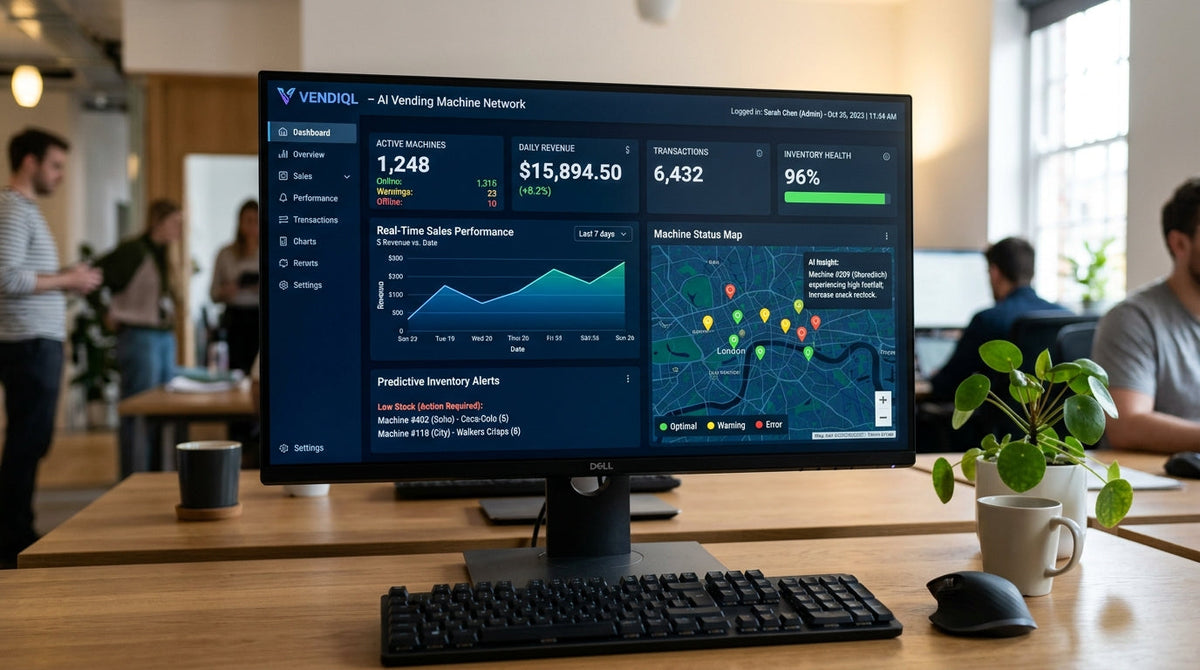
The management dashboard is the primary interface an operator uses to monitor every machine in a fleet from a single screen, surfacing per-machine sales totals, current inventory levels, and any active alerts without requiring a site visit. Strong dashboards let an operator drill from a fleet-wide summary down to a single machine's transaction history in a few clicks, while weaker platforms bury that detail behind exports or require a separate tool entirely for historical reporting. Because this dashboard is what an operator interacts with daily, its usability directly affects how quickly restocking decisions actually get made, which is why software quality belongs in the buying decision alongside the machine's physical specs, as covered in the Complete Buyer's Guide 2026.
Edge processing runs the product-recognition model directly on the machine's onboard computer, which confirms a transaction in under a second because no data has to travel to a remote server and back. This approach also means the machine can complete a transaction even during a brief connectivity outage, queuing the confirmed sale locally until the connection restores. The trade-off is higher onboard hardware cost, since the machine needs enough local compute power to run a full recognition model in real time.
Cloud processing sends camera or sensor data to a remote server for recognition, which lowers the onboard hardware requirement and allows the manufacturer to update recognition models centrally without touching physical machines. The trade-off is a dependency on connection quality — a slow or unstable connection adds latency to checkout confirmation and, during an outage, can stall the transaction entirely until service restores. Most commercial platforms use a hybrid approach, running basic recognition at the edge for speed while offloading heavier analytics and model retraining to the cloud. The underlying detection mechanics behind both approaches are detailed in How AI Vending Machines Work and What Is an AI Vending Machine, and the physical sensors this software interprets are covered in AI Vending Machine Parts Breakdown.
Inventory analytics software tracks sell-through rate per SKU, per machine, and per time window, which lets an operator identify underperforming products and cut them before they tie up shelf space that a faster-moving item could occupy. Predictive restocking goes further by projecting when a specific slot will deplete based on recent velocity, flagging it for restock before it actually empties rather than after — a direct improvement over threshold-based alerts that only fire once a slot already reads zero. This predictive layer is what most measurably improves per-machine revenue, since a stocked-out slot generates zero sales until an operator physically intervenes, a dynamic explored in depth in How AI-Powered Vending Machines Optimize Sales and AI Vending Machine ROI.
Fleet-wide analytics also surface location-comparison data, showing which sites outperform others on a per-visit or per-square-foot basis, which directly informs expansion decisions covered in AI Vending Machine Location Data, Case Study: Finding the Sweet Spot, and How Many AI Vending Machines You Need to Run a Full-Time Business.
The software layer sits between the physical card reader and the payment processor, formatting each transaction correctly for settlement while also logging it against the specific product the recognition engine identified. Because AI vending transactions are classified differently by some processors than standard retail swipes, the software's integration quality with the chosen payment gateway directly affects both transaction speed and the processing rate an operator ultimately pays — details covered in How Card Processing Works and Why AI Machines Have Different Rates.
Remote monitoring software pushes notifications for low stock, temperature deviations in refrigerated units, connectivity loss, and hardware error codes, allowing an operator to triage issues by severity instead of discovering them on a routine site visit. A temperature alert on a smart cooler, for instance, lets an operator address a cooling failure before spoiled inventory ever reaches a customer, directly protecting both revenue and reputation at that location. The reliability of this alerting layer is one of the clearest software-quality differentiators between platforms, since a system that generates excessive false alerts trains operators to ignore notifications entirely, defeating the purpose of remote monitoring in the first place.
Not every AI vending software platform offers the same depth of functionality, and the gap between basic and advanced tiers often determines whether a fleet scales smoothly or requires increasing manual oversight as machine count grows. The comparison below outlines the functional gap most operators encounter.
| Feature | Basic Platform | Advanced Platform |
|---|---|---|
| Restocking alerts | Threshold-based (empty slot) | Predictive (velocity-based) |
| Fleet view | Per-machine only | Consolidated multi-site dashboard |
| Mobile app | Limited or none | Full remote management |
| Data export / API access | Manual CSV export | Open API for integrations |
| Planogram optimization | Manual adjustment only | Data-driven layout suggestions |
Pros
Centralized fleet management from any device with internet access.
Recognition models improve over time without physical hardware updates.
Real-time alerts catch problems before they compound into lost revenue.
Cons
Full cloud dependency introduces a single point of failure during outages.
Ongoing software subscription cost adds to total cost of ownership.
Data privacy and security depend entirely on the manufacturer's infrastructure.
Some manufacturers bundle software access into the machine's upfront cost, while others charge an ongoing monthly subscription per machine — a cost that compounds quickly across a growing fleet and should factor directly into the total cost comparisons covered in AI Vending Machines: Cost and Payback: Pre-Made vs. Custom Build.
Requesting a demo login before purchasing more than one machine reveals whether the dashboard's usability matches the manufacturer's marketing claims, since a clunky interface undermines even the most accurate recognition hardware by slowing down the operator's actual response to alerts.
Ask specifically how the software handles a connectivity outage — whether transactions queue locally and sync later, or whether the machine simply stops accepting payment until service restores — since this detail materially affects revenue reliability in locations with less consistent internet infrastructure. Machine formats built around dependable software integration include the AI Grab-and-Go Vending Machine collection, the AI Smart Cooler Vending Machine, the Smart Fridge Vending Machine, and the AI Smart Cooler Combo Vending Machine. Broader category and terminology context is available in Smart Vending Machine vs. AI Vending Machine, Traditional vs. AI Vending Machines, and Is the Upgrade Worth It. For market context on how quickly this software category is maturing, see AI Vending Machine Market Size and The AI Vending Machine Experiment: How Smart Retail Is Changing, and for electronics-specific software considerations, Electronics Vending Machines Driving AI Smart Cities & Sustainability.
See the Software Behind a Real Machine
Explore AI vending machines built with dependable recognition and fleet management software.
Explore AI Vending Machines
Share:
AI Vending Machine Parts Breakdown - Every Component Explained
AI Vending Machine Business Plan - A Complete Roadmap for Operators