




Design the perfect vending solution for your location and customers.

Join the VMFS newsletter and step into a thriving network dedicated to collective success.
One signup. Endless possibilities.
Marcus had done everything right. He scouted the location for two weeks, counted foot traffic during lunch hour, and shook hands with the property manager. His new machine went in on a Tuesday. By Friday it had made eleven sales. The break room three floors up, however, was doing $900 a month for the operator next door. Same building. Same machine. Completely different result. The difference was not luck. The operator upstairs was running an AI vending machine that had already told him, before delivery day, exactly which floor would perform and why.
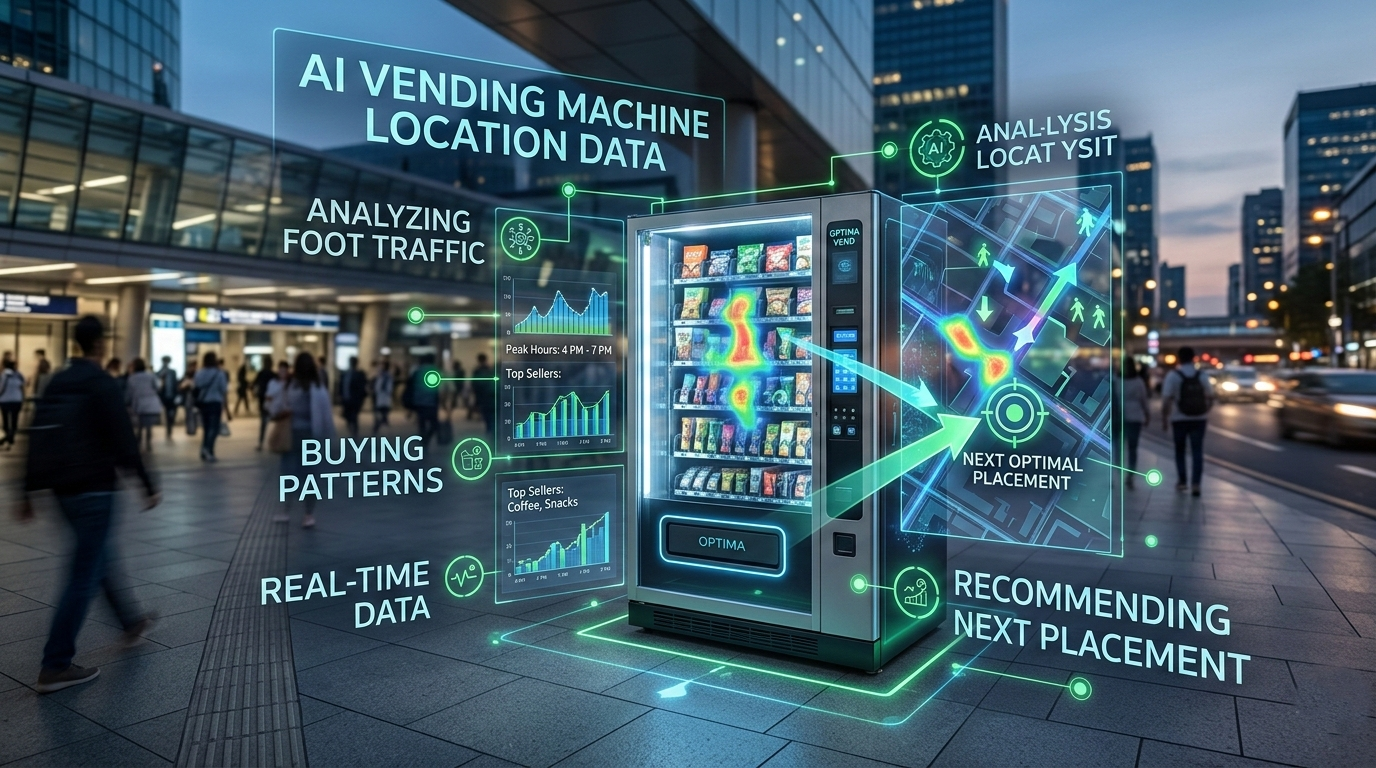
This is what separates modern vending operators from the ones still guessing. AI vending machines do not just sell products. They collect, analyze, and act on location data in ways that traditional machines simply cannot. And the operators who understand this are quietly outperforming everyone else on their routes.
AI vending machine location data is the real-time and historical information a smart machine collects about its environment, its buyers, and its own performance. Unlike a traditional machine that only records a sale when a coin drops, a digital vending machine powered by AI tracks everything happening around it.
That data includes foot traffic counts, peak purchase times, which products get picked up and put back, session duration, payment method preferences, and demographic patterns. All of it feeds into a remote dashboard operators can access from anywhere.
According to Future Market Insights, the intelligent vending machine market is projected to grow from $17.7 billion in 2026 to $53.2 billion by 2036, at a CAGR of 11.6%. Location intelligence is one of the core drivers of that growth.
Modern AI-powered vending platforms pull from external data sources to pre-score potential locations. These include mobile device movement data, retail foot traffic reports, Google Popular Times, and historical sales from nearby machines in the same operator network.
The result is a location confidence score generated before a single machine ships.
| Data Source | What It Tells the AI |
|---|---|
| Mobile movement data | How many people pass the location daily, at what times, and how long they stay |
| Historical sales from nearby machines | What products sell in similar environments within the same zip code |
| Google Popular Times | Traffic patterns by hour and day without needing a site visit |
| Payment data from the operator network | Average transaction value and purchase frequency at comparable sites |
| Demographic overlays | Income level, age range, and buying behavior of the audience at that location |
Total visitor count is only half the picture. AI systems distinguish between transient traffic (people walking through) and engaged traffic (people who stop, wait, or return regularly).
According to FMI research, deploying machines in high-traffic zones like airports reduces customer acquisition cost by 20% compared to isolated placements. The AI filters specifically for repeat visitors, because habitual buyers generate the majority of vending revenue at most locations.
How long does the average person spend near the machine? This is one of the strongest predictors of sales conversion.
FMI analysis shows that increasing average session duration from 30 to 60 seconds through interactive touchscreens boosts conversion rates by 15%. AI machines track this in real time and use it to flag locations where people walk past without engaging.
A machine stocked with energy drinks in a retirement community is not a product problem. It is a data problem. The AI cross-references location demographics with product performance across the full operator network to identify the right product mix before placement.
This is what drives the double-digit sales lifts some operators report after switching to AI-driven planograms, as noted by Neuroshop in 2025. The machine is not smarter. The placement decision is.
AI systems map nearby food and drink options within a defined radius of the target location. A site with no cafe, no convenience store, and no cafeteria within a two-minute walk scores significantly higher than one surrounded by alternatives.
VMFS USA's 2025 industry report confirmed that operators who moved to data-driven location evaluation saw 20 to 30% sales lifts compared to legacy machine placements in the same facilities.
The data work does not stop at placement. Once running, the machine continuously logs every interaction. It tracks products picked up and returned without purchase, payment method splits, peak conversion windows, and how seasonal demand shifts affect each location. That data feeds back into the placement model, making every future decision smarter.
| What the Machine Tracks | What Operators Do With It |
|---|---|
| Real-time stock levels | Service only when specific SKUs need restocking, not on a fixed schedule |
| Peak purchase hours | Time restocking visits to avoid disrupting high-sales windows |
| Products picked up and returned | Identify demand that is not converting and adjust pricing or product mix |
| Payment method breakdown | Confirm whether the audience uses contactless, card, or cash |
| Temperature and mechanical alerts | Flag maintenance issues before they cause downtime and lost revenue |
| Location Type | Why AI Rates It Highly | Est. Monthly Revenue |
|---|---|---|
| Airports and transit hubs | Highest dwell time, captive audience, 34.7% of intelligent vending market share (FMI 2026) | $1,500 to $3,000+ |
| Manufacturing and warehouses | Repeat daily buyers, fixed break schedules, no nearby food competition | $500 to $1,500 |
| Hospitals and medical centers | 24/7 operation, three buyer types simultaneously, high transaction frequency | $800 to $2,500 |
| Office buildings (100+ employees) | Habitual daily buyers, predictable peak windows, strong cashless payment adoption | $300 to $800 |
| University campuses | High volume, late-night demand, strong cashless payment usage among students | $200 to $700 |
A traditional vending machine tells you one thing: how much money is in the cash box.
It cannot tell you which products almost sold but did not. It cannot flag that Wednesday afternoons have 40% lower conversion because the break room upstairs opens at 1pm. It cannot alert you that the machine has been in the wrong spot for three months while a better location sits empty two corridors away.
Every service trip to a traditional machine is a guess. That gap in insight is why operators considering AI vending machines for sale increasingly treat the data platform as the actual product, with the physical machine being the delivery mechanism.
Most operators wait until after placement to start analyzing data. The smarter move is to pre-score locations before committing to a purchase or placement agreement.
Search the venue on Google Maps and review the Popular Times graph. This gives hour-by-hour traffic patterns without a site visit. If the graph shows consistent dead periods across multiple days, the revenue floor for that location is lower than it appears at peak hours.
Walk or map a two-minute radius from the proposed spot. Count cafes, convenience stores, canteens, and any machines already in place. Each competing option reduces expected sales volume. A location with no alternatives in that radius scores significantly higher on any AI location model.
Peak hour, mid-afternoon, and early evening. This gives a realistic daily average rather than an optimistic snapshot. Most operators who end up with underperforming machines visited once, at the busiest time, and committed based on that single reading.
Before you buy a vending machine, identify the exact buyer profile at your target location. Age range, income level, and reason for being there all determine what sells. A gym audience needs protein and hydration. A hospital waiting room needs comfort and caffeine. AI systems do this mapping automatically once running, but a manual version in advance prevents a costly first-month mismatch.
Not all new vending machines marketed as AI-powered offer the same data capabilities. Here is what to look for before purchasing.
| Feature | Why It Matters | Priority |
|---|---|---|
| Real-time sales dashboard | Shows which products and time windows drive revenue so you can act immediately | Must have |
| Remote inventory monitoring | Eliminates unnecessary service trips and identifies slow-moving stock | Must have |
| Foot traffic counting | Measures actual engagement with the machine, not just building traffic | Must have |
| Cashless payment analytics | Reveals payment preferences by location, which vary significantly by audience | Must have |
| Temperature and uptime alerts | Prevents revenue loss from undetected downtime or spoilage | Must have |
| Route optimization recommendations | AI suggests restocking order and timing based on actual sell-through rates | Recommended |
| Dynamic pricing capability | Adjusts prices based on demand, time of day, or inventory levels | Recommended |
Always request a dashboard demo before purchasing. If the supplier cannot show you real-time stock levels, sales by hour, and location performance comparisons, the machine is not genuinely AI-powered regardless of how it is marketed.
The biggest challenge for most operators is not finding the right machine. It is finding the right location. Even the most advanced AI vending machine generates zero useful data if it is sitting in the wrong spot because the operator ran out of time to scout properly.
Vending placement services through vPlaced connect operators with pre-qualified US locations that have already been evaluated for foot traffic, audience match, and competitive proximity. The same factors the AI scores internally are verified before the introduction is ever made. That means operators can focus on running their machines instead of spending weeks chasing property managers who may never say yes.
The vending industry spent decades treating location selection as a gut-feel decision. AI has turned it into a data problem, and data problems have solutions. Operators who embrace AI vending machine location data are making fewer bad placements, restocking more efficiently, and scaling faster because every machine they place teaches the next one where to go.
The machines are smarter. The question is whether the operator using them is ready to let the data lead, or are you still counting footsteps at noon and calling it research?
AI vending machines collect and analyze foot traffic counts, purchase timing, product interaction, payment method data, and session duration to build a performance profile for each location. This data feeds into dashboards that help operators identify underperforming machines, optimize product mix, and decide where to place new units based on evidence rather than guesswork.
A regular vending machine records a sale when a transaction completes. An AI vending machine tracks everything around that transaction including which products were considered but not purchased, when foot traffic peaked, and how often buyers returned. That continuous data loop allows operators to make smarter decisions about location, stocking, and pricing without a physical site visit.
Evaluate daily foot traffic volume, average dwell time, proximity of competing food and drink options within a two-minute walk, and the demographic profile of the audience at that location. Tools like Google Popular Times and mobile traffic data platforms give you a baseline before you commit to any placement agreement.
Yes, in documented cases. US operators have reported 20 to 30% sales lifts after moving to AI-driven planograms and cashless-first setups compared to legacy machines placed in the same locations, according to VMFS USA's 2025 industry report. The improvement comes from better product matching, fewer stockouts, and data-driven location decisions rather than the hardware itself.
Based on intelligent vending market data, airports and transit hubs, manufacturing facilities, hospitals, large office buildings, and university campuses consistently rank as the highest-performing locations. Airports and railway stations alone account for 34.7% of the global intelligent vending market share according to FMI's 2026 analysis, driven by high dwell time and captive audiences. Many of those same sites, especially offices and hospitals, also support coffee vending machines for morning and shift-change demand.
Prioritize machines with a real-time sales dashboard, remote inventory monitoring, foot traffic counting, cashless payment analytics, and uptime alerts. Always request a live demo of the data platform before purchasing. A machine marketed as AI-powered that cannot show live location performance data is not delivering the core value that justifies the upgrade.
Share:
Custom Vending Machines for Merchandise & Apparel (2026 Guide)
How Age Verification Vending Machines Work: Every Method Compared