




Design the perfect vending solution for your location and customers.

Join the VMFS newsletter and step into a thriving network dedicated to collective success.
One signup. Endless possibilities.
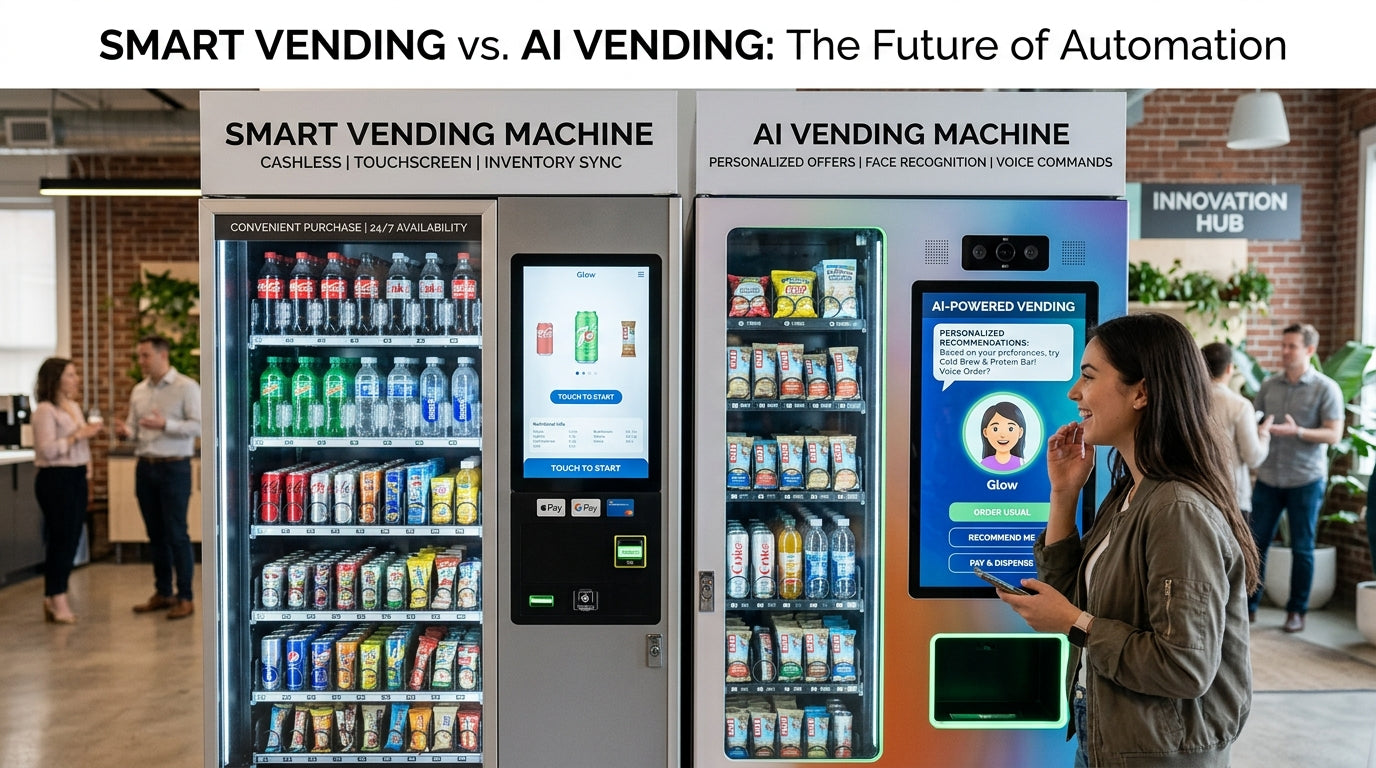
A smart vending machine is any internet-connected unit with cashless payment, remote monitoring, or telemetry, while an AI vending machine is a subset of smart vending that adds computer vision, weight sensing, or machine learning to identify products, prevent theft, and predict restocking needs without a barcode scan. Every AI vending machine is a smart vending machine, but not every smart vending machine is AI-powered — the distinction matters because "smart" only requires connectivity, while "AI" requires the machine to actually perceive and interpret what's happening inside it. Operators who confuse the two terms often overpay for basic telemetry expecting AI-level automation, or underpay for an AI unit and miss out on features that justify the premium.
This guide breaks down the technical differences, where each category fits operationally, and how to decide which one matches a given location's traffic and product mix.
Table of Contents
A smart vending machine connects to the internet to report basic telemetry — sales counts, temperature, door status, and cashless payment processing — back to an operator's dashboard. The term describes connectivity and remote visibility, not product-level intelligence, so a smart machine can track that a slot sold out without knowing which specific item a customer picked up if multiple products share a shelf.
An AI vending machine adds a perception layer on top of smart connectivity, using computer vision cameras, weight sensors, or RFID tags to identify exactly which product a customer removed, in what quantity, and whether it was actually paid for. This perception layer is what enables open-shelf, grab-and-go formats where customers pick up items directly rather than dispensing through a coil or drop mechanism. A full technical explainer is available in What Is an AI Vending Machine and How AI Vending Machines Work.
Smart machines track inventory at the slot level, meaning the system knows a coil emptied but relies on the dispensing mechanism itself to confirm the sale, not visual or sensor confirmation of the actual item. AI machines track inventory at the product level because computer vision or weight sensors identify the specific SKU removed, which is why AI units can support open shelving without a mechanical dispensing system.
Smart machines prevent loss primarily through the physical dispensing mechanism itself — a coil or drop system that only releases product after payment clears. AI machines prevent loss through active monitoring, where the vision system verifies that an item removed from an open shelf matches what was charged to the customer's card, closing the checkout loop after the fact rather than before dispensing.
Smart machines alert an operator when a slot is empty, which happens because the dispensing count hits zero. AI machines go further and can flag a slot approaching empty before it actually runs out, because the system tracks item-level velocity and can project when a specific SKU will deplete based on recent sales patterns. That predictive layer is covered in more depth in How AI-Powered Vending Machines Optimize Sales.
The table below isolates the functional differences that matter most when evaluating a machine purchase.
| Feature | Smart Vending Machine | AI Vending Machine |
|---|---|---|
| Internet connectivity | Yes | Yes |
| Product-level recognition | No | Yes (vision, weight, or RFID) |
| Open-shelf grab-and-go support | Rare | Standard |
| Predictive restocking alerts | Limited (threshold-based) | Yes (velocity-based) |
| Typical upfront cost | Lower | Higher |
| Best fit | Budget-conscious, low-traffic sites | High-traffic offices, gyms, residential |
Computer-vision AI machines use overhead and shelf-mounted cameras trained on the specific product catalog stocked in that machine, matching what a customer picks up against a reference image set in real time. Weight-sensing systems instead measure the change in shelf weight when an item is removed and cross-reference that delta against the known weight of each SKU to infer what was taken. Both approaches close the transaction only after the machine confirms what left the shelf, which is why AI vending machines can support an open, self-service layout that would be vulnerable to theft on a purely "smart" connected unit. This mechanism is also why AI-managed retail concepts gained mainstream attention following well-covered experiments in autonomous AI commerce — the underlying detection technology is the same category of system, just applied to different products, as discussed in The AI Vending Machine Experiment: How Smart Retail Is Changing.
AI vending machines cost more upfront than basic smart machines because of the added camera arrays, sensor hardware, and the compute needed to run recognition models on-device or via cloud processing. That premium narrows the more a machine's location relies on open-shelf convenience, since the alternative — a traditional coil mechanism retrofitted with connectivity — cannot replicate the grab-and-go experience regardless of price. A full cost breakdown across machine categories is available in AI Vending Machines: Cost, and the trade-off between pre-configured and custom-built units is covered in Payback: Pre-Made vs. Custom Build.
Smart Vending Machine
Lower upfront cost and simpler maintenance profile.
Reliable for standard coil or drop-dispensed products.
Cannot support open-shelf or item-level analytics.
AI Vending Machine
Enables open-shelf, grab-and-go customer experience.
Predictive restocking reduces stockouts and spoilage.
Higher upfront cost and more complex hardware to maintain.
Lower-traffic locations with a stable, narrow product mix — a small break room or a low-turnover residential lobby — often don't generate enough transaction volume to justify the premium AI hardware requires. A basic smart machine with cashless payment and remote alerts covers the operational need without unused capability.
High-traffic offices, gyms, and residential buildings benefit most from AI vending because the open-shelf format speeds up transactions during peak windows, and the predictive restocking directly protects revenue that would otherwise be lost to stockouts. Machine options built for this tier include the AI Grab-and-Go Vending Machine collection, the AI Smart Cooler Vending Machine, the Smart Fridge Vending Machine, and the AI Smart Cooler Combo Vending Machine for mixed ambient and refrigerated stock. A complete spec-by-spec buying framework is available in the Complete Buyer's Guide 2026.
Electronics vending, where individual items carry significantly higher value than snacks or drinks, almost always requires AI-level product verification because the loss-prevention stakes are too high for slot-based tracking alone. This dynamic is explored further in Electronics Vending Machines Driving AI Smart Cities & Sustainability.
AI vending machines typically post stronger net profit per unit than smart-only machines in high-traffic locations, because reduced stockouts and faster transaction throughput directly increase captured revenue, even after accounting for the higher upfront hardware cost. Operators building out a fleet size around income targets should factor this profit-per-machine difference directly into their math — the calculation is detailed in How Many AI Vending Machines You Need to Run a Full-Time Business and the underlying ROI mechanics are in AI Vending Machine ROI. Location quality still matters more than machine category alone — see AI Vending Machine Location Data and Case Study: Finding the Sweet Spot.
Marketing language often uses "smart" loosely, and buyers sometimes assume a connected, app-controlled machine includes product recognition it doesn't have. Verifying whether a machine uses computer vision, weight sensing, or RFID — versus simple slot-count telemetry — prevents a costly mismatch between expected and actual capability.
Placing a full AI-vision machine in a location with minimal daily traffic delays payback unnecessarily, since the premium hardware cost isn't offset by enough transaction volume to matter. Matching machine tier to traffic volume, not defaulting to the most advanced option everywhere, protects overall route ROI.
Card processing rates for unattended retail differ by machine classification, and AI-equipped units are sometimes categorized differently than legacy coil machines by processors. Reviewing merchant terms before purchase avoids a hidden cost that erodes the AI machine's ROI advantage — see How Card Processing Works and Why AI Machines Have Different Rates and the direct comparison in Traditional vs. AI Vending Machines and Is the Upgrade Worth It.
Compare AI Vending Machines for Your Location
See which machine format matches your traffic, product mix, and budget.
Explore AI Vending Machines
Share:
Why Trading Card Vending Machines Are Booming
Smart Vending Machine Market: AI Vending Size, Forecasts and Future