




Design the perfect vending solution for your location and customers.

Join the VMFS newsletter and step into a thriving network dedicated to collective success.
One signup. Endless possibilities.
Yes, AI vending machines are profitable when the basket is large enough and the site is busy enough. In our labeled worked example, a $3,950 AI Smart Combo selling 15 baskets a day at $6 nets about $563 a month after every fee, commission and an allowance for your time, and pays for itself in roughly eight months. Cut that to eight low-ticket sales a day and the same machine takes about five years.
This guide shows the full math behind that answer: live VMFS prices, the AI and card fees, location commission, product margins by type, payback for pre-made and custom builds, and the levers that shorten it. Every example is labeled with its assumptions so you can swap in your own numbers.
AI vending machines are profitable at sites that produce steady, higher-value baskets, and they struggle at sites that only produce a few cheap impulse sales. The reason is structural. An AI grab-and-go cooler carries a monthly software fee and a per-transaction recognition fee on top of the card processing every cashless machine pays, so the fixed part of the cost stack has to be covered before the machine earns anything. Once it is covered, each additional basket drops a predictable share of its value to profit, and that share grows with the size of the basket.
That is why the question is less "are AI machines profitable" and more "is this site and this product mix big enough for an AI machine". The format earns its keep by selling things a coil machine cannot: sandwiches, salads, glass-bottle drinks, protein shakes and other items priced in the $5 to $15 range. VMFS's own build page for the AI Machine Customizer describes $5 to $20 as the pricing sweet spot, notes that transaction fees compress margins fast under $5, and warns that conversion drops above $20. Our worked examples below come to the same conclusion from the cost side.
If you want the general picture for every machine type first, our hub on are vending machines profitable compares snack, drink, combo, coffee and AI formats. This page goes deep on the AI format only: the fee stack, the payback math, product margins and the operating decisions that move each number. If hot drinks are your focus, browse our coffee vending machines directly.
Lowest entry price
The AI Grab & Go Cooler is $2,950; the AI Smart Combo is $3,950 (live VMFS prices, October 2026).
Fixed monthly cost
AI Cloud $39.99, plus about $10 card reader service and an optional $15 SIM if you have no stable Wi-Fi.
Per-sale AI fee
$0.07 per completed transaction, plus $0.03 if weight sensors are enabled, on top of card processing. None on NEO GO and NEO PRO.
Base-case payback
About 8 months in our labeled example: 15 baskets a day at $6, 50% product cost, 10% commission.
Payback is the total upfront investment divided by monthly net profit, and ROI is the profit you keep over a period divided by what you invested. Both start with an honest monthly net, which is gross sales minus product cost, card processing, location commission, AI fees, connectivity, shrink and spoilage, route costs and the value of your own time. Leave any of those out and the payback figure looks shorter than it will be.
The U.S. Small Business Administration gives the break-even version of the same idea: fixed costs divided by the difference between price and variable cost equals the number of units you must sell to break even. For an AI machine the "unit" is a basket, the fixed costs are the AI Cloud plan, reader service, connectivity, route and labor, and the variable costs are product cost, processing, commission, shrink and the per-transaction recognition fee. Running that formula tells you the minimum daily baskets a site must produce before you sign a placement agreement.
Use three numbers together. Monthly net tells you whether the machine is worth servicing. Payback months tells you how long your cash is at risk. First-year ROI, calculated as twelve months of net minus the investment, divided by the investment, tells you how the machine compares with other uses of the same money. A machine with a short payback but a thin monthly net can still be a poor use of route time, which is why we show all three in the examples below.
Formulas used on this page: Monthly net = gross sales − (product cost + processing + commission + shrink) − (AI fee × baskets) − fixed monthly costs. Payback (months) = (machine price + first inventory fill) ÷ monthly net. First-year ROI = (12 × monthly net − investment) ÷ investment.
The full cost of running an AI vending machine is the purchase price plus three recurring layers: the VMFS AI system fees, third-party connectivity and reader fees, and card processing on every sale. VMFS separates these on its payment system and fee breakdown page, which is the source for every fee figure in this guide.
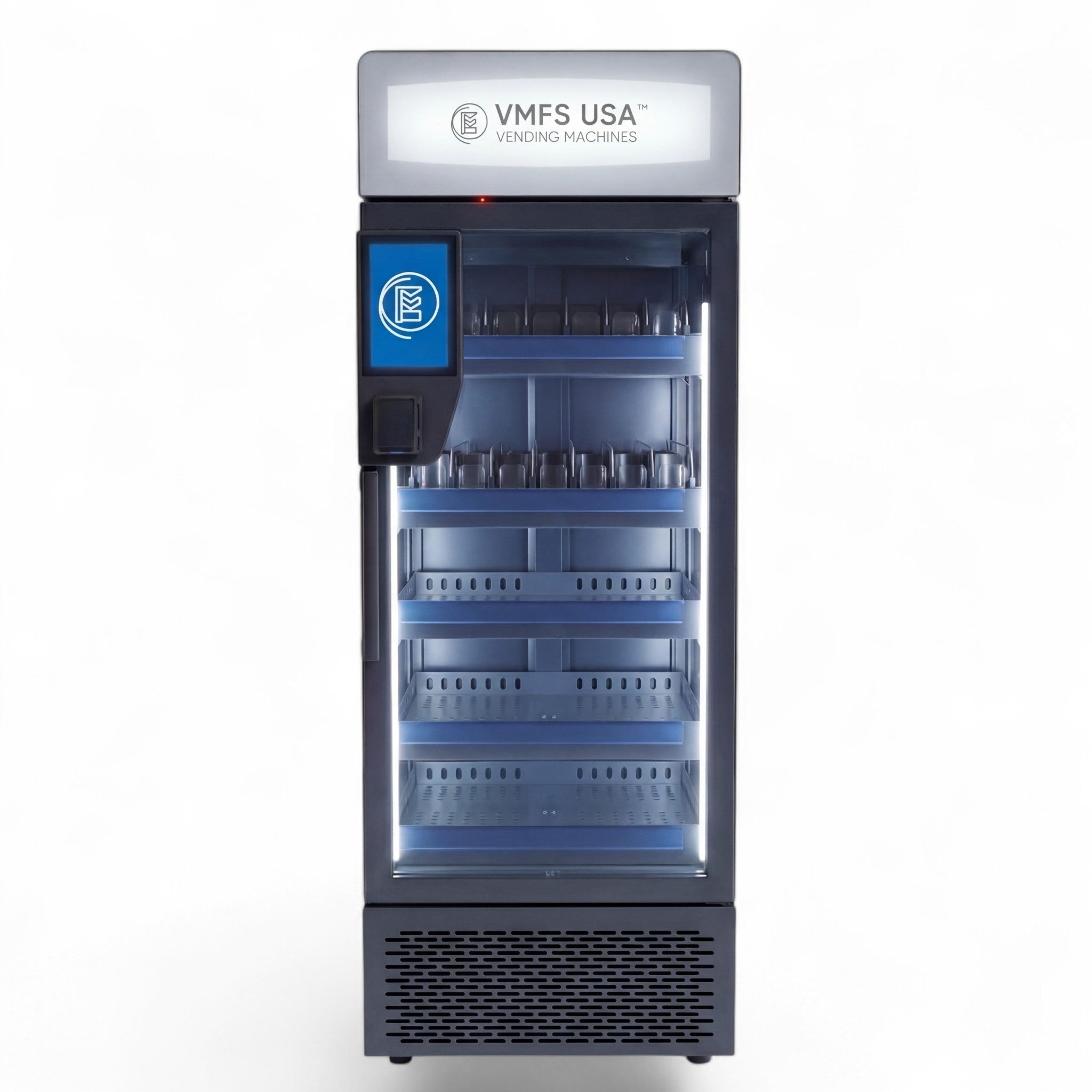
Current VMFS AI vending machines range from $2,950 to $12,650. The compact AI Grab & Go Cooler is the lowest-priced entry, the AI Smart Combo handles mixed snack and chilled planograms, the AI Smart Cooler is built around refrigerated food and drinks, and the AI Smart Fridge adds visual recognition with weight sensing in fridge and frozen versions. For a wider look at pricing across the format, including what drives the spread, see our guide to AI vending machine cost.
For busy sites, the NEO PRO is an AI vending machine at $3,950 with the card reader included. It is 26.8 inches wide and holds about 384 items on six adjustable trays.
| VMFS AI machine | Live price | Best fit |
|---|---|---|
| AI Grab & Go Cooler | $2,950 | Small footprints; about 294 items across six trays, 23.6 in wide |
| AI Smart Combo | $3,950 | Mixed snack and chilled planograms at most workplace sites |
| Build Your AI Vending Machine (customizer base) | From $3,950 | Sites where capacity, refrigeration, payment or branding must be matched |
| AI Smart Cooler | $4,950 | Refrigerated food and drinks |
| AI Smart Fridge | $9,950 (fridge) / $12,650 (frozen) | High-volume cold-chain sites, frozen meals |
Every AI machine carries a fixed monthly platform cost and a per-sale recognition cost. VMFS Cloud works with every VMFS machine and plans start at $7.99 per machine per month; the Basic plan is $7.99, Advertising is $16, and AI Cloud, the plan built for AI grab-and-go coolers and fridges, is $39.99. The VMFS Cloud AI plan adds computer-vision stock detection, customer behavior analytics, operator-set dynamic pricing rules and remote diagnostics. The recognition fee is $0.07 per completed transaction, plus $0.03 when weight sensors are enabled, and it only applies when a sale completes. The NEO GO and NEO PRO have no recognition fee.
| Fee | Paid to | Rate | Notes |
|---|---|---|---|
| VMFS AI Cloud | VMFS | $39.99 per machine per month | AI platform, alerts, updates, recognition training |
| AI recognition fee | VMFS | $0.07 per completed transaction | Charged per basket, not per item; none on NEO GO and NEO PRO |
| Weight sensor add-on | VMFS | +$0.03 per transaction | Only if the machine is configured with weight sensors |
| SIM / cellular data | Third party | $15 per month | Optional if the site has stable Wi-Fi |
| Card reader service | Third party | About $10 per month | Set by your payment provider |
| Card processing | Your processor | About 3%–6% of sales | VMFS's comparison lists ~5.95% flat or ~2.5% + $0.10 for Nayax |
Fees take a much larger share of small sales than large ones because part of every fee is a flat amount. The table below combines the two Nayax pricing options VMFS lists with the $0.07 recognition fee. At $1.50 the fee stack consumes 10.6% to 13.8% of the sale before product cost or commission. At $10 it drops to 4.2% to 6.7%. Because both the recognition fee and the flat card fee apply per transaction rather than per item, a customer who takes three items in one door opening pays the flat portion once, which is one reason basket size matters more than item price alone. Our cashless payment systems for vending machines guide explains how to choose between flat and split pricing.
| Basket value | 5.95% + $0.07 AI fee | Effective rate | 2.5% + $0.10 + $0.07 AI fee | Effective rate |
|---|---|---|---|---|
| $1.50 | $0.16 | 10.6% | $0.21 | 13.8% |
| $2.50 | $0.22 | 8.8% | $0.23 | 9.3% |
| $4.49 | $0.34 | 7.5% | $0.28 | 6.3% |
| $6.00 | $0.43 | 7.1% | $0.32 | 5.3% |
| $10.00 | $0.67 | 6.7% | $0.42 | 4.2% |
| $15.00 | $0.96 | 6.4% | $0.55 | 3.6% |
| $20.00 | $1.26 | 6.3% | $0.67 | 3.4% |
The practical rule that follows is simple: build the planogram around items priced $5 and up, keep a small share of slots for cheaper impulse items, and if your processor offers both pricing models, the percentage-plus-flat option usually wins once average baskets pass about $4. Confirm the exact crossover with your own processor quote.
In our worked examples, an AI vending machine pays back in about 4.5 to 8 months at a busy site and about five years at a weak one, and the difference is almost entirely baskets per day and basket size. The three scenarios below use the same AI Smart Combo at its live $3,950 price and identical cost assumptions. Only traffic and ticket change. They are illustrations built from stated assumptions, not reported results from a specific location.
Example assumptions: 30 selling days a month; product cost 50% of sales; card processing 6% of sales (top of VMFS's 3%–6% range); location commission 10% of gross; shrink and spoilage 3% of sales; AI recognition $0.07 per basket, no weight sensors; AI Cloud $39.99 + reader service $10 + SIM $15 per month; four service trips of 20 miles round trip at the IRS 2026 rate of 72.5 cents per mile ($58); six hours of your time at $20 an hour ($120). Investment = $3,950 machine + $600 first inventory fill (above the $200 to $500 VMFS’s customizer page estimates, to allow for a fresh-food range). Freight and sales tax are excluded because they depend on your address.
| Line (monthly) | Conservative: 8 baskets/day at $4.49 | Base: 15 baskets/day at $6.00 | Strong: 20 baskets/day at $7.00 |
|---|---|---|---|
| Baskets | 240 | 450 | 600 |
| Gross sales | $1,077.60 | $2,700.00 | $4,200.00 |
| Product cost (50%) | −$538.80 | −$1,350.00 | −$2,100.00 |
| Card processing (6%) | −$64.66 | −$162.00 | −$252.00 |
| Commission (10%) | −$107.76 | −$270.00 | −$420.00 |
| Shrink and spoilage (3%) | −$32.33 | −$81.00 | −$126.00 |
| AI recognition ($0.07/basket) | −$16.80 | −$31.50 | −$42.00 |
| AI Cloud, reader, SIM | −$64.99 | −$64.99 | −$64.99 |
| Route mileage | −$58.00 | −$58.00 | −$58.00 |
| Your time | −$120.00 | −$120.00 | −$120.00 |
| Monthly net | $74.27 | $562.51 | $1,017.01 |
| Net margin on sales | 6.9% | 20.8% | 24.2% |
| Payback on $4,550 | About 61 months | About 8.1 months | About 4.5 months |
| First-year result | −$3,659 | +$2,200 (48% ROI) | +$7,654 (168% ROI) |
The conservative case is the one most buyers never model. The basket value in it, $4.49, is not a guess: Cantaloupe's 2026 Micropayment Trends Report puts the 2025 average ticket for its Smart Store format at $4.49, the highest of any self-service format it tracks. A machine that sells only eight of those a day covers its costs but returns almost nothing on the investment. The lesson is not that AI machines fail at small sites; it is that small sites need the cheapest hardware and the tightest product mix, or a different machine type altogether.
Machine price matters less than traffic, but it still moves payback by months. Holding the base scenario constant at $562.51 a month and the $600 first fill, the six VMFS AI options pay back as shown below. The NEO GO and NEO PRO have no recognition fee, so their base-case net is $594.01 a month, $31.50 higher. This is why the AI Smart Fridge belongs at sites that can produce more than the base case, not at a site you are testing.
| Machine | Investment (machine + $600 fill) | Payback at base-case net |
|---|---|---|
| NEO GO (AI Grab & Go Cooler) | $3,550 | About 6.0 months |
| NEO PRO | $4,550 | About 7.7 months |
| AI Smart Combo | $4,550 | About 8.1 months |
| AI Smart Cooler | $5,550 | About 9.9 months |
| AI Smart Fridge (fridge) | $10,550 | About 18.8 months |
| AI Smart Fridge (frozen) | $13,250 | About 23.6 months |
Small changes to the assumptions move the base case noticeably. Raising commission from 10% to 15% cuts monthly net to about $428 and stretches payback to about 10.6 months. Enabling weight sensors adds $0.03 to each of 450 baskets, or $13.50 a month. Dropping card processing to 3% adds about $81 a month, and using the site's Wi-Fi instead of a SIM adds $15. Run your own version in the vending ROI calculator, which already includes the AI Cloud and recognition fees.
Run Your Own Payback Numbers
Plug in your machine price, traffic, basket and commission. AI Cloud and recognition fees are already built in.
Open the ROI CalculatorAn AI vending machine's monthly revenue is its daily baskets times average basket value times selling days, so a machine averaging 15 baskets at $6 grosses about $2,700 a month. There is no reliable industry-wide average for AI coolers yet, which is why any single monthly figure you see quoted should come with its traffic and ticket assumptions. The better approach is to estimate both inputs for your specific site.
For ticket size, published self-service data gives useful anchors. Cantaloupe's 2026 report puts the 2025 average vending ticket at $2.01, micro markets at $3.02 and its Smart Store format at $4.49. AI grab-and-go machines sit closer to the micro market and smart store end because shoppers can take several items in one door opening. Pricing your core range at $5 or more pushes the basket above those averages, but only if the site's audience will pay it.
For volume, a per-person method works well at workplaces. 365 Retail Markets estimates that the average customer spends around $7 a month at a vending setup and around $20 a month at a micro market. An office of 150 regular occupants would therefore suggest roughly $1,050 a month at vending-level spend and $3,000 at micro-market-level spend; an AI cooler with a fresh-food range will usually land somewhere between those bounds. For context on the traditional side, Nav cites $100 to $300 a week in gross sales for a decently performing conventional machine, with exceptional sites reaching $500 or more.
Break-even volume is the other number to know before you sign. Using the SBA formula with the example costs above, and treating the AI Cloud, reader, SIM, mileage and labor as fixed, the machine needs roughly 6.1 baskets a day at $4.49, about 4.5 a day at $6.00, and about 3.9 a day at $7.00 just to cover its monthly costs. Payback only begins above those levels. If a site cannot clearly beat them, it will not carry its share of a route, however good the machine.
AI vending profit margins vary mostly by product cost relative to price: cheap-to-buy drinks and snacks carry the highest percentage margin, while fresh food carries a lower percentage but more dollars per sale. A widely used rule of thumb, which Nav attributes to 365 Retail Markets, puts product cost at about 50% of the vending selling price, with water and premium beverages often beating it. Your real numbers depend on your distributor, so treat the examples below as a method, not a price list.
| Example item (single-item basket) | Price | Example unit cost | Processing 6% + commission 10% + $0.07 AI fee | Profit per sale | Margin |
|---|---|---|---|---|---|
| Bottled water | $2.00 | $0.45 | $0.39 | $1.16 | 58% |
| Bag of chips | $2.00 | $0.85 | $0.39 | $0.76 | 38% |
| Protein bar | $3.50 | $1.60 | $0.63 | $1.27 | 36% |
| Wrapped sandwich | $9.00 | $4.50 | $1.51 | $2.99 | 33% |
| Salad or meal bowl | $12.00 | $6.00 | $1.99 | $4.01 | 33% |
The table shows the trade-off that the old "high-margin candy" advice misses. A $12 meal bowl at a 33% margin earns $4.01, more than five bags of chips at 38%, for the same slot visit and the same door opening. Fresh food carries spoilage risk that packaged snacks do not, so the 3% shrink-and-spoilage allowance in our payback examples is a floor for a fresh-heavy machine, not a ceiling. The AI platform helps here: AI Cloud flags slow sellers and supports operator-set dynamic pricing rules, so you can mark down short-dated items before they become waste. For category ideas that fit the format, see our list of the best products for AI vending machines.
Gross margin return on inventory investment, or GMROI, measures gross profit earned per dollar tied up in stock, and it is a better way to rank slots than margin percentage alone. In an illustrative month, a chip SKU selling 90 units at $1.15 gross margin each earns $103.50 on an average of 15 units ($12.75) on the shelf, a GMROI of about 8.1. A sandwich selling 60 units at $4.50 gross margin earns $270 on 10 units ($45) on the shelf, a GMROI of about 6.0, but contributes more than twice the dollars. Strong planograms keep both kinds of SKU: fast, cheap turners that fund cash flow and higher-ticket items that lift the basket.
A good starting point is to put most slots into $5 to $10 core items, a meaningful share into $10 to $20 meals and premium drinks, and only a small share into sub-$5 impulse items. Treat these as a first draft to test, not a fixed formula. After 8 to 12 weeks of sales data, cut the slowest movers, give their slots to proven sellers and test a price change on one SKU at a time. Our operator pricing guide covers markup methods for each tier.
| Tier | Suggested share of slots | Price band | Examples |
|---|---|---|---|
| Core drivers | About 40% | $5–$10 | Premium drinks, protein bars, quality snacks, fruit cups |
| Profit center | About 35% | $10–$20 | Sandwiches, salads, meal bowls, shakes |
| Basket lifters | About 15% | Varies | Supplements, travel and phone accessories, specialty items |
| Impulse fillers | About 10% | Under $5 | Gum, candy, small snacks, water |
AI machines beat traditional machines on ROI when their larger baskets, wider product range and better data outweigh their higher fees and the cash sales they give up. They lose when the site only buys low-priced snacks or has many cash-only shoppers. Our full comparison of traditional vs AI vending machines covers hardware and capacity; here is the ROI side only.
The ticket gap is real. Cantaloupe reports that 78% of vending sales were cashless in 2025, up from 73%, and that cashless tickets averaged $2.45 against $1.57 for cash. AI machines are card and mobile only, so they capture the higher-ticket cashless customer but give up the share of shoppers who still pay in coins and bills. At a site with heavy cash use, that lost demand can cancel the basket advantage.
Data is the second advantage. The best-known example is company-reported: according to Best Practice AI's summary of a Hivery deployment across Reyes Coca-Cola Bottling's 19,000-plus vending machines, Coca-Cola attributed 6% additional revenue and 15% fewer restocking trips to AI-driven product and placement decisions. Those were analytics on conventional machines, not AI coolers, but they show where data-led restocking saves money. On an AI machine, live stock counts per slot let you skip unnecessary visits and arrive with the right products, which is the mileage and labor line in our examples.
Shrink is the third factor. In Vending Market Watch's 2026 State of the Industry survey, nearly two-thirds of operators reported shrink below 5% and 12.5% reported shrink above 10%, while smart coolers made up 33.5% of the equipment respondents deployed. An AI cooler ties every door opening to a payment card and records the session, which gives you an audit trail a glass-front open cooler or honor-system market lacks. That does not make shrink zero, so keep an allowance in your model. If you want the mechanics behind recognition, sessions and disputes, read how AI vending machines work.
Where AI improves ROI
Where AI hurts ROI
Venue type changes ROI through three inputs: how many regular people pass the machine, how long they stay, and how much they are willing to pay. A captive audience with long dwell time and few nearby food options lifts both baskets per day and basket size, which is why offices, hospital staff areas and residential buildings usually suit AI machines better than short-dwell corridors. Rather than publish revenue figures by venue that we cannot verify, the table below shows which model inputs each venue tends to move, so you can adjust the worked examples for your site.
| Venue | What drives ROI | Planogram emphasis | Main risk |
|---|---|---|---|
| Offices (100+ on site) | Daily repeat buyers, lunch baskets | Meals, cold brew, protein, healthy snacks | Low weekend sales; hybrid schedules |
| Hospital staff areas | 24/7 shifts, limited late-night food | Meals, breakfast items, coffee drinks | Higher commission requests |
| Gyms and fitness centers | High willingness to pay for nutrition | Protein drinks, electrolytes, bars | Peaky traffic at set hours |
| Apartment and residential buildings | Evening and weekend convenience | Grocery staples, frozen meals, drinks | Smaller daily volume per resident |
| Hotels | Guests without a 24-hour store nearby | Travel items, snacks, drinks | Occupancy swings |
| Warehouses and plants | Shift workers with short breaks | Filling meals, energy drinks | Price sensitivity on premium items |
Commission is the venue lever you can negotiate. NerdWallet puts typical location commissions at 5% to 25% of revenue, and our example uses 10%. Our breakdown of the vending revenue split between operator, location and supplier shows how to structure it, and our guide to locations for AI vending machines covers how to screen sites before you pitch. If you would rather have a placement found for you, VPlaced matches operators with property owners looking for machines.
A pre-made AI machine pays back sooner at most sites because it starts earning weeks earlier, while a custom build can earn more per month at a site whose demand you already know. VMFS's shipping information page says in-stock machines usually ship within 7 to 10 days, while custom builds, wraps and special configurations typically take around 45 days. That gap of about five weeks has a cost: at the base-case net of $562.51 a month, waiting an extra 35 days defers roughly $650 of profit.
The custom route earns that back when it removes a real constraint. The AI Machine Customizer starts at $3,950 and lets you choose capacity (small, double or triple slot configurations), refrigeration settings, payment systems and exterior branding, with five adjustable shelves and 15 configurable zones for drinks, snacks and fresh meals. If a hospital needs more chilled capacity than a standard unit offers, or a corporate campus will only approve a branded cabinet, the custom machine may be the only one that gets placed or the only one that avoids constant stockouts. Our custom vending machine cost guide breaks down what branding and configuration add.
| Factor | Pre-made AI machine | Custom AI build |
|---|---|---|
| Starting price | From $2,950 (AI Grab & Go Cooler) | From $3,950 plus selected options |
| Typical lead time | Ships in 7–10 days when in stock | Around 45 days |
| Configuration | Fixed, proven layouts | Capacity, refrigeration, payment and branding chosen per site |
| Payback advantage | Starts earning sooner; easy to redeploy | Higher monthly net when demand is known |
| Best for | Testing new venues, first machines, route fillers | Multi-year placements, branded or specialized sites |
Many operators use both: pre-made machines to test a venue type quickly, then custom builds for the sites that prove themselves. A machine that underperforms is also easier to move or resell when it is a standard model.
The fastest ways to shorten payback are raising the basket, raising daily volume and cutting the fixed costs you control. Each lever below maps to a line in the worked examples, so you can estimate its effect before you act.
When one machine works, the same discipline scales. Our guide to scaling an AI vending machine business covers route planning and hiring.
Financing lowers the cash you put in up front, taxes can shorten your after-tax payback, and a handful of operational risks can stretch it. All three belong in your plan before you order.
Financing turns the machine price into a monthly payment, so the useful test is whether expected monthly net comfortably exceeds that payment. VMFS's flexible financing page lists third-party options through ClickLease, Klarna and PayPal, with terms typically ranging from 6 to 48 months and PayPal monthly plans covering $49 to $10,000 over 3, 6, 12 or 24 months. In the base example, a payment well under $560 a month leaves the machine cash-flow positive from month one, though interest lengthens true payback. Our vending machine financing guide compares leases, loans and pay-over-time plans.
Federal tax rules can let you deduct the machine much faster than its useful life. According to the IRS, property acquired after January 19, 2025 qualifies for a permanent 100% first-year bonus depreciation deduction, and the Section 179 expensing limit rose to $2,500,000 for property placed in service in tax years beginning after December 31, 2024. Deducting the full purchase in year one reduces your tax bill in that year, which shortens after-tax payback. Whether and how to use it depends on your entity and income, so confirm with a tax professional.
Downtime, spoilage, insurance and compliance are the costs most often missing from a payback model. VMFS machines carry a 1-year parts warranty under the written warranty policy, with extended coverage available on some models, but a cooler that is down for a week still loses a week of sales and possibly its chilled stock. VMFS's financing page also notes that most locations ask for a certificate of insurance with $1 million per occurrence in general liability before approving a machine, so budget for coverage. Because AI machines record each shopping session on camera, post a clear notice at the machine; the FTC's 2023 policy statement on biometric information warns businesses against unexpected or undisclosed collection. For placement contracts and privacy notices, VAdviced provides legal guidance for vending operators. Licensing and sales tax registration vary by state and city, so confirm both before the machine goes live.
Pick the AI Machine That Fits Your Payback Target
Compare live prices on every VMFS AI grab-and-go model, from the $2,950 Grab & Go Cooler to the AI Smart Fridge.
Shop AI Vending Machines
Share:
Are Vending Machines Profitable? 2026 Profit, Income and ROI Guide
Vape Vending Profit by Venue: Bar vs Nightclub vs Hookah