




Design the perfect vending solution for your location and customers.

Join the VMFS newsletter and step into a thriving network dedicated to collective success.
One signup. Endless possibilities.
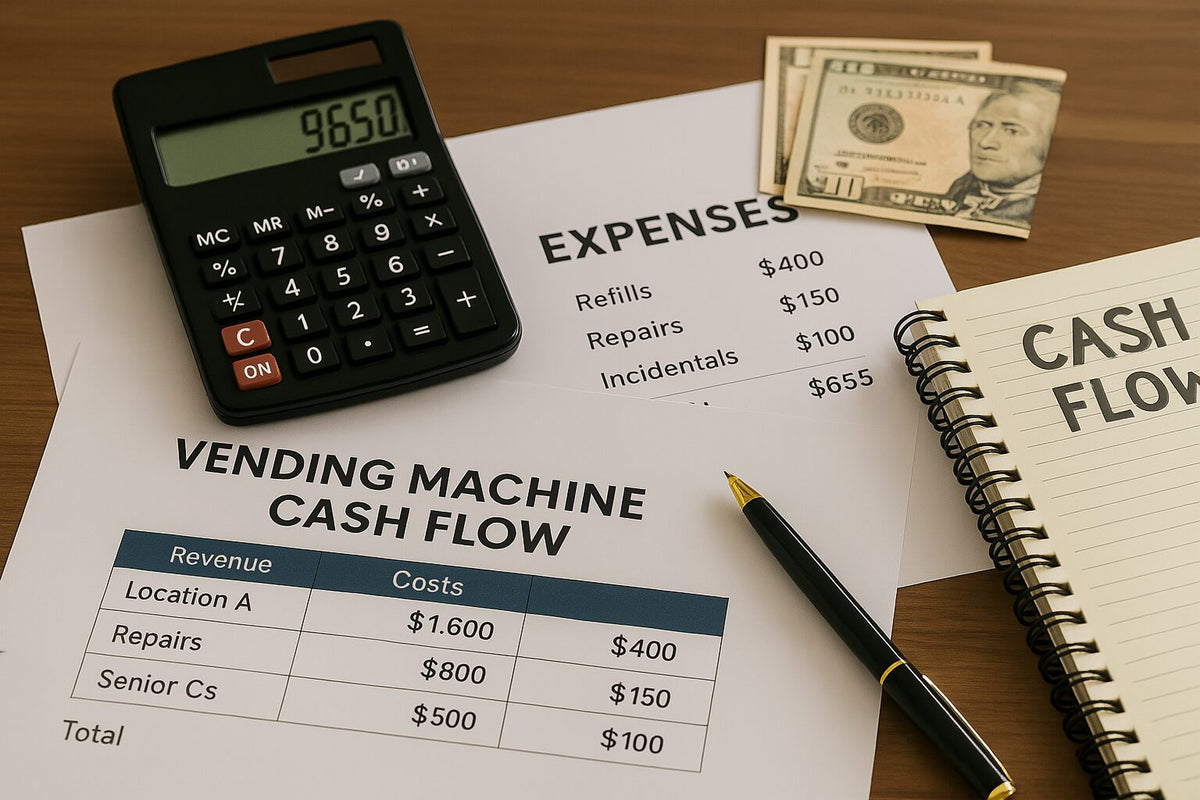
Vending machine cash flow is the timing of money in and out of your route: cash and card sales coming in, and inventory, location commission, card fees, fuel, repairs and loan payments going out. A machine can show a profit on paper and still leave you short if you restock with cash before the sales come back, so you plan around when money moves as well as how much.
This guide covers how to budget for startup, sort monthly costs into fixed and variable, forecast your first months, work out break-even, set reserves, use financing without starving the business and plan for taxes. The worked examples use live VMFS USA prices and fee schedules.
Vending machine cash flow is the actual movement of dollars through your business in a given week or month. Profit shows whether sales cover costs over time. Cash flow shows whether you have the money on hand to pay for them when they come due. The two separate quickly in vending because you pay for products before anyone buys them, a card processor holds your sales for days, and a location may invoice its commission monthly or quarterly while your financing payment lands on a fixed date.
That gap is why a vending machine business can look healthy on a spreadsheet and still feel tight in the bank. If your first machine needs a full fill on day one, a second purchase a week later and a repair call in month two, you can be several hundred dollars out of pocket before the first card deposit arrives. Operators who plan cash flow from the start know which week money goes out, which week it comes back and how big a cushion covers the gap.
For the earnings side of the picture, our guide to vending machine profitability sets out realistic revenue and margin ranges by placement.
Profit is not cash: a machine that clears $250 a month on paper can still leave your account empty if you prepay inventory, carry a slow-paying commission invoice and take a repair hit in the same month. Forecast the timing, not just the totals.
Your startup budget is the cash that leaves the business before the machine earns a dollar: the machine itself, a payment device if it isn't built in, the first fill of inventory, delivery, registration and insurance, plus an opening reserve. The machine is the largest line, and price depends on type. Across the active VMFS USA catalog, new machines currently run from $1,900 for the Countertop Snack Vending Machine to $19,950 for the largest specialty units, and entry-level combo vending machines, which sell snacks and cold drinks from one footprint, run from $3,450 to $4,950.
| Startup line | What drives it | Example (VMFS prices, Oct 2026) |
|---|---|---|
| Machine | Type, capacity, refrigeration, screen or AI features | Countertop Snack $1,900; Seaga SM2300 combo $3,450; Smart Combo $4,650 to $4,950 |
| Card reader (if not included) | Hardware model and processor plan | About $450 for Nayax hardware in VMFS's reader comparison |
| First inventory fill | Number of slots times your average unit cost | Example: 300 items at $1.00 average cost = $300 |
| Delivery and placement | Freight route, liftgate or white glove service | Quoted per address |
| Registration, licenses and permits | State, county and city rules | Varies by jurisdiction |
| Insurance | Coverage the location and lender require | Many locations ask for $1 million per occurrence general liability |
| Optional extended warranty | Years of parts coverage beyond the included year | 2 years $250; 3 years $400 |
| Opening reserve | Fixed costs, repairs and a second fill | Set in the reserves section below |
The worked example in this guide uses a Smart Combo Vending Machine in its drinks and snacks configuration at $4,950, a $450 reader and a $300 first fill, for $5,700 of startup cash before delivery, insurance and registration. Swap in your own quote. The SBA's startup cost worksheet lists the same categories most small businesses face, including equipment, licenses and permits, insurance and inventory, and is a useful checklist so nothing is left out.
Two choices change this number more than any other. Buying used lowers the machine line, and NerdWallet puts used machines at roughly $1,200 to $3,000 against $3,000 to $10,000 new, but older equipment carries repair risk you have to fund from reserves. Financing moves most of the machine cost out of the startup column and into a monthly payment, which helps cash today and adds a fixed cost tomorrow. Both trade-offs are covered below, and our vending machine cost guide breaks down machine prices by type.
Monthly vending costs fall into two groups: variable costs that rise and fall with every sale, and fixed costs you pay whether the machine sells or not. Sorting them this way is the core of any vending machine financial model, because variable costs set your margin per sale while fixed costs set how many sales you need before you make anything.
Product cost is the largest variable line. A common rule of thumb in vending is to price at about twice what an item costs, which puts product cost near half of sales, with drinks often marked up further and candy less. Location commission is the next variable line; NerdWallet reports operators typically pay a property owner 5% to 25% of revenue, and VMFS's own location program quotes 0% to 20% depending on traffic. Card processing is the third. With 78% of vending sales now cashless according to Cantaloupe's 2026 Micropayment Trends Report, processing fees apply to most of your revenue, and VMFS's reader comparison shows plans of about 5.95% flat or about 2.5% plus $0.10 per transaction.
| Cost line | Type | Typical basis | Example at $1,000 gross |
|---|---|---|---|
| Product cost (COGS) | Variable | About half of selling price at a 2x markup | $500 |
| Location commission | Variable | Typically 5% to 25% of sales; example uses 10% | $100 |
| Card processing | Variable | About 3% to 6% of card sales; example uses 5.95% on 78% cashless | $46 |
| Card reader service | Fixed | About $7.95 to $18.95 per month by provider | $10 |
| VMFS Cloud Basic | Fixed | $7.99 per machine per month | $8 |
| Vehicle cost | Semi-fixed | Miles per month at the IRS rate of 72.5 cents (2026) | $58 (80 miles) |
| Repair reserve | Fixed set-aside | Your choice; higher for used equipment | $25 |
| Electricity | Usually the location | Confirm in the placement agreement | $0 |
| Operating cash before insurance, financing and tax | About $253 |
The example lands near 25% of gross, before insurance, any loan payment and income tax. Change one input and the result moves quickly: a 20% commission instead of 10% removes another $100, and a weaker location that sells $600 instead of $1,000 drops operating cash to about $111 because the $101 of fixed costs does not shrink with sales. That is why the fixed column, not the variable one, is what sinks marginal placements. Our revenue split guide covers commission negotiation in detail.
Vending money comes in on two schedules: cash sits in the machine until your next service visit, and card sales arrive as processor deposits on the processor's payout calendar. Cantaloupe, for example, pays operators weekly on a Friday by default, with the deposit typically showing the next business day, and rolls any pending balance under $25 over to the following week. A card sale made on a Saturday can therefore take most of a week to reach your account.
Money goes out on a different rhythm. Inventory is paid for at the warehouse club or distributor before it is loaded, so every restock is a cash advance against future sales. Commission is paid on the schedule written into your placement agreement, which might be monthly or quarterly. Reader service, VMFS Cloud and any financing payment hit on fixed dates each month. Fuel is spent on every route day.
The practical result is a working-capital gap of roughly one restock cycle plus one payout cycle. If you restock weekly, you are always carrying about a week of inventory in the machines and a week of card sales at the processor. Cash collection adds a third pool: coins and bills sit in the machine until the next visit, so on a low-traffic route serviced every two weeks, that cash is idle for two weeks. Collect on every visit, reconcile the cash against the machine's sales report and deposit it promptly so your records and your bank balance tell the same story.
Cashless sales are also larger. Cantaloupe's 2026 report puts the average cashless ticket at $2.45 against $1.57 for cash, which is one reason a working cashless payment system belongs in the startup budget rather than on a someday list. A machine that cannot take cards gives up the larger tickets and leaves more of your revenue sitting as coins until the next visit.
A vending cash flow forecast is a month-by-month table of expected sales, variable costs, fixed costs, debt payments and the running cash balance, built for at least the first 12 months. It turns the cost lists above into a date: the month the machine pays back its startup cash, or the month you would run short without a reserve.
Build it in five steps. Estimate gross sales from the location, ideally from foot traffic, the share who buy and your average ticket, which is how the VMFS ROI calculator models revenue. Ramp the first months up gradually, since a new placement takes time to build habits. Apply your variable cost percentage to each month's sales. Subtract fixed costs and any loan payment. Then carry the result into a running balance that starts at minus your startup cash. Add seasonality where it applies: a school placement loses its summer, an office slows over the holidays and an outdoor machine near a pool may do its best months in July.
Break-even is the number of sales per month that covers your fixed costs, and the SBA's formula is fixed costs divided by sales price per unit minus variable cost per unit. Applied to a vending machine, use your average sale as the price. At the $2.01 average vend Cantaloupe reported for 2025, the example costs leave about $0.71 per sale after product (about $1.01), a 10% commission (about $0.20) and card fees (about $0.09). Fixed costs of about $101 divided by $0.71 is roughly 142 sales a month, or about five a day.
Add a financing payment and the bar rises. If your quote came back at $200 a month (an example, not a rate quote), fixed costs become about $301 and break-even climbs to roughly 424 sales a month, about 14 a day. Run this before you sign a placement agreement or a financing contract: if the location's likely traffic cannot clear the daily number with room to spare, the machine will drain cash rather than build it.
The table below follows the $5,700 Smart Combo example, paid in cash, at a placement that ramps from $600 to about $1,000 a month with a stronger summer month. Variable costs are 64.6% of sales (product 50%, commission 10%, card fees about 4.6% of total sales) and fixed costs are $101.
| Month | Gross sales | Variable costs | Fixed costs | Operating cash | Running balance |
|---|---|---|---|---|---|
| Start | $0 | $0 | $0 | -$5,700 | -$5,700 |
| 1 | $600 | $388 | $101 | $111 | -$5,589 |
| 2 | $800 | $517 | $101 | $182 | -$5,407 |
| 3 | $1,000 | $646 | $101 | $253 | -$5,154 |
| 4 | $1,000 | $646 | $101 | $253 | -$4,902 |
| 5 | $1,100 | $711 | $101 | $288 | -$4,614 |
| 6 | $1,000 | $646 | $101 | $253 | -$4,361 |
At about $253 a month, the remaining $4,361 takes roughly 17 more months, so this machine pays back its startup cash in about 23 months. That is a realistic result for an average placement and the reason sales volume matters so much: the same machine at a busier site pays back far sooner because fixed costs are spread over more sales.
| Monthly gross sales | Operating cash per month | Months to recover $5,700 |
|---|---|---|
| $600 | About $111 | About 51 |
| $1,000 | About $253 | About 23 |
| $1,500 | About $429 | About 13 |
| $2,000 | About $606 | About 9 |
Payback is not linear. Doubling sales from $1,000 to $2,000 cuts payback by more than half, because the fixed costs stay at about $101 while every extra sale adds about 35 cents on the dollar. Insurance, loan payments and income tax sit outside these figures, so treat them as the ceiling for an owner-operated machine.
A vending operator should hold enough cash to cover one full restock, two to three months of fixed costs and loan payments, and a repair fund sized to the age of the equipment. That is our planning rule rather than an industry statistic, and it is built around the timing gaps described above: inventory you prepay, card sales the processor is still holding and the slow first months of a new placement.
Repairs deserve their own line. Every VMFS machine includes a 1-year parts warranty, with replacement parts and their shipping covered in the continental US during the warranty period, and extended coverage is available at purchase. It is a parts warranty, so budget for labor on service calls, and once the warranty ends the parts are on you too. Used machines need a larger fund because nothing is covered from day one. Routine care reduces the size of these surprises, and our vending machine maintenance guide sets out a service schedule that keeps downtime and emergency spending low.
Operating account
Receives cash deposits and processor payouts, pays inventory, fuel, reader service, cloud fees and loan payments.
Inventory float
At least one full fill held as cash or stock so a slow payout week never leaves a machine half empty.
Repair fund
A monthly set-aside per machine, larger for used or out-of-warranty equipment, for labor, parts and lost sales days.
Tax and commission set-aside
Sales tax collected, commission owed and estimated income tax, moved out of the operating balance as you earn it.
Splitting cash this way, a light version of the Profit First envelope method, stops money that already belongs to someone else from looking like spare cash. Commission owed to a property, sales tax collected from customers and next quarter's income tax are liabilities from the day the sale happens. Moving them out of the operating balance every week makes it obvious how much you can actually spend.
Location decides vending cash flow because it sets both sides of the equation: how many sales the machine makes and how much it costs you in time and fuel to keep it full. A strong placement and a weak one can use identical machines and still produce opposite results, which is why proving one location matters more than the number of machines you own.
Picture two placements. In the first, four older cash-only machines sit in a quiet technician office a long drive from home, break down often and need frequent trips for small sales. In the second, two newer cashless combo machines sit in a busy apartment building close to home, stay running and need one restock a week. The first route burns fuel, labor and repair money on every visit and loses card customers entirely; the second converts most of its revenue into cash with little effort. At the IRS 2026 business rate of 72.5 cents a mile, a 40-mile round trip costs about $29 in vehicle expense before you sell anything, so a placement that needs weekly visits for $40 of sales loses money however good the machine is.
A high-performing placement usually shares the same traits: indoor, climate-protected space; daily traffic of people who stay on site; few food or drink alternatives nearby; a property manager who supports easy access for restocking and service; secure access with low vandalism risk; reliable Wi-Fi or cell signal for the card reader; and a short drive from your home or storage. Match the product mix to the audience: energy drinks and hearty snacks on blue-collar sites, water, juice and ready meals in senior housing, and protein bars and low-sugar options in gyms. The best sellers are what your customers already buy elsewhere, not your personal favorites. For a checklist on finding and pitching placements, see how to scout and pitch a vending machine location and our ranking of the best vending locations.
Financing helps vending cash flow when the monthly payment is comfortably below what the machine can earn at a conservative sales estimate, and hurts it when the payment is sized to an optimistic one. The point of financing is to keep startup cash available for inventory, reserves and the next placement, not to buy more machine than the location can carry.
VMFS USA does not lend in-house. Its partner providers each serve a different need: PayPal can split up to $1,500 into four interest-free payments or finance $49 to $10,000 over 3, 6, 12 or 24 months; Klarna offers pay-in-4, pay-in-30-days and monthly plans with a soft credit check; and ClickLease approves applicants down to a 500 FICO score for up to $30,000 with no time-in-business requirement. Terms typically run 6 to 48 months, and the financing team usually responds within 24 to 48 hours. Details and applications are on the VMFS financing options page.
Do not treat future credit as your reserve. In the Federal Reserve's 2026 Report on Employer Firms, meeting operating expenses was the most common reason employer firms sought financing, cited by 56%, and only 42% of applicants received the full amount they asked for. A new route that runs short in month three may not get approved for a bridge loan, which is why the reserve comes first and the financing payment goes into the break-even math before you sign. The SBA's microloan program, which lends $50,000 or less, is another route once you have records to show. Our full guide on how to finance a vending machine compares lenders, leases and SBA programs.
Financing the machine
Trade-offs to plan for
Finance a machine and keep your cash working
Check eligibility with VMFS partner lenders and see terms before you commit.
Explore Financing OptionsTaxes affect vending cash flow in three ways: sales tax you collect for the state, income tax you prepay through the year and depreciation that can lower the tax bill in the year you buy a machine. Planning for each keeps a tax deadline from landing as a surprise withdrawal.
Start by separating the money. The SBA advises opening a business bank account as soon as you start accepting or spending money as a business, because keeping business and personal funds apart protects you and makes your books readable. The IRS lets you use any recordkeeping system that clearly shows income and expenses, and good records are what let you monitor progress, prepare financial statements and support deductions. Mixing vending deposits with personal spending hides whether the business is growing at all. If you have not chosen a structure yet, our guide on whether you need an LLC for a vending machine business covers the options, and the local vending machine permits you need belong in the startup budget.
Sales tax generally applies to vending revenue, and NerdWallet notes the rate varies by state, so set aside the tax portion of each deposit as you go. For income tax, the IRS says individuals, including sole proprietors, partners and S corporation shareholders, generally must make estimated tax payments if they expect to owe $1,000 or more when they file. The year is split into four payment periods, and you can generally avoid an underpayment penalty by paying at least 90% of the current year's tax or 100% of the prior year's tax, whichever is smaller. A quarterly transfer into the tax set-aside makes those payments routine.
Depreciation can return cash in year one. Under the 2025 tax law, the IRS says businesses can take a permanent 100% first-year bonus depreciation deduction for qualifying property acquired after January 19, 2025, and the Section 179 expensing limit rose to $2,500,000 for tax years beginning after 2024. Vehicle use for route driving is deductible at 72.5 cents a mile in 2026 if you use the standard rate. Ask a tax professional how these apply to you, and read our overview of vending machine business tax implications.
Reinvest in a new machine only after the current ones cover their own costs and your reserve is fully rebuilt. Growth is where most vending cash crunches happen, because each new placement repeats the startup cycle: a purchase, a first fill, a ramp-up period with low sales and new fixed costs that start immediately.
Put reinvestment dollars where your own data shows the highest return. That might be a second machine at a proven site, an upgrade from a cash-only unit to a cashless smart machine that captures larger card tickets, or a better product mix in the machines you already own. Revenue gains often come cheaper than new hardware: optimizing placement, adding product variety and adjusting prices by time of day or demand can raise sales without another purchase. Telemetry makes those calls faster. VMFS Cloud works with every VMFS machine, with plans starting at $7.99 per machine per month for live inventory, real-time sales with margin and low-stock alerts; the $16 Advertising Cloud adds remote pricing, and the $39.99 AI Cloud adds operator-set dynamic pricing rules.
Clean records also decide what the business is worth if you sell. BizBuySell's data on vending businesses sold from 2021 to 2025 shows a median sale price of $83,500, median discretionary earnings of $39,601 and a median earnings multiple of 2.15. Buyers pay for documented cash flow, so every month of separated, reconciled records adds to the value of your route. Before buying or selling a route, read vending machine routes for sale: what to know before buying, and for the decision on how much to pay yourself versus reinvest, see reinvesting profit vs taking income out.
Most new operators who lose money do so through avoidable cash flow mistakes rather than because vending does not work. These are the ones that show up most often.
A short monthly review catches these early. Compare each machine's sales, product cost, commission and fees against the forecast, check the reserve balances and decide whether to restock deeper, reprice, move or pull a machine.
VMFS USA supports operator cash flow by matching the machine to the location, publishing its recurring fees up front and connecting buyers with financing that preserves startup cash. If a machine is not a good fit for your placement, the team will say so before you buy, because a mismatched machine is the fastest way to a negative balance.
The practical pieces: partner financing through PayPal, Klarna and ClickLease; a transparent fee schedule on the VMFS payment system page, including the $0.07 per-transaction AI recognition fee on AI machines other than the NEO GO and NEO PRO; VMFS Cloud data for every machine so you can forecast from real sales instead of guesses; a written 1-year parts warranty with optional extended coverage; and in-stock machines that usually ship within 7 to 10 days, so a signed placement starts earning sooner, while custom builds take around 45 days. VMFS also runs location matching for businesses that want a machine, which helps operators find placements with the traffic to clear break-even. Post-sale, the team helps with restocking questions and inventory planning so you can think like an operator rather than a buyer.
Before you place your first order, keep it simple: start with one good machine in one good location, track every dollar in and out, and choose a supplier that backs you after the sale. Vending success is about control of the numbers, and cash flow is where that control starts. When you are ready to compare equipment, our guide to buying a vending machine walks through the choice step by step.
Run your own cash flow numbers
Enter your machine price, traffic, ticket size and margin to see monthly profit and payback with fees included.
Open the ROI Calculator
Share:
Vending Machine Financing Model
Vending Machine Financing Model