


A used vending machine usually costs about $1,200 to $3,000 on the open market, and used drink and combo machines from dealers can run past $5,000. It is a good buy only when the machine is mechanically sound, can take modern card payments, has parts available, and still costs less than a new machine once repairs, delivery and a card reader are added.
This guide covers used, refurbished and new pricing side by side. You also get a landed-cost worksheet, a component-by-component inspection checklist, the cashless compatibility questions that kill most bad deals, and a scoring framework for deciding before you pay.
How Much Does a Used Vending Machine Cost?
A used vending machine typically sells for $1,200 to $3,000, according to NerdWallet's vending startup guide, which puts new machines at $3,000 to $10,000. Dealer prices sit higher: Vending.com, a national equipment dealer, puts used snack machines at $2,750 to $4,850, drink machines at $3,250 to $5,150 and snack-and-drink combos at $3,300 to $5,250.
The spread in those numbers is the whole story of buying used. At the bottom of the market you find private sales, auctions and route liquidations where the machine is sold as-is, with no testing and no warranty. Dealer stock costs more because someone has usually cleaned, tested and repaired it, and some dealers add a short warranty. You are paying either way: once to the dealer for the work, or later to a technician and in lost sales if the as-is machine needs that same work after it is installed.
Age is a weak predictor of price on its own. A well-maintained ten-year-old snack machine with a modern controller and a working card reader can be worth more to an operator than a five-year-old unit with an obsolete board that no reader will talk to. Value tracks remaining useful life and the machine's ability to produce revenue at your location, which is why the inspection and compatibility sections below matter more than the listing price.
| Price driver | Why it moves the price |
|---|---|
| Refrigeration health | A compressor or sealed-system failure is the most expensive single repair on a drink or combo machine. |
| Payment system | A working MDB-compatible controller and card reader add value; coin-only electronics subtract it. |
| Parts availability | Discontinued models with scarce boards, validators or motors lose value fast. |
| Capacity and selections | More columns and deeper spirals sell more between service visits. |
| Service history | Documented maintenance lowers the risk of hidden faults. |
| Cosmetic condition | Matters to offices, hotels and medical sites that judge equipment on looks. |
| Indoor vs outdoor build | Outdoor-rated cabinets cost more new and used. |
| Warranty or return terms | Any written coverage from a dealer justifies a higher price than as-is. |
For the full picture of what new equipment costs by machine type and feature, see the vending machine cost guide, which this article builds on for the used side of the market.
Used vs Refurbished vs New: What You Actually Get
A used machine is sold in its current condition, a refurbished machine has had some level of inspection, cleaning, repair or part replacement, and a new machine starts every wear component at zero hours. Each step up costs more and removes uncertainty.
The word "refurbished" carries no standard definition, so treat it as a claim to verify. A genuinely refurbished unit has had its refrigeration tested under load, worn vend motors replaced, the bill validator and coin mechanism serviced, and the cabinet repaired. A machine that has only been pressure-washed and photographed well is a used machine at a refurbished price. Ask the seller which components were replaced and ask for the parts invoices.
| Factor | Used (as-is) | Refurbished | New |
|---|---|---|---|
| Upfront price | Lowest | Middle | Highest |
| Repair risk in year one | Highest | Lower | Lowest |
| Warranty | Usually none | Often short or limited | Manufacturer or seller warranty |
| Payment technology | Often outdated | Can be upgraded | Configured at order |
| Telemetry and remote pricing | Rare | Sometimes added | Available by subscription on many models |
| Energy efficiency | Depends on age | Depends on age | Current designs |
| Parts availability | Model-dependent | Model-dependent | Strongest |
| Best fit | Mechanically confident buyers, low-stakes sites | Budget-conscious operators who want tested equipment | High-traffic sites, growing routes, demanding clients |
Advantages of buying used
- Lower upfront cash needed per machine
- Lets you test an unproven location cheaply
- Access to proven, simple models that are easy to service
- Smaller loss if the location fails and you resell
- Good way to learn stocking, pricing and repairs
Disadvantages of buying used
- Higher repair risk and unknown maintenance history
- Little or no warranty
- Older payment hardware that may not accept a modern reader
- Parts shortages on discontinued models
- Older refrigeration that can draw more power
- Worn cabinets that some locations will turn down
The pattern is simple: used equipment lowers the cost of entry and raises the cost of operating, while new equipment does the reverse. Which one wins depends on what downtime costs you at a specific site, and whether you can fix the machine yourself.
New vs Used Vending Machine Cost Comparison
On sticker price alone, used machines are cheaper: at the bottom of Vending.com's ranges below, used snack, drink and combo machines start about $950 to $2,350 below new ones of the same type. That saving shrinks once you add the repairs, delivery and payment upgrade a used machine typically needs, and it can disappear entirely when compared against entry-level new models.
The table sets Vending.com's published used and new ranges against what comparable new machines cost at VMFS USA today. VMFS prices are current starting prices for active models; check the product page before you buy, since prices and options change.
| Machine type | Used (Vending.com range) | New (Vending.com range) | New at VMFS USA (starting price) |
|---|---|---|---|
| Snack | $2,750–$4,850 | $3,700–$6,500 | Countertop Snack Vending Machine $1,900; Seaga ENV4S $3,950 |
| Drink / soda | $3,250–$5,150 | $5,600–$8,500 | Seaga Prosper $5,450 |
| Combo (snack and drink) | $3,300–$5,250 | $5,400–$8,300 | Seaga SM2300 SnakMart $3,450; Slim Combo (drinks and snacks) $3,950; Smart Combo (drinks and snacks) $4,950 |
| High-capacity combo | Not listed | Not listed | Dual Combo $8,950 |
| Smart / AI cooler | $3,800–$8,650 | $4,200–$10,800 | See AI grab-and-go models |
Two things stand out. First, the cheapest new machines now overlap the used market: the Countertop Snack Vending Machine at $1,900 sits inside NerdWallet's used range, and the $3,450 SM2300 and $3,950 Slim Combo sit in the lower half of Vending.com's used combo range. Second, the used discount is largest on full-size refrigerated equipment, which is exactly where the riskiest component, the cooling system, lives. A used drink machine that needs a compressor is no longer a discount.
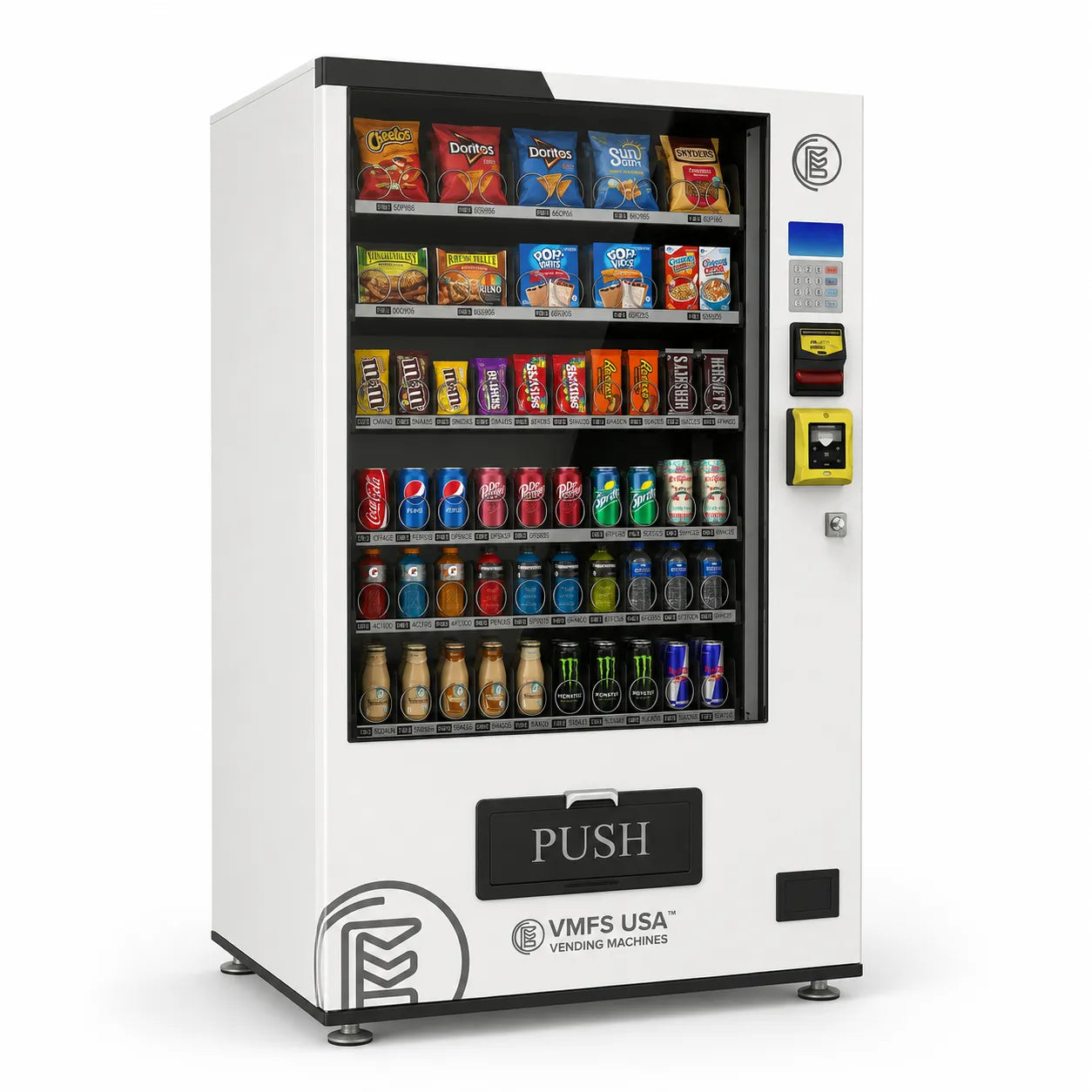
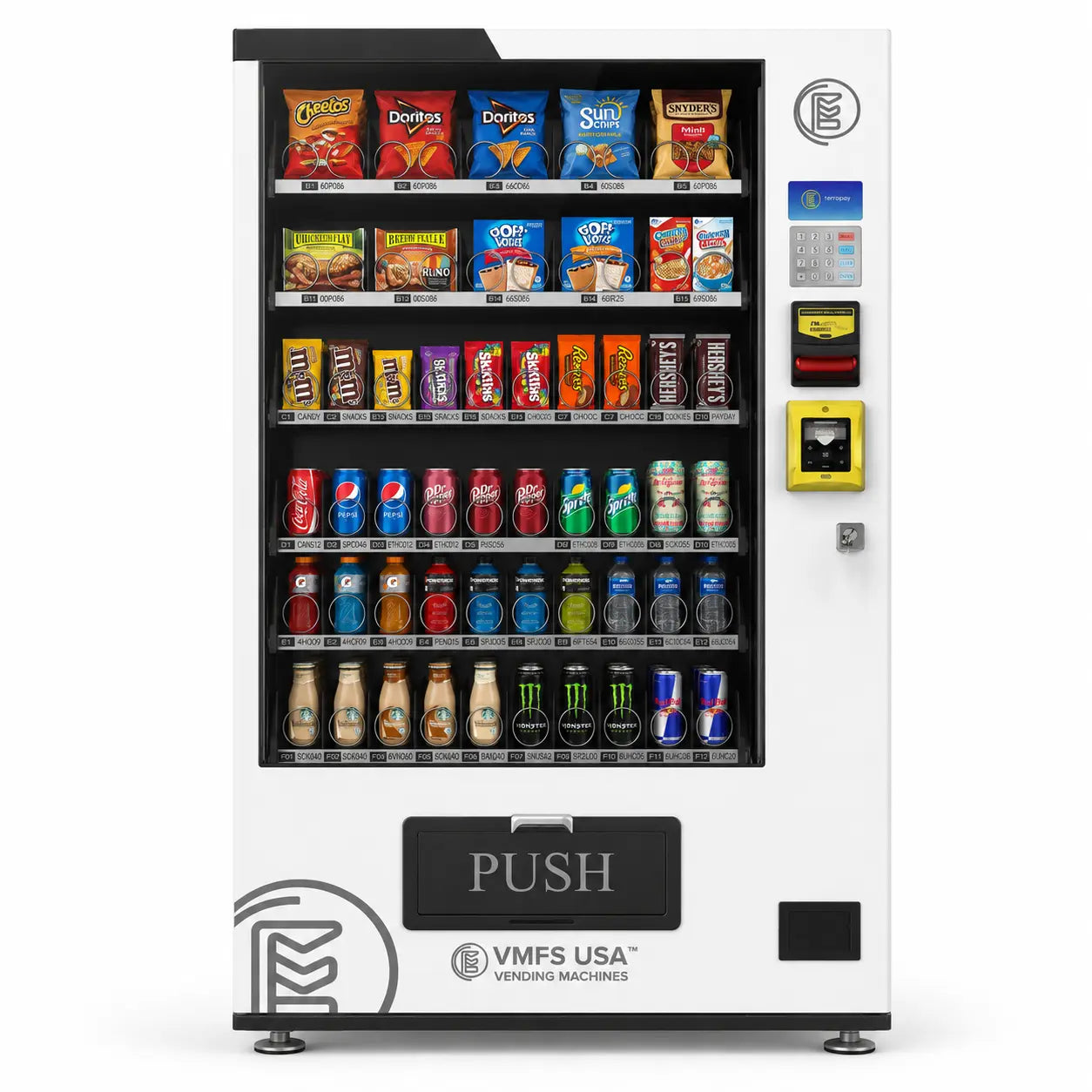
Across the active VMFS catalog, new machines run from $1,900 to $19,950 depending on format, so there is usually a new option within reach of a used budget. Browse combo vending machines and snack vending machines to compare formats and capacities before you commit to a used listing.
The Real Cost: Landed Cost and Cost to Operate
The real price of a used machine is what it costs to get it vending reliably at your location, not the seller's asking price. Compare machines on total cost to operational readiness: purchase price plus repairs, payment upgrade, delivery and installation.
Several of those line items are the same whether the machine is new or used, such as stock, commission and processing. The ones that differ are repairs, the card reader, delivery terms and energy use, and those are where a cheap listing turns expensive.
| Cost line | Typical amount | Notes |
|---|---|---|
| Delivery | $200–$1,000 | Vending.com estimate; liftgate, distance and stairs push it up. Rarely included in private used sales. |
| Card reader hardware | About $450 (Nayax, Cantaloupe); $500–$650 (PAX) | Per the VMFS payment system comparison. Only works if the controller supports it. |
| Reader service fee | About $7.95–$18.95 per month | Depends on provider and plan; usually includes cellular connectivity. |
| Card processing | About 3%–6% of cashless sales | Roughly 2.5% + $0.10, or about 5.95% flat, depending on plan. |
| Routine maintenance | $200–$600 per year | Vending.com estimate, plus a reserve of about $500 for unexpected repairs. |
| Electricity (refrigerated) | $20–$50 per month | Vending.com estimate for cold-drink machines; older units sit at the high end. |
| Location commission | 5%–25% of sales | Typical range per NerdWallet; negotiated with the property. |
| Telemetry | From $7.99 per machine per month | VMFS Cloud works with every VMFS machine; many older used machines cannot connect to any telemetry. |
A worked landed-cost example
The example below is hypothetical, built to show the arithmetic rather than to quote a market price. It compares a cheap used snack machine that needs work, a better used unit, and a dealer-refurbished machine with a reader already fitted.
| Scenario (illustrative) | Machine | Repairs | Card reader | Delivery | Ready-to-vend cost |
|---|---|---|---|---|---|
| Cheap used, needs work | $1,200 | $700 | $450 | $300 | $2,650 |
| Better used | $1,900 | $250 | $450 | $300 | $2,900 |
| Refurbished, reader fitted | $2,500 | $0 | $0 | $300 | $2,800 |
Best-value rule: Compare machines by total cost to operational readiness, not by the advertised price. A cheap listing with an unknown repair bill is a price range, not a price.
The $1,200 machine only looks cheapest until the repairs and reader are counted, and its repair figure is a guess until the machine has been opened up. The refurbished unit costs more on paper and less in risk. Set those totals against new list prices, such as the $1,900 Countertop Snack Vending Machine or the $3,450 Seaga SM2300 combo, each with a written 1-year parts warranty, and the used discount shrinks to under $1,000 or disappears. Check whether the new model you compare includes a card reader or needs one added.
Downtime is the cost nobody lists
Every day a machine sits dark waiting on a part is a day of lost sales and a dent in your relationship with the location. As a simple illustration, a machine averaging $900 a month in sales that is offline for 11 days loses about $330 in revenue, before the repair bill. Two of those events in a year can cost more than the discount you got by buying used. The vending ROI calculator is a quick way to plug in your own sales and costs and see how sensitive your payback is to downtime.
Compare used listings against new machines that ship now
See in-stock VMFS machines with list prices, warranty terms and payment options before you pay for someone else's repairs.
Browse in-stock machinesTypes of Used Vending Machines and Their Weak Points
Each machine type fails in its own way, so the inspection should focus on the components that type depends on. Simple snack machines are the safest used buy, while refrigerated, combo and smart machines carry more risk at the same age.
Used snack vending machines
Snack machines sell shelf-stable chips, candy, cookies and pastries from spiral coils, so they have no refrigeration to fail. Their weak points are vend motors, coils, shelves and delivery sensors. Weak or noisy motors and bent coils cause jams that cost sales every day, so test every selection, not a sample.
Used beverage vending machines
Drink machines depend on the compressor, condenser, evaporator, fans, thermostat, door gasket and drain system. A cabinet can look perfect and still be running its compressor nearly nonstop to hold temperature, which shows up on the power bill well before it fails. Treat any seller who will not demonstrate a cold machine as selling unverified equipment.
Used combo vending machines
Combo machines hold an ambient snack section and a refrigerated drink section in one cabinet, so they save floor space but carry roughly twice the mechanical surface of a single-purpose machine. When they age, they age on two fronts at once. A used combo therefore carries more risk than a used snack-only machine of the same age and price, and the refrigeration test matters as much as it does on a drink machine. If the site needs both categories, compare used listings against the new combo prices in the cost table above first.
Used coffee and specialty machines
Coffee, fresh-food, frozen and other specialty machines need category-specific checks. Coffee equipment has pumps, boilers, grinders, valves and seals that wear with every cup, and maintenance history matters more here than on a snack machine. Fresh-food and frozen machines also have to meet food-safety temperature controls, covered in the checklist below.
Used smart and AI machines
Smart machines are part hardware and part software, and the software may not transfer. Cameras, touchscreens, sensors, telemetry and payment accounts often depend on a provider's subscription and on the seller's account being released. Confirm the machine can still connect to the manufacturer's current platform and that you can register it under your own account. For how these systems work, see how AI vending machines work and the comparison of traditional vs AI vending machines.
Used Vending Machine Inspection Checklist
Inspect a used vending machine in person, powered on, and test every function you will rely on: the cabinet, every selection, refrigeration, payment devices, locks and the control board. Photos and listing descriptions are not a substitute for any of these checks.
Cabinet and structure
Start with the physical machine before the electronics. Look for rust, water damage, bent panels, cracked glass, damaged hinges and signs of forced entry. Surface rust and scratches are cosmetic; rust that flakes or perforates the base, the refrigeration deck or the electrical compartment is structural, and that machine is finished. Check that the machine sits level and that the door opens, closes and seals properly.
Every selection, every motor
Run a vend from every selection and note any motor that is slow, noisy or dead. Watch that each product drops cleanly, that the delivery sensor registers it, and that the machine records the sale at the right price. A machine that cannot complete every vend is not a fully working machine, and should not be priced as one.
Refrigeration
Ask the seller to switch the machine on well before you arrive, then put a thermometer inside and watch it for at least an hour. It should reach and hold a steady cold temperature, and the compressor should cycle off rather than run continuously; a unit that never cycles off is struggling. Listen to the compressor start: grinding, a loud click or a long labored start points to a sealed system near the end. Check the condenser coil for packed dirt, which signals poor maintenance.
Close the door on a dollar bill at several points along the gasket and pull. If the bill slides out easily, the seal has failed and the compressor is cooling the room. For machines that sell perishable food, confirm the automatic temperature shutoff works. Virginia's food regulations, for example, require a refrigerated vending machine selling time and temperature controlled food to stop vending if the cabinet stays above 41°F for more than 30 minutes after loading or servicing. Check your own state's rules.
Payment devices
Test the bill validator with worn and crisp notes in both orientations, test the coin mechanism with every denomination, and confirm correct change comes back. If a card reader is fitted, complete a real transaction and ask which provider account it is registered to. The next section covers what to check if you plan to add one.
Locks, keys and security
Get every key and test every lock. A replacement lock is a modest cost; missing keys on a damaged door frame, or repeated pry marks, deserve a closer look. For semi-outdoor or unattended sites, judge security more strictly than you would for an indoor office break room.
Control board and parts availability
Get the exact manufacturer and model number, and search the part numbers for the control board, validator, coin mechanism and motors before you agree a price. Parts availability decides whether an older machine is a cheap asset or a future scavenger hunt. VMFS supplies vending machine parts across snack, beverage, combo, coffee and specialty machines; for any older brand, confirm a parts source before you buy.
Red flag: no cold demo
A seller who will not show a refrigerated machine holding temperature is selling unverified equipment.
Red flag: perforated rust
Rust that flakes through the base or refrigeration deck is structural, not cosmetic.
Red flag: unknown controller
If nobody can tell you whether the board supports MDB, assume it may not take a modern reader.
Red flag: vague history
"It was working when we unplugged it" is not a service record. A route consolidation is a good reason to sell; silence is not.
Once the machine is yours, a routine service schedule protects what you paid for. The vending machine maintenance guide covers daily, monthly and annual tasks by component.
Card Readers, MDB and Cashless Compatibility
A used vending machine should either have a working card reader or a controller that supports one, because most vending sales are now cashless. Cantaloupe's 2026 Micropayment Trends report found that 78% of vending sales were cashless in 2025, up from 73% the year before, and that cashless customers spent an average of $2.45 per transaction against $1.57 for cash.
Those figures turn payment capability into a revenue question. A coin-and-bill machine cannot sell to the large share of customers carrying only a card or phone, and it caps the price points you can realistically charge. Cantaloupe also reports that 85% of cashless vending transactions were tap-to-pay, so a reader without contactless is already behind.
What MDB means for an old machine
MDB, the Multi-Drop Bus, is the industry standard protocol that lets a vending controller talk to payment devices such as bill validators, coin changers and card readers. NAMA maintains the MDB standard; version 4.3 revised Section 7, which covers cashless devices. Most modern card readers connect through MDB, so the practical test for an old machine is whether its controller has a working MDB interface. If it does not, there is no software fix: you are buying a new control board, or a cash-only machine.
Cashless-ready is not cashless-equipped
"Cashless-ready" usually means the machine has the interface a reader needs. "Cashless-equipped" means a reader is installed and working. Listings blur the two, so ask the seller to run a card transaction in front of you, or to confirm the controller model so you can check compatibility with your chosen provider before you pay.
Before buying, write down the machine's MDB support, any existing reader and its provider, connectivity (cellular or Wi-Fi), mounting space on the door, and the provider's monthly and per-transaction fees. The cashless payment systems for vending machines guide compares Nayax, Cantaloupe and other readers in detail, and the VMFS payment system comparison lists current hardware and fee ranges. New machines avoid the question entirely: a vending machine with a card reader is configured for payments at the point of order.
Where to Buy a Used Vending Machine and What to Ask
You can buy used vending machines from private sellers, auctions, liquidations, refurbishers and established vending dealers. The cheapest channel is rarely the cheapest machine to own, because the lower price usually comes with less testing and no support.
| Seller type | Typical advantage | Main risk |
|---|---|---|
| Private seller or marketplace listing | Lowest asking price, room to negotiate | No testing, no warranty, no support |
| Auction | Potentially very low price | Condition unknown; often no chance to test |
| Route liquidation | Multiple matching machines at a discount | Inspection time may be limited |
| Refurbisher | Tested equipment, parts replaced | Higher price; quality of "refurbished" varies |
| Established dealer | Support, parts knowledge, written warranty | Highest used price; can approach entry-level new |
Questions to ask the seller
Ask for the exact model number, approximate age, service history, reason for sale, known faults, payment configuration and whether parts are still available. Ask whether delivery is included, and what happens if the machine fails in the first week. Written answers protect you if the machine is not as described.
If you cannot inspect in person, ask for a continuous, unedited video that shows the machine powering on, the display and keypad working, several selections vending, the bill validator accepting a note, the coin mechanism returning change, a card reader completing a sale and, for refrigerated units, a thermometer reading inside the cabinet. A seller who cannot show basic operation is selling untested equipment and should price it that way.
Before you shop any channel, the step-by-step guide on how to buy a vending machine covers sizing, specs and supplier questions that apply to used and new purchases alike.
When Used Makes Sense and When New Wins
Buying used makes sense when the site is low-risk, the machine is simple, and you can do basic repairs yourself. Buying new wins when downtime would cost you the location, when you need cashless and telemetry from day one, or when you are building a route that has to run without constant attention.
Used is a reasonable call for an unproven site where you have no sales data, a genuinely low-traffic location where a few vends a day barely wear the machine, an informal placement such as a friend's workshop that will tolerate an outage, or a first machine you want to learn the trade on. If you can swap a vend motor and diagnose a refrigeration fault yourself, the repair math shifts strongly in your favor. For a low-stakes test site, a compact format can be smarter than any full-size cabinet: mini vending machines tie up less floor space and less inventory while you learn whether the location performs.
New equipment earns its premium at hospitals, corporate offices, hotels and universities, where the client judges the machine as an amenity and a week offline can end the contract. It also wins when two operators pitch the same site, because a clean modern cabinet with tap-to-pay and a touch screen smart vending machine interface often decides the pitch. Capacity matters too: a dual combo vending machine makes sense once a single cabinet runs empty between service visits, because route time is the most expensive thing an operator has.
Energy efficiency
Newer refrigerated machines generally cost less to run. ENERGY STAR reports that certified refrigerated beverage vending machines are on average 9% more efficient and save about 1,000 kWh a year, and they include a low-power mode that dims lighting or eases refrigeration during idle hours. An older used drink machine that predates those designs, or has a tired compressor, gives back part of its discount on the electric bill every month, and in many placements that bill is paid by the location, which notices.
Warranty and support
A used machine bought privately usually has no warranty at all, and dealer warranties on used stock vary and are usually shorter than new-equipment coverage. Every new VMFS machine carries a 1-year parts warranty covering electrical components, motors, sensors, control boards and payment modules, with 2-year ($250) and 3-year ($400) extensions available on many models at purchase. Coverage can vary by product, so check the product page. VMFS Cloud works with every VMFS machine; plans start at $7.99 per machine per month. The Basic plan covers live sales and slot-level stock, and remote pricing comes with the $16 Advertising plan, features most older used machines cannot offer. See the VMFS Cloud platform for plan details.
Financing changes the comparison
Many operators choose used because of one constraint, cash on hand, and financing addresses exactly that. A private used sale is normally paid in full up front, while new machines can be spread over monthly payments. VMFS does not finance in-house; its vending machine financing partners include PayPal (pay in 4 on up to $1,500, or monthly plans on $49 to $10,000), Klarna, and Clicklease (up to $30,000, with applicants down to a 500 FICO considered). Keeping cash for inventory matters, because stocked machines generate revenue and half-empty ones do not.
Taxes: used equipment can qualify for bonus depreciation
Used business equipment can qualify for bonus depreciation in the US, as long as you did not use it before buying it and did not buy it from a related party, according to IRS guidance on the 2017 tax law changes. The 2025 tax law made a 100% first-year deduction permanent for qualified property acquired after January 19, 2025, and raised the Section 179 expensing limit to $2.5 million, per the IRS. That means a used machine and a new machine can both be written off quickly; confirm the treatment for your situation with a tax professional.
How to Negotiate and When to Walk Away
Negotiate a used vending machine with a documented repair list, not a round number. Each fault you find during inspection becomes a priced reason for a lower offer, and sellers accept reductions more readily when you can show exactly what the machine needs.
Price each issue before you make the offer: a missing reader, a noisy compressor, dead motors, a failed gasket, a broken lock, missing keys, freight to your site. Subtract those from what a working equivalent would cost and offer from there. If the seller will not move, the same list tells you whether a refurbished or new machine is now the better deal.
Walk away from major structural rust, a refrigeration system that will not hold temperature, a controller that cannot take a card reader when you need cashless, critical parts that are no longer made, or a seller who will not demonstrate basic operation. As a working rule, one failed checklist item is a negotiating point; three or more and the discount will rarely cover what is coming.
Location First, Then Legal Setup
Secure the location before you buy the machine, used or new. The location sets the product mix, the machine type, the footprint, the power supply and the payment methods customers expect, so buying first and placing later usually forces a compromise.
The better sequence runs location, then customer demand, then product mix, then machine type, then purchase. A gym wants cold drinks, protein and tap-to-pay; a three-shift factory wants capacity and durability; an apartment lobby wants a compact, secure machine; a corporate office wants equipment that looks deliberate. A well-placed basic machine will outsell an excellent machine where nobody walks past. For prospecting, see how to find vending machine locations and the list of best vending locations. Operators who would rather not cold-call can use VMFS location matching, and property owners who want a machine can list a location on VPlaced.
A written location agreement should cover the commission or rent, electricity, access hours, who services the machine, product restrictions, damage and termination. Before placing any machine commercially, set up the business side as well: an entity if you want one, an EIN, sales tax registration and any vending permits your state, county or city requires. The SBA notes that licenses and permits can come from federal, state and local agencies and vary by activity and location. Start with the guide to vending machine permits in the United States, and if you are weighing an LLC, read do you need an LLC for a vending machine or VAdviced's walkthrough on forming an LLC for a vending business.
Scoring a Used Machine Before You Pay
Score each candidate machine from 1 to 5 across the categories below and compare totals against a refurbished or new alternative at the same landed cost. A low price should never compensate for a failing score on refrigeration, payment compatibility, parts or location fit.
| Category | What a 5 looks like | Score |
|---|---|---|
| Mechanical condition | Every selection vends cleanly; no jams | /5 |
| Refrigeration (if fitted) | Holds temperature, compressor cycles off, gasket seals | /5 |
| Payment compatibility | MDB controller with a working contactless reader | /5 |
| Parts availability | Board, validator and motors still sold | /5 |
| Physical condition | No structural rust, intact glass and locks | /5 |
| Service history | Written maintenance records | /5 |
| Warranty or support | Written dealer coverage or return window | /5 |
| Price vs alternatives | Landed cost clearly below refurbished and new | /5 |
| Location fit | Footprint, power and product mix match the site | /5 |
Before money changes hands, confirm the machine's dimensions, weight and electrical requirements against the site, that every selection, the validator, coin mechanism and reader work, that keys and locks are complete, that delivery is booked and priced, that any warranty is in writing, and that permits and sales tax are sorted for the location. If the machine passes and its landed cost still beats a refurbished unit, buying used is a sensible way to enter or expand a route.
The quick decision rule: choose used when you have technical confidence and want the lowest entry cost; choose refurbished when you want a balance of price and tested reliability; choose new when uptime, warranty, payment technology and appearance justify the premium; and choose smart or AI equipment when the site rewards remote monitoring and higher-value products. Whichever route you take, the vending machine profit guide shows how to turn the machine's cost into a realistic payback estimate, and VMFS sells a full range of new vending machines if the numbers point that way.
Spread the cost of a new machine instead of buying someone else's repairs
Check financing options through VMFS partners and keep your cash for inventory.
Explore financingFrequently Asked Questions
Sources
- NerdWallet — How to Start a Vending Machine Business (used and new machine costs, location commission)
- Vending.com — The True Cost of Vending Machines (used vs new price ranges, delivery, maintenance, electricity)
- Cantaloupe — 5 Numbers from the 2026 Micropayment Trends Report
- NAMA — NAMA Releases MDB Version 4.3
- ENERGY STAR — Refrigerated Beverage Vending Machines
- IRS — New Rules and Limitations for Depreciation and Expensing (used property and bonus depreciation)
- IRS — Working Families Tax Cuts: Businesses (100% bonus depreciation, Section 179 limit)
- Virginia Administrative Code 12VAC5-421-1310 — Vending machine automatic shutoff
- U.S. Small Business Administration — Apply for Licenses and Permits
Share:
AI Vending Machine Problems: Troubleshooting, Repair and Costs
Inside a Trading Card Vending Machine: How the Hardware Actually Works