


A vending machine commission is the share of machine sales an operator pays the property that hosts it. VMFS's published host tiers run from 0 to 20% of gross machine sales, and industry guides such as NerdWallet cite 5% to 25%. Out of every sales dollar, product suppliers take roughly half, the card processor and software take a few cents, the location takes its commission, and the operator keeps what is left to cover labor, fuel, equipment and profit.
This guide shows the real split in dollars, compares commission, flat rent and free placement, explains why gross versus net matters, and gives you published rates from school district, college and airport contracts plus the contract terms that protect your margin.
What Is a Vending Machine Commission?
A vending machine commission is a percentage of the machine's sales that the operator pays the location owner in exchange for floor space, power and access to the people who buy. The operator still owns the machine, buys the stock, services it and collects the money; the host simply earns a cut of what sells. That arrangement is the standard model behind most "free" placements, where the business pays nothing for the equipment and receives a share instead.
Commission exists because good locations are scarce and operators compete for them. NerdWallet's guide to starting a vending business says owners can generally expect to pay the property owner 5% to 25% of machine revenue, and Nav puts the typical figure at 5% to 20% of gross sales. Neither number is a legal requirement. Paying a location is a negotiated business term, and plenty of small sites host a machine for no commission at all because staff convenience is the benefit they actually want.
The percentage is only half of the deal. The other half is what the percentage is calculated on, how often it is paid, who supplies electricity, and what happens when sales are weak. Two offers that both say "10%" can differ by hundreds of dollars a year once those details are written down, which is why the rest of this guide treats commission as a contract structure rather than a single number. If you are new to how operators run their routes, the guide on what a vending machine operator does covers the job itself.
How a Vending Machine's Revenue Is Split
A vending machine's revenue is split among five parties: the product supplier, the payment processor and software provider, the tax authority, the location owner and the operator, who keeps the remainder. The location's commission is usually smaller than the product bill by a wide margin. Understanding that order stops operators from fixating on a few points of commission while ignoring a product mix that costs them far more.
The product supplier's share comes first. Nav, citing 365 Retail Markets, describes product cost as approximately 50% of the vending selling price as a general rule of thumb, with water and premium beverages carrying better margins. Wholesale clubs, specialty distributors and direct bottler relationships each move that number, and the guide on how much it costs to stock a vending machine breaks down the trade-offs between buying convenience and buying volume.
Payments are the next slice, and they grow every year because cash keeps shrinking. Cantaloupe's 2026 Micropayment Trends Report found that 78% of vending sales were cashless in 2025, up from 73% the year before. On the VMFS payment system page, transaction fees run about 5.95% flat or about 2.5% plus $0.10, and card reader service plans run roughly $7.95 to $18.95 per device per month depending on provider and plan. Machine software adds a fixed monthly line too: VMFS Cloud works with every VMFS machine, and plans start at $7.99 per machine per month.

The table below follows one illustrative month of $1,000 in sales through the split. The assumptions are stated so you can swap in your own: prices include 6% sales tax, 78% of sales are cashless at about 5.95%, product cost is 50% of pre-tax sales, the card reader plan is $9.95 and VMFS Cloud Basic is $7.99.
| Line | Who receives it | Amount on $1,000 of sales | Share of sales |
|---|---|---|---|
| Sales tax collected | State and local government | $56.60 | 5.7% |
| Product cost | Product suppliers | $471.70 | 47.2% |
| Card processing | Payment processor | $46.41 | 4.6% |
| Reader plan and machine software | Reader provider, VMFS Cloud | $17.94 | 1.8% |
| Location commission at 10% of gross | Location owner | $100.00 | 10.0% |
| Left for labor, fuel, equipment, insurance and profit | Operator | $307.35 | 30.7% |
That last line is not profit. Route labor, vehicle costs, spoilage, repairs, insurance, the machine's purchase price and income tax all come out of it. This is where the equipment supplier's share of the revenue split lives: the money you paid for the machine is recovered from that remainder month by month, so a commission that eats the remainder also stretches the payback period. The vending machine profitability guide walks through those operating costs in detail.
Typical Vending Machine Commission Rates
Typical vending machine commission rates depend on traffic: VMFS's published host tiers run from 0 to 5% of gross machine sales at small locations to 15 to 20% at high-volume ones. Those tiers appear on VMFS's location matching page, and VMFS notes that the standard 5 to 15% tier is where most placements land. They sit inside the 5% to 25% band cited by NerdWallet and by the small-business lender United Capital Source, and the 5% to 20% of gross sales cited by Nav. Traffic is the main driver: a location earns a higher rate by delivering more buyers, not by asking louder.
Rates by location type
Volume, captive audience and competition set the rate. A 30-person office with a gas station across the street supports little or no commission, while a multi-shift distribution center with no food options nearby can justify the top of the range because the machine sells around the clock. Product mix matters as well: drink-heavy machines and higher-ticket items leave more dollars to share than a snack-only machine selling low-priced chips.
| Location tier (VMFS) | Commission (VMFS published) | Example sites |
|---|---|---|
| Small locations | 0 to 5% of gross machine sales | Offices under 50 staff, small gyms, salons, waiting rooms |
| Standard locations | 5 to 15% of gross machine sales | Mid-size offices, apartment buildings, schools, clinics, dealerships |
| High-volume locations | 15 to 20% of gross machine sales | Large plants, multi-shift warehouses, campuses, distribution centers |
Use these tiers as an opening map, then adjust for what you can verify on site. The checklist in how to scout and pitch a vending machine location covers headcount, shift patterns and competing food options, and the guide to the best vending locations ranks venue types by traffic quality.
What public contracts actually pay
Public contracts often pay at or above the top of the private range because agencies bid accounts out competitively and publish the results. Howard County Public School System in Maryland reported $92,804 in vending sales and $18,757.48 in commission for April 2023 through February 2024, which works out to about 20%. St. Lucie Public Schools in Florida, answering bidder questions on its 2026 beverage vending solicitation, said its current commission is 35%, with drinks priced from $2.25 to $3.25. Chabot-Las Positas Community College District's 2022 vending solicitation states that the existing Las Positas College contract paid a 28.1% commission on gross sales, on reported annual gross sales of about $22,124, and required the new contractor to pay commission monthly and guarantee a minimum annual commission.
Airports sit at the extreme. A 2023 Los Angeles World Airports board report shows First Class Vending paying the greater of $100 per machine per month or 59.5% of gross sales for 72 machines at LAX and the Van Nuys FlyAway, with prices capped at 18% above "street pricing." Writing in Vending Market Watch in 2014, Dominic Finelli noted that government requests for proposals generally require commission on gross revenue with no deductions. Those numbers are bid-driven, not a benchmark for a private office. If you pursue these accounts, the guides on vending machines in schools and airport vending cover those venues in more depth.
Reality check: A rate that works at a public account with guaranteed traffic and controlled pricing can sink a machine in a 40-person office. Price the commission off the sales you can verify, not off the highest number you have heard.
Commission vs. Rent vs. Free Placement
Free placement pays the location nothing, a commission pays it a percentage of sales, and flat rent pays it a fixed dollar amount every month regardless of sales. Each model moves risk between operator and host in a different way, so the right one depends on how predictable the location's traffic is. Most operators default to free placement or a modest commission and reserve fixed rent for sites with proven sales history.
Free placement
Free placement means the operator installs, stocks and services the machine at no cost to the host and pays no commission or rent. The host's benefit is the amenity itself: staff and customers get food and drinks on site, and nobody has to manage a breakroom supply run. It works best at small and medium sites where the machine's sales cannot support a payout, such as small offices, auto shops with waiting rooms, light industrial breakrooms and local gyms. The host is not entirely without cost, because it usually supplies the electricity, which is covered below.
Percentage commission
A percentage commission ties the host's income to actual sales, so a slow month costs the operator less and a busy month pays the host more. That alignment is why it is the most common structure at mid-size and large accounts. The weak points are the definition of "sales" and the reporting burden: both sides need a clear base, a clear payout schedule and a reporting method the host trusts.
Flat monthly rent
Flat rent fixes the host's payment in dollars, which shifts all of the traffic risk to the operator. If sales jump, the operator keeps the upside; if the site closes for two weeks or a tenant leaves, the rent is still due. In the illustrative model below, a $100 monthly rent equals 25% of sales in a $400 month and only 4% in a $2,500 month. Accept rent only where traffic is proven, ideally from at least a year of sales data on an existing machine.
Hybrid: minimum guarantee plus percentage
Larger public accounts often combine the two models: the operator pays the greater of a percentage or a fixed minimum. The LAX contract above uses exactly this structure, and the Las Positas solicitation asks for a minimum annual commission on top of the monthly percentage. Hybrids give the host a floor, so treat them like rent when you model the downside month.

| Factor | Free placement | Percentage commission | Flat rent |
|---|---|---|---|
| Location cost to operator | None | Rises and falls with sales | Fixed every month |
| Who carries traffic risk | Operator, with no fixed payout | Shared | Operator only |
| Best fit | Small sites where the amenity is the benefit | Mid-size and large accounts | Proven, high-traffic sites |
| Reporting burden | Minimal | Periodic sales statements | One fixed payment |
| Main contract risk | Host later asks for a cut | Unclear sales base | Rent due in slow months |
Why operators prefer percentage deals over rent
- Payout falls automatically when sales fall
- Hosts have a reason to keep the machine visible and powered
- Easier to justify with sales statements than a lease rate
- Works with tiers and minimum thresholds
Where percentage deals go wrong
- Vague definition of sales invites disputes
- Hosts may push the rate up at renewal
- Requires reporting the host can check
- Commission on tax collected costs the operator twice
Hosting a machine instead of running one?
VMFS matches US businesses with vetted operators, and your commission is set in writing before install.
See if your location qualifiesGross vs. Net: What the Percentage Applies To
Commission on gross sales is calculated on every dollar the machine collects, while commission on net sales is calculated after agreed deductions such as sales tax, card fees or product cost. The base matters as much as the rate. On the same month of sales, "10%" can mean anything from about $90 to $100, and a percentage of gross profit can equal a much lower rate on gross.
Finelli's Vending Market Watch example makes the point with a $5,000 monthly account, 45% product cost, 6% sales tax and a 20% rate: commission on gross was $1,000, commission after removing sales tax was $940, and commission on gross profit was $490. Applying the same idea to our $1,000 illustrative month gives the comparison below.
| Commission base | Base amount | Commission |
|---|---|---|
| 10% of gross collections | $1,000.00 | $100.00 |
| 10% of sales net of sales tax | $943.40 | $94.34 |
| 10% of sales net of tax and card fees | $896.99 | $89.70 |
| 20% of gross profit (net sales minus product cost) | $471.70 | $94.34 |
Excluding sales tax is the easiest deduction to defend, because the tax was never the operator's money: it is collected on behalf of the state. Card fees are a fair ask too, since they are a direct cost of each sale, but some hosts and most public agencies insist on gross. VMFS's own host-facing tiers are quoted on gross sales, so if you negotiate a net base, write the exact deductions into the agreement and show the host how they are calculated. A gross-profit share can sound generous at a high percentage but depends on product costs the host cannot see, so it needs more reporting to stay trusted.
Whichever base you agree, make the prices work around it. Commission is one of the costs your shelf price must cover, and the operator pricing guide shows how to set product prices that hold margin after every slice.
Tiered and Sliding-Scale Commissions
A tiered commission pays the location nothing, or a low rate, until monthly sales clear a threshold, then pays the agreed rate on sales above it. The threshold protects the operator's fixed costs in weak months, and the host still earns more as the machine gets busier. It is the cleanest answer to a host who asks for 10% at a site you are not sure will perform.

One simple version is 0% on the first $500 of monthly sales and 10% on everything above. In the illustrative model, that pays nothing in a $400 month, $50 in a $1,000 month and $200 in a $2,500 month. A three-step ladder such as 0% below $500, 5% from $500 to $999 and 10% from $1,000 works the same way. Rates can also differ by category, for example a higher rate on drinks than on snacks, which Finelli describes as one way to keep a split workable.
Tiers also help when a site grows. Rather than renegotiating the whole deal when sales climb, the contract already says what the host earns at each level. Write the thresholds as calendar-month totals, state which base they use, and say whether they reset each month.
How Commission Changes Break-Even and Payback
Every dollar of commission has to be earned back by extra vends, so higher rates raise the sales a machine needs to cover its costs and lengthen the time to recover the purchase price. Using Cantaloupe's 2025 average vending ticket of $2.01, each vend in the illustrative model contributes about $0.85 after tax, product, card fees and software. Paying a $100 monthly commission therefore takes about 117 average vends just to fund the location's share.

The table applies five location deals to the same machine at three sales levels. "Operator remainder" is what is left after tax, product cost, card fees, the reader plan, software and the location's share, before labor, fuel, insurance, repairs and income tax.
| Location deal (operator remainder) | $400 month | $1,000 month | $2,500 month |
|---|---|---|---|
| Free placement (0%) | $152.18 | $407.35 | $1,045.28 |
| Tiered: 0% to $500, 10% above | $152.18 | $357.35 | $845.28 |
| 10% of gross | $112.18 | $307.35 | $795.28 |
| 15% of gross | $92.18 | $257.35 | $670.28 |
| Flat rent, $100 per month | $52.18 | $307.35 | $945.28 |
Now apply a real machine price. A Slim Combo Vending Machine starts at $3,650 on vmfsusa.com. At $1,000 in monthly sales, the model's remainder covers the purchase price in about 9 months under free placement, about 12 months at 10% of gross and about 14 months at 15%, before labor and fuel. The same math on a Smart Combo Vending Machine, which starts at $4,650, stretches from about 11 to about 18 months across that range. Run your own numbers in the VMFS ROI calculator, and see the vending machine cost guide for the full price range.
Two lessons fall out of the table. First, flat rent is the worst deal at low volume and among the best at high volume, which is why it belongs only at proven sites. Second, the difference between 10% and 15% is $50 a month at $1,000 in sales, about 59 extra vends, which is real but smaller than the swing from a weak product mix or a poorly placed machine. Fix placement and pricing first, then negotiate the rate.
How to Negotiate a Commission Offer
Negotiate a commission by leading with service and convenience, offering a rate that matches verified traffic, and putting any percentage on a written base with a threshold. Most office managers and shop supervisors care more about reliable, stocked machines than a small monthly check, so the strongest opening is often no commission at all at small sites. At larger sites, show the math so the host sees what a percentage is worth in dollars.
Make the opening offer
For a small or medium site, frame the machine as a fully managed workplace amenity: you supply modern equipment with card readers, stock what their people want, and handle cleaning, repairs and restocking, at no cost to them. Point out that an on-site machine keeps staff from leaving on short breaks. For a high-volume site, open with a tiered or modest percentage and offer to show monthly sales statements, because transparency is worth more to many hosts than an extra point or two. A small product allowance for staff events is another way to give value without raising the rate. Equipment choice supports the pitch: vending machines with card readers and AI grab-and-go vending machines look and sell like a modern amenity, and the AI Grab & Go Cooler Vending Machine is $2,950. Card acceptance matters to the host too, since commission is paid on sales: Cantaloupe's 2026 report put the average 2025 cashless ticket at $2.45 versus $1.57 for cash.
Be wary of anyone selling you machines with locations included. The FTC's Business Opportunity Rule (16 CFR Part 437) covers sellers who represent that they will provide locations for vending machines, requires a written disclosure at least seven calendar days before you sign or pay, and requires written substantiation for any earnings claim. If you would rather find sites yourself, VMFS's sister site VPlaced matches operators with verified locations.
Renegotiate, relocate or pull the machine
When an existing split stops working, choose the cheapest fix first. Renegotiating costs a meeting, relocating within the building costs an hour of labor, and pulling the machine costs a move but frees the equipment for a better site.
| Action | When to use it | Cost to execute | Expected outcome |
|---|---|---|---|
| Renegotiate | Good volume, but the rate or base leaves too little after product and card costs | Low: one meeting with sales statements | Lower rate, a tier threshold, a net-of-tax base, or approval to raise prices |
| Relocate on site | Machine is hidden, so total sales are too low to share | Low: a short move inside the building | Higher visibility lifts volume so the current split works |
| Pull the machine | Sales stay below break-even after a trial and the host will not adjust terms | Moderate: rigging and transport | Equipment redeployed to a site that can support it |
Contract Terms That Protect the Split
A placement contract protects the split by stating the rate, the base, the payout schedule, the term, how either side exits and who pays for power. VMFS's location page describes a fair agreement as usually one page, with a one-year first term that typically renews automatically, 30 to 60 days' notice for either side to exit, the commission in writing, and clear terms for swapping a slow machine and covering damage. Start from the vending machine contract template and add the clauses below.
Rate and base
The percentage, whether it applies to gross or net sales, and the exact deductions if net.
Thresholds
Any monthly minimum before commission starts, and the tiers above it.
Payout schedule
Monthly or quarterly, the payment method, and what statement accompanies each payment.
Performance exit
A trial period, a sales floor, and the operator's right to swap or remove the machine.
Pricing rights
The operator's right to adjust prices when product costs rise, with notice to the host.
Power and ownership
Who pays electricity, and confirmation that equipment and stock remain the operator's property.
Electricity deserves its own line because it is the host's real cost of a "free" machine. VMFS tells hosts that a refrigerated machine draws roughly 3 to 4.4 kWh a day and that the location usually pays for power. The U.S. Department of Energy lists an ENERGY STAR Class A refrigerated beverage machine at 1,354 kWh a year, and at the EIA's July 2026 average US commercial rate of 14.53 cents per kWh that is about $16 a month. That figure helps in negotiation: at a small site, covering power is a fair trade for zero commission, and at a large site it is a reason not to accept a rate at the very top of the range.
Exclusivity is worth asking for at accounts that justify a commission, so a second vendor cannot split the same traffic, but keep it tied to the term: VMFS's host guidance notes that multi-year exclusivity on a first agreement is not standard. If the host may want a micro market later, ask for first right to provide it. Have a qualified professional review terms in your state; VMFS's sister site VAdviced covers contracts and compliance for operators.
Reporting, Payouts and Taxes
Report commission with a simple statement for each payout that shows sales, the agreed deductions, the rate and the amount paid, generated from machine data rather than estimates. Accurate statements are what keep a percentage deal trusted; Finelli's article describes operators understating reported sales to cut commissions, a practice that misleads both the account and the tax authorities. Clean data protects you as much as the host.
Every VMFS machine supports DEX reporting, the vending industry's data exchange standard for sales and audit records. VMFS Cloud logs each transaction with product, payment method and time, calculates cost, retail, tax and margin on each transaction, and exports totals for your accountant in one click. That makes a net-of-tax or tiered commission easy to calculate and easy to prove. Public solicitations such as Las Positas College's require monthly payment, and quarterly payouts reduce admin at small private sites; pick one, write it down, and stick to it.
Taxes come in two places. First, sales tax rules for vending vary by state, which is one reason to define whether commission is calculated before or after tax; the guide to vending machine permits and rules in the United States covers state registration. Second, commission paid to a host may be reportable. If your tax preparer treats it as rent for the space, the IRS instructions for Form 1099-MISC say to report rents of $2,000 or more in box 1 for tax years beginning after 2025, and payments to corporations are generally exempt. Collect a W-9 from each host before the first payment so you have what you need at year end.
Admin tip: Set up each location in your software with its rate, base and threshold on day one. A commission you can calculate in one click is a commission you will pay on time, and on-time payment is a strong argument at renewal.
Mistakes That Shrink the Operator's Share
The mistakes that shrink an operator's share are mostly contract and pricing errors made before the machine is installed. Each one is cheap to avoid at signing and expensive to fix later.
Paying commission on tax you collected. A gross base with no tax exclusion means you pay the host a percentage of money that belongs to the state. Where the host accepts it, exclude sales tax in writing.
Signing flat rent at an unproven site. Rent is due in the slow month too. Without sales history, choose a percentage or a tier and revisit rent after a year of data.
No exit or trial clause. Without a performance exit, a machine can sit at a site that never covers its costs. Include a trial period and notice terms so you can swap or remove it.
Freezing prices for the contract term. Product costs rise, and a price freeze turns every increase into lost margin. Keep the right to adjust prices with notice.
Trusting a headcount you did not verify. A manager's estimate of daily traffic often ignores shifts, hybrid schedules and visitors. Count traffic yourself before agreeing to a rate.
Overstocking slow movers to chase a lower product cost. Bulk buying lowers the supplier's share only if the stock sells before it expires. Expired product raises your effective product cost, which shrinks the remainder that commission comes out of.
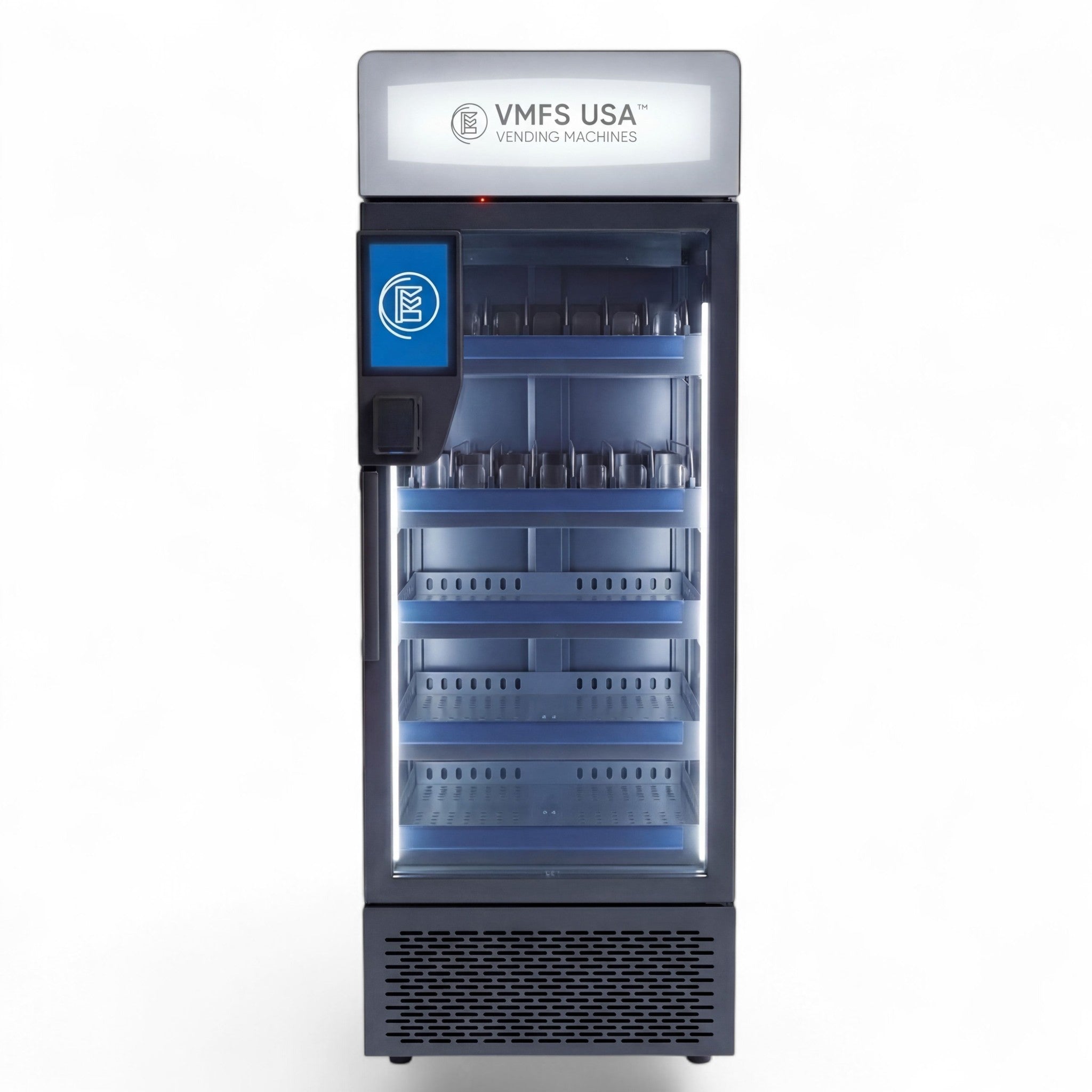
Sound equipment choices help too. Combo machines suit smaller free-placement sites because one cabinet covers snacks and drinks, and the range of combo vending machines includes slim cabinets for tight breakrooms; for very small sites, the Countertop Snack Vending Machine is $1,900. Busier accounts with higher drink volume may justify dedicated drink vending machines, and the full range of vending machines for every venue type is on the VMFS homepage.
Pick a machine that fits the deal
Compare VMFS combo machines with card readers, DEX and VMFS Cloud support for free-placement and commission sites.
Shop combo vending machinesFrequently Asked Questions
Sources
- NerdWallet — How to Start a Vending Machine Business (location commission 5% to 25%)
- United Capital Source — Vending machine business guide (property owners paid 5% to 25% of sales as rent or commission)
- Nav — Vending machine business guide (commission 5% to 20% of gross; product cost about 50%, citing 365 Retail Markets)
- Cantaloupe — 2026 Micropayment Trends Report (78% cashless; $2.01 average ticket; $2.45 cashless vs $1.57 cash)
- Vending Market Watch — Let's talk commissions (Dominic Finelli, 2014)
- Howard County Public School System — Vending sales and commission records
- St. Lucie Public Schools — RFP 26-15 Beverage Vending Services, Addendum 1 (April 2026; current commission 35%)
- Chabot-Las Positas Community College District — RFP 21/22-07 Vending Machine Agreement
- Los Angeles World Airports — Board report on LAX and VNY vending concession (2023)
- eCFR — 16 CFR Part 437, FTC Business Opportunity Rule
- IRS — Instructions for Forms 1099-MISC and 1099-NEC
- U.S. Department of Energy FEMP — Purchasing energy-efficient refrigerated beverage vending machines
- U.S. EIA — Electric Power Monthly, Table 5.6.A average price of electricity by sector
- VMFS USA — Location Matching (commission tiers and placement agreement terms)
- VMFS USA — Payment System (transaction and reader fees)
Share:
Vending Machine Repair Jobs - Salary and Work Explained
Smoothie Vending Machines: How They Work, What They Earn, and Why We Are Piloting Them Across the US