


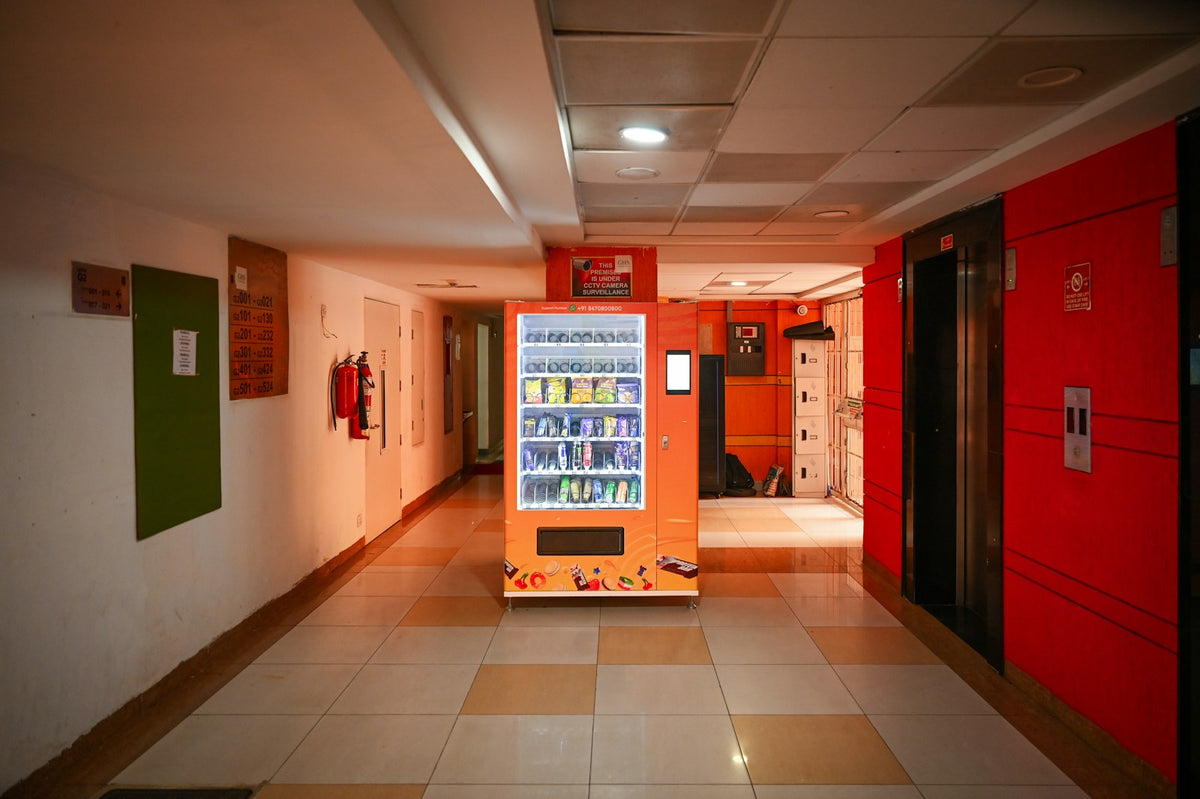


Design the perfect vending solution for your location and customers.

Join the VMFS newsletter and step into a thriving network dedicated to collective success.
One signup. Endless possibilities.
A hospital vending machine is the food, drink and essentials service that keeps selling after the cafeteria closes, and hospitals need one because care never stops: the Bureau of Labor Statistics reports that 59% of registered nurses work in hospitals, where they work in shifts to provide round-the-clock coverage.
This guide shows operators and facility buyers who actually uses hospital vending, the healthy-food standards hospitals write into contracts, what to stock (including the rules on OTC medicine), where machines belong, how GPO and RFP procurement works, CDC-aligned cleaning, and which VMFS machines fit each zone at current prices.
Hospital vending machines serve four groups: clinical and support staff, visitors, patients' families who stay for hours or days, and ambulatory patients who are allowed to buy their own food. Each group shops at different times and wants different things, so a single generic snack machine in the lobby leaves most of the demand unmet.
Staff are the core customer. The BLS describes hospital nurses as working in shifts that provide round-the-clock coverage, including nights, weekends and holidays, and many are on call. A nurse on a night shift has a short break, often no open café, and no time to leave the building. That person buys a real meal, coffee and a cold drink in one stop, which is why staff areas suit meal-style items and premium price points.
Visitors and families behave differently. They arrive in waves around visiting hours and procedures, they wait in emergency department and surgical waiting rooms, and they often do not want to leave a bedside to find food. They buy water, coffee, snacks, phone chargers and small comfort items. Patients themselves are the smallest and most restricted group, because many are on prescribed diets; machines on patient floors should lean toward water, low-sugar drinks and simple items, and the hospital's nutrition team usually has a say.
Night-shift staff
Want fast meals, protein, coffee and energy drinks close to the unit. Highest repeat frequency and the strongest case for fresh food.
Visitors and families
Buy water, coffee, snacks, chargers and small gifts while they wait. Peak around visiting hours and procedure times.
Ambulatory patients
Limited by care plans. Stock water, low-sugar drinks and light snacks, and follow the nutrition team's guidance on patient floors.
Outpatient traffic
Clinic and lab visitors who are in and out within hours. They buy drinks and grab-and-go snacks near entrances and waiting areas.
Hospital vending demand runs around the clock because admissions, emergency care and inpatient units never close, while staffed food service usually does. That gap between a 24-hour building and a daytime cafeteria is the entire business case for vending in healthcare.
Large foodservice contractors are building around that gap. In an April 2026 update, Aramark said that at Madonna Rehabilitation Hospital in Omaha a 24/7 micro market accounts for roughly one-third of total retail sales, that Houston Methodist has at least one micro market in eight of its nine hospitals, and that it refines overnight assortments with a Night Shift Council of staff. Another hospital in the same report runs its micro market around the clock near the lobby and emergency department because the main café closes in the early evening. The lesson for an independent operator is simple: after-hours sales in hospitals are not a side stream, they are a large share of retail revenue.
Round-the-clock demand changes how you equip and service the account. Machines need cashless readers because night-shift staff rarely carry cash, telemetry so you can see a sold-out coffee row before the morning rush, and a restock window that does not collide with shift change. If you are new to card readers, our cashless payment system guide covers readers, fees and setup, and every machine in our card reader vending machine collection ships ready for tap-to-pay.
Operator tip: Ask the hospital for its café and cafeteria hours before you size the menu. Every hour the café is closed is an hour your machines are the only food option on site, and that is where meal-style items earn their premium.
Many hospitals ask the vending menu to meet a written nutrition standard, and three published benchmarks are worth knowing: the Partnership for a Healthier America (PHA) hospital commitments, local healthy-hospital programs such as New York City's, and the federal Food Service Guidelines. Reading them before the pitch lets you show a compliant planogram instead of promising one.
In 2012, Kaiser Permanente and sixteen other hospital systems made PHA commitments to limit unhealthy beverages, including sugar-sweetened drinks, to a maximum of 20 percent of purchases in cafeterias and vending machines, alongside calorie labeling and the removal of fryers, according to VendingMarketWatch. Those commitments were system-wide, so a hospital that signed on expects its vending operator to report against them.
New York City's Healthy Hospital Food Initiative shows how this plays out on the machine itself. A 2016 study in the CDC journal Preventing Chronic Disease found that 40 hospitals joined the program, that its beverage vending standard limited sugary drinks to no more than two slots per machine and promoted water, and that by the end of the study 14 of the participating private hospitals (58%) had implemented the beverage vending standard. The same study noted that nearly all of the machines were run by outside vendors, which means the operator is the one who makes or breaks compliance.
The federal Food Service Guidelines for Federal Facilities (2017) are the most detailed public benchmark, and a hospital without its own written standard can adopt them as a ready-made test. At the standard level, all packaged snacks must have 200 mg of sodium or less and no trans fat, at least 75% must also meet the calorie (200 or fewer), saturated fat and sugar criteria, and at least 50% of beverage choices must contain 40 calories or fewer per 8 fluid ounces, with free chilled drinking water available.
| Federal Food Service Guidelines (2017) item | Standard level | What it means in the machine |
|---|---|---|
| Packaged snacks meeting the standard | At least 75% | Three of every four snack slots should be compliant items |
| Calories per packaged snack | 200 or fewer | Use snack-size bars, nuts and chips rather than share packs |
| Sodium per package | 200 mg or less on all packaged snacks, with 0 g trans fat | Rules out many crackers and jerky; check labels |
| Saturated fat / total sugars | Under 10% of calories / 35% of weight or less | Filters out most candy and many granola bars |
| Beverages at 40 calories or fewer per 8 fl oz | At least 50% (75% at the innovative level) | Water, sparkling water, unsweetened tea, zero-sugar sodas |
| Water | Free access to chilled potable water | Bottled water still sells; fountains are the hospital's job |
Calorie disclosure is a separate, federal requirement. The FDA requires operators who own or operate 20 or more vending machines to disclose calorie information for the food they sell, so a growing hospital route quickly falls under the rule. Touch-screen and AI coolers make this easier because the calories can sit on the product screen or shelf label.
Healthy menus also change the economics, and it pays to plan for that rather than discover it. Our healthy vending snacks guide walks through compliant product lists, the Smart Snacks thresholds and a published hospital study in which an all-healthy machine earned less than a mixed one, so read it before you price a 100% compliant planogram. For hardware built around chilled and fresh items, start with our healthy vending machines.
Stock a hospital vending machine for the zone it serves: meals, protein and coffee for staff areas; water, snacks and comfort items for waiting rooms; and, where the hospital and state law allow it, over-the-counter medicine and personal care items in a dedicated, secure machine. A zone-based planogram outsells one menu copied across the building.
Staff areas justify meal-style items: sandwiches, salads, wraps, yogurt parfaits, fruit cups and hot boxed meals. Aramark's update makes the same point, noting that micro markets carry items that vend poorly in spiral machines, such as fresh fruit cups, yogurt parfaits and salads, which is exactly why AI coolers and refrigerated lockers suit hospitals. Add protein bars, nuts, cheese and crackers, and a strong cold-drink lineup led by water, electrolyte drinks, unsweetened tea and zero-sugar sodas. Coffee belongs near every staff zone that runs nights.
Waiting rooms lean toward familiar packaged snacks, bottled water, juice, coffee and something light enough for a parent to eat at a bedside. Keep a share of indulgent items where the contract allows it, because visitors under stress still reach for familiar brands. For slot-level advice on what moves, see what sells best in vending machines.
Over-the-counter medicine can be vended in many states, but the rules are set state by state and some require a licensed pharmacy to own the machine. The FDA requires a standard Drug Facts label on all OTC drug products, so you should only vend medicine in the manufacturer's original, labeled packaging and never repackage it.
Maine is a useful example of how tight state rules can be. Its pharmacy statute bans selling drugs through vending machines except by a pharmacy licensed as a vending machine outlet, and the Board of Pharmacy rules must require nonprescription drugs only, storage at the manufacturer's recommended conditions, original tamper-proof and expiration-dated packaging, posted owner and Board contact details, and no machines in schools or child care facilities. Check your state pharmacy board before you quote, and expect the hospital's pharmacy department to review the planogram.
For hardware, our Pharmacy Vending Machine is a refrigerated, elevator-based unit designed for OTC medication and wellness essentials, and the full range sits in our medicine vending machines collection. Our medicine vending machine buyer guide covers configuration and compliance in depth, and hospitals that also want harm-reduction access can read about Narcan vending machines.
Non-food items fill real gaps in a hospital. Visitors forget phone chargers, staff need earbuds or a spare charging cable, and families want a small gift for a patient after the gift shop closes. An electronics vending machine near ICU waiting areas handles the tech side, and a flower vending machine near the main entrance gives visitors a gift option at any hour.
Masks, hand sanitizer, tissues and basic hygiene items sell to visitors in public areas. Clinical PPE and scrub dispensing are different: those are normally part of the hospital's own supply chain and linen programs, so confirm who owns the inventory and the dispensing data before you offer a machine for them.
The best hospital vending locations are emergency department waiting rooms, staff lounges and break rooms on inpatient floors, the area around the cafeteria for after-hours coverage, and main-entrance or outpatient corridors. Each zone has a different customer, peak time and best machine, so plan placement zone by zone with the facilities team.
| Zone | Main customers | Peak demand | Machine that fits |
|---|---|---|---|
| Emergency department waiting room | Families, patients' companions | Evenings, nights, weekends | Combo machine or AI cooler with water, snacks and light meals |
| Staff lounge / break room | Nurses, physicians, techs | Shift breaks, overnight | AI smart fridge or meal locker plus a coffee machine |
| Cafeteria area (after hours) | Everyone once the café closes | Evening to early morning | Hot food or lunch box machine, AI cooler, coffee |
| Surgical and ICU waiting areas | Families waiting for hours | Daytime and procedure windows | Combo machine, electronics machine, coffee |
| Main entrance / outpatient corridor | Visitors, clinic patients | Business hours and visiting hours | Drink machine, flower machine, OTC pharmacy unit |
| Nurse stations and small staff rooms | Unit staff | All shifts | Countertop or slim machines where floor space is tight |
Hospitals are strict about corridors, so expect the facilities and life-safety team to approve every footprint and outlet. Keep machines out of egress paths and away from equipment traffic, and prefer alcoves and lounge walls. Quiet units such as maternity and pediatrics favor quieter refrigeration and smaller cabinets, which is one reason a narrow AI cooler or a countertop snack machine gets approved where a full-size merchandiser does not.
Accessibility matters in a building full of wheelchairs and walkers. The U.S. Access Board's ADA guide sets the reach range for operable parts at 15 to 48 inches when unobstructed, so check that keypads, card readers, touch screens and pickup doors fall inside that range. Our best vending locations guide explains how to judge foot traffic before you commit a machine to a spot.
The best hospital setup usually pairs an AI cooler or smart fridge for fresh food, a combo machine for packaged snacks and drinks, and a coffee machine in every staff zone that runs nights, with a pharmacy unit or electronics machine where the hospital wants non-food items. The table below lists current VMFS USA prices for the machines that fit hospital zones.
| Machine | Best hospital use | VMFS price |
|---|---|---|
| AI Grab & Go Cooler Vending Machine | Narrow fresh-food and drink cooler for lounges and lobbies | $2,950 |
| AI Smart Cooler Vending Machine | Higher-capacity staff fresh-food cooler | $4,950 |
| AI Smart Fridge Vending Machine | Meals and drinks for busy staff areas | $9,950 to $12,650 |
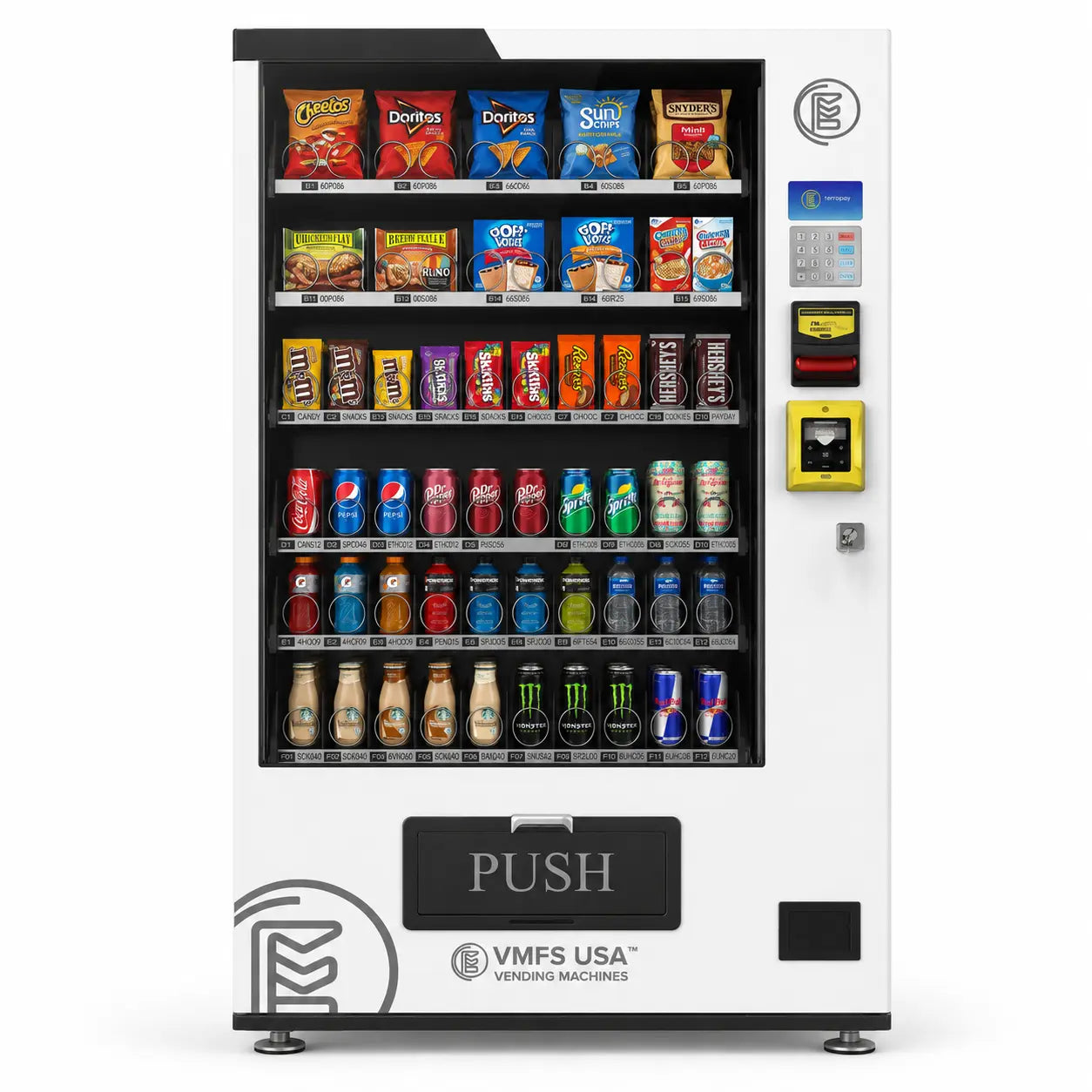
| Smart Combo Vending Machine | Snacks and drinks in waiting rooms | $4,650 to $4,950 |
| Seaga QuickBreak QB4000 Combo | Compact snack and drink combo | $4,450 |
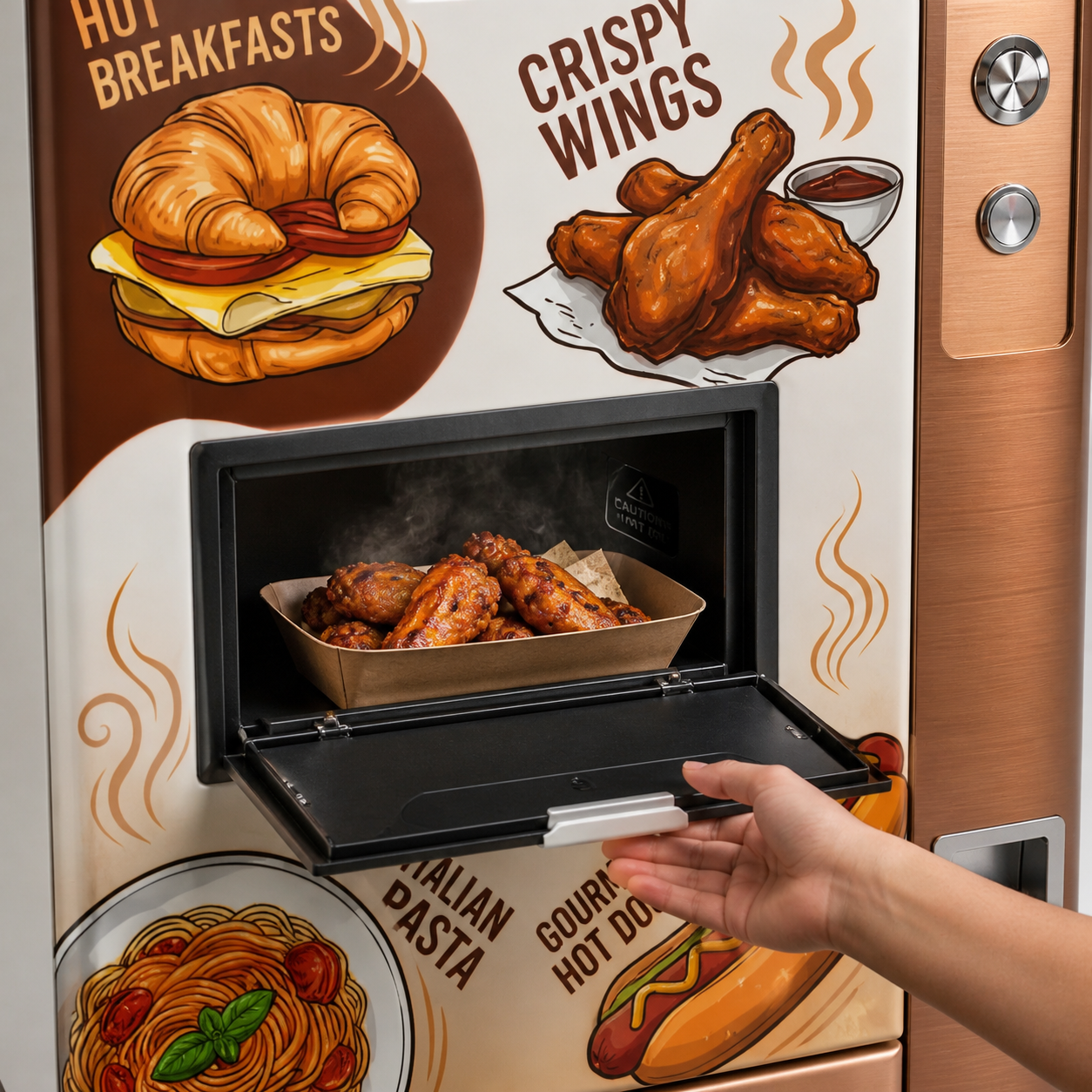
| Lunch Box Vending Machine | Boxed and heated meals near a closed cafeteria | $14,450 |
| Coffee and Hot Beverage Vending Machine | Freestanding coffee for staff and waiting areas | $8,950 |
| Premium Countertop Touch Screen Coffee Machine | Counter coffee for staff lounges | $4,550 to $4,850 |
| Pharmacy Vending Machine | OTC medicine and wellness items | $14,275 |
| Electronics Vending Machine | Chargers and earbuds near waiting areas | $7,950 |
| Countertop Snack Vending Machine | Small staff rooms and nurse stations | $1,900 |
Prices are current VMFS USA list prices as of October 2026 and can change; check each product page before you quote a hospital.
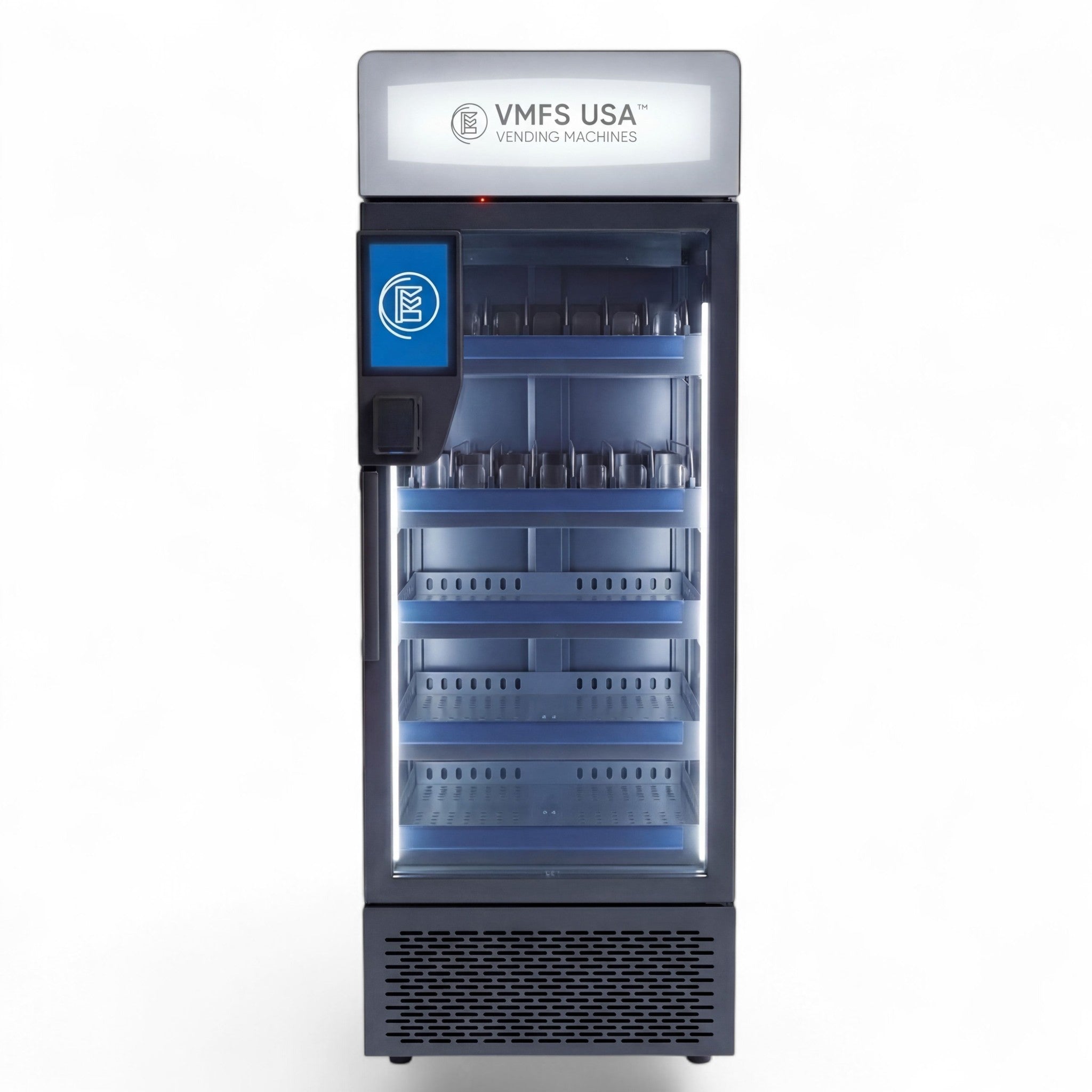
AI coolers solve the hospital fresh-food problem because the customer opens the door, takes items from open shelves and is charged automatically, so a salad or parfait never has to survive a spiral drop. The AI Grab & Go Cooler is 23.6 inches wide with a 32°F to 86°F range and roughly 294 items of capacity, which suits break rooms that will never approve a full-size merchandiser. For bigger staff areas, the AI Smart Fridge carries more meals per visit. Browse the full line in our AI grab-and-go vending machines collection, and compare formats in traditional vs AI vending machines.
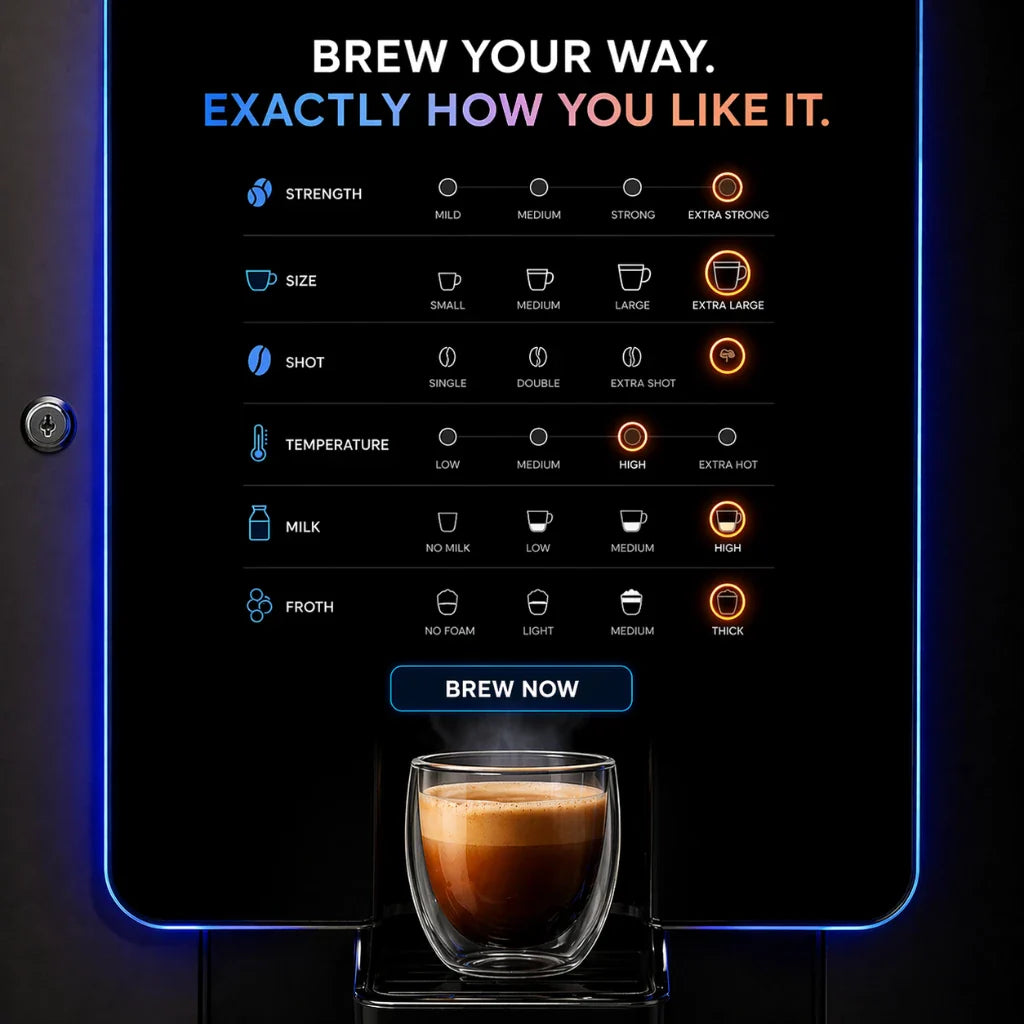
Coffee is a dependable overnight seller in a hospital, so every staff zone that runs nights should have it. Freestanding coffee vending machines work in lounges and waiting areas, while countertop units fit staff rooms. Combo vending machines remain the workhorse for waiting rooms because they hold snacks and drinks in one footprint, and hot-meal units from our food vending machines collection cover the hours when the cafeteria line is shut.
AI coolers in hospitals: advantages
AI coolers in hospitals: limitations
Build a hospital-ready lineup
Compare chilled, fresh-food and better-for-you machines that meet hospital menu standards.
Shop Healthy Vending MachinesHospitals buy vending through one of three routes: their contract foodservice company, a group purchasing organization (GPO) agreement, or a direct request for proposals, and the location is usually paid a commission on sales. Knowing which route a hospital uses tells you whether you can pitch the facility directly or need to subcontract.
GPOs are the default buying channel in US healthcare. The Government Accountability Office reported that about 98 percent of US hospitals use GPOs to purchase products, that hospitals use an average of two to four GPOs each, and that GPO customers can also buy nonmedical services such as housekeeping through GPO-negotiated contracts. The same report put vendors' average contract administrative fees, weighted by purchasing volume, at 1.22% to 2.25% of purchases in 2008. For a vending operator, that means a large health system may already have a national refreshment contract, and the realistic opening is often a subcontract or a niche the national contract does not cover, such as fresh-food coolers or OTC units.
Public hospital districts and university medical centers frequently run formal RFPs instead. Expect requirements for insurance certificates, service response times, healthy-menu compliance, cashless acceptance, monthly sales reporting and a commission schedule, and read whether the award replaces any existing GPO agreement for refreshment services.
Commissions follow the same logic as other locations. Typical vending commissions run about 5% to 25% of sales, according to NerdWallet, and higher-volume accounts sit toward the top of that range. A hospital with heavy overnight traffic can command a strong commission, but healthy-menu rules and fresh-food spoilage reduce your margin, so price the bid on net margin rather than gross. Our breakdown of the vending revenue split between operator, location and supplier shows how to model it.
Clean a hospital vending machine's touch points more often than you would at an office, and follow the hospital's infection-prevention policy for products and frequency. CDC's environmental infection-control guidelines say the methods, thoroughness and frequency of cleaning are set by facility policy, but that high-touch surfaces in patient-care areas should be cleaned and disinfected more often than surfaces with minimal hand contact.
On a vending machine, the high-touch surfaces are the keypad or touch screen, the card reader, the cooler door handle, the delivery bin and pickup door, and any coin or bill bezel. The same guideline recommends an EPA-registered hospital disinfectant/detergent for housekeeping surfaces in patient-care areas when the nature of the soil is uncertain, while detergent and water are adequate in nonpatient-care areas such as offices. A machine in a waiting room or staff lounge is touched by many hands, so build a checklist that cleans these points on every service visit, then disinfects them with the product the hospital's environmental services team approves. Leave it on for the label's contact time, and never spray liquid into payment hardware.
Food safety is the second half of hygiene. Refrigerated and fresh-food machines need reliable temperature control, date-code rotation and logs you can show the hospital's environmental services or food safety team. State and local food-vending permits apply inside hospitals too; our vending machine permits guide lists what to check, and our vending machine maintenance guide covers coil cleaning, gasket checks and service schedules. Cashless-only machines also cut the cash handling that staff and infection-prevention teams prefer to avoid.
Put it in writing: Attach your cleaning checklist, disinfectant product sheet and temperature-log process to the proposal. Infection-prevention staff often sign off on new equipment, and a documented routine answers their questions before they ask.
To get a vending machine into a hospital, find out who controls refreshment services, then bring a zone-by-zone proposal that answers nutrition, infection-control, accessibility and reporting questions up front. Hospital approvals involve more departments than an office placement, and a complete package shortens the review.
Our step-by-step guide on how to scout and pitch a vending machine location includes pitch scripts you can adapt for a hospital. If you would rather have placements sourced for you, VPlaced matches operators with location owners, including healthcare properties.
A hospital account runs on data: telemetry tells you what sold overnight, which rows are empty and whether a cooler drifted out of temperature, so you restock on facts instead of fixed routes. That matters more in hospitals than almost anywhere else because the busiest sales hours happen when nobody is there to report a problem.
Connected machines report sales, stock levels and alerts to a dashboard such as VMFS Cloud, which lets you pre-pick each visit, time restocks away from shift change and prove healthy-item share to the hospital each month. Use the same data to retire slow items, extend the rows that sell out overnight and decide when a zone has outgrown a combo machine and needs a cooler or a small micro market. Our micro markets operator guide explains when that step makes sense.
Service expectations should be written into the contract: response time for out-of-order machines, refund handling for visitors, and who the charge nurse or security desk calls at 2 a.m. A clear refund path through the card reader app or a posted phone number prevents most complaints. For a multi-machine hospital rollout, compare the wider range of vending machines before you commit each zone to a format.
Need a hospital or healthcare placement?
Tell us your machines and target area and our team will help you find and secure high-traffic locations.
Get Location Matching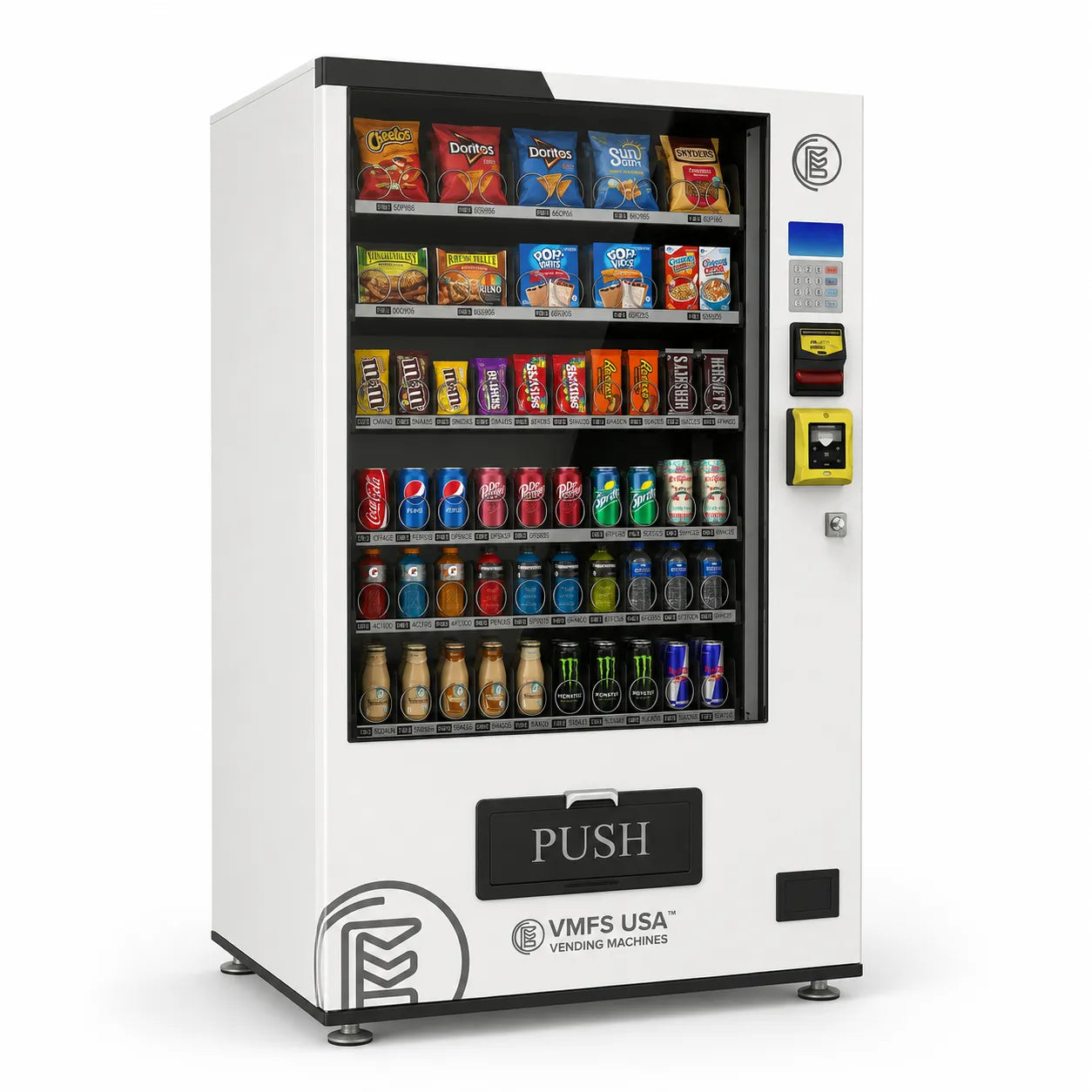
Share:
How to Buy a Vending Machine: Step-by-Step Buyer's Guide for 2026
Dasani Vending Machine: Best Machine Type For Selling Bottled Water