


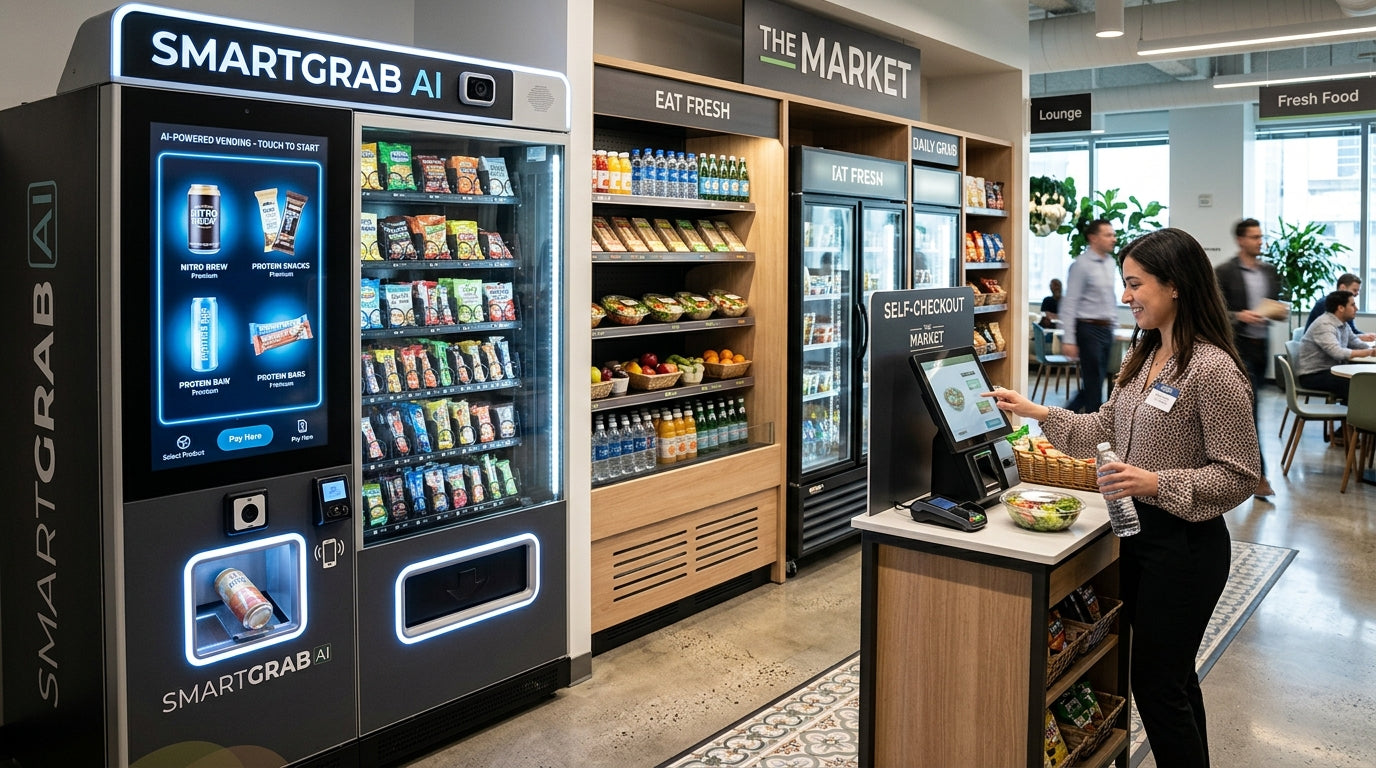


Design the perfect vending solution for your location and customers.

Join the VMFS newsletter and step into a thriving network dedicated to collective success.
One signup. Endless possibilities.
The future of AI vending machines points toward deeper personalization, expansion into higher-value product categories, and tighter integration between recognition hardware and predictive software, building directly on the recognition and inventory technology already standard in today's machines. None of these directions are speculative leaps — they extend trends already visible in current deployments, from computer-vision accuracy improvements to the shift toward dynamic, data-driven product mixes covered in How AI-Powered Vending Machines Optimize Sales. What changes over the next several years is less the underlying concept and more the sophistication of what the software does with the data hardware already collects.
This guide covers the technology and market trends most likely to shape AI vending's next phase, framed as informed projections grounded in current trajectory rather than certainties, along with what today's operators can reasonably prepare for now.
Table of Contents
The intelligent vending machine market's double-digit growth rate, combined with rapid maturation of computer vision and cashless payment infrastructure, sets the baseline trajectory the category's future builds on rather than departs from — data and drivers covered in AI Vending Machine Market Size. Public familiarity with AI-managed retail has also grown quickly following widely covered experiments in autonomous commerce, which lowers adoption friction for new formats and categories that would have seemed unusual just a few years earlier, a shift discussed in The AI Vending Machine Experiment: How Smart Retail Is Changing.
Recognition systems that already identify what a customer removes from a shelf are a natural foundation for recommendation and loyalty features, since the same camera and sensor infrastructure could plausibly extend to recognizing returning customers and surfacing personalized product suggestions on touchscreen vending machines. Dynamic pricing — adjusting price based on time of day, inventory levels, or demand patterns — is technically straightforward given the real-time sales data AI machines already generate, though widespread adoption will likely depend on consumer acceptance and pricing transparency norms as much as the underlying technology itself.
AI vending's core advantage — accurate, item-level loss prevention on an open shelf — is what already makes electronics and other higher-value categories viable in ways a coil-dispensing machine never could, a shift already underway and covered in Electronics Vending Machines Driving AI Smart Cities & Sustainability. As recognition accuracy improves further, categories requiring even tighter identification — cosmetics, specialty pharmaceuticals with appropriate regulatory frameworks, higher-end apparel accessories — become more plausible candidates for unattended retail, extending the category well beyond its snack-and-beverage origins.
Combining computer vision, weight sensing, and RFID within a single machine — rather than relying on one detection method alone — is a clear near-term direction, since each method compensates for the others' weaknesses, and multimodal systems already reduce false reads compared to vision-only setups covered in AI Vending Machine Parts Breakdown. Edge computing improvements will likely continue pushing more recognition processing onto the machine itself rather than the cloud, reducing checkout latency and improving reliability during connectivity outages, a trade-off explained in AI Vending Machine Software.
Predictive restocking alerts already reduce the guesswork in route management, and the logical next step — robotic or semi-automated restocking systems that reduce manual labor per visit — is an area several manufacturers and logistics companies are actively exploring, though widespread commercial deployment likely remains further out than software-side improvements. In the near term, the more immediate shift is route optimization software that sequences restocking visits based on real-time inventory data across an entire fleet, extending the machine-count and route-efficiency math covered in How Many AI Vending Machines You Need to Run a Full-Time Business.
AI vending machines already reduce food waste and energy use relative to legacy equipment through better inventory turnover and smarter refrigeration cycling, and this efficiency angle is likely to become a more explicit selling point as municipalities and large property owners weight sustainability credentials in vendor selection decisions. Integration with broader smart city infrastructure — shared power grids, real-time public transit data informing placement decisions, municipal sustainability reporting — represents a longer-term but directionally clear expansion of the category's role beyond individual retail transactions.
Not every trend covered in this guide moves at the same pace, and separating near-term operational shifts from longer-horizon technology bets helps operators plan realistically rather than chasing speculative capability too early.
| Trend | Expected Timeframe |
|---|---|
| Multimodal recognition (vision + weight + RFID) | Near-term, already emerging |
| Fleet-wide route optimization software | Near-term |
| Dynamic, demand-based pricing | Near to mid-term |
| Expansion into higher-value categories | Mid-term, category-dependent |
| Robotic or automated restocking | Longer-term, early exploration stage |
Early Adoption of New Capability
First-mover positioning in an emerging category or feature set.
Potential differentiation from competitors still running basic setups.
Higher risk of investing in technology that changes before it matures.
Sticking With Proven Technology
Lower risk, since current AI vending hardware already has a proven track record.
Easier to model ROI against established performance benchmarks.
Slower to capture advantages once emerging features become standard.
Selecting a manufacturer whose software platform receives regular updates positions an operator to benefit from personalization and route-optimization improvements as they roll out, without needing to replace hardware — a factor worth weighing directly against manufacturer support quality covered in AI Vending Machine Manufacturers in the USA.
Consistent, well-organized sales and inventory data collected today becomes the training foundation for more sophisticated personalization and pricing features later, so operators treating data hygiene as a priority now are better positioned to adopt these capabilities as they mature.
Expansion into higher-value or novel product categories should follow demonstrated success with proven formats first, rather than skipping ahead based on speculative category growth, a sequencing approach that connects to the location and format fundamentals in the Complete Buyer's Guide 2026 and AI Vending Machine Location Data.
Start With Technology That's Proven Today
Explore AI vending machines built on the recognition and software foundation the category's future is extending.
Explore AI Vending Machines
Share:
How to Buy an AI Vending Machine - Must Follow these Guidelines
AI Vending Machine vs. Micro Market - Which Fits Your Location