


A combo vending machine wins for most operators when a location has limited floor space and moderate traffic, because one cabinet sells snacks and cold drinks for roughly half the cost and half the floor area of a matched pair. Separate snack and drink machines win at busy sites where capacity and selection count matter more than square footage.
Whether you place one vending machine or run a full route, this guide gives you the full comparison with real numbers. You will see floor space math, item capacity and selection counts, refrigeration layouts, product mix limits, live VMFS USA prices, restocking labor and a decision matrix you can use on your next site visit. A worked example at the end puts it all together for one office.
9.3 sq ft
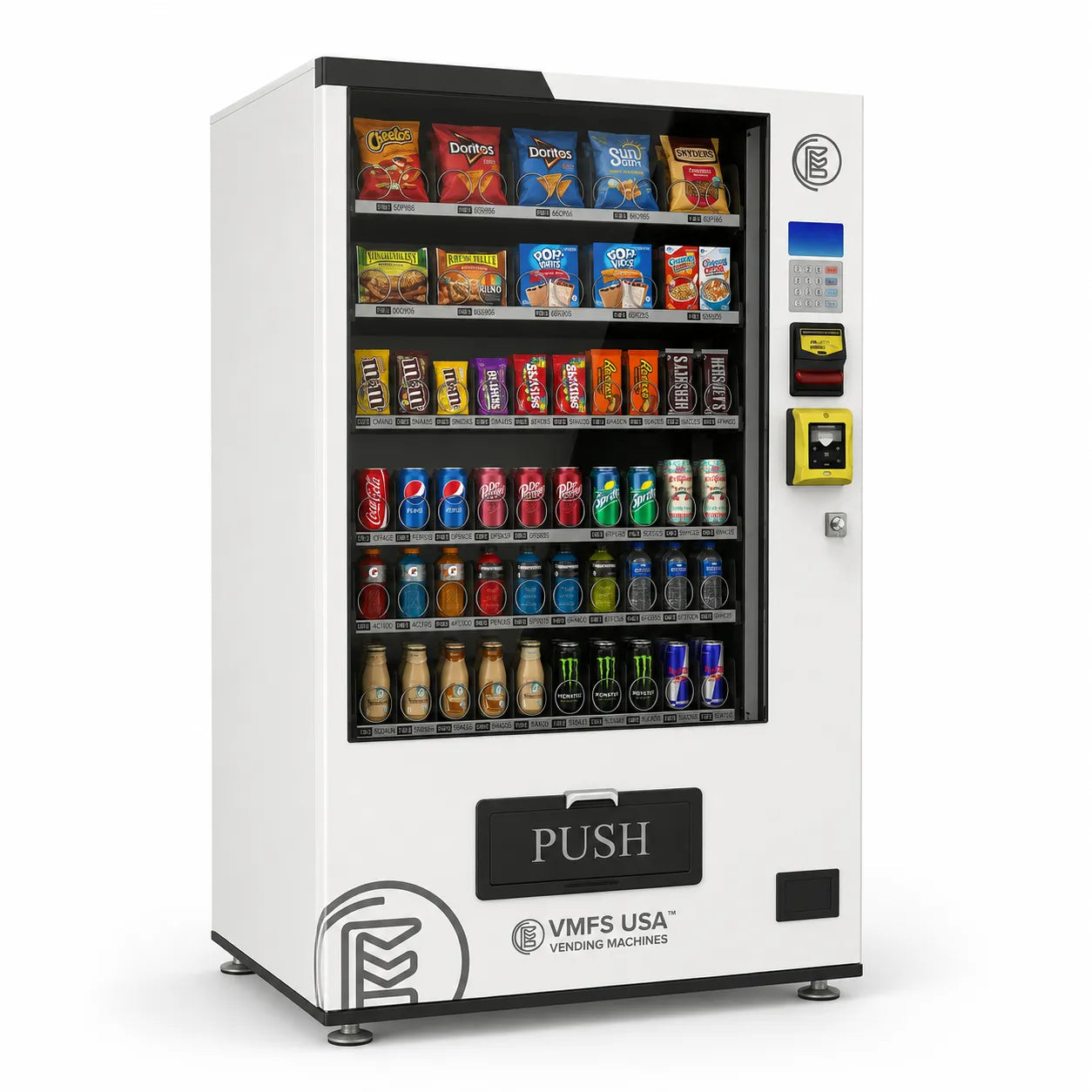
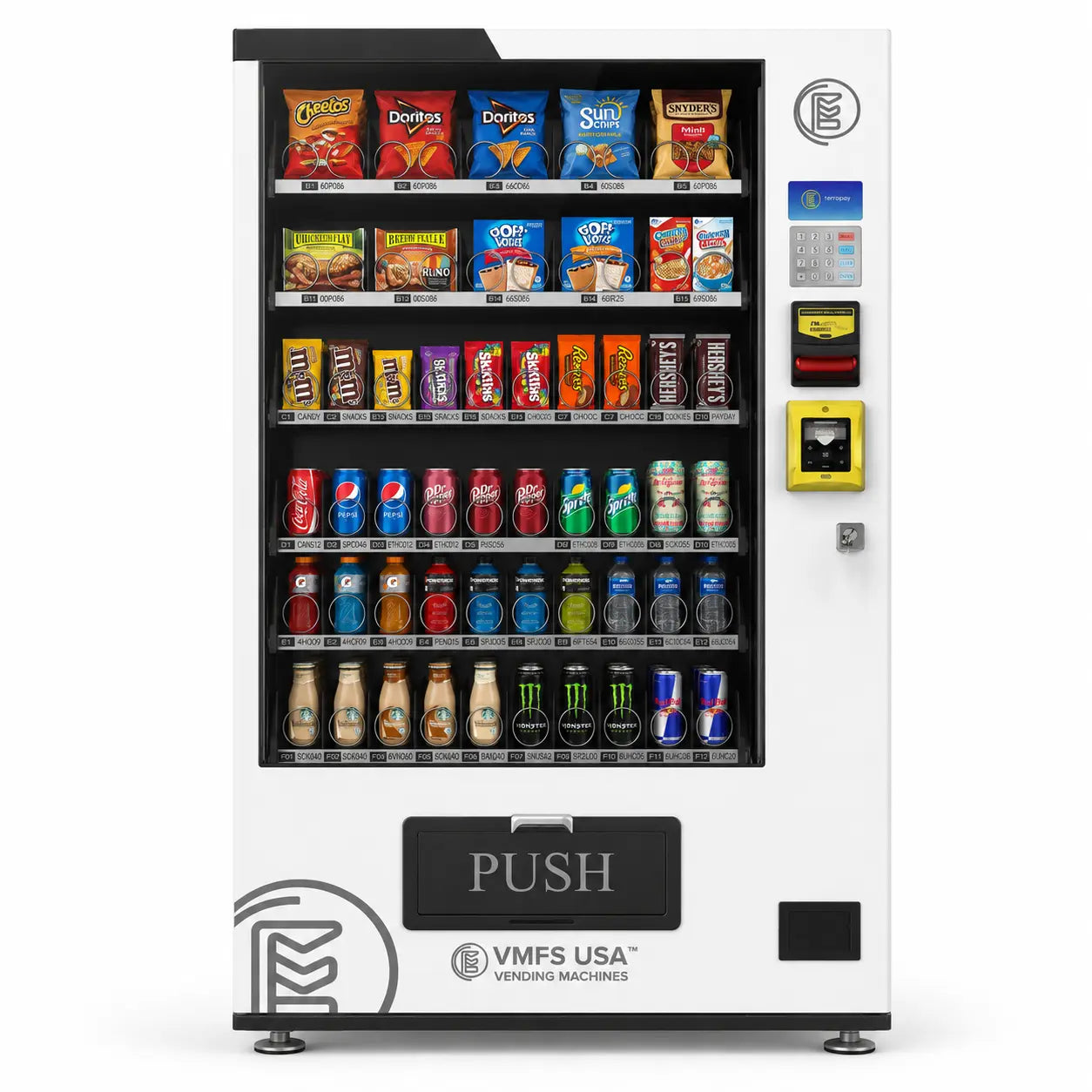
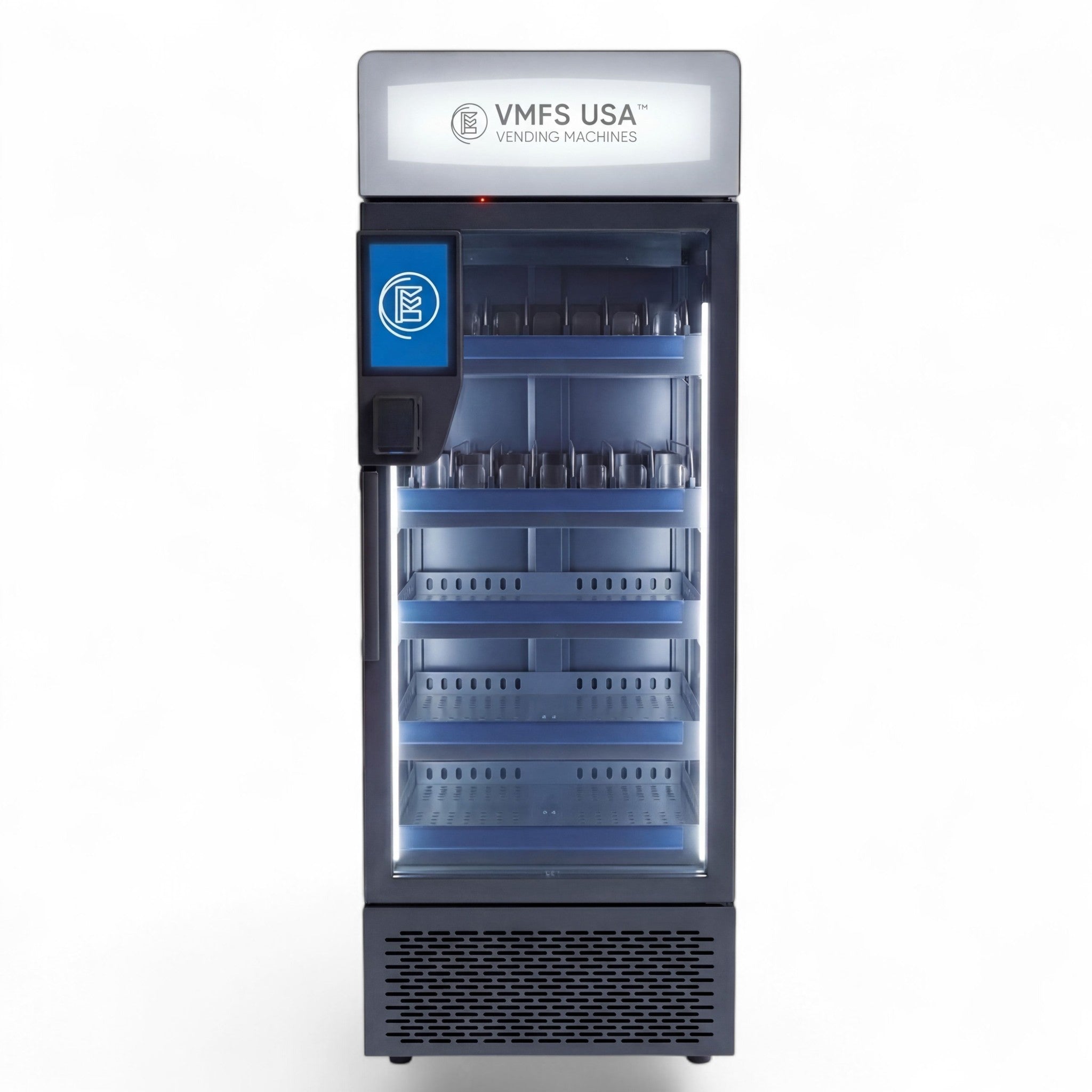
Floor area of one Smart Combo Vending Machine (42 in x 32 in)
$4,950
Smart Combo Vending Machine for snacks and cold drinks, machine only
$12,400
Seaga ENV5S snack machine plus Seaga ENV5B drink machine, machines only
36 vs 80
Selections: Seaga ENV5C combo vs ENV5S and ENV5B pair
Footprint And Floor Space For Each Format
Floor space is the first test in any combo vending machine vs separate snack and drink machines decision, because it is the first thing a location host protects. A break room, a clinic corridor or an apartment lobby has a fixed wall, and every inch you take is an inch the host has to give up. Combo vending machines use that space well, because they put both product categories behind one door and one payment point.
The cleanest way to compare is to use machines from the same family, so build quality and dispensing stay equal. The Seaga Envision line gives you that comparison. The ENV5C combo, the ENV5S snack machine and the ENV5B drink machine all share the same 39 inch cabinet width.
| Setup | Width | Approx. floor area | Total items | Selections |
|---|---|---|---|---|
| Seaga ENV5C combo | 39 in | 9.75 sq ft (39 x 36 in) | 371 | 36 |
| Seaga ENV5S + Seaga ENV5B pair | 78 in | About 20 sq ft | About 790 (550 snacks + 240 drinks) | 80 |
| Smart Combo Vending Machine | 42 in | 9.3 sq ft (42 x 32 in) | 300 to 400 | 60 |
| Seaga ENV4S + Seaga ENV5B pair | 74 in | About 19 sq ft | About 708 (468 snacks + 240 drinks) | 72 |
| Slim Combo Vending Machine | 28.7 in | 6.2 sq ft (28.7 x 31.2 in) | 180 to 300 | 36 |
| Seaga SM2300 | 30 in | 6.0 sq ft (30 x 29 in) | 253 | 23 |
The pattern is simple. A separate pair doubles the wall width and roughly doubles the floor area. In return, it roughly doubles the item count and more than doubles the selection count. A combo keeps the footprint small and asks the products to share the space.
Clearance matters too. VMFS product pages ask for about 40 inches in front of each machine for the door swing, plus a few inches behind for airflow. Two machines need that front clearance along a wider stretch of wall. In a narrow corridor, that alone can decide the format. Before the site walk, you can share the VPlaced guide to combo vending machine dimensions with the host, so they know how much wall and clearance to plan for.
Item Capacity And Selection Count Compared
Capacity is where separate machines earn their place. A dedicated snack machine fills every tray with coils for chips, candy and bars. A dedicated drink machine fills every column with cans and bottles. Each category gets the full cabinet to itself.
Look at how the Seaga ENV5C splits its 371 items. It holds 96 refrigerated drinks across 16 selections, 110 snacks across 20 selections and 165 candy units. Compare that with the Seaga ENV5B on its own, which holds 240 bottles and cans across 40 selections. The ENV5B alone gives you 2.5 times the cold drink capacity of the combo.
- Drink capacity: 96 drinks in the ENV5C combo vs 240 drinks in the ENV5B. Drinks are often the first category to sell out, so this gap matters at busy sites.
- Snack capacity: 110 snacks plus 165 candy in the ENV5C vs about 550 snacks and candy in the ENV5S.
- Selection count: 36 in the combo vs 80 across the pair. More selections let you carry more brands, more healthy options and more price points.
- Flexible combos: the Smart Combo Vending Machine and the Seaga QuickBreak QB4000 let you set the snack to drink ratio yourself, so the split can follow your sales data instead of a fixed tray plan.
The same logic answers the common question of a combo vending machine vs a snack machine. A dedicated snack machine always holds more snacks. A combo trades some of that snack space for cold drinks, so the site gets both categories from one cabinet.
Practical tip: Count capacity in days of supply, not in items. Divide the capacity of your fastest category by its expected daily sales. If drinks would run out in three days but snacks last ten, a combo will force extra visits for drinks. That is a signal to add a separate drink machine or to move up to a larger combo.
Refrigeration Zones Work Differently In Each Format
Refrigeration is the biggest engineering difference between the two formats, and it shapes what you can sell. Federal energy rules even treat them as different equipment. Under 10 CFR 431.292, a combination vending machine is a beverage machine with two or more compartments separated by a solid partition, where at least one compartment is refrigerated and at least one is not.
The combos in the VMFS USA catalog use one of three cooling layouts:
Split cabinet
The Seaga ENV5C, QB4000 and SM2300 chill a dedicated drink section and keep snacks and candy at room temperature. Chocolate and chips stay out of the cold, and drinks stay cold.
Whole cabinet cooling
The Slim Combo cools all 36 slots at once, adjustable from 39°F to 77°F. Every product sits at one temperature, which suits chilled snacks, protein bars and drinks together.
Two separated zones
The Dual Combo Vending Machine uses two doors and two thermally separated sections. Opening the snack door never warms the drink side.
A separate pair is simpler. Snack machines such as the Seaga ENV4S run ambient with no compressor at all. The drink machine carries the only refrigeration system. So a pair does not double your refrigeration load. It does add a second cabinet to power, light and maintain, and each machine needs its own outlet.
Energy is worth a quick check either way. ENERGY STAR reports that certified refrigerated beverage vending machines are about 9% more efficient than standard models and save about 1,000 kWh per year. Ask about refrigerant type too. The Seaga ENV5C, ENV5B and SM2300 product pages all list R-290 refrigerant.
Product Mix Limits In One Cabinet
A combo asks every product to fit one cabinet design. That works well for the core vending mix of chips, candy, bars, cans and 20 oz bottles. It gets harder as the menu grows.
Where A Combo Handles The Mix Well
- Standard chips, candy bars and protein bars on coils
- 12 oz cans and 20 oz bottles in the cold section
- A balanced office mix of 30 to 40 core items
- Adjustable shelf heights and slot widths on the Smart Combo and Slim Combo
Where Separate Machines Handle It Better
- Large drink menus with water, energy drinks, juices and sports drinks all at once
- Many bottle sizes, since the ENV5B takes 8.3 oz through 20 oz on the same trays
- Deep snack variety with healthy, regional and premium lines
- Sites that need multiple facings of best sellers so they never sell out
There is one more limit to plan for. Combos with a dedicated drink section cap the drink menu. The ENV5C, for example, has 16 drink selections. If the site wants 25 different drinks, that section cannot carry them all. Operators solve this in two ways. They pick a combo with an operator set ratio, or they move the drink menu to its own machine.
Labeling rules apply to both formats in the same way. Under FDA rule 21 CFR 101.8, an operator with 20 or more machines must post calories for covered food when the buyer cannot see the Nutrition Facts label before buying. A pair gives you two machine fronts to label, and a combo gives you one. Calorie labels are only one part of compliance. VAdviced explains when you need a license to operate a combo vending machine, so you can check the rules before you place it.
Upfront Cost With Real VMFS USA Prices
The table below compares live VMFS USA catalog prices. All prices are for the machine only, before payment hardware and shipping. Payment hardware is an add-on on every machine. Card readers run $450 to $550 per machine, and bill and coin acceptors run $450 to $550 per machine, depending on the model. Every machine also supports QR code payments.
| Option | Format | Machine price | Payment add-ons per machine |
|---|---|---|---|
| Seaga SM2300 | Combo | $3,450 | Card reader $550, bill/coin $550 |
| Slim Combo Vending Machine | Combo | $3,950 | Card reader $450, bill/coin $450 |
| Seaga QuickBreak QB4000 | Combo | $4,450 | Card reader $550, bill/coin $550 |
| Smart Combo Vending Machine | Combo | $4,950 | Card reader $450, bill/coin $450 |
| Seaga ENV5C | Combo | $6,495 | Card reader $550, bill/coin $550 |
| Snack vending machine builder + drink vending machine builder | Separate pair | From $3,595 + from $4,200 = from $7,795 | Two of each |
| Seaga ENV4S + Seaga Prosper | Separate pair | $3,950 + $5,450 = $9,400 | Two of each |
| Seaga ENV5S + Seaga ENV5B | Separate pair | $5,950 + $6,450 = $12,400 | Two of each |
The payment hardware doubles with a pair, and so do the monthly reader fees. Card reader plans from Nayax or Cantaloupe run roughly $7.95 to $9.99 per month per reader. Two machines mean two plans. VMFS Cloud remote monitoring is an optional paid add-on, and the Basic plan is $7.99 per month.
About 2x
Machine cost of a matched pair vs one combo in the same family
$900 to $1,100
Card reader hardware for a pair vs $450 to $550 for one combo
$7.95 to $9.99
Monthly card reader plan, per reader
To budget each side of a pair in more detail, see how much a snack machine costs and our drink machine pricing guide.
Compare Every Combo In One Place
See live prices, capacities and configurations across the full VMFS USA combo lineup.
Shop Combo Vending Machines →Revenue Per Square Foot For Each Format
Operators usually measure revenue per machine. Location hosts, especially retailers and property managers, often measure the value of their space in revenue per square foot. If you can show strong sales per square foot, the host has a clear reason to approve the placement.
The logic works like this. Sales at a site depend mostly on foot traffic, the share of people who buy, and the average ticket. A second machine does not create new people. It adds selection and capacity, which can lift the share who buy and prevent lost sales from sold out slots. That lift is real, but it is usually smaller than the doubling in floor area.
Good signage, clear pricing and the right product mix also raise the share of people who buy. The VMarketed guide on how to market a snack vending machine covers each of these steps, and they apply to a combo in the same way.
- Low to moderate traffic: a combo usually wins on revenue per square foot because it captures most of the demand in half the space.
- High traffic: separate machines can win because a combo sells out between visits, and every empty slot is lost revenue.
- Captive sites such as clinics and hotel floors often support higher prices, which raises revenue per square foot for compact combos even more.
The VMFS Smart Combo product page models a typical office this way: about 210 people pass each day, 6 in 100 buy, and the average item is $3. That comes to about $2,268 in monthly sales. Spread across the Smart Combo footprint of 9.3 square feet, that is about $243 per square foot per month. Use it as a planning illustration, then replace it with your own site numbers.
Restocking Labor And Route Time
Labor is the cost most new operators underestimate. Every visit has fixed steps and variable steps. The fixed steps are parking, walking in, opening the door, reading the audit, cleaning the glass, checking the payment hardware and closing up. The variable steps are loading product, and those scale with how much sold.
A combo gives you one set of fixed steps per stop. A pair gives you two. The product you load is about the same either way, because demand is the same. So on a per visit basis, a combo saves the second round of fixed work. The ENV5C product page puts a full load of 371 items at about 15 to 20 minutes with its tool free trays, which gives you a useful benchmark for one cabinet.
The picture flips when one category sells much faster than the other. With a combo, a fast drink section forces a visit even when the snack side is half full. With a pair, or with the two door Dual Combo Vending Machine, you can restock the fast side on its own schedule. Remote stock data from VMFS Cloud or your card reader plan helps here, because you only drive out when a machine actually needs product.
More buyers at each machine also make every restocking stop more productive. Once a machine is live, you can list your machines on VendingFinder for free, so people nearby can find it on the map.
Restocking Questions To Answer Before You Choose
- ✓How many days until the fastest category sells out?
- ✓Will that force more visits than the slower category needs?
- ✓How far is the site from your storage or your other stops?
- ✓Can you see stock levels remotely before you drive?
- ✓Does the host allow visits at the times your route needs?
Location Sizes Where Each Format Wins
Placement is where this decision becomes practical. When a site has no room for two cabinets, a combo is the default. When a site has the traffic and the wall space, separate machines add selection and capacity. The table below shows where each format usually fits.
| Site profile | Best fit | Why |
|---|---|---|
| Small office, 10 to 25 people | Seaga SM2300 or Slim Combo | Compact cabinet, enough capacity for one weekly visit |
| Office of 15 to 50 people, clinic, studio | Seaga QB4000 or Slim Combo | Balanced snacks and drinks without a full size cabinet |
| Office of 30 to 100 people, school staff room | Smart Combo or Seaga ENV5C | Full size combo capacity in one footprint |
| Apartment lobby or hotel floor | Combo | Hosts value small footprints and steady amenity demand |
| Warehouse or plant with shift changes | Separate pair or Dual Combo | Shift breaks drain drinks fast and need deep capacity |
| Hospital, campus union, transit hub | Separate machines or a bank of machines | High daily volume and wide menus need more selections |
Warehouses deserve a special note. Shift change creates short, intense rushes. A combo can empty its drink section in one break. If you are pitching an industrial site, VPlaced explains how to get vending machines into warehouses and what those hosts expect.
Decision Matrix For Combo Or Separate
Use this matrix during your site walk. Score each row for the site in front of you. If most of your answers land in the combo column, start with a combo. If most land in the separate column, plan for two machines or a two door combo.
| Factor | Choose a combo when | Choose separate machines when |
|---|---|---|
| Floor space | The host offers one spot, or the wall is under about 6 feet | The host offers 7 feet or more of wall and clearance |
| Daily traffic | Moderate, with steady demand through the day | High, or with sharp rushes at breaks and shift changes |
| Drink menu | Up to about 16 drinks, mostly cans and 20 oz bottles | 25 or more drinks, or many bottle sizes |
| Snack menu | A core mix of 20 to 40 snacks | Deep variety, healthy lines and premium items |
| Budget | You want one machine, one reader and one fee | You can fund two machines and two readers |
| Restocking | Both categories sell at a similar pace | One category sells much faster than the other |
| Host priorities | Clean look, small footprint, one point of contact | Maximum choice for a large population |
Contract tip: Whichever format you choose, write the footprint, the outlet location and the commission terms into the placement agreement. VAdviced covers what belongs in a combo machine placement agreement and the clauses to watch for.
Worked Example For A 120 Person Office
This is an example with stated assumptions, not a forecast. Swap in your own numbers before you decide.
Assume a 120 person office with one break room. The host can offer one spot or two side by side spots. The office runs 22 workdays per month. Assume the site sells 40 items per day at an average price of $2.75, with a 55% gross margin on product.
To keep the comparison fair, both options come from the Seaga Envision line, so build quality and dispensing are the same. Option A is one Seaga ENV5C combo. Option B is a dedicated Seaga ENV5S snack machine next to a dedicated Seaga ENV5B drink machine. Each machine gets one Seaga card reader at $550.
| Line item | Option A: one Seaga ENV5C combo | Option B: Seaga ENV5S snack machine + Seaga ENV5B drink machine |
|---|---|---|
| Machine price | $6,495 | $5,950 + $6,450 = $12,400 |
| Card readers | $550 | $1,100 (two at $550) |
| Upfront total before shipping | $7,045 | $13,500 |
| Floor area | 9.75 sq ft | About 20 sq ft |
| Item capacity | 371 items, 36 selections | About 790 items, 80 selections |
| Assumed monthly sales | 40 x 22 x $2.75 = $2,420 | Assume a 10% lift from more selection: $2,662 |
| Gross margin at 55% | $1,331 | $1,464 |
| Card reader plans (about $10 each) | About $10 per month | About $20 per month |
| Sales per square foot per month | About $248 | About $133 |
| Months to recover upfront cost from gross margin | About 5.3 | About 9.2 |
In this example the combo pays back about four months sooner and earns nearly twice the sales per square foot. The pair earns a little more in total dollars, but it needs almost twice the capital and twice the floor space to do it. Commission to the host, card processing fees, taxes and your labor come out of both options, so the gap stays similar after those costs.
A lower cost pair narrows the capital gap, but it does not close it. A custom snack machine from $3,595 plus a custom drink machine from $4,200 starts at $7,795 before payment hardware. That is still more than the single combo in this example, and it still takes two cabinets of wall space.
Now change one assumption. Suppose the same office runs two shifts and sells 90 items per day, and about 60 of those are drinks. The ENV5C holds 96 drinks, so its drink section would run empty in under two days, and you would have to visit far more often or lose sales. The ENV5B holds 240 drinks, which lasts about four days at the same pace. At that volume the separate pair, or the two door Dual Combo Vending Machine, is the better fit. Let the sales pattern at the site decide the format.
Design The Combo That Fits Your Site
Pick the snack and drink split, payment hardware and branding in the builder.
Build Your Combo Vending Machine →If you choose a combo, the builder lets you set the snack and drink layout, payment hardware and branding before the machine ships. Vending machine financing is available through outside partners PayPal, Klarna and ClickLease. If the site needs something beyond snacks and drinks, such as coffee or fresh food, you can compare every category of vending machines for sale in one catalog.
Related Reading
Share:
Food Vending Machine Market Statistics for 2026: Size, Segments and Growth
ZYN Vending Machine Cost: Price, Add-Ons, Stocking and Payback