




Design the perfect vending solution for your location and customers.

Join the VMFS newsletter and step into a thriving network dedicated to collective success.
One signup. Endless possibilities.
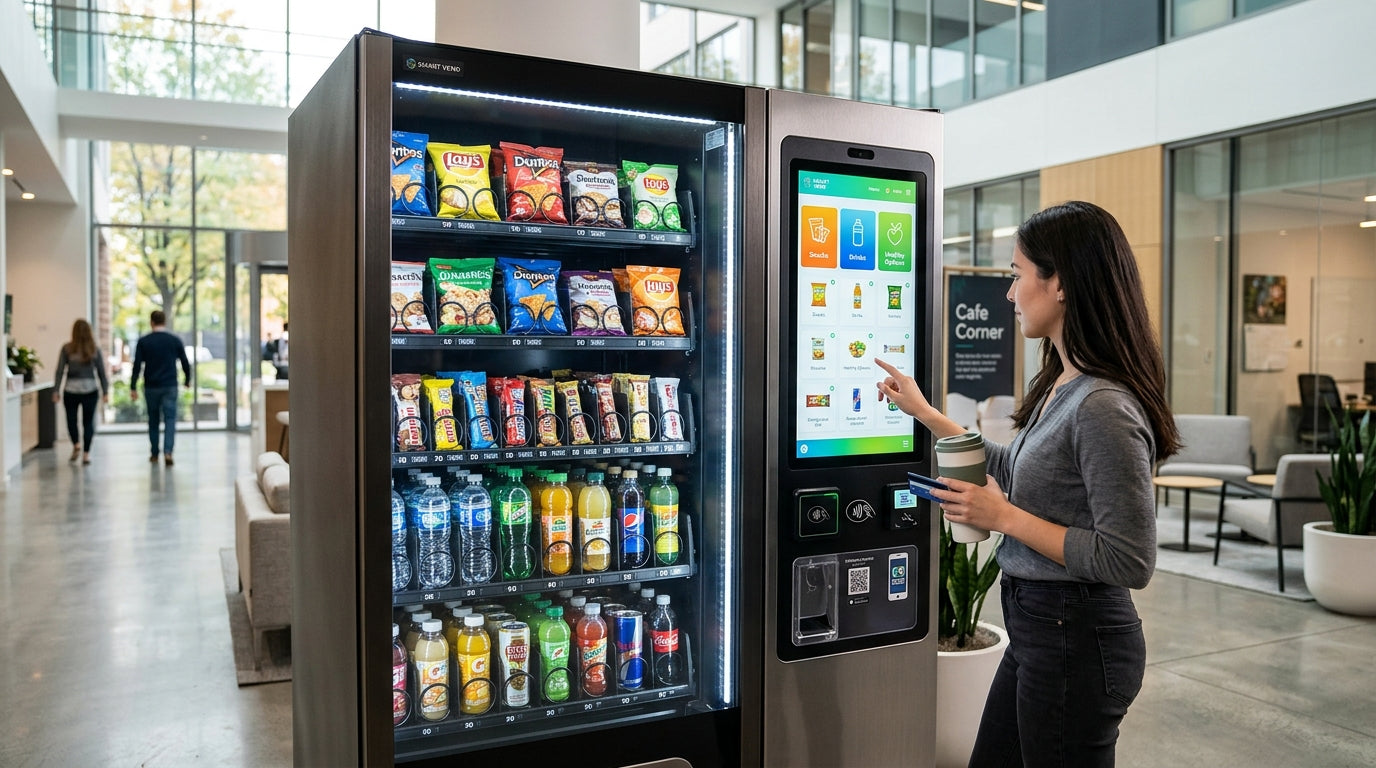
A smart combo vending machine is one cabinet that sells both snacks and cold drinks, takes card and mobile payments through a connected reader, and reports every sale, stock level and fault to the operator's phone. It replaces a separate snack machine and drink machine with a single footprint and adds the data layer that lets an operator restock from numbers instead of guesses.
This guide explains how the machine works step by step, from the coil that turns to the infrared sensor that confirms the drop, how payments travel over MDB, what telemetry and VMFS Cloud add, the real specs of the VMFS combo lineup, when a combo beats two machines, and where it earns best.
A smart combo vending machine is a single vending unit that holds both packaged snacks and bottled or canned drinks, keeps the drinks cold, and connects to cashless payments and remote telemetry. "Combo" describes the product mix; "smart" describes the connected layer of card readers, sensors and software that sits on top of the mechanics.
The idea is older than the technology. Operators have long run a snack vending machine beside a soda machine, and the combo format simply folds both into one cabinet so a location with moderate traffic can offer full variety without giving up the floor space, power outlets and service time of two units. What changed is the smart layer: MDB card readers that bring their own cellular connection, infrared vend sensors, and cloud dashboards that show each slot's stock in real time.
The word "combo" is used loosely in the industry, so it helps to know the regulatory meaning. The U.S. Department of Energy defines a combination vending machine as a beverage vending machine with two or more compartments separated by a solid partition, where at least one compartment is refrigerated and at least one is not. Many glass-front snack-and-drink machines sold as combos, including the VMFS coil combos described below, work differently: refrigeration covers the whole cabinet, and snacks simply ride in the cooled space alongside the drinks. Both designs are called combo vending machines in the market; the difference matters when you compare energy ratings or decide what you can stock.

A smart combo vending machine works by pairing a refrigerated cabinet and motor-driven product trays with a vending machine controller that talks to the payment devices over MDB and reports every event to a cloud dashboard. The customer sees a keypad, a glass front and a delivery bin; behind the panel, five subsystems hand off to each other in a few seconds.
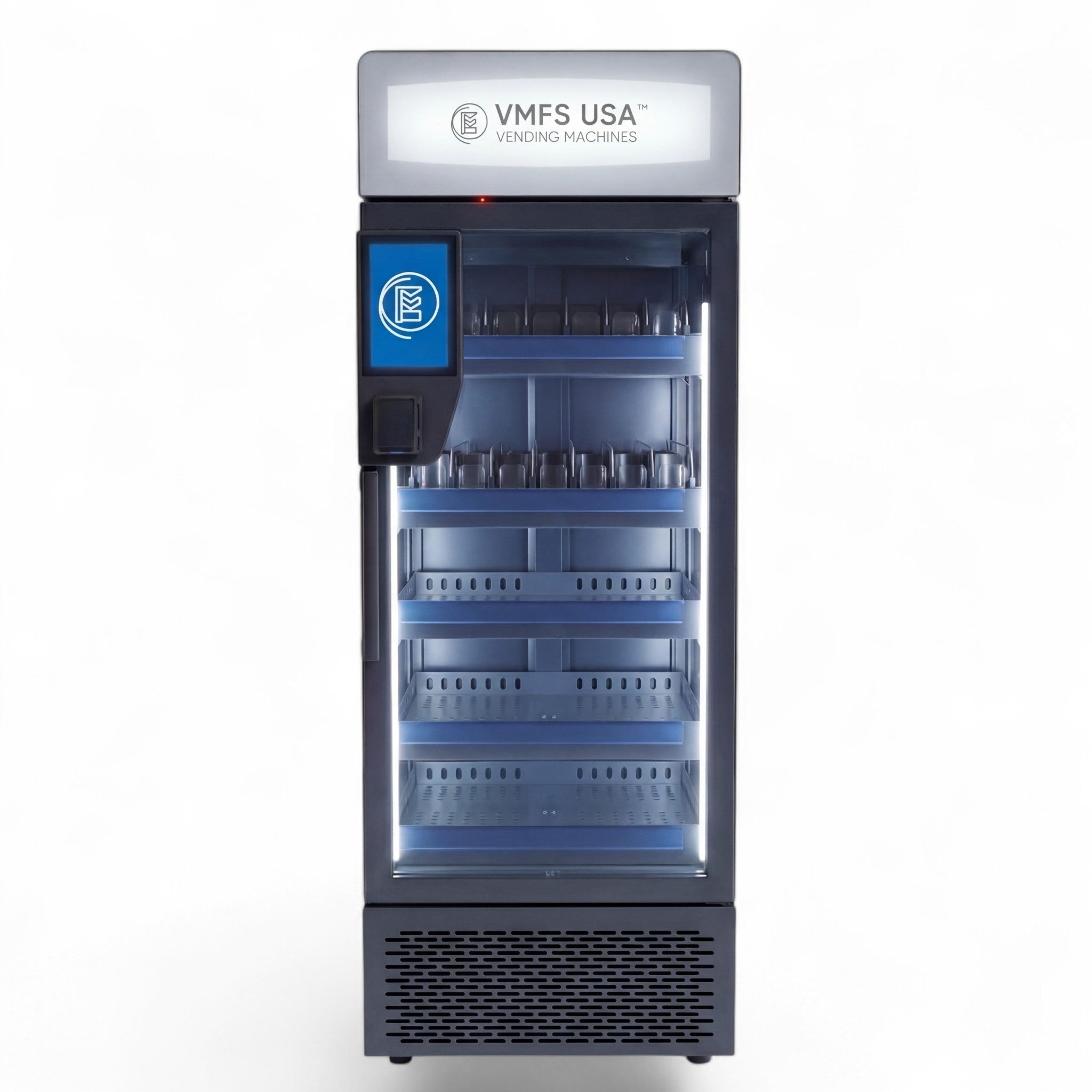
The cabinet is an insulated steel box with a glass door, a refrigeration deck and adjustable trays. On the VMFS smart combo vending machine, refrigeration is adjustable from 39°F to 77°F across the cabinet, which is cold enough for sodas, water and energy drinks while chips, bars and candy tolerate the same air. Operators who sell only shelf-stable snacks can order the non-refrigerated snacks-only variant. Because the whole cabinet is cooled, the snack-to-drink split is not fixed: you move tray heights and decide which rows hold drinks.
Products sit in spring coils, one coil per slot. When a slot is selected, a small motor turns that coil one full rotation, which pushes the front item off the end of the tray. The Smart Combo carries 60 adjustable coil slots on six shelves, with reinforced trays for heavy bottles and adjustable tray heights so tall bottles, short cans and chip bags can share the cabinet. Coil pitch matters: a product that is too loose in its spiral can twist and hang, which is the root of most jams.
Most coil combos use drop-down delivery: the item falls from its tray into a delivery bin at the bottom of the cabinet. That is simple and reliable for cans, bars and bags, but it is hard on glass bottles and fragile packaging. An elevator machine replaces the drop with a platform that rises to the selected tray, receives the product and lowers it to the pickup door. The Pro Combo Elevator Vending Machine uses a spiral-free channel system with this soft-drop elevator, which is why operators pick it for premium or breakable items. For more on the mechanism, see how elevator vending machines work.
Payments run over MDB (Multi-Drop Bus), the vending industry's standard protocol for connecting card readers, bill validators and coin mechanisms to the machine controller. NAMA maintains the standard and released version 4.3 in 2019, a revision that updated the section on cashless devices. Because every VMFS machine ships MDB-ready, a Nayax or Cantaloupe reader plugs into the existing harness instead of needing custom wiring, and the machine also supports DEX, the companion standard for sales and audit data. Our explainer on MDB and DEX covers the wiring and data side in detail.
An infrared beam runs across the drop zone. When a product falls through it, the controller knows the vend succeeded and lets the payment complete. If the beam is not broken, the machine treats the vend as failed, so the customer can try another selection instead of paying for nothing. This "guaranteed vend" sensor is what keeps customers from paying for a product that never dropped, and it removes most refund arguments at the location.
Telemetry is the wireless transfer of machine data, such as sales, slot counts, temperature and faults, to a database the operator can read from anywhere. Card readers from Nayax and Cantaloupe include their own dashboards with sales and reader status, and many operators start there. VMFS Cloud goes further: VMFS Cloud works with every VMFS machine; plans start at $7.99 per machine per month. The Basic plan covers live slot stock, real-time sales with margin, low-stock and fault alerts and a visual planogram; the $16 Advertising Cloud adds remote pricing and screen ads; the $39.99 AI Cloud is built for AI grab-and-go machines. New Smart Combo orders include a 90-day VMFS Cloud trial, per the product page.
Cabinet
Insulated steel cabinet, glass front, refrigeration adjustable 39°F to 77°F on VMFS coil combos.
Dispensing
Spring coils push items off adjustable trays; elevator models lower them to the pickup door instead.
Payments
MDB connects the card reader, bill validator and coin mech to the controller with plug-in harnesses.
Data
Vend sensor, DEX and telemetry feed sales, stock and alerts to the reader portal or VMFS Cloud.
A purchase on a smart combo takes a few seconds and follows the same sequence every time: select, authorize, dispense, confirm, settle and report. Knowing the order helps you diagnose problems, because each step has its own failure mode.
The same flow looks very different from each side of the glass. The customer sees a quick tap and a falling can; the operator sees a stream of data that decides when the next service trip happens.
| Stage | What the customer sees | What the operator sees |
|---|---|---|
| Selection | Slot number on keypad or product on screen | Nothing yet |
| Payment | Tap, chip, mobile wallet or cash prompt | Transaction logged with payment type |
| Dispense | Item drops or is lowered to the pickup door | Slot count decremented |
| Sold-out slot | Selection unavailable | Low-stock alert and pick-list line |
| Fault | Retry prompt or machine out of service | Jam, door, temperature or reader-offline alert by SMS or email |
A combo machine becomes smart when it can take cashless payments, confirm each vend with a sensor, and report sales and faults remotely. A standard combo with only a coin mech and bill validator still vends snacks and drinks, but the operator learns what sold only by opening the door, and every customer without cash walks away.
The payment side alone justifies the upgrade for most locations. According to Cantaloupe's 2026 Micropayment Trends Report, 78% of vending sales were cashless in 2025, up from 73% the year before, and the average cashless ticket was $2.45 against $1.57 for cash. Contactless taps made up 85% of cashless vending sales. A machine without a reader is cut off from most of that demand, and our guide to cashless payment systems compares the reader options.
The data side changes how a route runs. With remote monitoring, an operator restocks machines that actually need product, carries a pick list built from live slot counts, and hears about a jam or a warm cabinet before the location manager calls.
| Component | What it does | Standard combo | Smart combo |
|---|---|---|---|
| Card reader (MDB) | Tap, chip, Apple Pay, Google Pay | Often none | Yes |
| Infrared vend sensor | Confirms the item dropped before charging | Sometimes | Yes |
| Telemetry | Sends sales, stock and faults over cellular or Wi-Fi | No | Yes |
| DEX reporting | Standard sales and audit data | Usually, read on site | Read remotely |
| Dashboard | Pick lists, alerts, planogram, margin by slot | No | Reader portal or VMFS Cloud |
Advantages of the smart layer
Trade-offs
See the Smart Combo up close
Specs, payment add-ons, starter planograms and the operator manual for VMFS's best-selling combo.
View the Smart ComboVMFS sells three connected combos for indoor sites, plus an elevator model for premium products, and the right one depends on floor space, traffic and how you want customers to shop. The table below uses the specifications listed on each active product page.
| Spec | Smart Combo | Slim Combo | AI Smart Combo | Pro Combo Elevator |
|---|---|---|---|---|
| Starting price | From $4,650 (snacks only); $4,950 drinks and snacks | From $3,650 (snacks only); $3,950 drinks and snacks | $3,950 | From $8,650 (snacks only); $8,950 standard drinks and snacks |
| Selections | 60 coil slots on six shelves | 36 coil slots on six trays | 5 adjustable shelves | Up to 72 slots on up to 8 trays |
| Capacity | About 300 to 400 items | About 180 to 300 items | About 200 to 300 items | Up to 800 items, depending on product size |
| Temperature | 39°F to 77°F | 39°F to 77°F, whole cabinet | 32°F to 50°F, frost-free | 39°F to 77°F |
| Delivery | Coil, drop-down bin | Coil, drop-down bin | Door opens, grab and go | Elevator |
| Checkout | Keypad, 5-inch LCD; card reader +$450; cash +$450 | Keypad, 5-inch LCD; card reader +$450; cash +$450 | Camera AI recognition, billed after door closes | Card reader +$550; cash +$550 |
| Size (H × W × D) | 77 × 42 × 32 in | 76.5 × 28.7 × 31.2 in | 78.3 × 27.6 × 28.9 in | 72.2 × 31.5 × 39.0 in (refrigerated) |
| Weight | About 550 lb | About 474 lb | About 265 lb | About 813 lb refrigerated |
| Power | 110V, 60 Hz outlet | 110V, 60 Hz outlet | 110 to 120V, about 350 W | 110V/230V, 380 W refrigerated |
The Smart Combo is the full-size workhorse for offices, gyms, warehouses and hospitals. It needs a standard outlet, 40 inches of clearance in front for the door and 5 inches behind for airflow, and it carries VMFS's 1-year parts warranty, extendable to two or three years.
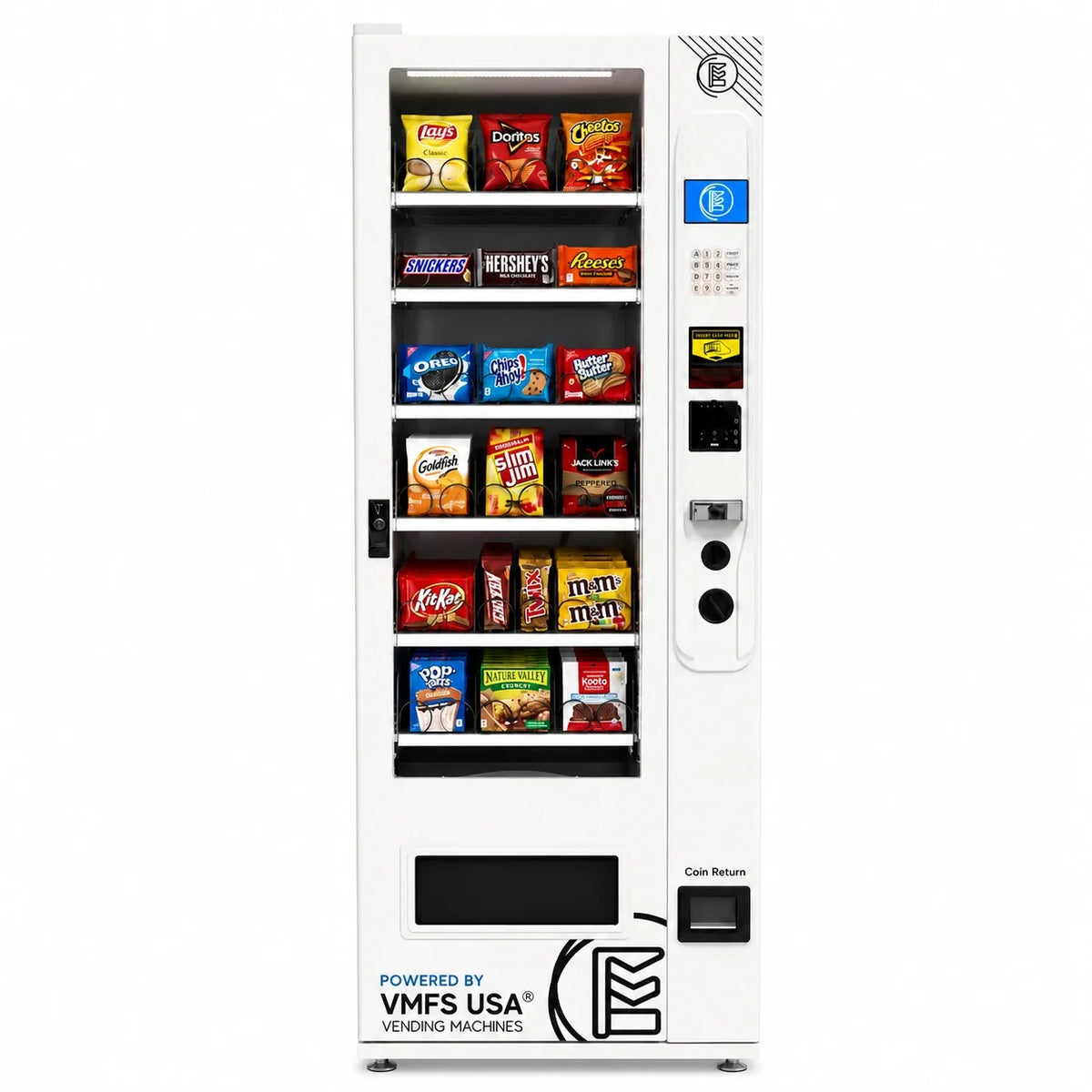
The Slim Combo Vending Machine keeps the same coil-and-keypad design in a cabinet 28.7 inches wide, narrow enough for a standard interior doorway and a hallway. It trades capacity for footprint, so it suits small offices, salons and lobbies with lower traffic.
The AI Smart Combo Vending Machine is a different animal. The customer taps a card to release the door lock, takes items off flat shelves and closes the door; cameras identify what was taken and the charge completes automatically. There are no coils to jam, and the open-shelf format makes it easy to take more than one item, but the model carries AI platform fees and needs a stable network connection for recognition. Our explainer on how AI vending works covers that checkout in depth.

A combo machine is the better choice when a location's traffic supports one machine's worth of sales but wants both snacks and drinks; two separate machines win when demand is high enough to empty a combo between visits. The decision comes down to sales volume per square foot and per service trip.
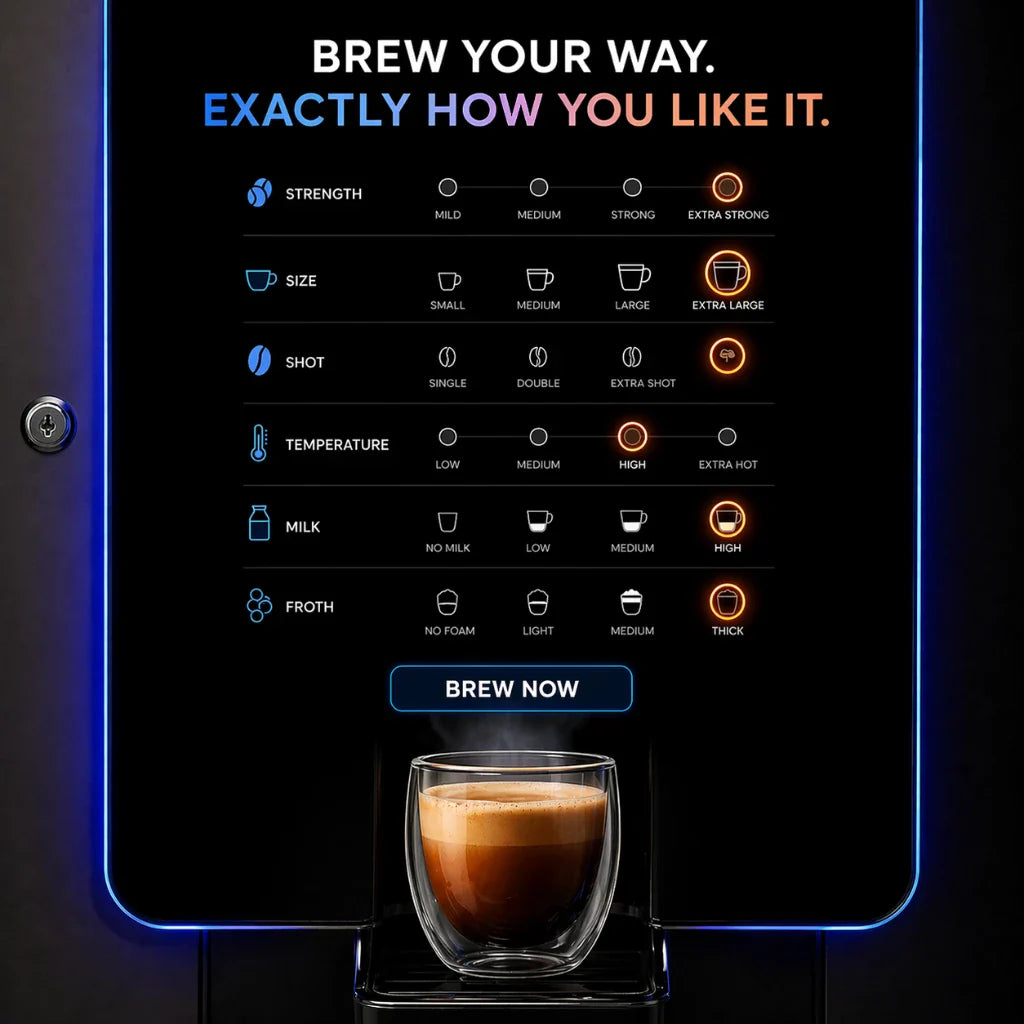
One combo means one purchase, one outlet, one card reader fee and one stop on the route. For a break room with a few dozen regular users, that is usually the profitable setup, because two half-empty machines double the fixed costs without doubling sales. A combo also makes the pitch to a property manager easier, since it asks for less floor space. If the same break room also wants hot drinks, add one of our coffee vending machines rather than a second combo.
Separate machines take over at busy sites. A dedicated drink machine usually holds more beverages than the drink rows of a combo, and a dedicated snack machine offers more selections. If your combo sells out of its best drinks before the weekly visit, or you are adding a second service day just to keep it full, splitting into a snack machine and a drink machine raises capacity without adding trips.
Choose a combo when
Choose separate machines when
Beyond the purchase price, a smart combo's running costs are the card reader's monthly service fee, card processing on each cashless sale, a VMFS Cloud plan, electricity and the location's commission. Each is predictable once you know the rates, and our full breakdown of smart combo vending machine cost walks through the purchase side.
On VMFS's payment comparison, Nayax readers list a monthly fee of $7.95 to $14.95 per device and Cantaloupe about $9.95 to $18.95 depending on plan. Processing runs about 2.5% plus $0.10 per transaction or about 5.95% flat with Nayax, and about 5% to 5.95% with Cantaloupe, so most operators pay roughly 3% to 6% of cashless sales. The VMFS payment system page lists the current figures and the reader options.
Software is a flat monthly plan per machine on VMFS Cloud, starting at $7.99. Coil combos such as the Smart Combo and Slim Combo carry no AI fees. The AI Smart Combo adds the $39.99 AI Cloud plan, a $0.07 recognition fee per completed transaction and another $0.03 per transaction if weight sensors are enabled. Location commission is negotiated site by site; NerdWallet puts the typical range at 5% to 25% of the machine's revenue. To see how these lines net out against sales, read whether vending machines are profitable at typical volumes.
Cost check: Price the reader, processing and Cloud plan before you sign a location. A site that sells mostly low-priced items loses a larger share of each sale to flat per-transaction fees.
The best locations for a smart combo are indoor sites with steady daily traffic, a captive audience and limited food options nearby: offices, gyms, warehouses and distribution centers, hospitals, schools, apartment buildings and waiting areas. These sites have people who stay long enough to want both a drink and a snack, and they often lack space for two machines.
Match the model to the site. A full-size Smart Combo fits a busy break room or a fulfillment center with shift traffic; the Slim Combo fits a narrow hallway or a salon lobby; the AI Smart Combo fits staffed-but-busy sites with reliable network coverage, where higher-priced items and multi-item baskets pay for the AI fees. Outdoor sites need a weatherproof cabinet such as the Smart Outdoor Combo, not an indoor unit under an awning.
Before you place a machine, check three compliance points. For accessibility, the ADA standards set a 15 to 48 inch unobstructed reach range for operable parts such as keypads, card readers and bill slots, so check where those parts sit on the cabinet. If you own or operate 20 or more vending machines, the FDA requires you to disclose calorie information for the food you sell, with some exemptions. Local business licenses and sales tax rules vary by city and state, so review vending machine permits for your area.
For site-by-site advice, start with our list of the best vending locations and the playbook on how to scout and pitch a vending machine location. VPlaced also publishes a focused guide to the best locations for smart combo vending machines, and once a site says yes, VAdviced explains what belongs in a smart combo placement agreement.
Stock a combo machine by location: lead with the categories that sell at that site, then let the first month of sales data promote winners and drop slow movers. Because slots and tray heights adjust, the snack-to-drink split is a setting, not a hardware decision.
VMFS publishes starter planograms for the 60-slot Smart Combo. An office mix starts with 35 snack and 25 drink slots anchored by chips, protein bars, cold brew and energy drinks, priced around $1.75 to $3.50. A gym flips it to 35 drink and 25 snack slots with electrolyte drinks, protein shakes, bars and jerky at $2.50 to $5.00. A warehouse runs an even split of hearty snacks, sodas, water and energy drinks at $1.50 to $3.00, and an apartment building leans on late-night convenience items such as instant noodles, candy, soda and water at $2.00 to $4.00.
Two practical rules keep a combo selling. First, fit each product to the right coil pitch and tray height, since loose items twist and hang. Second, rotate stock front to back so older product sells first. Our guides to what sells best in vending machines and loading and stocking a vending machine go deeper on product choice and loading technique.
The common problems on a smart combo are coil jams, failed vends, a card reader going offline, temperature drift and lost connectivity, and the smart layer either handles them automatically or alerts you before customers notice. Mechanical faults still need a site visit; data faults often do not.
Coil jams happen when a product is the wrong size for its spiral, sits crooked after loading, or has a bulky package that catches on the coil. The vend sensor stops the customer from paying for a product that hangs, and VMFS Cloud sends a jam alert so you can fix the slot on the next visit. The permanent fix is matching product to coil pitch and tray height.
Card reader offline alerts usually trace to weak cellular signal, a loose MDB connection or a processor account issue. Cash keeps working while the reader is down, which is one reason many sites keep a bill validator. Check signal strength at the install spot before you mount the reader.
Temperature alerts flag a cabinet that is running warm, often from a door left ajar during service, blocked airflow behind the machine or a dirty condenser. Keep the 5-inch rear clearance clear and clean the condenser on your vending machine maintenance schedule.
Lost connectivity delays reporting rather than stopping sales: a coil combo still vends to cash buyers without a connection, and card sales depend on the reader's own link. For a broader fault list, see our guide to common vending machine issues.
Choose a smart combo by measuring the space first, estimating daily traffic second, and picking the checkout style your customers will use third. Brand preferences and feature lists matter less than whether the machine fits the doorway and sells out at the right pace.
Measure the delivery path as well as the final spot. The Smart Combo needs a 42 by 32 inch footprint plus door clearance, while the Slim Combo needs only 28.7 inches of width. Count the people who pass the site each day and how long they stay: heavy traffic points to a full-size Smart Combo or a pair of machines, moderate traffic to a Slim Combo, and premium mixes with multi-item baskets to the AI Smart Combo. Confirm cellular coverage at the site for the card reader, and budget the reader and Cloud plan from day one rather than running cash-only.
If you are still comparing formats, our step-by-step guide to buying a vending machine covers financing, delivery and setup.

Compare every combo in the VMFS lineup
Smart, slim, AI, elevator and outdoor combos side by side, with prices and specs.
Shop Combo Machines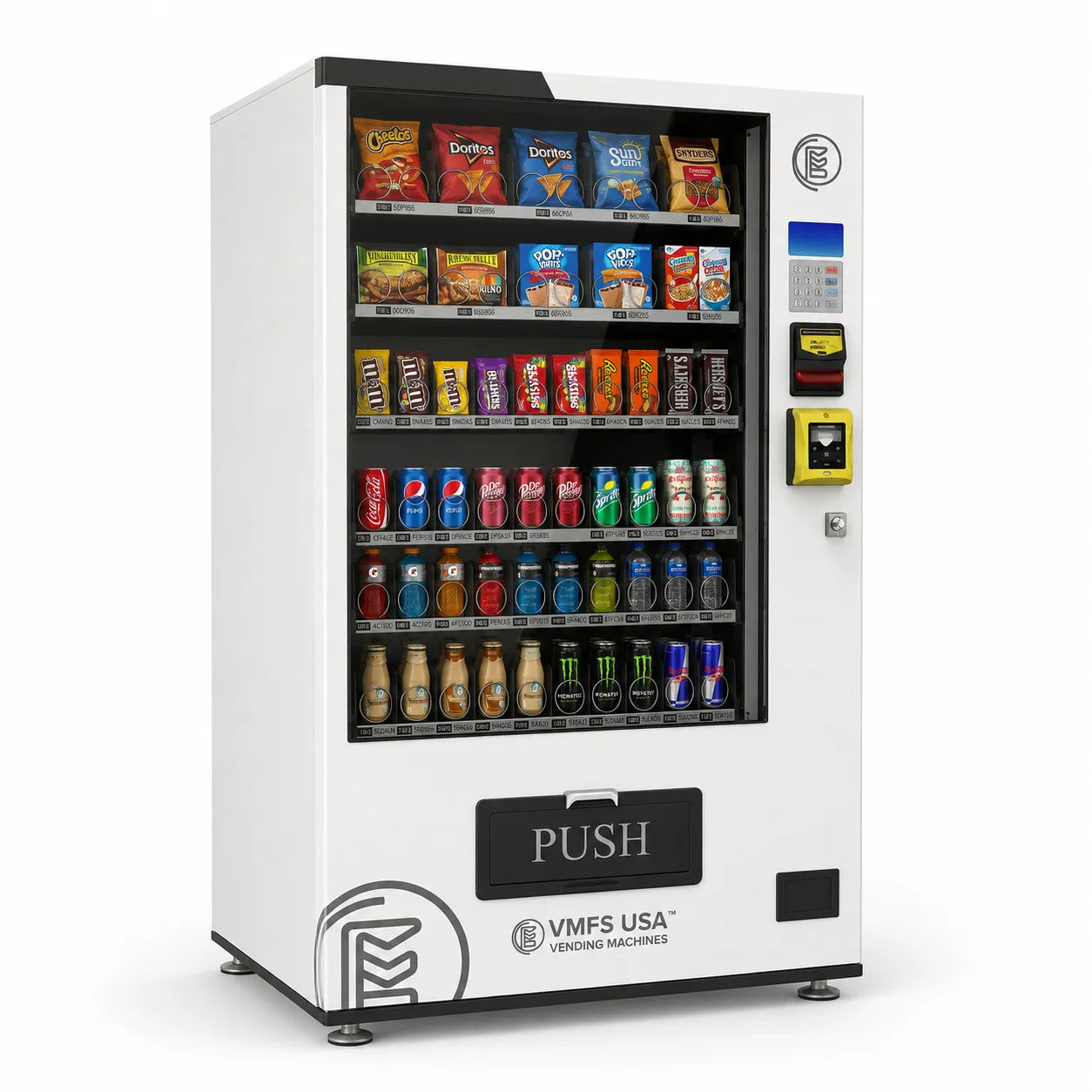
Share:
Pokémon Vending Machine Restock Schedule: An Operator's Playbook
How Does a Smart Combo Vending Machine Work? Step-by-Step Guide