


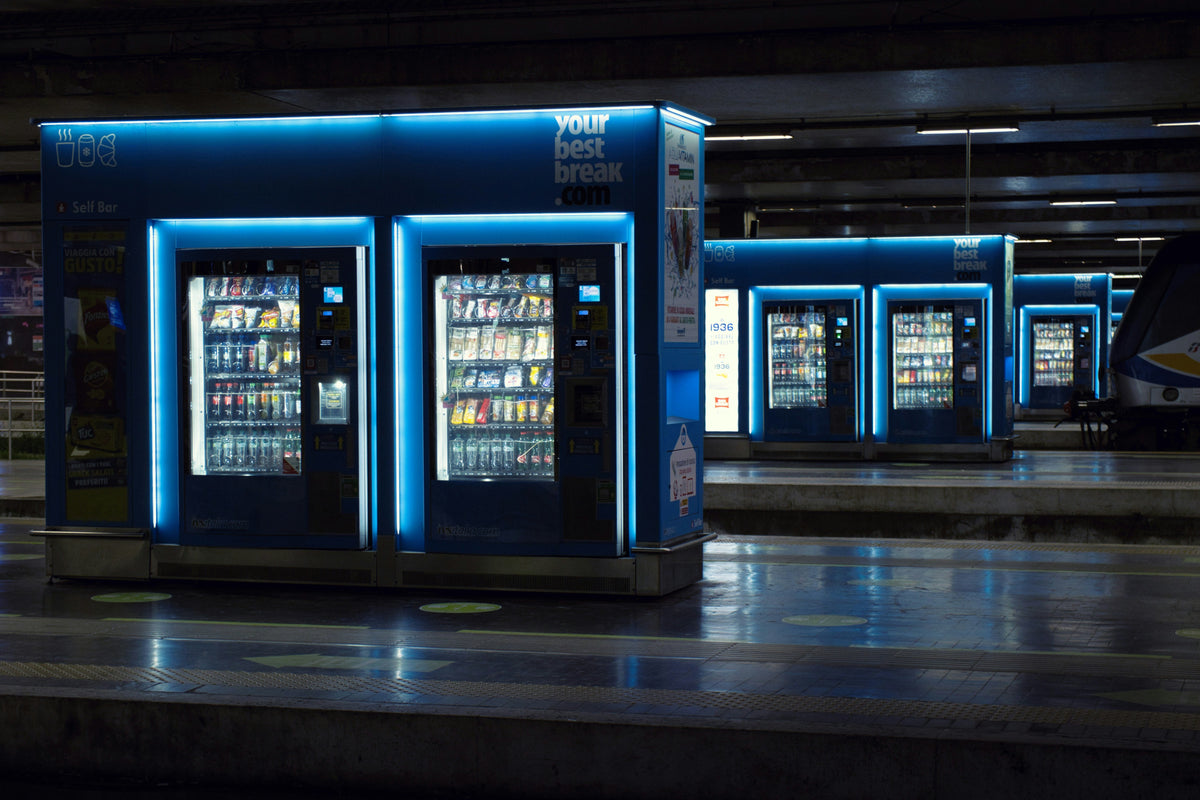


Design the perfect vending solution for your location and customers.

Join the VMFS newsletter and step into a thriving network dedicated to collective success.
One signup. Endless possibilities.
A smart vending machine is a connected vending machine that takes card and phone payments, reports its sales, stock and faults to a cloud dashboard in real time, and lets the operator change prices and settings remotely. Some models add a touchscreen, an elevator or sensor-verified delivery, age verification, or AI cameras that let customers open the door and take what they want.
This guide explains how the technology actually works, from the card reader to the dashboard, which features earn their keep and which are marketing, what a smart machine costs to buy and run in 2026, and how US operators should upgrade an existing route.
A smart vending machine is a vending machine that is connected to the internet and to a management platform, so it can accept cashless payments, report what it sold and what is left, raise alerts when something breaks, and take price or settings changes without anyone standing in front of it. That connection is the defining feature. A machine with a big screen but no data link is a digital vending machine, not a smart one, and a machine with a data link but a coin mech and push buttons is already smarter than it looks.
The word "smart" is stretched in vending marketing, so it helps to separate three layers. The first is connectivity: the machine talks to the cloud. The second is interaction: a touchscreen, product information, multi-item checkout and on-screen promotions. The third is intelligence: computer vision, weight sensors, demand forecasting and automated restock lists. Most of the day-to-day value for an operator comes from the first layer. The third layer is real, but it only pays off once the data from the first layer is clean, which is why how an AI vending machine works is a separate topic from smart vending in general.
Cashless acceptance
EMV chip, contactless cards, Apple Pay and Google Pay, plus cash where the location still needs it.
Telemetry
Sales, stock by slot, temperature, door events and error codes sent to a dashboard as they happen.
Remote control
Change prices, planograms, screen content and alert rules from a browser instead of a service visit.
Optional intelligence
Touchscreens, ID scanning, vision-based checkout and forecasting, added where the location justifies the cost.
If a machine does the first three things on that list reliably, it is smart in the way that matters on a route. Everything else should be judged on whether it improves a decision you make or a sale you would otherwise lose, not on the label printed on the cabinet.
A smart vending machine works by passing every sale and every machine event from the vending controller, through a payment and telemetry device, over a cellular or Wi-Fi link, to a cloud platform where the operator reads it and sends changes back. The hardware path is old and standardized; what changed is that the data now leaves the machine continuously instead of waiting for a route driver with a handheld.
Inside most US machines, the components talk over MDB, the Multi-Drop Bus. Cantaloupe's vending glossary describes MDB as a serial bus interface used for electronically controlled vending machines, and the standard is maintained by NAMA, which released MDB version 4.3 in August 2019 with its revisions concentrated in the cashless-device section. The second protocol is DEX, short for Data Exchange, the audit file a machine produces with its sales and event counts. Our guide to MDB and DEX covers the wiring and compatibility side in detail.
Two practical limits are worth knowing. Telemetry is a strong signal, not perfect truth: slot-level stock counts drift when a driver loads the wrong product, a spiral jams, or a planogram changes and nobody updates the software. And a dashboard can tell you sales dropped at a site without telling you why. Treat the data as a way to aim your judgment and your maintenance visits, not as a replacement for them.
The core technologies in a smart vending machine are cashless payments, telemetry, touchscreen interfaces, sensor-based delivery, age verification and energy management, and each solves a different operating problem. The table below maps each one to what it does and where it earns its cost; the sections after it explain the details.
| Technology | What it does | Operator payoff | Where it matters most |
|---|---|---|---|
| Cashless reader (EMV, NFC, wallets, QR) | Accepts cards and phones, reports each sale | Higher average ticket, fewer lost sales, less cash handling | Every location |
| Telemetry module (cellular or Wi-Fi) | Streams sales, stock and faults to the cloud | Fewer wasted trips, faster repairs, clean numbers | Routes with more than a handful of machines |
| Touchscreen interface | Product photos, nutrition info, multi-item cart, ads | Upsells, bundles, second revenue stream from ads | Offices, lobbies, gyms, transit |
| Elevator or sensor-verified delivery | Lowers products gently, confirms each vend | Sell glass, fragile and premium items; fewer refunds | Premium drinks, fresh food, electronics |
| Computer vision and weight sensors | Identifies what a shopper took from an open cooler | Larger assortment, faster purchase, bigger baskets | Supervised, higher-traffic indoor sites |
| ID scanning and age verification | Checks ID before releasing restricted items | Opens regulated categories where the law allows | Adult-only venues |
| Energy controls | LED lighting, low-power modes, efficient cooling | Lower power bills, easier approval from facilities | Refrigerated machines |
Cashless acceptance is the single highest-impact smart feature because it changes how much people spend. Cantaloupe's 2026 Micropayment Trends Report found that 78% of vending sales were cashless in 2025, up from 73% the year before, that contactless made up 85% of cashless vending sales, and that the average cashless ticket was $2.45 against $1.57 for cash. Contactless also improves security: EMVCo notes that each contactless EMV transaction generates a one-time security code, which makes it harder to counterfeit than a magnetic stripe. If you are choosing hardware, our cashless payment system guide compares readers, fees and setup.
Telemetry turns a machine from something you check into something that reports to you. The useful outputs are sales by machine, slot and payment type; low-stock and sold-out alerts; error codes from the bill validator, motors or cooling unit; door-open events; and an online or offline status. Platforms then build on that data with pre-kitted restock lists, coil alerts for slots that have not sold in a set period, and dynamic scheduling so drivers only visit machines that need attention, all terms Cantaloupe's glossary defines. Our article on remote monitoring in vending machines goes deeper on dashboards and alert design.
A touchscreen replaces the keypad with product photos, prices, ingredient and allergen details, and a cart that lets a customer buy several items in one payment. Operators use the same screen to run promotions between sales and, on advertising models, to sell screen time to local businesses. On VMFS machines, screens run from 21.5 inches on the Smart Elevator to 32 inches on the TallPro and 49 inches on the Seaga EnVision IQ. A screen also makes multilingual menus and larger, clearer text practical, which helps in tourist areas and with accessibility. The trade-offs are power draw, glare in bright lobbies and one more component to keep working.
Delivery technology decides what you can safely sell. Elevator machines carry the product down to the delivery port instead of dropping it, which protects glass bottles, cakes and boxed goods. Infrared drop sensors confirm that something actually reached the bin, so a customer is not charged for a vend that hung on the spiral. Open-door AI coolers go further: the customer unlocks the door with a card, takes items, and cameras and weight sensors work out what was taken. Amazon describes its Just Walk Out system the same way, as cameras, weight sensors and AI models working together, without facial recognition. VMFS sells these formats as AI vending machines.
ID scanning lets a machine check a driver's license or other ID before releasing an age-restricted product, and some systems add a face match or a remote attendant. It does not make a restricted product legal to vend everywhere. Federal and state rules on tobacco, nicotine and alcohol still decide whether a machine can be placed at all, so treat age verification as a compliance tool, not a loophole. The details are in our guide to age verification vending machines.
Refrigeration is the biggest power draw in most machines, so the smart features that save money are LED lighting, scheduled low-power modes for quiet hours and efficient compressors. ENERGY STAR says its certified refrigerated beverage vending machines are on average 9% more efficient and save about 1,000 kWh a year, and they come with a low-power lighting mode for inactive periods. Facilities managers notice this when approving a placement, and efficient refrigeration is one of the few smart features that also cuts a fixed cost.
Smart vending machines come in five main formats: touchscreen spiral machines, elevator machines, smart combo machines, AI grab-and-go coolers and fridges, and advertising machines, and each fits a different location and budget. All of them can report to the cloud; what differs is the delivery method, the screen and how much the customer can see and touch before paying.
| Format | How it sells | Best locations | VMFS examples (current price) |
|---|---|---|---|
| Touchscreen spiral machine | Spiral coils behind glass, touchscreen menu, cashless | Offices, gyms, apartment lobbies | WallMount $3,450–$3,850; TallPro $4,950; Snack & Drink RDS $6,950 |
| Elevator machine | Lift carries products to the port; no drop | Premium drinks, fresh and fragile items | Smart Elevator $8,650–$8,950; Smart Elevator Advertising $10,650–$10,950 |
| Smart combo | Snacks and chilled drinks in one cabinet with a large screen | Hospitals, campuses, large workplaces | Seaga EnVision IQ $14,500; Pro Combo Elevator AD $17,650–$17,950 |
| AI grab-and-go cooler or fridge | Tap to unlock, take items, AI bills the card | Supervised offices, residential, gyms | AI Grab & Go Cooler $2,950; AI Smart Cooler $4,950; AI Smart Fridge $9,950–$12,650 |
| Advertising machine | Large display sells product and paid ad time | High foot-traffic public spaces | Smart Elevator Advertising; Pro Combo Elevator AD |
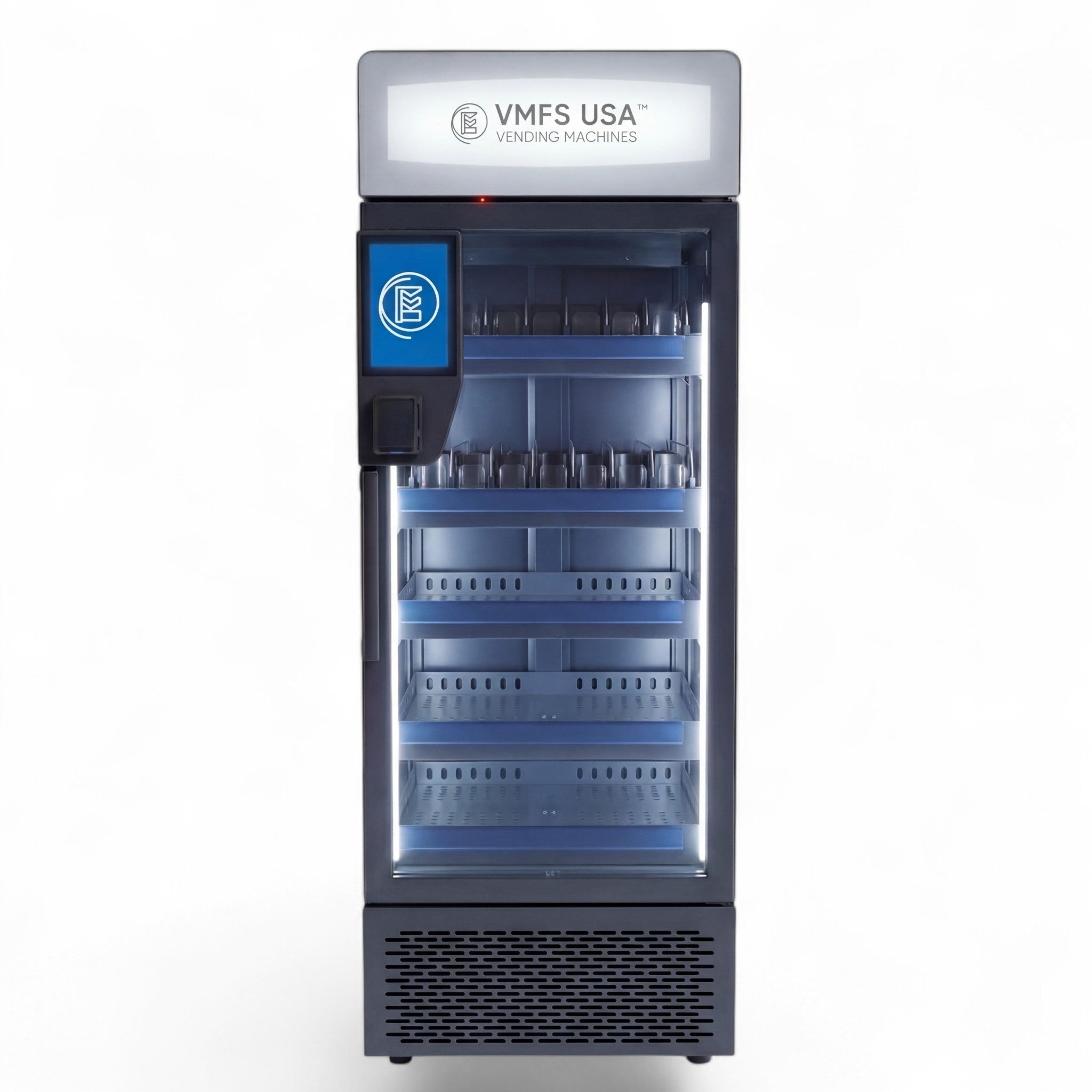
For most first upgrades, a touchscreen spiral or elevator machine is the sensible default: it behaves like a vending machine customers already understand, adds cashless and telemetry, and does not depend on shoppers trusting an open door. VMFS groups these as smart vending machines. The Smart Elevator Vending Machine, for example, pairs a 21.5-inch HD touchscreen with elevator delivery and cloud connectivity. At the top of the range, the Seaga EnVision IQ has a 49-inch touchscreen, infrared guaranteed delivery, real-time telemetry and room for up to 450 items across 64 selections.
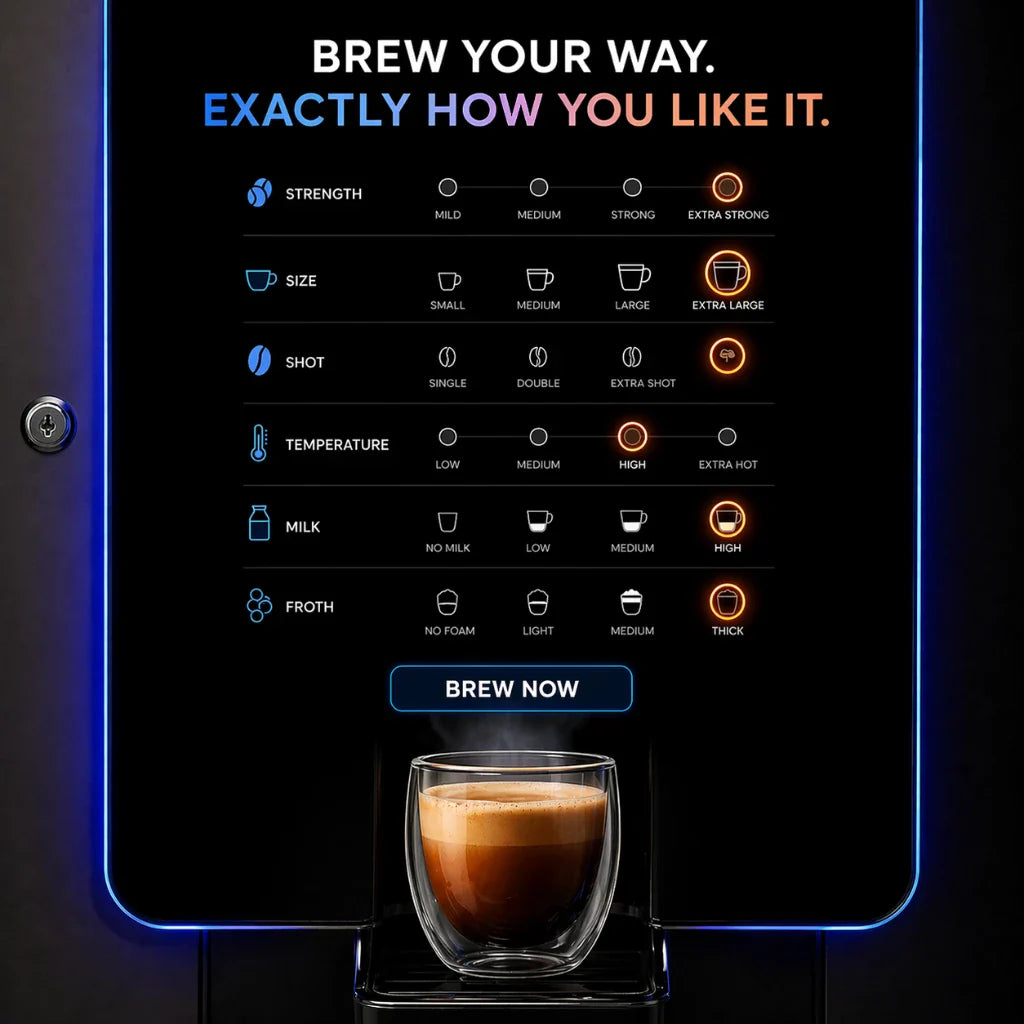
AI coolers suit locations where the same people buy every day and someone is around, because each door opening is tied to a card authorization and shoppers have to trust the system to bill them correctly. The AI Grab & Go Cooler holds roughly 294 items in 16.1 cubic feet, runs from 32°F to 86°F and is 23.6 inches wide, which gets it into break rooms where a full-size machine would not be approved. If you are deciding between the two formats, the smart vs AI vending machine comparison sets them side by side. Larger break rooms with 24/7 access may be better served by micro markets, which use open shelves and a self-checkout kiosk instead of a machine. For sites that mostly want hot drinks rather than chilled items, our coffee vending machines are the better fit.
Compare smart vending machines side by side
Touchscreen, elevator and combo models with cashless and cloud reporting, configured before they ship.
Shop smart vending machinesSmart vending fixes four leaks that cost operators money: wasted trips, stock-outs, unnoticed downtime and numbers that do not reconcile. Every genuine benefit of the technology traces back to one of these, which makes them a useful filter when a salesperson lists features.
Wasted trips. Without telemetry, drivers visit on a fixed schedule and find some machines half full and others empty. With live stock levels, the route is built around what each machine actually needs, and restock lists are packed before the van leaves. The saving is fuel, wages and time that can go to adding new locations.
Stock-outs. The item a location buys most is usually the first to sell out, and every hour it is gone is lost revenue and a frustrated customer. Low-stock alerts per slot, rather than per machine, catch it early, and sales history shows which products deserve more facings.
Downtime. A bill validator that stops accepting notes, a card reader that drops offline or a compressor that fails will quietly stop sales until someone notices. Fault and temperature alerts can shorten that gap from days to hours, and for refrigerated food they protect product that would otherwise have to be thrown out.
Messy numbers. Cash counts that do not match expectations, and no reliable way to see what sold where, make pricing and placement decisions guesswork. Transaction-level data by machine, slot and payment type gives you clean records for commission statements to location hosts, tax reporting and decisions about whether vending machines are profitable at a given site.
Feature filter: if a smart feature does not reduce wasted trips, stock-outs, downtime or messy numbers, or directly raise the average sale, it is a nice-to-have. Price it accordingly.
Smart vending is now mainstream in the United States: most vending sales are cashless, most machines accept cards, and smart coolers have become a standard format rather than an experiment. A few sourced data points set the context, with the caveat that each source surveys a different slice of the industry.
The NAMA Foundation's 2022–2023 industry census, prepared by Technomic, estimated about 2.89 million vending machines in use, with roughly 75% of them taking cashless payments, up from 69% in 2018. Cantaloupe's transaction data shows how far behavior has moved since then, with 78% of 2025 vending sales paid cashless. Cantaloupe also reported that its Smart Store locations grew from 71 to 572 during 2025, with an average ticket of $4.49, the highest of any self-service format in the report.
Operator surveys point the same way. Automatic Merchandiser's State of the Industry 2026 report, published by Vending Market Watch in July 2026, found that more than half of responding operators now run smart coolers, and that smart coolers made up 33.5% of the equipment respondents had deployed, nearly level with traditional glass-front machines. For the wider market picture, including where AI fits, see our overview of the vending industry in 2026.
The practical takeaway is that connectivity has become expected infrastructure. Location hosts increasingly assume a machine will take phones and cards, and a machine that cannot report data is harder to manage at scale and harder to sell later as part of a route.
The smart vending features that reliably pay off today are cashless payments, telemetry, remote pricing, touchscreen merchandising and, at the right sites, AI checkout; the ones that are mostly oversold are personal recognition, "smart city" integration, augmented reality and crypto payments. Many older articles about vending technology promised all of them in the same breath.
Personalization is the clearest example. The idea of a machine greeting a returning customer by name or remembering their usual order requires identifying people, and identifying people with cameras or face data brings real legal exposure. The Federal Trade Commission adopted a policy statement on biometric information on May 18, 2023, flagging practices such as collecting biometric data surreptitiously or failing to assess foreseeable harms before collecting it. Loyalty through a payment app or a phone number is a safer route to the same goal. Our vending machine data privacy guide covers what to disclose.
Context-aware selling is more grounded than it sounds. You do not need a link to a city transit network to stock more cold drinks in summer or caffeine before 9 a.m.; you need sales history by hour and a screen that can schedule promotions. Dynamic pricing works the same way when it is operator-set rules, such as a discount on items near their sell-by date, rather than an opaque algorithm. Augmented reality, social media sharing from the machine, cryptocurrency payments and integration with smart homes or cars remain rare in US vending and have little evidence of paying back.
Proven on US routes
Oversold or premature
One more caution: many features marketed as AI are simple rules, such as an alert when temperature crosses a threshold. That is useful, but it should not carry AI pricing. Real machine learning in vending is mostly product recognition in open coolers and demand forecasting, and both depend on accurate planograms and service records. If your data is messy, AI only helps you guess faster. Our comparison of traditional vs AI vending machines shows where the extra cost does and does not pay back.
A smart vending machine costs from about $2,950 to $17,950 to buy at VMFS today, depending on format, plus a monthly software plan, card processing fees and, for AI machines, a small per-transaction recognition fee. Think in components rather than one sticker price, because the running costs decide your margin far more than the purchase price over a few years.
On hardware, the active VMFS catalog runs from $1,900 for the Countertop Snack Vending Machine, a basic unit, up to $19,950 for the most specialized machines. Within smart formats, the AI Grab & Go Cooler starts at $2,950, touchscreen spiral machines run about $3,450 to $6,950, elevator machines about $8,650 to $10,950, and large-screen combo machines $14,500 to $17,950. Model-by-model figures are in our breakdown of smart vending machine prices, and the wider picture of how much a vending machine costs covers used and traditional options.
| Running cost | Typical amount | Who you pay |
|---|---|---|
| VMFS Cloud Basic (live sales, stock, alerts, planogram) | $7.99 per machine per month | VMFS |
| VMFS Advertising Cloud (adds screen ads, remote pricing and settings) | $16 per machine per month | VMFS |
| VMFS AI Cloud (adds computer-vision stock checks, dynamic pricing rules) | $39.99 per machine per month | VMFS |
| AI recognition fee (AI machines other than NEO GO and NEO PRO) | $0.07 per completed transaction, plus $0.03 with weight sensors | VMFS |
| Card processing | About 3%–10% per transaction (for example ~2.5% + $0.10, or ~5.95% flat) | Payment provider |
| Card reader service | About $7.95–$18.95 per month | Payment provider |
| Cellular data (if you use a SIM instead of site Wi-Fi) | About $15 per month | Carrier or provider |
VMFS Cloud works with every VMFS machine; plans start at $7.99 per machine per month, and the Enterprise tier is priced to the fleet. Reader hardware, processing and connectivity are third-party costs, and the VMFS payment system page lists them alongside reader options from Nayax, Cantaloupe and PAX. Run your own numbers before you commit, using realistic sales for the specific location rather than an industry average.
Whether the premium over a basic machine pays back depends on the site. Cashless lifts the average sale, telemetry cuts service cost and remote pricing protects margin, but a smart machine in a weak location is still a weak machine. Location quality sets the ceiling, and the technology helps you get closer to it.
Before you buy a smart vending machine, check payments, telemetry, data access, connectivity, accessibility, service and the software maker, in that order of priority. A machine that looks impressive on a showroom floor can still be expensive to run if the software is locked down or the reader is hard to replace.
For small operators, the order matters as much as the list. Reliable cashless acceptance comes first because it moves revenue immediately; telemetry second because it cuts cost; clean reporting third; and AI last, once the first three are producing data you trust. The broader checklist for buying a vending machine covers capacity, power and delivery logistics.
A smart vending machine adds digital risks to the physical ones, so operators need to think about payment security, customer data and labeling rules as well as locks and placement. None of it is complicated, but it is easier to get right at purchase than after a problem.
Payment security is governed by the PCI Data Security Standard, which applies to entities that store, process or transmit cardholder data. In practice, choosing a reputable, certified card reader and processor keeps card data out of your own systems, which is the simplest way to limit your exposure. EMV chip and contactless acceptance also reduce fraud compared with magnetic stripe. Keep dashboard logins individual, use strong passwords and remove access when a driver or partner leaves.
Physical security still matters on a connected machine. Door-open alerts, tamper events and an offline status can flag a break-in quickly, and reinforced cabinets, good lighting and camera coverage of the site do the rest. Our vending machine security guide covers placement and hardware in more detail.
Two rules catch operators who move to screens and food. FDA's vending labeling rule requires operators who own or operate 20 or more vending machines to disclose calories for covered food items, subject to certain exemptions, so check how calories will be shown before you load food into a new machine. And if a machine uses cameras or ID scanning, tell customers what is collected, keep only what you need, and check state privacy law; California's CCPA, for example, lists biometric information processed to identify a consumer as sensitive personal information. Permits and location rules are covered in our guide to vending machine permits, and VAdviced helps operators with contracts and licensing.
Most operators should retrofit cashless and telemetry onto MDB-compatible machines that still run well, and replace machines only when they need a capability a retrofit cannot add, such as a touchscreen, elevator delivery or open-door AI. Retrofitting is cheaper per machine and gets data flowing across the whole route quickly; replacing is the right call for new locations, premium sites and machines near the end of their life.
A card reader with built-in telemetry, installed on an MDB machine, delivers most of the smart benefits on a budget: cashless sales, remote sales reports and basic alerts. Older non-MDB machines need an interface kit or a controller upgrade first, and some are not worth the investment. For new placements, or when a host asks for a modern look, buying a machine that ships connected avoids the patchwork of readers and apps that builds up on a mixed fleet. VMFS machines ship with a communication module built in at the factory and connect over cellular or Wi-Fi on their own, so the dashboard is live once a plan is active.
A safe sequence for any route looks like this:
If you want a specific format, the touch screen vending machine builder and the AI vending machine builder let you choose the configuration, and financing can spread the cost of a fleet upgrade. When the hardware is settled, the right location decides the result; the best vending locations guide and VPlaced can help you find sites that suit a smart machine.
See what VMFS Cloud shows you
Live sales, slot-level stock and fault alerts for every VMFS machine, with plans from $7.99 per machine per month.
Explore VMFS Cloud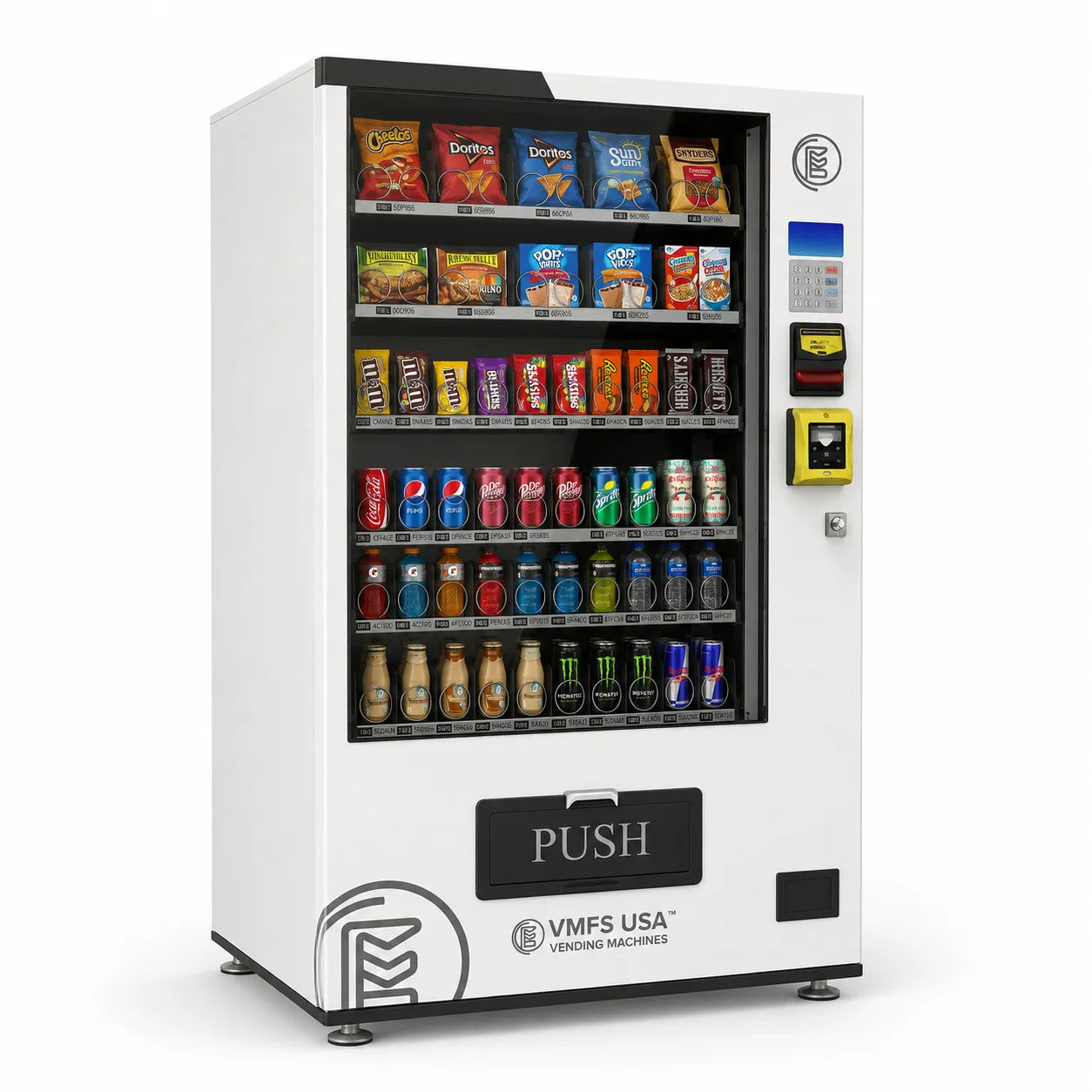
Share:
Hot Food From a Vending Machine: What We Saw at Venditalia 2026
Coffee Vending Routes & Operations: The Complete Guide for 2026