



Design the perfect vending solution for your location and customers.

Sales, inventory and alerts for your whole route, from one machine to a fleet.
Answer a few questions about your location, products and budget and get a shortlist.
Estimate revenue, payback period and margin before you buy.
Sales, setup help, warranty and parts from the VMFS USA team.
Join the VMFS newsletter and step into a thriving network dedicated to collective success.
One signup. Endless possibilities.
Anyone can purchase a commercial trading card vending machine to sell authentic Pokémon merchandise, but independent operators cannot buy official, factory-branded Pokémon Center kiosks directly from The Pokémon Company International. Determining whether can anyone buy pokemon vending machine units requires separating corporate-owned retail hardware from private automated trading card game (TCG) machinery. While corporate kiosks are restricted to corporate retail partners, independent entrepreneurs can buy automated TCG hardware from a trusted Vending Machine Company in USA, stock it with genuine sealed booster boxes, and operate an independent automated retail route legally.
Understanding the boundary between proprietary corporate retail programs and independent automated vending enables operators to launch a profitable route while remaining fully compliant with trademark laws and business regulations.
Official Pokémon Center kiosks are proprietary automated retail machines managed directly by corporate entities, whereas commercial TCG vending machines are universally accessible hardware built for independent operators.
Official Pokémon Center vending machines are owned, monitored, and replenished exclusively by corporate logistics networks. The Pokémon Company International deploys these branded green and blue touchscreen units in major retail chains such as Kroger, King Soopers, and Safeway, as well as high-volume transportation hubs. According to The Pokémon Company International Automated Retail Report, these official kiosks function as direct-to-consumer distribution channels rather than franchise opportunities. Private individuals cannot buy, lease, or operate official Pokémon Center kiosks under any commercial agreement.
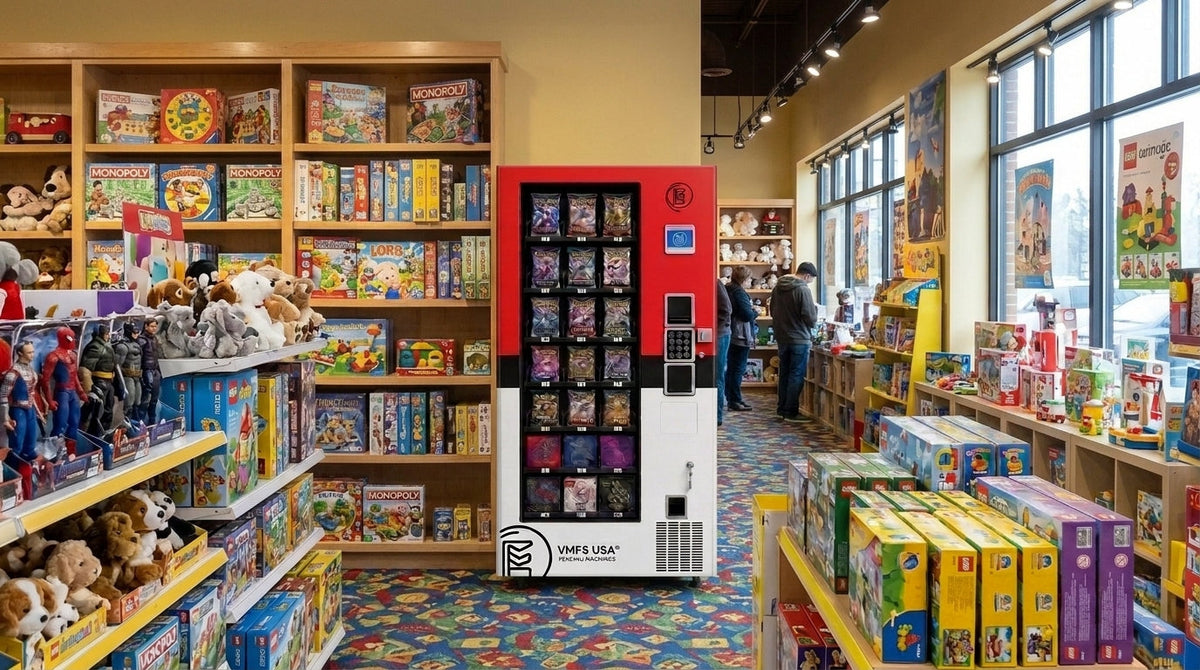
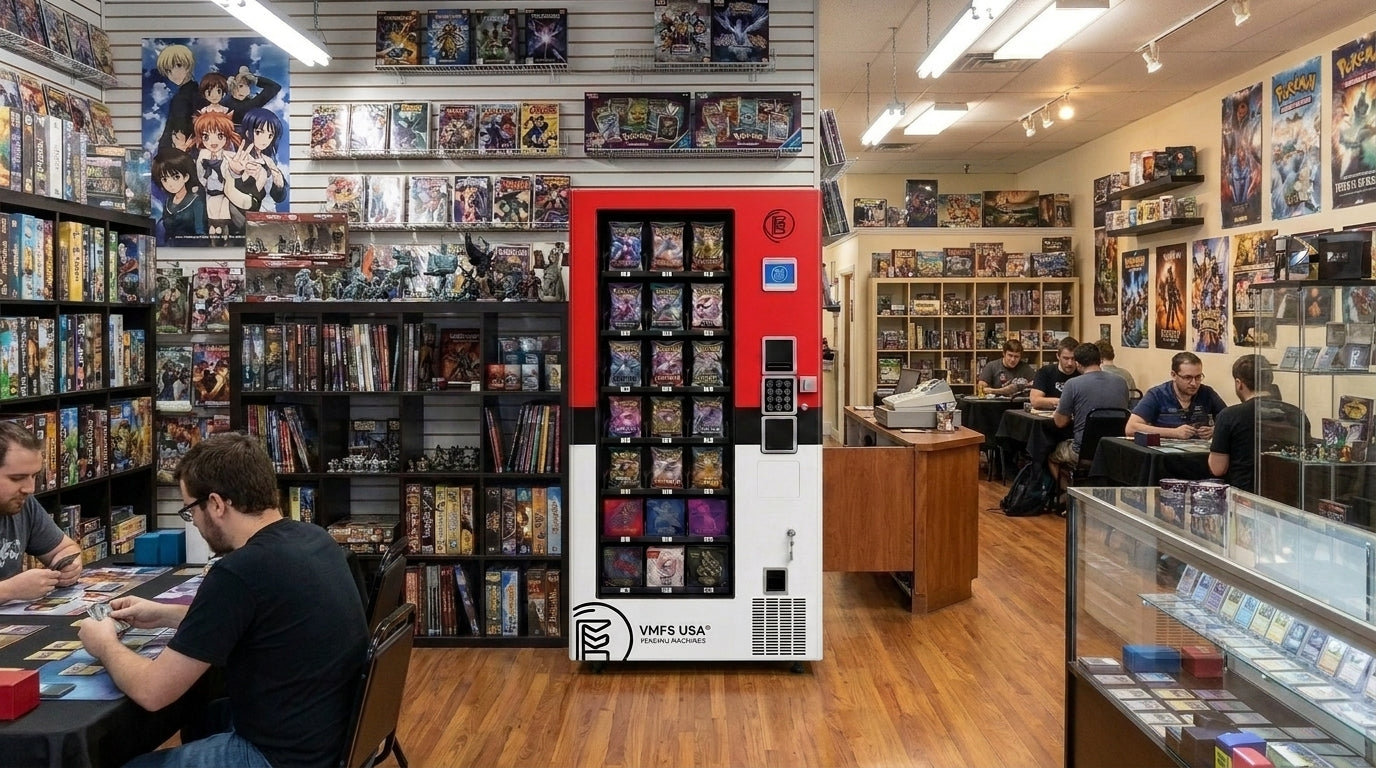
Independent operators achieve identical retail automation by purchasing commercial automated trading card vending machines. Private operators buy specialized glass-front or touchscreen hardware, apply custom business branding, and stock the channels with factory-sealed Pokémon booster packs, Elite Trainer Boxes (ETBs), and graded card slabs.
Reviewing what are pokemon vending machines reveals that commercial hardware offers equal or superior payment telemetry, drop sensors, and security compared to proprietary corporate kiosks.
Operating an independent trading card vending machine is legal when the operator sells authentic merchandise and avoids unauthorized trademark usage.
The First Sale Doctrine, codified under U.S. Copyright Office First Sale Doctrine Section 109, grants individuals the legal right to resell lawfully purchased, authentic trademarked goods without permission from the copyright owner. Once a booster box or collection tin is purchased from an authorized distributor or retail store, the owner possesses the unrestricted legal right to resell that item through any automated dispensing machine. Refer to detailed legal analysis on can you legally sell pokemon in vending machines to understand statutory protections for reseller operations.
Trademark laws prohibit operators from decorating vending machines with official Pokémon logos, Pikachu artwork, or misleading corporate signage that implies an official affiliation.
Operators must review legal guidance on can you use the pokemon logo on a TCG vending machine before finalizing exterior vinyl wrap artwork.
Launching an automated retail route requires establishing a formal business structure, securing sales tax permits, and executing location agreements.
Business Entity Setup: Establishing a legal entity protects personal assets from commercial liability. Operators can form an LLC for a vending machine business to secure legal separation between business debts and personal finances.
Tax Registrations: Vending operators must register for state sales tax permits to collect and remit retail taxes on automated card sales.
Placement Agreements: Written location contracts define commission structures and electrical access. Executing a standard pokemon vending machine placement agreement ensures clear terms with property owners.
Commercial trading card vending machine prices range from $1,400 for wall-mounted units to over $8,000 for high-capacity touchscreen automated kiosks. Hardware pricing reflects cabinet size, dispensing mechanisms, telemetry features, and security builds.
Choosing the right equipment format depends on location footprint and target inventory density.
| Machine Category | Average Cost | Inventory Capacity | Ideal Placement Environment |
| Wall-Mount Mini | $1,400 – $1,800 | 100 – 250 Packs | Barber shops, small hobby stores, convenience store walls |
| Freestanding Slim | $2,000 – $3,500 | 300 – 600 Items | Card shops, arcades, bowling alleys, shopping centers |
| Large Elevator Kiosk | $4,000 – $8,000 | 800+ Mixed Items | Regional malls, airports, major entertainment centers |
Operators evaluating initial capital costs should review a comprehensive pokemon vending machine prices cost guide to align hardware models with budget limits.
Trading cards are sensitive collectibles; physical damage to booster pack foil or graded card slabs destroys retail value. Specialized TCG hardware must incorporate specific mechanical protective features:

Soft-Drop Elevator Platforms: XY-axis elevator platforms rise to catch products, eliminating gravity drops that dent box corners.
Infrared Drop Sensors: Optical sensors confirm that a product has dispensed before charging the customer's credit card, preventing vend failures.
MDB 4.2 Telemetry Readers: Contactless card readers support Apple Pay, Google Pay, and credit cards with real-time cloud sales tracking.
Climate Control Isolation: Internal ventilation preserves card foil integrity against ambient humidity warping.
To acquire hardware built for collectible trading cards, operators can purchase a dedicated Pokemon Card Vending Machine equipped with soft-drop elevators and anti-tamper security locks.
Launching a single commercial TCG vending machine requires allocating funds across hardware, opening inventory fill, and working capital.
Studying the complete breakdown in how do pokemon vending machines work complete guide helps operators streamline initial mechanical setup and testing.
Long-term success depends on securing high-footfall host locations, obtaining legitimate inventory, and maintaining machine uptime.
Selling counterfeit trading cards exposes operators to severe federal copyright and trademark litigation. Inventory must be sourced through authorized TCG distributors, established wholesale hobby suppliers, or verified sealed retail liquidations.
Operators should maintain itemized purchase invoices for every batch of inventory loaded into the machine to prove chain of custody during quality checks.
Machine placement directly dictates daily sales volume. Target host environments include local card stores (LCS), video game arcades, family entertainment centers, shopping malls, and college campus recreation centers.
Competitor Location Mapping: Research existing machines via find a Kroger pokemon vending machine guides or explore mapped networks on pokemon vending machine locations to locate underserved territories.
Site Selection Strategy: Evaluate foot traffic demographics using best places for pokemon vending machine placement frameworks before approaching property managers.
Pre-Placement Audit: Execute a thorough site assessment using the checklist before placing a pokemon vending machine to verify 110V power outlets and cellular telemetry signals.
Operators seeking assistance locating machine sites can consult how to find pokemon vending machines for field scouting techniques.
Preventive maintenance prevents lost revenue caused by card reader failures or physical jams.
Restock Management: Track inventory turns in real-time and utilize a dedicated pokemon vending machine restock tracker to avoid empty slots.
Preventive Servicing: Adhere to a strict pokemon vending machine maintenance schedule to clean drop sensors, inspect motor coils, and test bill acceptors.
Card Reader Troubleshooting: Fast resolve connection drops by reviewing how to fix pokemon vending machine card reader protocols.
For specialized hardware needs, operators can deploy a high-capacity TCG Vending Machine or upgrade high-footfall sites with a Large Pokemon Vending Machine for expanded storage capacity.
Commercial trading card vending machines generate attractive profit margins due to strong consumer demand for sealed collectibles and zero labor costs at point-of-sale.
Gross profit margins on sealed Pokémon booster packs average 30% to 50% when sourced wholesale. A machine placed in a high-traffic location dispensing 25 booster packs per day at $5.00 per pack generates $3,750 in monthly gross revenue.
After deducting 10% host location commission ($375), monthly telemetry SaaS fees ($15), and processing fees ($112), net monthly profit averages $998, leading to complete capital payback within 5 to 8 months. Review full economic projections on is the pokemon vending machine business profitable to model route growth.
Evaluating the commercial benefits and operational risks clarifies business expectations before purchasing equipment.
┌──────────────────────────────────────────────────────────────────────────────────┐
|                             PROS VS. CONS COMPARISON                             |
├──────────────────────────────────────────────────────────────────────────────────┤
| PROS:                                                                            |
| • 24/7 Automated Revenue: Generates sales without staffing costs.                |
| • Compact Footprint: Low monthly rent compared to physical retail storefronts.  |
| • High Demand Collectibles: Pokémon remains a top-selling global brand.          |
|                                                                                  |
| CONS:                                                                            |
| • Sourcing Constraints: High demand sets can face wholesale inventory shortages. |
| • Theft & Vandalism Risks: High-value inventory requires secure locations.        |
| • Capital Requirement: Upfront equipment and inventory funding needed.           |
└──────────────────────────────────────────────────────────────────────────────────┘
Operators should consult the comprehensive pokemon card vending machine the complete 2026 operator guide for scaling protocols.
The table below compares independent commercial TCG vending machines against proprietary corporate retail kiosks:
| Feature / Attribute | Independent Commercial TCG Machine | Proprietary Pokémon Center Kiosk |
| Availability | Available to any buyer / business | Corporate restricted (Not for sale) |
| Custom Branding | Fully customizable business wraps | Fixed green/blue corporate graphics |
| Product Flexibility | Pokémon, Sports Cards, Magic, Yu-Gi-Oh! | Strictly official Pokémon products |
| Profit Retention | 100% net revenue retained by operator | Corporate revenue channel |
| Payment Options | Credit card, Apple Pay, cash acceptors | Cashless payment terminal |
Deploying vending hardware efficiently requires leveraging professional business legal services and location matching networks.
Proper corporate structuring isolates business liability and ensures tax compliance across operating jurisdictions. Operators can utilize specialized services to structure their business:
Corporate Entity Selection: Evaluate a C-Corporation setup for venture funding or an S-Corporation structure for pass-through tax efficiency.
LLC & Partnership Setup: Form an LLC or explore a partnership for a vending machine business when launching with co-investors.
Sole Proprietorship Alternative: Review sole proprietorship features for single-machine starter routes.
Registered Agent Representation: Secure official registered agent services for vending to handle state regulatory notices seamlessly.
Finding host locations is simplified through dedicated location placement networks. Property owners with unused floor space can list your location space details for vending placement on VPlaced to connect directly with vetted local operators.
Operators looking to acquire machinery can review how to buy a pokemon vending machine or jumpstart operations by studying how to start and operate a pokemon vending machine. Implement target promotional campaigns using insights on how to market a pokemon vending machine to drive foot traffic directly to your machine.
No, official Pokémon Center vending machines are owned and operated exclusively by The Pokémon Company International and are not sold to private individuals or franchisees.
You can buy an independent commercial trading card vending machine, brand it under your own business name, and stock it with authentic, legally purchased Pokémon products.
Commercial trading card vending machines cost between $1,400 for wall-mounted units and $8,000+ for large touchscreen elevator kiosks.
No permission is required to resell authentic products under the First Sale Doctrine, provided you do not use trademarked Pokémon logos or artwork on the machine's wrap.
No, using official Pokémon logos, character artwork, or trademarked branding on your machine wrap without a license violates federal trademark law.
Sealed booster packs, Elite Trainer Boxes (ETBs), mystery collection blister packs, and graded card slabs generate the highest sales volume.
Commercial TCG vending machines utilize soft-drop elevator platforms and conveyor belts rather than steep gravity drops, preserving mint pack conditions.
Yes, operators average 30% to 50% gross profit margins on sealed merchandise, with well-placed machines achieving complete capital payback in 5 to 8 months.
Essential features include soft-drop elevators, infrared drop sensors, MDB 4.2 contactless card readers, anti-tamper locking systems, and remote inventory telemetry.
Prime locations include local card shops, video game arcades, shopping malls, family entertainment centers, and high-footfall retail hubs.


Compartir:
How Much Does a Food Vending Machine Cost? 2026 Commercial Price Guide
When Did Pokemon Vending Machines Come Out? Complete History & Launch Timeline