




Design the perfect vending solution for your location and customers.

Join the VMFS newsletter and step into a thriving network dedicated to collective success.
One signup. Endless possibilities.
Vending machines are a good investment for people who want a hands-on, cash-flowing small business: in our full-cost scenarios a well-placed machine earns back its startup cost in about 17 to 30 months, then keeps producing income and builds a route you can sell. They are a poor investment if you want truly passive returns, cannot verify a location before you buy, or plan to run a single machine at a slow site.
This guide treats vending the way an investor should: how much capital it takes, what return and payback to expect, where the money is lost, how a route is valued when you sell, how it compares with other places to put your money, and how to spot a "turnkey" offer that is really a scam.
Yes, vending machines are a good investment when you treat them as an operating business: put each machine where enough people pass every day, keep it stocked and working, and reinvest early profits into more machines on the same route. In the full-cost scenarios later in this guide, a machine at a typical to strong site returns roughly 39% to 72% a year on the money invested before you pay yourself for your time, while a machine at a slow site barely covers its own fixed costs.
That spread is the real answer to the question. A vending machine does not earn a market return the way a fund does; it earns whatever its location and its operator allow. The hardware is the smaller decision. The location, the product mix, the payment options and the discipline to review sales every week decide whether the investment pays back in a year and a half or never.
The underlying market is large and still growing. NAMA's latest industry census estimates U.S. convenience services revenue at $31.1 billion in 2025, up from $26.6 billion in 2023, an average annual growth of 8.1%. The same release reports that 65% of operators cite client requests for healthier product mixes, which tells you where new placements are being won.
Payments have also shifted in the operator's favor. Cantaloupe's 2026 Micropayment Trends Report found that 78% of vending sales were cashless in 2025, up from 73% the year before, and that the average cashless ticket was $2.45 against $1.57 for cash. A machine that takes cards and phones is not a nice extra; it is part of the investment case. If you want the detailed income math behind that, our guide to are vending machines profitable breaks a machine's P&L down line by line.
Short verdict: good investment for an active owner with a verified location and a plan to build a cluster of machines; weak investment for someone who wants hands-off income from one machine bought on a promise.
Not investment advice: This guide is general education for people weighing a vending business, not personalized investment, tax or legal advice. The ROI figures below are illustrations built on stated assumptions, not projections or promises. Results depend on your location, products, prices and costs, and you can lose money. Talk to a licensed financial adviser, tax professional or attorney before committing significant capital.
There are four common ways to put money into vending, and they carry very different levels of control, time and risk. Most first-time investors start by buying and operating their own machines because it gives them control over the location, products and pricing, which are the three things that move returns most.
The second path is hosting a machine at a business you already own or manage, such as a gym, laundromat, hotel or shop. You skip the location commission and most of the drive time, so a small machine can earn a strong return on a modest base of sales. The third is buying an existing route, which gives you income from day one but requires careful due diligence on every location agreement. The fourth is a passive arrangement: paying a company to supply machines and locations, or financing someone else's machines for a share of profit. That path has the least control and is where most vending investment scams sit, which is why it gets its own section below.
| Investment path | Capital | Your time | Control | Main risk |
|---|---|---|---|---|
| Buy and operate your own machines | From about $3,350 for a countertop setup to $6,600+ for a refrigerated smart combo | Weekly restocks and reviews | Full | Weak location or poor execution |
| Host a machine at your own business | Machine plus reader and first fill | Minutes a week on site | Full | Low traffic at your own site |
| Buy an existing route | A multiple of the route's yearly owner earnings | Full route workload from day one | Full after handover | Locations that do not transfer or were overstated |
| Turnkey programs or financing another operator | Varies by contract | Little | Low | Inflated earnings claims and poor-quality placements |
Each path rewards a different investor. If you want to learn the business first, own one to three machines and run them yourself. If you have more capital than time, buying a documented route is usually safer than handing money to a placement promoter. If you are comparing a franchise with going independent, our guide to franchise vs going independent walks through the trade-offs.
A single-machine vending investment usually needs about $3,350 to $6,600 in total capital, depending on the machine, plus a cash reserve for restocks and repairs. New VMFS machines currently range from $1,900 for the Countertop Snack Vending Machine to $19,950 for the most specialized models, and the combo machines compared in this guide list from $3,450 (Seaga SM2300) to $4,950 (Smart Combo with drinks and snacks).
The machine is only part of the bill. A credit card reader is a $450 upgrade on most VMFS models covered here ($550 on the Seaga SM2300), plus a monthly reader service fee of roughly $7.95 to $18.95 depending on the provider and plan. Shipping depends on your ZIP code and whether you need a liftgate or inside delivery; in-stock machines usually ship within 7 to 10 days and custom builds take around 45 days, per VMFS shipping information. For a model-by-model price list, see how much a vending machine costs.
| Capital item | Typical amount | Notes |
|---|---|---|
| Machine | $1,900 to $19,950 | Live VMFS range; the combo machines in this guide list from $3,450 to $4,950 |
| Card reader | $450 upgrade on most models ($550 on the Seaga SM2300) | Plus about $7.95 to $18.95 a month in service fees |
| Shipping | Varies by ZIP code | We assume $400 in the scenarios below for illustration |
| Opening inventory | About $300 to $500 | One full fill and a small backup stock |
| Licenses, permits and setup | About $300 assumed | Fees vary by state and city |
| General liability insurance | About $37 a month | Insureon's median for vending operators, with $1 million per occurrence limits |
| VMFS Cloud | From $7.99 per machine per month | Works with every VMFS machine: remote sales, stock and fault alerts |
Hold back a reserve on top of the purchase. Product has to be bought before it sells, a part can fail in the first month, and a new location takes a few weeks to build its buying habit. Investors who spend every dollar on hardware are the ones forced to sell a machine at a loss when the first slow month arrives. Licensing rules differ by state, so check vending machine permits for your area before you budget. If your capital is very limited, the guide on how to start a vending business with no money covers financing, hosting and other low-cash entry routes.
Vending machine ROI in our full-cost scenarios runs from about 39% to 72% a year on the total investment at typical and strong sites, which means a payback period of roughly 17 to 30 months. A slow site with a commission can produce close to zero, because fixed costs eat almost all of the gross margin.
The scenarios below use live VMFS machine prices and the same cost assumptions throughout: product cost at 48% of sales (Nav's sample profit illustration puts cost of goods at about 50% of sales), 78% of sales on card at 5.95%, a $9.95 reader plan, VMFS Cloud Basic at $7.99, 60 miles a month at the IRS 2026 rate of 72.5 cents, insurance at Insureon's $37 monthly median, a $20 maintenance reserve and 2% shrink. Electricity for a refrigerated machine is set at $16 a month: the Department of Energy's ENERGY STAR benchmark of 1,354 kWh a year for a Class A refrigerated beverage machine with 30 cubic feet of refrigerated volume, priced at the 14.53 cents per kWh average U.S. commercial rate the EIA reported for July 2026. Combo scenarios use the refrigerated drinks-and-snacks versions ($3,950 Slim Combo, $4,950 Smart Combo). Total investment is the machine plus a $450 reader, a $400 shipping estimate, opening inventory and $300 of setup.
| Scenario | Total investment | Monthly gross | Monthly net | Annual ROI | Payback |
|---|---|---|---|---|---|
| Slim Combo, slow site, 10% commission | $5,600 | $400 | About $7 | Under 2% | Does not pay back; move it |
| Slim Combo, typical office, 10% commission | $5,600 | $900 | $184 | 39% | About 30 months |
| Slim Combo, commission-free site | $5,600 | $900 | $274 | 59% | About 20 months |
| Smart Combo, strong site, 10% commission | $6,600 | $1,500 | $396 | 72% | About 17 months |
| Countertop Snack hosted at your own business | $3,350 | $350 | $121 | 43% | About 28 months |
The hosted countertop scenario drops the commission, mileage, separate insurance and electricity lines, and uses a $300 opening fill. Nav reports that, according to 365 Retail Markets, a decent machine grosses about $100 to $300 a week, which brackets the $900 typical case; the $1,500 case belongs to genuinely busy sites. Location commissions typically run from 5% to 25% of sales, according to NerdWallet, so every scenario is sensitive to what you agree with the property.
A lone refrigerated machine needs about $380 a month in gross sales just to break even. The SBA's break-even formula divides fixed costs by the margin left on each sale: here roughly $134 of monthly fixed costs (reader, software, mileage, insurance, electricity and maintenance) divided by the 35% of each sales dollar left after product, commission, card fees and shrink. Below about $88 a week, the machine is losing money no matter how cheaply you bought it.
This is why the second machine matters more than the first. Mileage and insurance are shared across a route, so adding another machine on the same loop adds about $54 of fixed cost instead of $134. Investors who cluster machines within a short drive see per-machine profit rise as the route grows; investors who scatter single machines across a metro area never get that benefit. Our guide to how to scout and pitch a vending machine location shows how to qualify a site's traffic before you sign.
Vending ROI figures usually leave out the owner's time, and investors should not. If you budget about an hour per machine per week for restocking, cleaning, cash and card reconciliation and the drive, the typical $184 scenario pays about $42 an hour, and the strong $396 scenario about $91 an hour. That is a good part-time wage with an asset attached, but it is wage-like income, not a passive yield. Remote monitoring through VMFS Cloud shortens that hour by showing stock levels, sales and faults before you leave home, so you only drive to machines that need you.
At $184 to $396 of net profit per machine, $100,000 a year takes roughly 21 to 46 machines, depending on the quality of your locations. By that size you are running a real business with a vehicle, storage and usually help on restock days. The full math is in how many vending machines it takes to make $100k a year.
Run the numbers for your own location
Set foot traffic, ticket size, commission and machine price, and see monthly profit and payback before you buy.
Open the ROI CalculatorA vending business typically sells for a little over two times its yearly owner earnings, which is the part of the investment case most people forget. BizBuySell's valuation benchmarks for vending machine businesses sold from 2021 to 2025 show a median sale price of $83,500, median revenue of $71,000, median owner earnings (SDE) of $39,601 and a median multiple of 2.15 times earnings, with a median of 64 days on the market.
In practice, every dollar of steady yearly profit you build is worth roughly two dollars when you exit. A route producing $40,000 a year in owner earnings at the 2.15 median would be worth about $86,000. That equity only materializes if a buyer can trust the numbers, so the habits that raise the price are the same ones that raise profit: written location agreements with clear terms, modern machines that take cards, and clean sales reports by machine. Month-to-month placements, cash-only equipment and handwritten records push a route toward the bottom of the range. If you are on the buying side, read vending machine routes for sale before you make an offer.
Vending is closer to owning a small rental property than to owning a fund: you control the asset and can improve its return, but you also do the work and carry the operating risk. An index fund asks nothing of you and can be sold in a day; a vending route asks for weekly attention and takes weeks to sell, but it lets your effort and judgment change the outcome.
| Factor | Index fund | Rental property | Franchise | Vending route |
|---|---|---|---|---|
| Starting capital | Any amount | Down payment plus closing costs | Franchise fee plus buildout | One machine at a time |
| Time required | None | Tenant and maintenance management | Full-time in most cases | About an hour per machine weekly |
| Control over return | None | Rent, upgrades, tenant choice | Limited by the system's rules | Location, products, pricing |
| Liquidity | Days | Months | Transfers usually need franchisor consent | Weeks to months for a route |
| Main risk | Market swings | Vacancy and repairs | High fixed costs and royalties | Location loss and execution |
Many investors use vending as a second engine rather than a replacement: money that would sit idle buys a machine, the machine pays back in under three years, and the cash flow funds the next one. That works only if you value the hands-on part. If you would rather not visit a machine every week, a fund is the more honest choice.
Why vending works as an investment
Why it disappoints some investors
Vending suits people who want a physical asset that produces monthly cash, side earners who can service machines in the evenings or on weekends, business owners who already visit offices, gyms or schools, and property owners who want more revenue from their own sites. It suits people who like simple numbers and weekly feedback. It does not suit anyone who needs the money back quickly, cannot spare a few hours a week, or is counting on a seller's promise of guaranteed locations.
The biggest risk in a vending investment is a weak location, followed by poor product choices, equipment downtime, theft and losing a placement. None of them is unusual, and all of them show up early in the sales data if you look.
| Risk | Early warning sign | How investors reduce it |
|---|---|---|
| Low-traffic location | Under about $88 a week after the first two months | Count traffic before signing; move the machine rather than wait |
| Wrong product mix | Slots that sell fewer than a few units per visit | Rotate one or two slow items at a time; keep best sellers at eye level |
| Downtime and repairs | Card or vend faults reported by customers | Remote fault alerts, test vend after every restock, parts warranty |
| Theft and vandalism | Damage, missing stock that does not match sales | Well-lit, camera-covered spots; sturdy cabinets; less cash on hand |
| Losing the placement | Contact changes, complaints, building sale | Written agreement with term and notice period; responsive service |
| Cash-flow squeeze | Restock bills before card deposits arrive | Keep two to three weeks of inventory money in reserve |
Product risk is the easiest to manage because the data is in front of you. Watch sales by slot, keep top sellers in place and change only a couple of items per visit, then price against the nearest alternatives while protecting your margin. Our guides to what sells best in vending machines and how to set product prices give you a starting planogram.
Equipment risk falls with good habits and good coverage. Clean bill validators and coin mechanisms, check card readers, keep coils aligned and test a sale after each restock. Every VMFS machine includes a one-year parts warranty, with extended terms available on some models, and the checklist in vending machine maintenance covers the routine that prevents most service calls. Liability is the last piece: many locations ask for a certificate of insurance before you install, and the vending machine insurance guide explains what to buy.
The safest rule is simple: be skeptical of anyone who sells you machines together with a promise of profitable locations and income figures. Federal law treats that package as a business opportunity, and the seller has to give you a written disclosure document before you pay.
Under the FTC's Business Opportunity Rule (16 CFR Part 437), a seller who says it will provide locations for vending machines must give you its disclosure document at least seven calendar days before you sign a contract or pay anything. The document must state whether the seller makes earnings claims (and attach an earnings claim statement if it does), whether it or its officers faced certain legal actions in the past 10 years, whether it has a cancellation or refund policy, and a list of recent purchasers you can call. The rule also bars sellers from misrepresenting earnings or presenting the deal as a job.
Guaranteed income
Any promise of a fixed monthly return per machine. Real returns depend on the site, and a lawful earnings claim comes with written substantiation.
Locations you cannot visit
Placements described only as "high traffic" with no address, contact or signed agreement you can review before paying.
Pressure to pay now
Discounts that expire today, or a contract presented before the seven-day disclosure window has passed.
Hand-picked references
Only a few happy buyers instead of the required list of recent purchasers. Call several on your own.
Legitimate help with locations looks different. VMFS location matching connects businesses that want a machine with vetted operators in their area, and the host's commission and terms are agreed in writing before anything is installed. You still choose whether a site meets your traffic test, and no income is promised. For a list of the site types that usually perform, see best vending locations.
Two federal tax rules make machine purchases more attractive for operators: permanent 100% first-year (bonus) depreciation for qualified property acquired after January 19, 2025, and a Section 179 expensing limit raised to $2.5 million, according to the IRS summary of the 2025 tax law. In many cases that lets you deduct the full cost of a machine placed in service this year instead of spreading it over several years.
The effect on an investment is a faster cash payback. If a $4,950 machine is deducted in year one and you are in the 22% federal bracket, your federal tax bill falls by about $1,089, which shortens the real payback by a few months. Mileage on your route is deductible too; the IRS 2026 business standard rate is 72.5 cents a mile. Entity choice matters for liability as much as tax, so read do you need an LLC for a vending machine business and confirm the details with a tax professional before you file.
Financing changes the return on your own cash. VMFS does not lend directly, but its flexible financing partners include PayPal (monthly plans from $49 to $10,000), Klarna and ClickLease (up to $30,000, with applicants down to a 500 FICO considered). Financing makes sense when the machine's expected net comfortably exceeds the payment; on the $184 typical scenario, a large payment can turn a solid asset into a break-even one, so run the numbers first.
For a first investment, a combo machine is usually the best choice because snacks and drinks in one cabinet serve the widest range of buyers and pay only one commission per site. Snack-only machines are cheaper and simpler to stock, drink machines suit gyms and warehouses, and smart or AI machines cost more but give you better data and higher tickets.
Lowest entry: $1,900
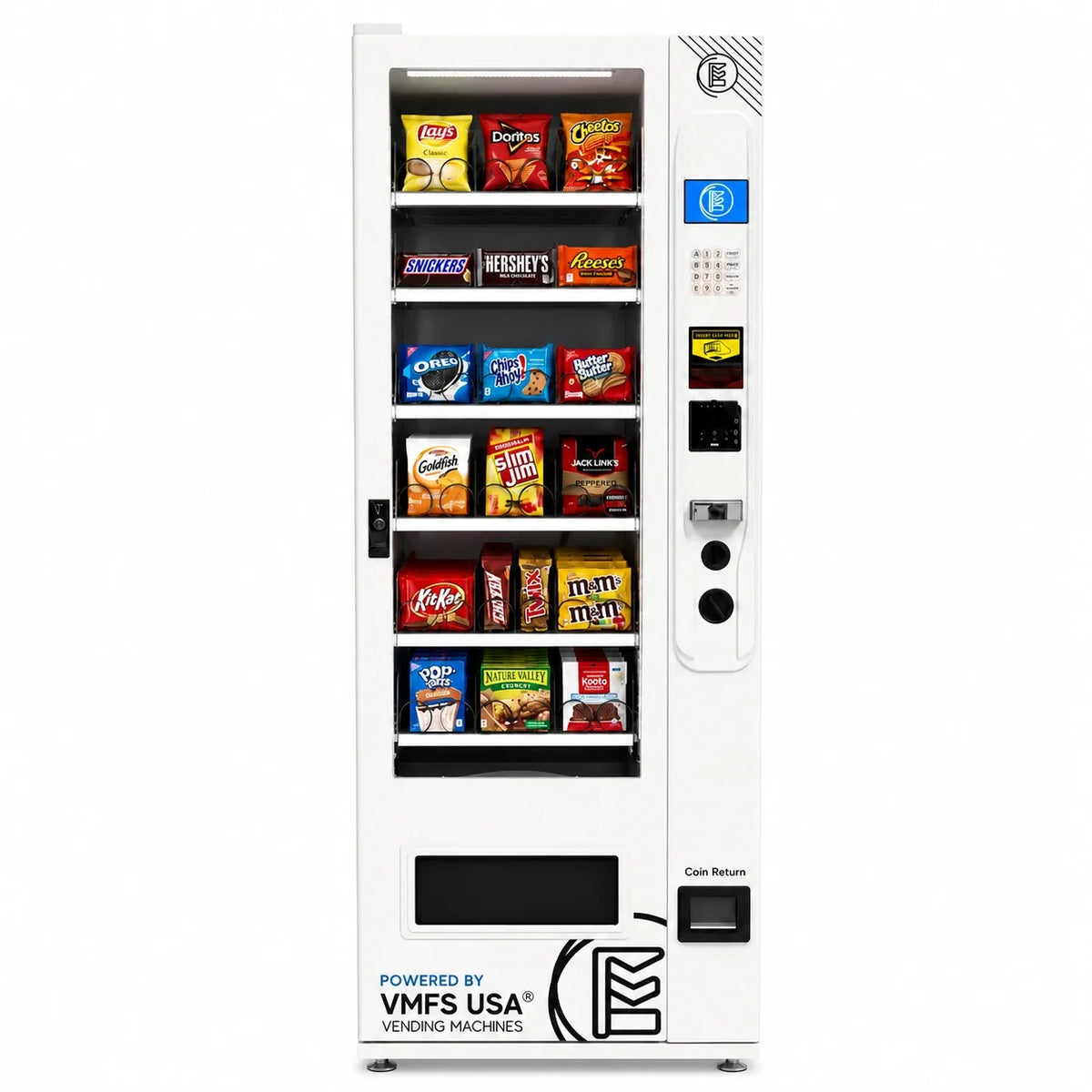
The Countertop Snack Vending Machine is the lowest-priced new VMFS machine, built for countertops, kiosks and small offices you host yourself. It is cashless-only, so budget the $450 card reader upgrade.
Classic combo: $3,450
The Seaga SM2300 SnakMart Combo puts snacks and refrigerated drinks in one compact cabinet for small break rooms; a card reader is a $550 add-on.
Slim footprint: $3,950 refrigerated
The Slim Combo Vending Machine pairs a narrow footprint with refrigerated storage for sites where floor space is short. A snacks-only version is $3,650.
Strong sites: $4,950 refrigerated
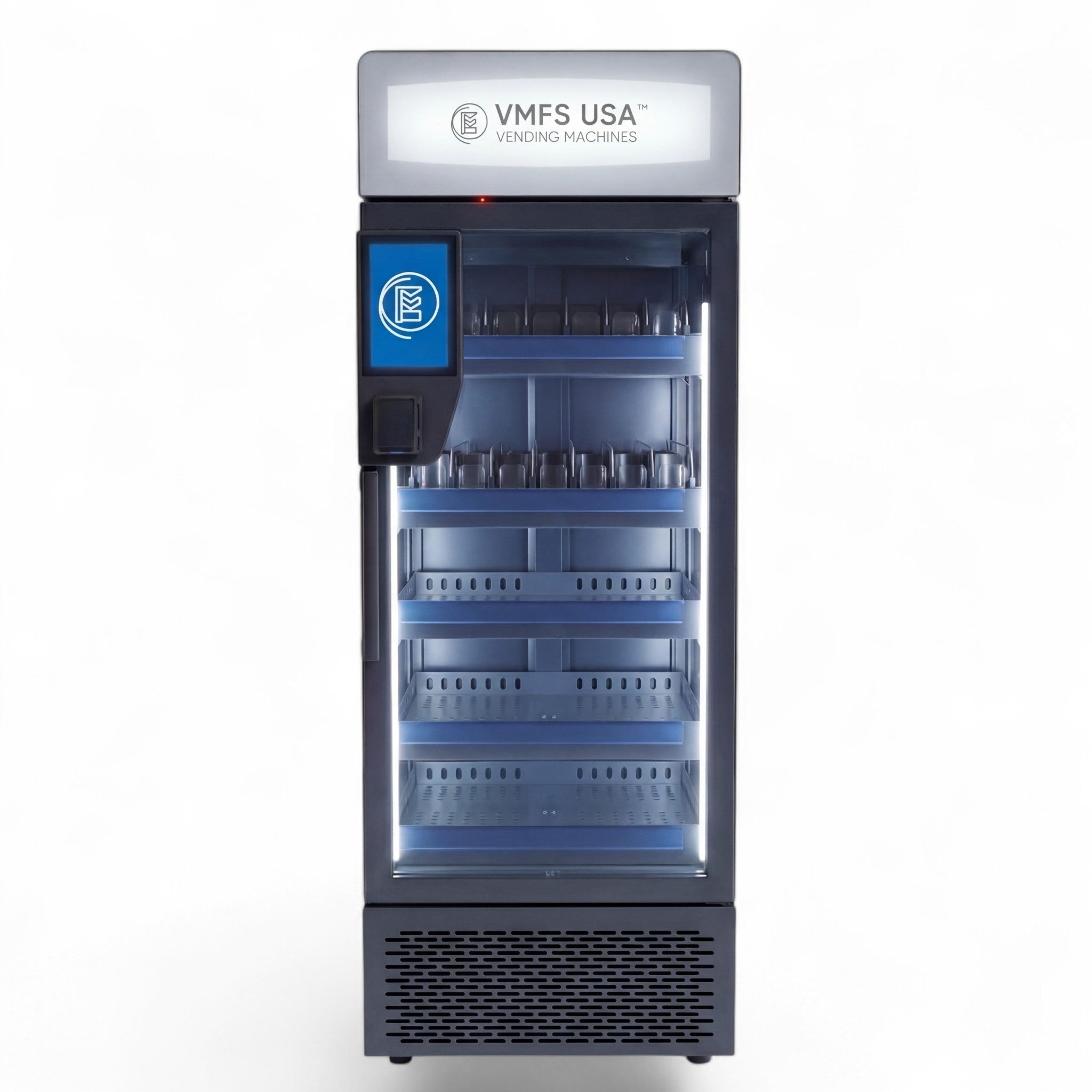
The Smart Combo Vending Machine offers up to 60 adjustable slots, modern payments and cloud management for busier locations.
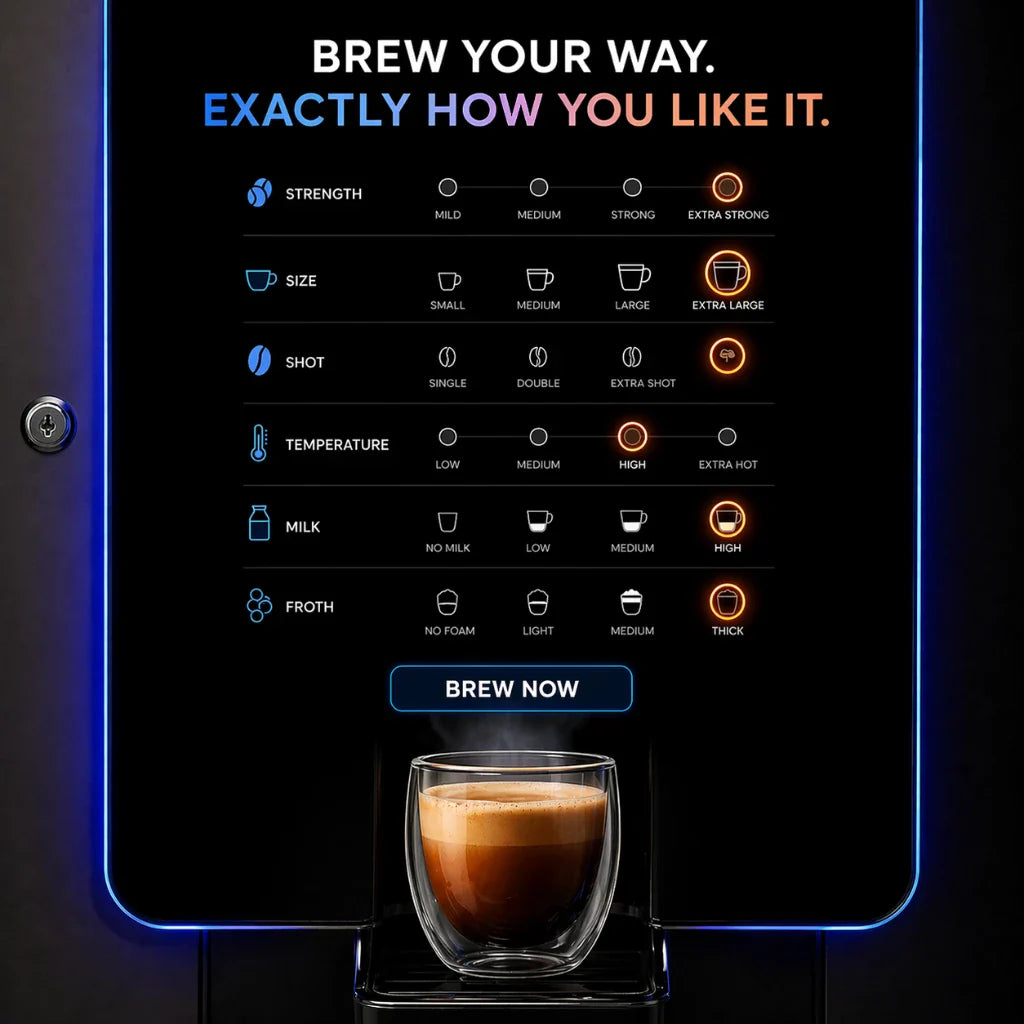
Browse the full range of combo vending machines, or compare snack vending machines and drink vending machines if your site leans one way. Specialty categories such as coffee or age verification vending machines can carry higher tickets, but they add product, compliance and demand risk, so most investors add them after their first placements have proven themselves. Screen-equipped advertising vending machines can add a second revenue line from paid ads at high-visibility sites.
New equipment usually pays back more predictably than used. A refurbished machine is cheaper on paper, but older models may need upgrades to take cards, parts for discontinued models are hard to find, and an unknown repair history can erase the savings. Our buying a vending machine guide compares the options in detail, and the cashless payment system guide explains what to look for in a reader. ENERGY STAR certified refrigerated machines also trim the electricity line, which matters more when you run many machines.
Start with one well-qualified location, buy the machine that fits it, track the numbers for two to three months, then use the cash flow to add machines on the same route. The steps below assume you are buying and operating your own machines.
Most failed vending investments trace back to a few avoidable decisions: buying a machine before securing a location, accepting a low-traffic spot because it was easy to get, skipping card readers to save a few hundred dollars, scattering machines across a wide area so the drive eats the profit, and never reviewing weekly sales. Successful investors do the opposite. They visit several sites before choosing, keep machines clean and full so buyers trust them, treat each placement as an asset with a performance target, and relocate a machine that misses it instead of hoping it improves.
When the first machine is stable, scale on the same loop rather than chasing distant sites. Every new placement should pass the same traffic test as the first, arrive with a card reader already fitted, and report into the same dashboard so you can compare machines side by side.
Ready to place your first machine?
Compare combo machines that serve snacks and drinks from one cabinet and pay one commission per site.
Shop Combo Vending Machines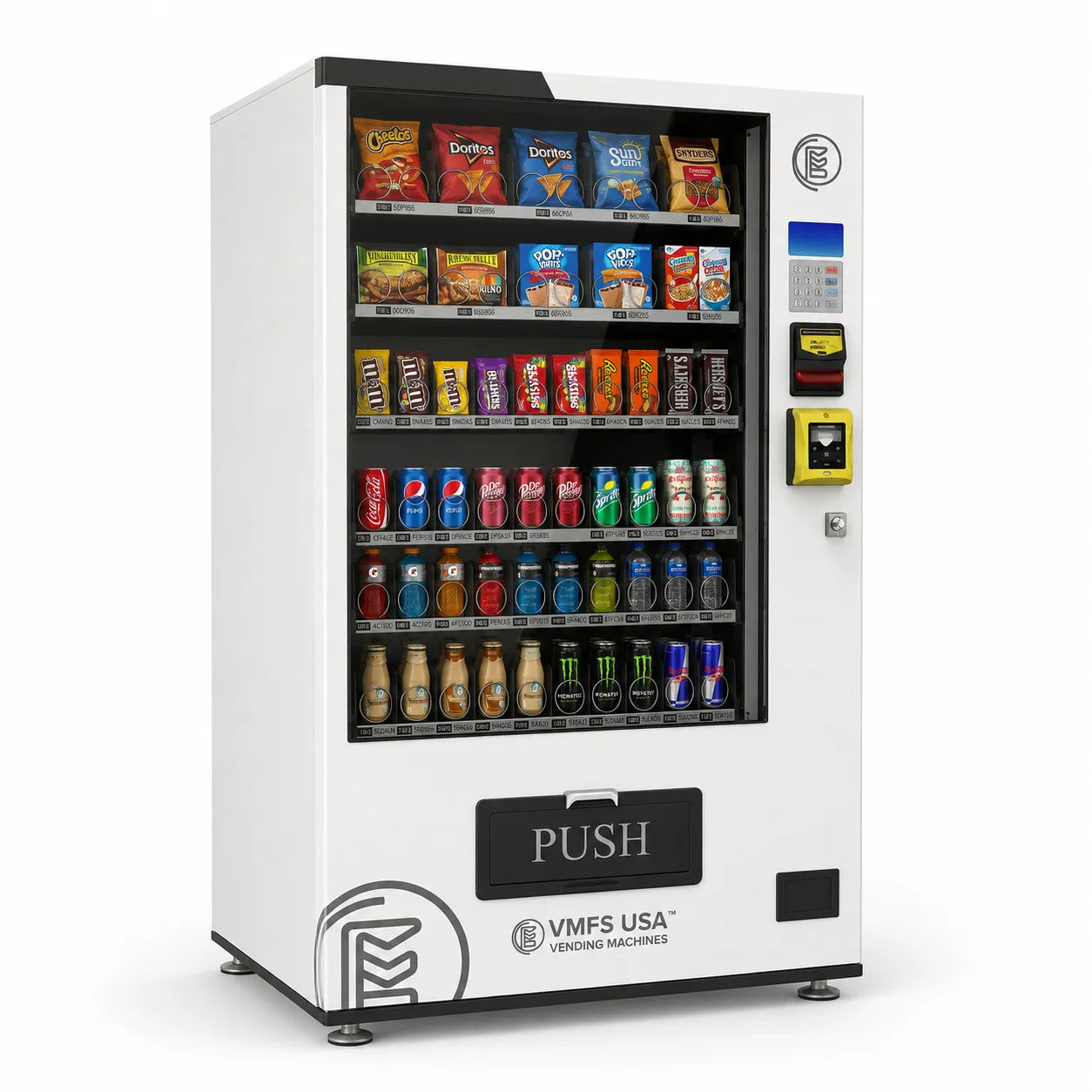
Share:
Coffee Vending Machines Surge In 2025: Why The Coffee Vending Machine Market Is Expanding Faster Than Ever
Coffee Vending Machines Surge In 2025: Why The Coffee Vending Machine Market Is Expanding Faster Than Ever