



Design the perfect vending solution for your location and customers.

Sales, inventory and alerts for your whole route, from one machine to a fleet.
Answer a few questions about your location, products and budget and get a shortlist.
Estimate revenue, payback period and margin before you buy.
Sales, setup help, warranty and parts from the VMFS USA team.
Join the VMFS newsletter and step into a thriving network dedicated to collective success.
One signup. Endless possibilities.
The best coffee machine for an office is a fully automated bean-to-cup commercial system because it provides high cup-per-minute throughput, fresh whole-bean espresso extraction, low cost per serving, and automated self-cleaning cycles. Workplace beverage demands vary significantly based on headcounts, peak morning consumption windows, water plumbing access, and breakroom space constraints.
Determining which coffee machine is best for office use involves analyzing daily drink counts, drink customization needs, plumbing infrastructure, and long-term operating costs.
Daily cup volume dictates the internal boiler volume, grinder burr rating, and waste container capacity needed for reliable operation. Small offices with fewer than 25 employees average 30 to 50 cups per day, whereas mid-sized headquarters with 100 employees require 150 to 250 cups per day.
Peak hour demand requires high-performance dual-boiler systems or high-wattage thermoblocks because back-to-back beverage requests drop internal water temperature in residential-grade units. When water temperature drops below 195°F (90°C), coffee extractions turn sour and under-extracted due to incomplete soluble compound dissolution.
Commercial units built for high throughput process individual espresso shots in 25 to 30 seconds and dispense milk specialty beverages in under 45 seconds. Rapid cycle speed prevents breakroom bottlenecks and maintains employee productivity during morning shift arrivals.
Beverage quality relies on precise grind particle distribution, water temperature stability between 195°F and 205°F, and consistent pump pressure. Flat steel or ceramic burr grinders deliver uniform particle size, preventing fine particles from clogging internal mesh filters or causing bitter over-extraction.
Modern workplace demographics expect specialty beverage variety, including lattes, cappuccinos, flat whites, americanos, hot chocolate, and warm water for tea. Advanced automated machines house multi-canister systems containing whole bean hoppers alongside soluble powders like non-dairy creamer, cocoa, and specialized chai powders.
Automatic milk texturing modules draw fresh milk from refrigerated side units or mix premium soluble milk powders using high-speed whisk motors spinning at 12,000 RPM. Rapid rotation creates micro-foam emulsion without manual steam wand operation or barista intervention.
Plumbing connectivity determines whether a machine requires manual water reservoir management or operates autonomously via direct line connection. Plumbed systems draw water continuously through a 3/8-inch dedicated water line, eliminating manual refill labor and preventing dry-boiler heating damage.
Water filtration systems protect internal boilers from scale buildup caused by calcium and magnesium ion precipitation. Scale accumulation insulates heating elements, increases energy consumption by up to 30%, and clogs internal 2-way and 3-way solenoid valves.

Commercial installation requires multi-stage filtration units featuring sediment removal, active carbon absorption, and ion-exchange resin softening. Maintaining total dissolved solids (TDS) between 75 ppm and 150 ppm ensures optimal flavor extraction while extending internal plumbing life. Facilities managers should review the complete coffee vending machine installation guide prior to plumbing configuration.
Total cost of ownership encompasses initial hardware purchase price, consumable ingredients, electrical consumption, preventive maintenance, and water filter replacements over a 5-year operational lifecycle. Bean-to-cup systems feature higher upfront equipment costs but deliver substantially lower cost-per-cup metrics than pod systems.
Whole coffee beans cost approximately $0.12 to $0.22 per 10-gram espresso shot, whereas commercial coffee pods cost $0.75 to $1.25 per serving. An office consuming 150 cups per day saves over $25,000 annually by transitioning from single-serve pods to an automated bean-to-cup machine.

Reviewing a comprehensive coffee vending machine price guide helps procurement teams evaluate capital expenditure against ongoing operating budgets. The financial model below demonstrates cost projection metrics across primary office coffee technologies.
Commercial coffee equipment spans multiple operational categories, each engineered for distinct spatial footprint, volume throughput, and beverage customization targets.
Understanding how do coffee vending machines work helps workplace planners choose between countertop bean-to-cup models and high-capacity floor-standing units. Countertop bean-to-cup machines integrate burr grinders, hydraulic tamping pistons, thermoblock heaters, and ingredient dosers within a compact cabinet.
Matching equipment specifications to team headcount ensures long-term operational reliability and prevents equipment burnout. Browse the full collection of commercial coffee vending machines to compare model specifications and capacity ratings.
Small offices require compact equipment that delivers premium espresso drinks without consuming valuable breakroom counter space or requiring complex plumbing modifications.
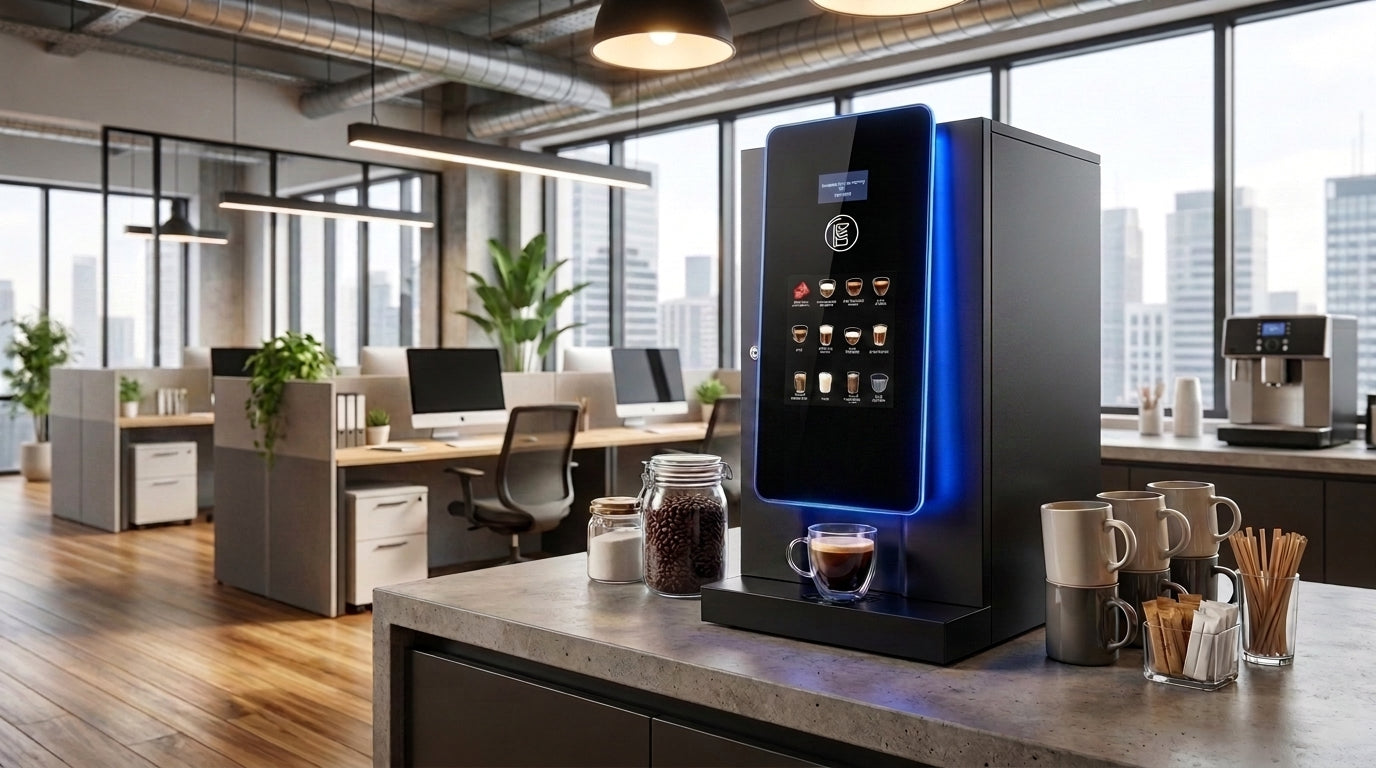
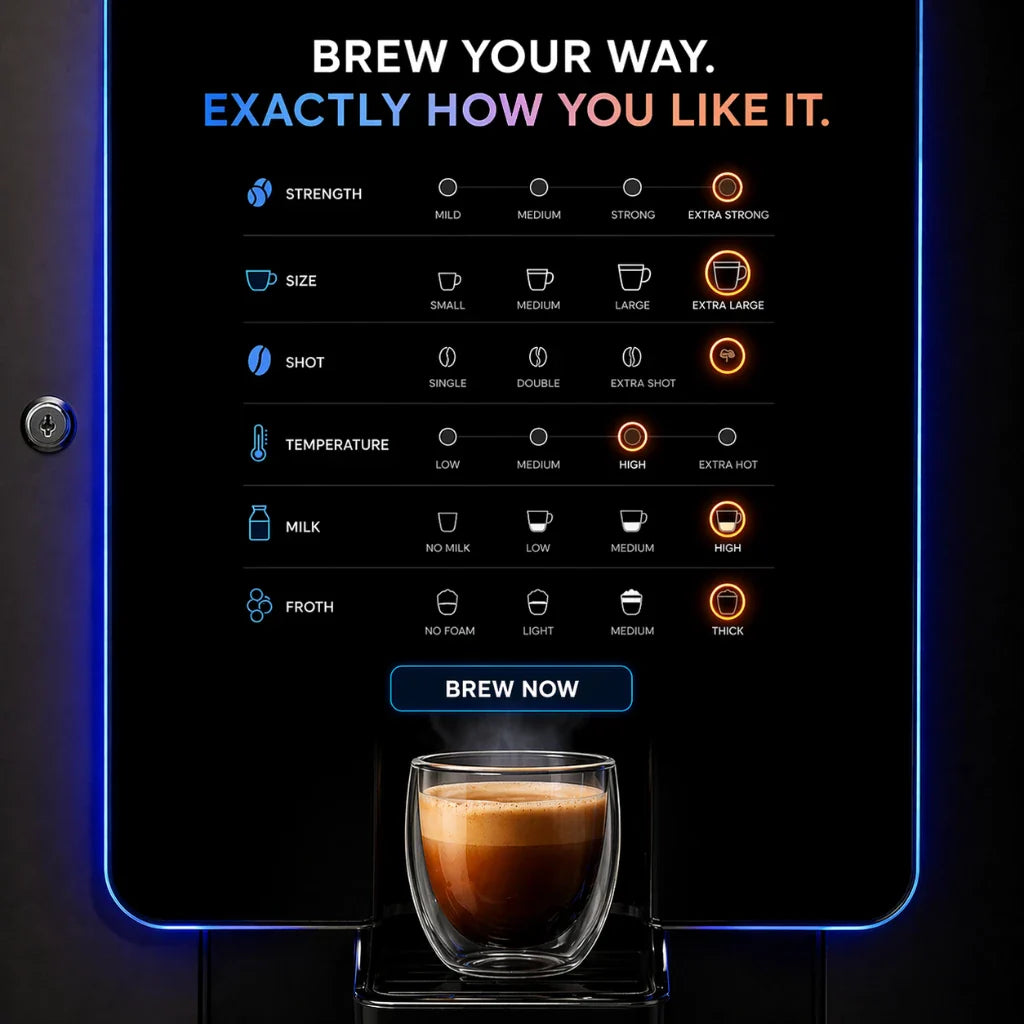
The Premium Countertop Touch Screen Coffee Machine is engineered specifically for small businesses, executive suites, and satellite offices seeking high-end beverage quality in a sleek footprint. It features an intuitive digital touchscreen interface that allows employees to select custom espresso strength, water volume, and beverage type with one touch.
Throughput Capacity: Rated for up to 150 cups per day with a rapid 30-second extraction cycle.
Fluid System: Dual-mode water access supports both direct water line connection and a removable internal reservoir.
Grinding System: Precision ceramic burr grinder with adjustable grind settings to prevent bean scorching.
Pros: Compact aesthetic, intuitive touch UI, low daily cleaning overhead, whisper-quiet grinding.
Cons: Requires manual powder canister refills in non-plumbed configurations.
For work-from-home leaders or micro-offices, evaluating the best coffee machines for home office 2025 provides additional perspective on smaller spatial layouts.
Mid-sized corporate environments need commercial durability, fast drink prep speeds, and dual bean capacity to prevent morning coffee line delays.
The Pro Coffee Vending Machine provides the ideal balance of heavy-duty commercial brewing architecture and automated beverage dispensing speed. Outfitted with high-capacity hoppers and commercial flat steel burr grinders, it processes continuous drink orders without thermal recovery pauses.
Throughput Capacity: Engineered for 200 to 300 daily servings under continuous operation.
Canister Configuration: Dual bean hoppers paired with three soluble powder canisters for lattes, mocha, and hot chocolate.
Smart Telemetry: Cloud connectivity monitors real-time bean levels, cup counts, and preventive maintenance alerts.
Pros: Rapid beverage delivery under 45 seconds, heavy-duty boiler, flexible recipe programming.
Cons: Demands dedicated counter space and a direct 3/8-inch water line connection.
For organizations evaluating broader operational models, reviewing commercial coffee vending machines highlights how medium-duty systems streamline breakroom management.
Large corporate headquarters, manufacturing plants, and high-density call centers demand industrial-grade coffee hardware capable of operating 24/7 with minimal refill intervention.
The CorePro Coffee Vending Machine is an industrial commercial workstation built for extreme volume demands. It incorporates commercial brewing groups, high-capacity waste bin storage, and optional automated cup-dispensing mechanisms to handle heavy morning rushes seamlessly.
Throughput Capacity: Built for heavy duty performance exceeding 400+ cups per day.
Payment Ready: Compatible with MDB protocols, credit card readers, contactless mobile payments, and employee badge scanners.
Sanitation Engineering: Automated steam cleaning and internal fluid line flushing cycles prevent milk residue accumulation.
Pros: Maximum operational autonomy, industrial component longevity, full telemetry suite.
Cons: Higher initial capital investment requiring planned floor or counter allocation.
Organizations expanding into multi-station setups can consult ultimate guide to office coffee machines for enterprise fleet management strategies.
Breakroom integration requires verifying physical dimensions, electrical circuits, water plumbing, and ventilation clearances before equipment delivery.
Verifying exact physical specs via standard coffee vending machine dimensions prevents installation delays caused by low upper cabinets or inadequate counter depth. Countertop machines typically measure 16 to 22 inches in width, 20 to 24 inches in depth, and 24 to 30 inches in height.
Electrical infrastructure must support the high wattage drawn by commercial heating boilers. Compact systems operate on standard 120V / 15A dedicated lines, whereas high-throughput industrial units require 208V / 20A single-phase circuits to power dual heating elements simultaneously.
Proper employee orientation reduces operational errors and improper machine handling. Reviewing guidelines on how to use a coffee machine in office breakrooms helps staff operate digital touchscreens and handle bean hoppers correctly.
Routine preventive maintenance preserves extraction flavor quality, prevents internal scale buildup, and extends commercial machine lifespans beyond 7 years.
Automated bean-to-cup equipment performs self-rinsing cycles during startup and shutdown to clear coffee oils from internal spouts. Following a comprehensive coffee vending machine cleaning and maintenance guide reduces service calls and prevents flavor contamination between beverage dispenses.

Commercial milk lines require daily sanitation using food-safe alkaline cleaning solutions to dissolve butterfats and milk proteins. Neglecting milk line sanitation causes bacterial buildup, clogs micro-foam aeration nozzles, and degrades beverage foam quality.
Descaling frequency depends on water hardness levels measured in grains per gallon (GPG). Automated machines track water flow volume via internal flowmeters and prompt operators when descaling is required.
Modern office coffee machines incorporate telemetry modules to support flexible payment options, subsidized employee perks, and automated inventory management.
Integrating cashless payment systems for coffee vending machines allows organizations to offer subsidized employee coffee while charging external guests standard retail rates. Internal MDB (Multi-Drop Bus) architecture connects card readers, mobile wallet processors, and company RFID badge readers directly to the main control board.
Cloud telemetry systems transmit operational data to facilities managers in real time. Telemetry hardware monitors ingredient canister levels, tracks daily cup counts, detects internal component faults, and triggers automated reordering of whole beans and soluble powders.
Analyzing industry forecasts in the coffee vending machine market 2025 report highlights how IoT telemetry and touchless mobile ordering continue to reshape corporate breakroom amenities.
Selecting an office coffee machine requires matching thermal heating capacity and grinder durability to employee volume. Commercial breakrooms experience concentrated operational spikes between 8:00 AM and 10:00 AM when up to 70% of total daily coffee consumption occurs.
Under-specifying commercial hardware leads to thermo block thermal degradation, long queues, brew delay, and frequent mechanical failure. Conversely, over-specifying equipment for a small office unnecessarily increases upfront capital expenditure and daily sanitation overhead.
Modern commercial units utilize bean-to-cup technology to grind whole coffee beans immediately before extraction under 15 bars of pump pressure. This process yields superior crema, aroma, and flavor consistency compared to pre-ground drip batch brewers or expensive single-serve pod systems. Exploring specialized best office coffee machines allows office managers to align operational expenditure with staff satisfaction goals.
The Premium Countertop Touch Screen Coffee Machine is the best choice for small offices because it delivers fresh bean-to-cup espresso drinks in a compact footprint with minimal daily cleanup.
Bean-to-cup automated commercial machines minimize cost per cup because bulk whole coffee beans cost between $0.15 and $0.25 per serving compared to $0.75 to $1.25 for single-serve pods.
Direct plumbing is recommended for medium and large offices to eliminate manual reservoir refilling, though many countertop units offer optional internal water tanks for flexible placement.
Commercial bean-to-cup machines require 5 minutes of daily maintenance to empty grounds bins and flush milk lines, alongside automated monthly descaling cycles.
A commercial-grade office coffee machine lasts 5 to 7 years when serviced according to manufacturer maintenance schedules and operated with proper water filtration.
Yes, modern commercial machines feature modular internal configurations that support fresh milk refrigeration units alongside soluble powder canisters for cocoa and non-dairy options.
Most countertop commercial coffee machines run on standard 120V / 15A grounded circuits, while heavy-duty enterprise models may require dedicated 208V / 20A lines.
Telemetry systems monitor bean levels, cup counts, and mechanical status remotely, allowing facilities teams to automate supply orders and resolve maintenance issues proactively.
A 50-person office averaging 2 cups per employee daily consumes approximately 2.2 pounds (1 kg) of whole coffee beans per day based on a standard 10-gram espresso dosage.
Buying outright yields the highest long-term ROI and lowest cost per cup, whereas leasing provides lower initial capital expenditure and bundled maintenance agreements for large enterprises.
Compartir:
VMFS Cloud - Modernizing Vending Operations Through End-to-End Automation
Reinvesting Profit vs. Taking Income Out - Operator’s Cash Allocation Guide