


The Complete Guide
Learn the Fundamentals behind working of Coffee Vending Machines
From bean-to-cup brewing cycles and component diagrams to payment systems, maintenance schedules, and buying criteria — everything operators and buyers need in one place.
400B+
cups of coffee consumed globally per year
~90s
average full brew cycle on modern bean-to-cup machines
$3–$7
typical retail price per cup in US offices & venues
$18–32K
commercial bean-to-cup machine price range (2025)
Table of Contents
- What Is a Coffee Vending Machine?
- Types of Coffee Vending Machines
- Coffee Vending Machine Components
- The Brewing Process — Step by Step
- How to Use a Coffee Vending Machine
- Payment Systems & Connectivity
- Pros & Cons for Operators
- Machine Type Comparison Table
- Maintenance & Cleaning Essentials
- Buying Criteria Checklist
- Frequently Asked Questions
What Is a Coffee Vending Machine?
A coffee vending machine is a self-contained beverage dispenser that automates the entire coffee-making process — grinding, brewing, mixing, and dispensing — without any human operator involvement. The customer selects a drink, pays, and receives a freshly prepared cup in under 90 seconds.
Modern commercial Hot coffee vending machines are not simple hot-water dispensers pouring into a powder packet. They are sophisticated electro-mechanical systems combining a burr grinder, high-pressure boiler, precision dosing mechanisms, and cloud-connected payment hardware. That distinction matters enormously to buyers, operators, and anyone evaluating how coffee vending machines work at a technical level.
Why the category is growing: The US office coffee service market exceeded $5.9 billion in 2024, and bean-to-cup vending is the fastest-growing segment — driven by the expectation of barista-quality drinks without staffing costs. See the full 2025 market analysis →
Types of Coffee Vending Machines
The category breaks into four distinct machine architectures, each optimized for a different volume, drink quality, and footprint profile.
| Type | How Coffee Is Stored | Brew Quality | Best For |
|---|---|---|---|
| Bean-to-Cup | Whole coffee beans in hopper | Highest — freshly ground per cup | Offices, hotels, high-traffic venues |
| Instant / Powder-Based | Pre-mixed soluble powder canisters | Moderate — consistent but not fresh-ground | Budget deployments, low-traffic locations |
| Capsule / Pod | Single-serve proprietary capsules | High — sealed for freshness | Small offices, boutique settings |
| Filter / Drip-Style | Ground coffee or pods in brew basket | Moderate-High | Breakrooms, cafeterias needing volume |
Bean-to-cup machines dominate the commercial vending landscape because they deliver the broadest menu — espresso, Americano, cappuccino, latte — from a single unit. Powder-based machines are cheaper to purchase and service but sacrifice taste consistency over time as canisters absorb ambient humidity.
Coffee Vending Machine Components
Understanding a coffee vending machine diagram starts with its core subsystems. Every commercial machine — regardless of brand or model — shares the same functional architecture below, though component quality and configuration vary significantly.
Core Component Overview
Bean Hopper
Sealed airtight container (400–2,000g capacity) storing whole beans. Some models include a second hopper for decaf or a second origin.
Burr Grinder
Flat or conical ceramic/steel burrs produce uniform particle size. Grind coarseness adjusts via motorized burr spacing (typically 5–12 positions).
Boiler / Thermoblock
Heats water to 92–96°C for optimal extraction. High-end machines use dual boilers — one for espresso, one for steam — eliminating thermal switching delays.
Brew Group / Piston
Pressurized chamber where ground coffee is tamped and water is forced through at 9 bars. The most mechanically stressed component in the machine.
Milk System
Either a fresh-milk refrigerated tank (up to 2L) or a powder-based frother. Fresh-milk systems require daily cleaning but produce superior microfoam.
Water Tank / Plumbed Line
Tank models hold 3–12L; plumbed models connect directly to a water line with an inline filter. High-volume locations (150+ cups/day) should always plumb directly.
Touchscreen Interface
7–15.6" capacitive display showing the drink menu, customization options, and payment prompts. Higher-end units support brand-customized UI skins.
Payment Module
Accepts coins, bills, contactless NFC cards, mobile wallets (Apple Pay, Google Pay), and optionally QR-code payments. EMV compliance is now standard.
Grounds Container
Collects spent coffee pucks after extraction. Typically holds 30–80 pucks before requiring emptying — a key maintenance touchpoint.
Operator note: The brew group is the single most important component to evaluate when purchasing a machine. Machines with a removable, self-cleaning brew group (e.g., Schaerer, WMF, Franke) significantly reduce technician callout frequency and extend service intervals to 3,000–5,000 cups between deep cleans.
The Brewing Process — Step by Step
The coffee vending machine process from selection to dispensing involves six tightly sequenced mechanical events, all completed in 45–90 seconds depending on drink type. Here is exactly what happens inside the cabinet the moment a customer presses "Cappuccino."
1
Selection & Payment Authorization
The customer's drink choice triggers a signal to the main control board (MCU). Payment authorization runs in parallel — the MCU will not release ingredients until the transaction is confirmed. This prevents waste from failed payments mid-brew.
2
Ingredient Dosing
The MCU triggers the grinder motor for a pre-set duration (typically 5–8 seconds) to dispense a specific bean dose — usually 7–10g for a single espresso shot. Powder-based machines simultaneously open the soluble-powder auger for a calibrated rotation.
3
Tamping & Brew Chamber Sealing
Ground coffee falls into the brew group chamber. A mechanical piston tamps the grounds at 15–30 kg of pressure, creating a uniform puck. The chamber then seals, creating the pressurized environment necessary for espresso extraction.
4
Water Heating & Pressure Build-Up
The pump (typically a vibratory or rotary gear pump) draws water from the tank or plumbed line and forces it through the boiler or thermoblock. At 93°C and 9 bars of pressure, water is pushed through the coffee puck — this is the defining physics of espresso extraction.
5
Extraction & Mixing
Hot pressurized water extracts soluble compounds from the coffee puck in 20–30 seconds. The resulting espresso combines with hot water (Americano), hot water + powder milk (latte), or steamed/frothed milk (cappuccino) through a mixing chamber before reaching the cup.
6
Dispensing & Ejection
The finished drink is dispensed through a calibrated outlet nozzle into the cup drop zone. Simultaneously, the brew group ejects the spent coffee puck into the grounds container, and the chamber rinses with a short water flush — preparing for the next cycle.
The 9-bar rule: Espresso requires water forced through compressed coffee grounds at exactly 9 bars of pressure (approximately 130 PSI). Machines operating below this threshold produce under-extracted, sour shots. Above 11 bars, over-extraction produces harsh, bitter flavors. Pump calibration is one of the first checks any technician performs during a service call.
The working of Iced Coffee Vending Machine is slightly different than the hot machine
How to Use a Coffee Vending Machine
Operating a modern touchscreen coffee vending machine is intuitive, but the sequence matters — especially for machines with fresh-milk systems that require a specific cup placement before the cycle begins.
1
Place Your Cup
Position the cup in the dispensing zone. Fresh-milk machines begin milk steaming as soon as brewing starts — a misplaced cup means spills.
2
Select Drink
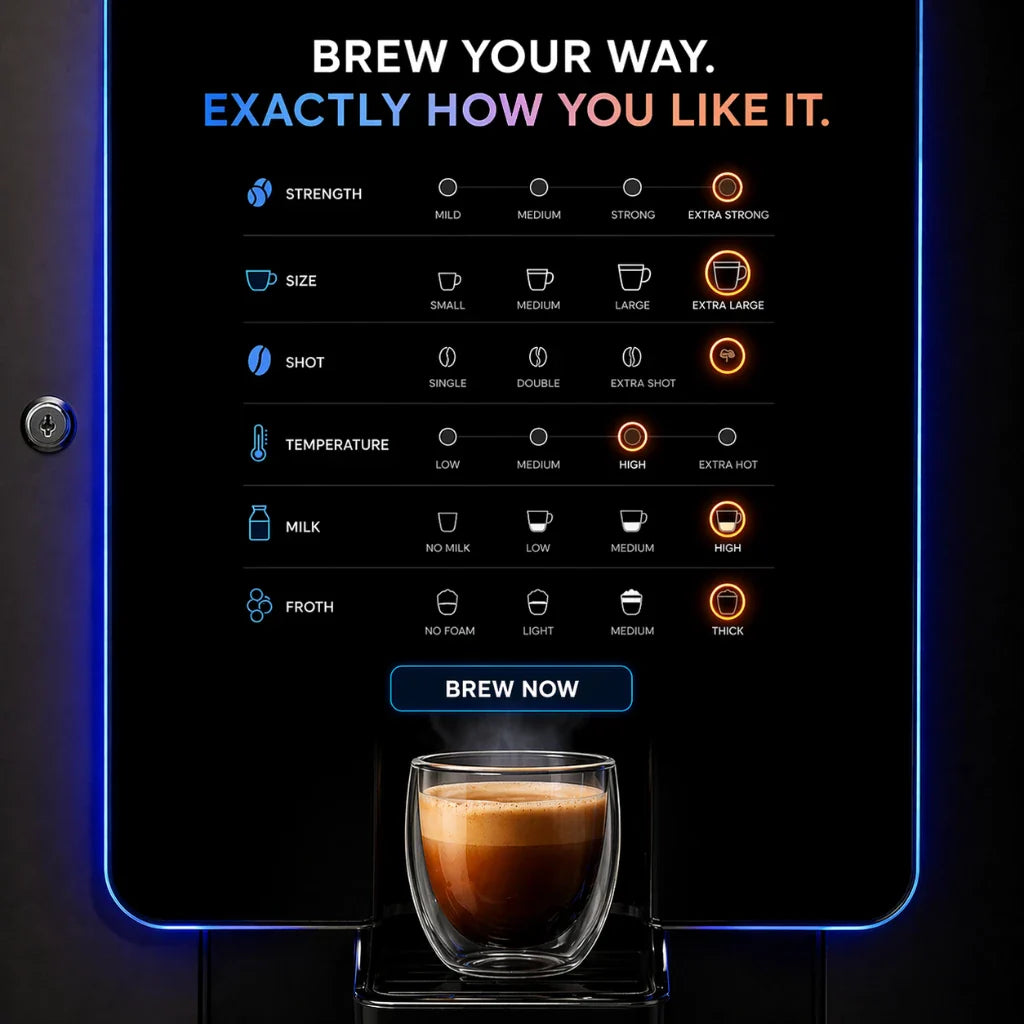
Tap your choice on the touchscreen. Most machines offer size options (small / medium / large) and strength adjustment (mild / regular / strong).
3
Customize (Optional)
Add extra shot, adjust sugar level, select non-dairy milk if available. Customization depth varies significantly by machine model.
4
Pay
Tap card, mobile wallet, or insert coins/bills. Contactless is now default on 90%+ of new commercial installations in the US.
5
Wait for Brew
The display shows a brewing animation and countdown. Bean-to-cup: 60–90 seconds. Instant/powder: 20–35 seconds.
6
Collect & Go
Remove cup when the dispensing chime sounds. Hot beverages — the cup will be hot; use the cup sleeve if provided.
For a detailed walkthrough with model-specific tips, see our dedicated guide on how to use a coffee vending machine, and our companion article covering how to use a coffee machine in an office setting.
Payment Systems & Connectivity
Payment Options on Modern Machines
Payment technology has become a primary differentiator between machines. An operator choosing a unit without contactless payment in 2025 is actively losing revenue — studies consistently show contactless-enabled machines achieve 15–25% higher transaction volumes than cash-only units at comparable locations.
| Payment Method | Hardware Required | Transaction Fee (Typical) | Best For |
|---|---|---|---|
| Coin Mechanism | Multi-coin acceptor | None | Low-tech, transit, outdoor |
| Bill Validator | Bill acceptor + stacker | None | High-denomination locations |
| Credit/Debit (EMV) | Chip card reader | 2.0–2.9% | General commercial |
| NFC Contactless | NFC antenna + reader | 2.0–2.9% | High-traffic, modern venues |
| Mobile Wallet (Apple/Google Pay) | NFC module | 2.0–2.9% | Younger demographics |
| QR Code (WeChat, Venmo) | Display screen + QR generator | 0.5–1.5% | International venues, campuses |
| RFID / Employee Badge | RFID reader + back-end account system | Varies by agreement | Corporate offices, hospitals |
Remote Monitoring & Telemetry
Commercial coffee vending machines built after 2020 almost universally include a cellular or Wi-Fi telemetry module. This sends real-time data — cups dispensed, canister fill levels, error codes, and sales by drink type — to an operator dashboard. Telemetry is not a luxury feature for operators running more than 10 machines; it's the difference between proactive refilling and arriving to find a machine out-of-stock for two days.
Leading platforms like Nayax VPOS, Cantaloupe Seed, and Vendon integrate directly with most commercial machines, providing both payment processing and inventory telemetry in a single hardware module.
Pros & Cons for Operators
✓ Advantages
- Zero staffing cost — machine operates 24/7 without a barista
- Consistent product quality regardless of human variable
- High-margin product: $0.30–$0.80 ingredient cost vs. $3–$7 retail price
- Telemetry enables remote inventory management across many locations
- Bean-to-cup machines serve 8–12 drink variants from a single SKU footprint
- Low footprint — most machines require 0.6–1.0 m² of floor space
✗ Disadvantages
- High upfront capital: $8,000–$32,000 for quality bean-to-cup units
- Brew group and milk system require daily cleaning discipline
- Mechanical failures (pump, grinder, board) require specialized technicians
- Fresh-milk systems add a perishable product management layer
- Strong consumer preference for brand names (Starbucks, Costa) limits perceived value in some locations
- Water quality directly impacts taste and component longevity — filtration is non-optional
For a full profitability analysis with location-specific ROI calculations, read our guide on whether coffee vending machines are profitable.
Machine Type Comparison Table
| Feature | Bean-to-Cup | Instant / Powder | Capsule / Pod | Filter / Drip |
|---|---|---|---|---|
| Drink Quality | ★★★★★ | ★★★ | ★★★★ | ★★★ |
| Machine Cost (USD) | $8K–$32K | $1.5K–$8K | $2K–$10K | $800–$5K |
| Ingredient Cost / Cup | $0.40–$0.80 | $0.15–$0.35 | $0.50–$1.10 | $0.12–$0.30 |
| Menu Width | 8–20 drinks | 6–14 drinks | 4–8 drinks | 1–3 variants |
| Daily Service Need | High (grinder, milk) | Low | Medium (pod waste) | Medium |
| Plumbing Required | Optional (recommended) | No | No | Optional |
| Capacity (Cups/Day) | 100–400 | 100–300 | 50–150 | 50–200 |
| ROI Timeline | 12–24 months | 6–12 months | 10–18 months | 4–10 months |
Need help choosing the right machine for your location type and volume? Compare the best coffee machines for home and office in 2025 or explore our roundup of best office coffee machines by venue size.
Maintenance & Cleaning Essentials
The lifespan of a commercial coffee vending machine is directly proportional to cleaning discipline. Machines that are not cleaned on schedule accumulate coffee oils, milk residue, and limescale — all of which degrade flavor, cause blockages, and accelerate component wear.
Daily Maintenance Tasks
- Empty grounds container — do not wait for a full-container alarm; overflowing grounds contaminate the brew group.
- Rinse milk circuit — all fresh-milk systems must be fully flushed at end of service to prevent bacterial growth (critical for food safety compliance).
- Wipe drip tray and dispensing zone — sugar residue and coffee splatter harbor bacteria and attract pests in food-service environments.
- Check water level / filter indicator — tank-fed machines need daily topping; filter indicators prevent hard-water damage to the boiler.
Weekly Maintenance Tasks
- Run a full cleaning tablet cycle through the brew group (usually triggered via the service menu).
- Descale the milk system if a steam-based frother is used.
- Check and clean the bean hopper for old or oily beans — stale beans jam the burr grinder's feed channel.
Monthly / Quarterly Service
Every 3,000–5,000 brew cycles, the brew group gaskets, piston seal, and filter screens should be inspected and replaced as needed by a qualified technician. Skipping this interval is the single most common cause of premature pump failure, which is one of the most expensive repairs on a bean-to-cup machine ($200–$600 parts + labor).
Water filtration is non-negotiable. A single-pass activated-carbon filter with a scale inhibitor removes chlorine (flavor impact) and calcium (limescale). Filter cartridges typically need replacement every 300–500 liters, or roughly every 4–8 weeks at moderate-volume locations.
📋 Operator tip: Log every cleaning cycle in a maintenance sheet attached to the machine. Location managers expect this record, and it protects you during equipment warranty disputes with the manufacturer.
Buying Criteria Checklist
Before committing capital to a machine, evaluate these eight criteria against your specific location profile. A machine ideal for a 200-person corporate campus is wrong for a 30-person office — and vice versa.
| # | Criteria | Why It Matters | Threshold to Clear |
|---|---|---|---|
| 1 | Daily Cup Volume | Drives ROI and determines cleaning frequency | Match machine capacity to 70% of projected daily demand |
| 2 | Water Connection | Plumbed vs. tank affects servicing labor | Plumb if >80 cups/day |
| 3 | Contactless Payment | Directly impacts transaction volume | NFC + mobile wallet mandatory for 2025 placements |
| 4 | Brew Group Serviceability | Removable = faster, cheaper servicing | Self-rinsing, removable brew group preferred |
| 5 | Milk System | Fresh vs. powder changes menu quality and servicing complexity | Fresh milk only if daily cleaning is guaranteed |
| 6 | Telemetry | Remote monitoring cuts restocking trips | Built-in cellular telemetry or compatible 3rd-party module |
| 7 | Footprint & Power | Space and electrical constraints at location | Confirm 220V availability for high-wattage boiler models |
| 8 | Warranty & Service Network | Downtime = lost revenue at $150–$400/day | Parts warranty ≥2 years; local authorized technician <50 miles |
If you're evaluating starting a full coffee vending operation rather than a single machine, read our complete guide on how to start a coffee vending machine business and the operational deep-dive on coffee vending routes and operations.
📚 Continue Reading — VMFS Coffee Vending Resource Library
- How Do Coffee Vending Machines Work — Technical Deep Dive
- How to Use a Coffee Vending Machine — Step-by-Step User Guide
- How to Use a Coffee Machine in an Office Environment
- The Ultimate Guide to Office Coffee Machines
- Best Office Coffee Machines — Reviewed by Use Case
- Best Coffee Machines for Home & Office 2025
- Coffee Vending Machine Market Report 2025
- Coffee Vending Routes & Operations Guide
- How to Start a Coffee Vending Machine Business
- Are Coffee Vending Machines Profitable?
Browse the Full Coffee Vending Machine Collection
Bean-to-cup, instant, and capsule machines — commercial-grade units ready for office, hospitality, and route deployment across the US.
View Coffee Vending MachinesFrequently Asked Questions
A bean-to-cup machine grinds whole coffee beans on demand using a built-in burr grinder, then forces hot water at 9 bars through the freshly ground coffee puck in a sealed brew group. The extracted espresso is then mixed with hot water, steam-frothed milk, or powder depending on the selected drink — all in 60–90 seconds. The spent puck is automatically ejected to a grounds container after each cycle.
The key components are: a bean hopper, burr grinder, boiler or thermoblock (heats water to 92–96°C), pump (generates 9 bars pressure), brew group (extraction chamber), milk system (fresh tank or powder frother), water tank or plumbed supply, touchscreen interface, payment module, and grounds container. The brew group is the most mechanically critical component.
Place your cup in the dispensing zone, select your drink on the touchscreen, choose size and strength if prompted, pay by contactless card or cash, then wait 20–90 seconds for the machine to complete the brew cycle before collecting your drink. Always position the cup before initiating payment on fresh-milk machines, as milk steaming begins immediately upon brewing start.
Instant and powder-based machines dispense in 20–35 seconds. Bean-to-cup machines take 60–90 seconds because the grind, tamp, extract, and mix sequence adds time. Capsule machines fall in between at 30–50 seconds. Dual-boiler bean-to-cup machines are fastest because they do not need to thermally switch between brewing and steaming temperatures.
Commercial coffee vending machines brew espresso at 9 bars of pressure (approximately 130 PSI). This is the internationally recognized standard for espresso extraction — below 7 bars produces under-extracted, sour flavors; above 11 bars causes bitter over-extraction. Most machines use a vibratory pump for smaller units or a rotary gear pump for high-volume commercial installations.
Both options exist. High-end commercial machines use a refrigerated fresh-milk tank (0.5–2L capacity) that produces genuine microfoam — the result is a café-quality cappuccino or latte. Entry-level and mid-range machines use a soluble milk powder canister, which is easier to manage and has a longer shelf life but produces noticeably thinner foam. Fresh-milk systems require a mandatory daily milk circuit flush to meet food safety standards.
Daily operator tasks include emptying grounds, rinsing the milk circuit, and wiping the dispensing zone. Weekly tasks include a cleaning tablet cycle through the brew group and checking the bean hopper. Full technical servicing — brew group gasket replacement, descaling, pump inspection — is required every 3,000–5,000 brew cycles, or every 3–6 months at moderate-volume locations. Water filter cartridges typically need replacement every 300–500 liters.
Yes — all modern commercial coffee vending machines can be equipped with cashless payment modules that accept EMV chip cards, NFC contactless cards, and mobile wallets (Apple Pay, Google Pay). Cashless-enabled machines generate 15–25% more revenue on average than cash-only equivalents at comparable locations. Platforms like Nayax and Cantaloupe Seed offer combined telemetry and payment hardware in a single retrofit unit.
A coffee vending machine is the broad category — it includes any machine that automatically dispenses coffee, whether using instant powder, capsules, or whole beans. A bean-to-cup machine is a specific subtype that stores whole coffee beans, grinds them fresh per order using an integrated burr grinder, and extracts espresso under pressure. Bean-to-cup machines produce the highest-quality output but require more maintenance and carry a higher purchase price than powder-based vending machines.
Commercial coffee vending machines range from $1,500 for entry-level powder-based units to $32,000 for premium bean-to-cup machines (Schaerer, WMF, Franke). Mid-range bean-to-cup machines from brands like Necta, Bianchi, and N&W typically fall in the $8,000–$15,000 range and are suitable for locations serving 80–200 cups per day. Leasing starts at $150–$350/month, making machine acquisition accessible without heavy upfront capital.

Share:
Coffee Vending Franchise Guide - How to Choose the Right Franchise
Coffee Vending Machine Price Guide 2026: New, Used & Cost Per Cup