


A commercial coffee vending machine is a self-serve coffee machine built to sell drinks all day: it takes cash, card or mobile payment, holds enough beans, powder and cups for about 150 to 500 drinks between refills on current VMFS models, and uses boilers, grinders and pumps rated for constant use. An industrial coffee vending machine is the same class of equipment sized and placed for factories, warehouses and multi-shift sites.
This guide explains what separates commercial equipment from home and office brewers, how to size a machine to your cups per day and break windows, what industrial sites need on top, and how the seven current VMFS USA coffee models compare on capacity, power, water and price.
What Makes a Coffee Vending Machine Commercial Grade?
A coffee vending machine is commercial grade when it is built to brew and sell hundreds of drinks a day without an attendant, which means a duty-rated boiler and grinder, large ingredient and cup capacity, payment hardware and food-contact parts designed for daily cleaning. A home or small-office brewer can share the same brewing principle, but its parts are sized for a handful of cups, so it wears out quickly once a paying crowd starts using it.
The difference shows up in four places. The first is duty cycle: a commercial machine holds water at brewing temperature all day and recovers between back-to-back orders, so the tenth cup at 8:15 a.m. tastes like the first. The second is capacity. Every current VMFS coffee model is rated by cups per refill, from up to 150 on the countertop unit to up to 500 on the floor-standing Pro, so an operator can plan service visits instead of reacting to empty hoppers. The third is payment: commercial machines accept coins, bills, cards and phones through standard vending interfaces such as MDB, the protocol that lets one machine work with readers from different payment providers. The fourth is hygiene and safety. The NSF/ANSI 25 standard sets minimum food protection and sanitation requirements for food and beverage vending machines, and UL 751 is the UL safety standard for payment-accepting vending machines, so ask any supplier which standards or certifications a model carries before you buy.
Duty-rated brewing
Boilers, pumps and grinders built for continuous cycling. The VMFS Coffee and Hot Beverage machine uses a Swiss flat burr grinder rated for more than 750,000 grinding cycles.
Capacity per refill
Bean hoppers, powder canisters and cup towers sized for 150 to 500 drinks between service visits on current VMFS models.
Vending payments
Coin, bill, card and mobile wallet acceptance through MDB-compatible hardware, so each cup is a sale rather than a free amenity.
Remote management
Sales, stock and fault data sent to a dashboard so service trips are planned from data, not guesswork.
Commercial grade is also a business decision, not only an engineering label. If the machine will sell drinks in a lobby, a hospital corridor or a plant break room, it has to survive public use, take payments reliably and stay serviceable for years. That is the standard the rest of this guide uses.
How a Commercial Coffee Vending Machine Works
A commercial coffee vending machine works by running payment, water heating, ingredient dosing and dispensing in sequence inside one cabinet, with each selection triggering a stored recipe that sets the exact amount of water, coffee and powder. That recipe control is what keeps cup quality consistent from the first vend of the day to the last.
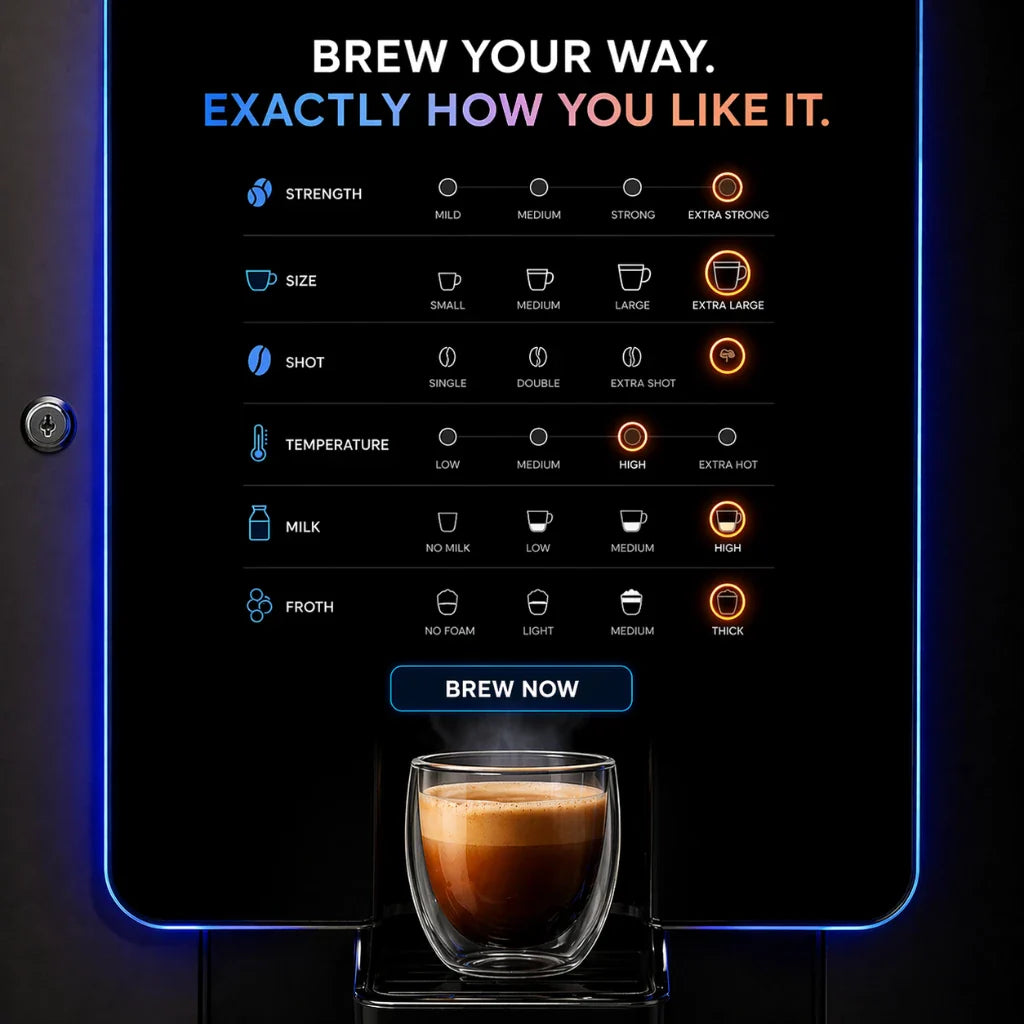
The customer pays by card, phone, cash or coin and picks a drink and cup size on a keypad or touchscreen. Water from a plumbed line or an internal tank passes through a filter and is held at brewing temperature in the boiler; the VMFS Coffee and Hot Beverage machine, for example, brews at 9 bar and a held 92°C. In a bean-to-cup machine the grinder doses fresh beans into the brew group, hot water is pushed through the grounds and the spent puck drops into a waste bin. In an instant machine, motorized augers meter soluble coffee, milk powder or chocolate into a mixing bowl where a whipper blends them with hot water. A cup drops, the drink dispenses, and the machine runs automatic rinse cycles on its mixing and brewing parts. Connected models then report the sale, ingredient levels and any fault to the operator.

Because every model follows this sequence, the real buying differences come down to brewing method, capacity per refill, drink menu, payment hardware and water supply. Our full explanation of how coffee vending machines work walks through each internal component in more detail.
Types of Commercial Coffee Vending Machines
Commercial coffee vending machines fall into six main types: bean-to-cup, instant or powder, fresh brew, countertop, iced and combination machines. Brewing method decides drink quality and service effort, while format decides where the machine can physically go.
Bean-to-cup machines
Bean-to-cup machines grind whole beans for every order and extract under pressure, so one menu can cover espresso, americano, cappuccino and latte. Every active VMFS coffee model is bean-to-cup, including the Coffee and Hot Beverage Vending Machine, which an earlier version of this guide wrongly grouped with instant machines. The trade-off is more cleaning and more parts than a powder machine, in exchange for a cup customers will pay more for.
Instant and powder machines
Instant machines mix soluble coffee and other powders with hot water. They skip the grinder and brew group, so they are mechanically simpler and quick to serve, and they suit sites where speed and low ingredient cost matter more than taste.
Fresh brew machines
Fresh brew machines meter ground coffee and brew each cup through a filter. Many fresh brew units on the market are refurbished platforms from long-established brands, which can make sense when a technician already knows the machine.
Countertop machines
Countertop machines put a full bean-to-cup system on a counter instead of a freestanding cabinet. The Premium Countertop Touch Screen Coffee Machine measures 30.2 by 16.4 by 18.2 inches, weighs 97 lbs and serves up to 150 drinks per fill, which fits reception desks and small break rooms where a property will not approve a floor unit.
Iced coffee machines
Iced machines combine a bean-to-cup brewer with refrigeration and ice production. The Iced Coffee Vending Machine has a built-in ice maker rated at 165 lbs of ice per day, holds 180 cups and serves hot or iced drinks in about 60 seconds, which matters on campuses, in gyms and across warm-climate sites.
Coffee and snack combos
Combination machines pair a coffee module with snacks or cold drinks in one cabinet. The Coffee & Snack Vending Machine serves four hot and four cold drinks alongside up to 400 packaged snacks, giving two revenue streams where a host will only approve one machine.
Commercial vs Consumer Coffee Machines
A commercial coffee vending machine costs more than a consumer or office brewer but is the only one of the two built to take payments and run under public, all-day use. A consumer machine is fine for a few people who share it for free; once strangers are paying per cup, it becomes a reliability and revenue problem.
Consumer machines lack payment hardware, remote monitoring and the large hoppers and cup towers that let a machine run for days between visits. Their boilers and pumps are sized for intermittent use, so heavy use shortens their life and every fault becomes a site visit. For a free office amenity serving a handful of people, a quality office brewer is still a reasonable choice; our roundup of the best office coffee machines compares those options, and VMFS sells office coffee machines for that use.
Commercial vending machine
- Built for hundreds of daily cycles
- Accepts cash, card and mobile payments
- Large capacity per refill and remote alerts
- Serviceable, modular parts and a written warranty
Consumer or office brewer
- Lower upfront cost, but no way to sell drinks
- Parts wear quickly under public use
- Small hoppers mean frequent refills
- No telemetry, so faults are found by users
Industrial Coffee Vending Machines for Factories and Warehouses
An industrial coffee vending machine is a commercial coffee vending machine chosen and placed for factories, warehouses, distribution centers and other multi-shift sites, where demand arrives in short, intense break windows and the surrounding environment is harder on equipment. There is no separate industrial category of coffee machine with its own standard; what makes a setup industrial is higher capacity, faster throughput, a tougher cabinet and a placement that keeps the machine out of dust and temperature swings.
That distinction matters because many listings use "industrial" loosely. Ask what the claim rests on. A machine with a reinforced steel cabinet, large capacity per refill and no need for plumbing is a sound fit for a plant break room. A claim of dust resistance, by contrast, should come with a published ingress protection rating, described below.
Environment: dust, heat and cold
Coffee vending machines are generally built as indoor equipment, and none of the VMFS coffee product pages lists a dust or ingress protection rating. The practical rule is to put the machine in an enclosed, climate-controlled break room rather than on the production floor or next to a loading dock door. If a site insists on placing equipment where dust is present, ask for the enclosure's IP code under IEC 60529: a first digit of 5 means dust-protected, so dust that enters will not interfere with operation, and 6 means dust-tight. Without that rating, dust and debris will reach vents, boards and the grinder, and the machine will fail sooner than its service history would otherwise predict.
Multi-shift capacity planning
Size an industrial machine for total cups across every shift in 24 hours, not for the busiest single shift. A plant that runs two or three shifts can sell far more in a day than its headcount on any one shift suggests, and the machine only gets refilled when someone is scheduled to visit. According to the Bureau of Labor Statistics, 85% of wage and salary workers had a regular daytime schedule in 2024 and 2025, so roughly one worker in seven did not. Those evening, night and rotating-shift workers are the customers a round-the-clock machine serves after a cafeteria or nearby shop has closed.
Break-window throughput
Throughput during a break matters more than daily capacity on a shift floor. The U.S. Department of Labor notes that federal law does not require coffee breaks, but where employers offer short breaks they usually last about 5 to 20 minutes. VMFS lists its bean-to-cup models at roughly 45 to 60 seconds per drink, so one machine can serve about 10 to 13 drinks in a 10-minute window. If 40 people want coffee in the same break, one machine cannot serve them all before the break ends, no matter how many cups it holds.
Break math: drinks per break = break minutes × 60 ÷ seconds per drink. At 60 seconds per drink, a 10-minute break allows about 10 drinks per machine and a 15-minute break about 15. Divide the number of people likely to buy in one break by that figure to get the number of machines, or stagger breaks.
Placement in large facilities
Put the machine at the break room entrance or on the main walking route to it, and split capacity across zones when a facility has more than one break area or a long walk between them. Two smaller machines in two break rooms usually beat one large machine that half the workforce cannot reach and use within a short break. The same logic applies across a route of several sites: put capacity where people actually take their breaks.
Payments for shift workers
Fast contactless payment shortens the line when every second of the break counts. Cantaloupe's 2026 micropayment report found that 78% of vending sales were cashless in 2025, up from 73% the year before, with an average cashless sale of $2.45 against $1.57 in cash. Some employers also want badge or payroll-deduction payment for staff; that depends on the payment provider and the employer's systems, so raise it early with your supplier rather than assuming any machine supports it.
Uptime and service
A machine that fails during a shift break disappoints a large group at once, so industrial placements need tighter service intervals and remote alerts. Use telemetry to see stock and faults before the next shift, keep wear parts such as seals and brewer components on the truck, and schedule cleaning more often than you would for an office. Our coffee vending machine troubleshooting guide lists the faults to fix first.
| Factor | Office or commercial placement | Industrial or multi-shift placement |
|---|---|---|
| Demand pattern | Spread through the day, morning peak | Concentrated in 5 to 20 minute break windows across shifts |
| Sizing basis | Cups per day | Cups per day across all shifts plus drinks per break |
| Cabinet | Standard cabinet or countertop | Floor-standing, steel or vandal-resistant cabinet |
| Environment | Climate-controlled | Enclosed break room away from dust and dock doors; IP rating if exposed |
| Water | Plumbed or tank | Tank-fed or no-plumbing models simplify approval; plumbed for very high volume |
| Service cadence | Weekly is common | Set by cups per day and telemetry alerts; often more than weekly |
How to Size a Machine to Cups Per Day
The right size is the machine whose capacity per refill covers the cups sold between service visits, with a margin for busy days. Undersizing loses sales to empty hoppers; oversizing ties up capital and lets ingredients sit longer than they should.
Start with an honest estimate of cups per day. Count people on site per shift, estimate how many will buy on a typical day, and test that number against early sales rather than assuming everyone drinks coffee. National data gives context but not your answer: the National Coffee Association's fall 2026 report found that 66% of American adults had coffee in the past day and that 38% of past-day drinkers had coffee away from home. Then divide capacity per refill by cups per day to see how often each model needs a visit.
| VMFS model | Capacity per refill | Days between refills at 50 cups/day | At 100 cups/day | At 200 cups/day |
|---|---|---|---|---|
| Premium Countertop | Up to 150 | About 3 | About 1.5 | Under 1 |
| Coffee and Hot Beverage | 140 to 160 | About 3 | About 1.5 | Under 1 |
| Iced Coffee | 180 | About 3.5 | About 1.8 | Under 1 |
| CorePro | About 300 | About 6 | About 3 | About 1.5 |
| Pro | Up to 500 | About 10 | About 5 | About 2.5 |
Capacity per refill depends on the recipe, dose and cup size, so treat these as planning figures and confirm with real sales. The pattern is still clear: a site selling 100 or more cups a day either needs a high-capacity floor model such as the Pro Coffee Vending Machine or a service schedule built around near-daily visits. Plan ingredient orders the same way; our guide to coffee vending machine supplies covers beans, powders, cups and other consumables.
Compare Commercial Coffee Machines
See every active VMFS coffee model with capacity, drink menu, power needs and current pricing.
Shop Coffee MachinesFeatures to Compare Before You Buy
The features that matter most on a commercial coffee vending machine are brewing method, capacity per refill, drink menu and cup sizes, payment hardware, remote management, water supply and power draw. Compare models on all seven with the same location in mind, because a feature that pays off in a hospital lobby can be dead weight in a 30-person office.
Payment hardware. Check whether card and mobile payment is built in or an add-on. On the VMFS lineup, the configurable Build Your Coffee Vending Machine includes cashless payment as standard; the countertop, CorePro and Pro accept MDB card readers as an add-on; and the Iced, Coffee and Hot Beverage and Coffee & Snack machines list card and mobile payment, so confirm whether the $450 credit card reader upgrade applies to your configuration. VMFS lists card processing at about 3% to 6% depending on the reader plan. Our guide to cashless payment systems for coffee vending machines covers the options in depth.
Remote management. Telemetry turns service from fixed visits into planned visits. VMFS Cloud works with every VMFS machine; plans start at $7.99 per machine per month for Basic, with Advertising Cloud at $16, which adds remote pricing and screen ads, and AI Cloud at $39.99.
Menu and cup sizes. More drinks raise perceived value but add canisters to fill and clean. The Pro offers 18 or more direct selections from six ingredient sources; the Coffee and Hot Beverage machine offers 20 recipes in 8, 12 and 16 oz cups; and the configurable Build Your Coffee Vending Machine handles cups from 8 to 20 oz with a menu you set before it ships.
Cleaning design. Automatic rinse and scheduled self-cleaning cycles cut daily labor. Look for food-contact parts that come out easily for washing and for a boiler design that resists scale; VMFS uses aluminum boilers with encapsulated heating elements on its CorePro and Pro.
Which Commercial Coffee Vending Machine Is Best for Your Site?
The best commercial coffee vending machine is the least expensive model that can serve your location's busiest window and daily volume, takes the payments your customers use, and fits the site's power, water and floor space. There is no single best machine; there is a best match.

| Model | Price (Oct 2026) | Format | Capacity per refill | Power | Best fit |
|---|---|---|---|---|---|
| Build Your Coffee Vending Machine | $4,470 | Configurable bean-to-cup | Set per build | Set per build | Custom menus, 8 to 20 oz cups |
| Premium Countertop Touch Screen | From $4,550 | Countertop bean-to-cup | Up to 150 | 1,150 W, 120 V | Reception, small offices, clinics |
| CorePro | $4,950 | Compact floor, 20 in wide | About 300 | 1,150 W, 120 V | Break rooms, mid-size offices |
| Pro | $7,450 | Floor, steel cabinet, no plumbing | Up to 500 | 1,150 W, 110 V | Plants, warehouses, campuses |
| Coffee and Hot Beverage | $8,950 | Floor, 22 in touchscreen | 140 to 160 | 3,000 W | Premium lobbies, hospitals |
| Coffee & Snack | From $11,650 | Combo: 4 hot and 4 cold drinks plus snacks | Up to 400 snacks; cup count not listed | 1,800 W | One-machine sites |
| Iced Coffee | $11,950 | Floor, built-in ice maker | 180 | 3,200 W peak | Campuses, gyms, warm climates |
Prices are VMFS list prices for active products in October 2026; check the product page for current pricing and options. The table points to five common matches.
Small office or front desk
A countertop bean-to-cup unit. VMFS positions its compact countertop format for sites doing about 20 to 60 cups a day.
Mid-size workplace
The CorePro Coffee Vending Machine: about 300 cups per refill in a 20-inch-wide cabinet on a standard 120 V outlet.
Factory, warehouse or campus
The Pro: up to 500 cups per refill, 18 or more selections, a vandal-proof steel cabinet and no plumbing required.
Premium lobby or hospital
The Coffee and Hot Beverage machine, with a 22-inch touchscreen, 9-bar espresso and bucket-fed or plumbed water.
Cold-drink demand
The Iced Coffee machine for hot and iced from one cabinet, or the Coffee & Snack combo where one machine must cover food too.
To compare every model side by side, browse VMFS coffee vending machines.
Power, Water and Installation Requirements
Most commercial coffee vending machines need a grounded outlet on a circuit that can carry their full load, a level floor or counter, and either a plumbed water line or an internal tank. Check all three before you sign a placement, because a missing circuit or water line is the most common reason an install day slips.
Power draw varies widely. The countertop unit, CorePro and Pro draw 1,150 W, which works out to under 10 amps at 120 V and fits a standard 15-amp commercial outlet. The Coffee & Snack machine draws 1,800 W, about 15 amps at 120 V, and VMFS specifies a 20-amp outlet for it. The Coffee and Hot Beverage machine has 3,000 W of heating power and the Iced Coffee machine peaks at 3,200 W; at 120 V that would mean 25 to 27 amps, more than a standard 15 or 20 amp circuit carries, so confirm the voltage configuration with VMFS and have an electrician check the circuit before delivery. Standby draw is low on newer machines, under 25 W on the Coffee and Hot Beverage model, which helps when a host pays for the power.
Water supply decides how easy a placement is to approve. The Pro needs no plumbing, the Coffee and Hot Beverage machine runs bucket-fed or plumbed, and the configurable build ships with a plumbed connection or internal tank to suit the site; plumbed water is the better choice for high-volume sites where daily tank refills are impractical. Filter the water either way. The U.S. Geological Survey classifies water above 180 mg/L of calcium carbonate as very hard and notes that utilities try to avoid that range partly because of scaling in equipment. A commercial cartridge such as the Everpure Claris S is rated for 450 gallons on coffee equipment and should be replaced at least once a year, or sooner if it reaches that capacity.
Weight and access come next. Full-size machines range from 220 lbs for the CorePro to about 485 lbs for the Coffee and Hot Beverage machine and about 970 lbs for the Coffee & Snack combo, so liftgate or white-glove delivery is worth it at sites without a dock. In-stock VMFS machines ship within 7 to 10 days and custom builds take around 45 days, according to VMFS shipping information. The coffee vending machine installation guide walks through clearances, power and water on install day.
Maintenance, Uptime and Warranty
Commercial coffee vending machines need daily or near-daily cleaning of food-contact parts, regular descaling and filter changes, and periodic replacement of wear parts such as seals and grinder burrs. The more cups a machine serves and the harder the water, the shorter each interval becomes.
Automatic rinse and scheduled self-cleaning cycles handle much of the daily work on current machines, but someone still has to empty waste bins, wipe the delivery bay, refill canisters and check for leaks. Descaling frequency depends on water hardness and volume, so follow the manufacturer's schedule and shorten it on very hard water. Multi-shift industrial sites burn through cleaning intervals and filter capacity faster than a single-shift office, which is why remote alerts are worth more there. Our coffee vending machine cleaning and maintenance guide sets out daily, weekly and periodic tasks, and the coffee vending machine parts guide lists the components that wear first.
Warranty and parts access decide how long a fault lasts. Every VMFS machine includes a 1-year parts warranty under the written warranty policy, with extended coverage of up to 3 years on some models, and VMFS lists US warehouse parts inventory on its coffee machine product pages. When you compare suppliers, ask the same questions every time: what the warranty covers in writing, how fast parts ship, and who answers the phone when a machine faults. Our checklist for choosing a coffee vending machine supplier covers the rest.
Cost, Financing and Ownership Options
A new commercial coffee vending machine from VMFS costs $4,470 to $11,950 in October 2026, depending on format, capacity and whether it adds ice or snacks. Buying outright gives the lowest long-term cost; financing spreads that cost over monthly payments; renting, leasing or a placement agreement lowers upfront cash at the expense of margin or control.
The sticker is only part of the budget. Add payment hardware where it is not included, a water filter, delivery, a first fill of beans, powders and cups, a VMFS Cloud plan and the location's commission, which typically runs 5% to 25% of revenue according to NerdWallet. The coffee vending machine price guide prices every machine type and works through cost per cup and payback.
If you would rather not buy, our guide to renting or leasing a coffee vending machine compares terms. Operators planning several placements should also read whether coffee vending machines are profitable at their expected volumes. VMFS also sells every other vending machine category if a site needs snacks or cold drinks alongside coffee.
Spread the Cost of a Commercial Coffee Machine
Ask about financing on any VMFS coffee vending machine and keep your cash for supplies and placements.
See Financing OptionsFrequently Asked Questions
Sources
- ANSI Blog: NSF/ANSI 25-2023, vending machines for food and beverages
- UL Standards & Engagement: UL 751, Standard for Vending Machines
- Interpower: Ingress protection, classifying the degrees of protection (IEC 60529)
- U.S. Bureau of Labor Statistics: Job flexibilities and work schedules, 2024-25
- U.S. Department of Labor: Breaks and meal periods
- Cantaloupe: Micropayment Trends Report 2026
- National Coffee Association: National Coffee Data Trends
- U.S. Geological Survey: Water hardness in the United States
- Everpure Claris S replacement cartridge: capacity and replacement interval
- NerdWallet: How to start a vending machine business (location commissions)
Share:
Industrial Coffee Vending Machine: The Complete Guide
AI Vending Machine Locations: How to Find and Qualify Sites