


Coffee vending machine troubleshooting starts with matching a specific symptom — an error code, a weak pour, a jammed cup, a failed payment — to its root mechanical or electrical cause, since guessing at fixes wastes service time and risks damaging components under warranty. This guide walks through the exact diagnostic sequence technicians use to isolate faults across brewing, payment, and dispensing systems, with a full symptom-to-cause reference table for fast on-site repairs.
Table of Contents
- How to Diagnose a Coffee Vending Machine Fault
- Brewing and Water System Issues
- Cup, Ingredient, and Dispensing Faults
- Payment and Card Reader Failures
- Common Error Codes and What They Mean
- Symptom-to-Cause Reference Table
- DIY Troubleshooting vs Calling a Technician
- Preventive Maintenance to Reduce Faults
- The Cost of Ignoring Recurring Faults
- Frequently Asked Questions
How to Diagnose a Coffee Vending Machine Fault
Diagnosing a Hot coffee vending machine fault requires isolating which subsystem failed — power, water, brewing, dispensing, or payment — before touching any internal component, because most faults present overlapping symptoms that point to different causes depending on machine model. A machine that dispenses no drink at all, for instance, could stem from a jammed cup sensor, a tripped power breaker, or a stalled payment authorization, and each requires a different fix.
Technicians follow a fixed sequence: check power and display first, then water supply, then the brew cycle, then dispensing mechanics, and finally payment hardware. This order matters because upstream failures — like low water pressure — cause downstream symptoms, such as a "brew incomplete" error, that look unrelated at first glance. Understanding how coffee vending machines work internally makes this sequence far easier to follow, since each fault maps directly to a known mechanical stage.
Power Check
Confirm the outlet, breaker, and internal fuse before assuming an electronic board failure.
Water Supply Check
Verify reservoir fill level and line connections, since low water triggers most brew-cycle errors.
Sensor Check
Cup, coin, and door sensors misfire from dust or misalignment more often than they fail outright.
Software Reset
A full power cycle resolves a large share of intermittent electronic faults before parts need replacing.
Brewing and Water System Issues
Brewing and water system issues account for the majority of coffee vending machine service calls, because the boiler, pump, and water lines run continuously under thermal and mineral stress. Most brewing faults are preventable and directly linked to the machine's cleaning and maintenance schedule — a skipped descaling cycle is the single most common root cause behind weak or failed brews.
Weak or Watery Coffee
Weak coffee happens because the brew ratio sensor under-doses grounds, or because scale buildup in the boiler reduces water temperature below the extraction threshold. Cold or under-heated water fails to extract oils and solids from the coffee properly, producing a thin, flat-tasting cup regardless of bean quality.
No Water Flow or Slow Pour
No water flow typically means the pump is airlocked, the water line is kinked, or mineral scale has narrowed the internal tubing enough to choke flow. Slow pour without a full stoppage usually points to partial scale blockage rather than pump failure, since a fully failed pump produces silence, not a trickle.
Brew Cycle Stops Mid-Pour
A brew cycle that halts mid-pour is caused by the machine's internal sensor detecting a fault condition — commonly low water, an overheating boiler, or a jammed brew group — and triggering a safety stop rather than continuing to a potentially damaging cycle.
Cup, Ingredient, and Dispensing Faults
Dispensing faults involve the mechanical delivery system: cup drop, ingredient hoppers, and mixing chambers. These faults are mechanical rather than electrical in most cases, meaning they respond to physical inspection and cleaning before any part replacement is needed.
- Cup jams: Caused by misaligned cup stacks, warped cups, or a worn cup-drop solenoid that no longer releases with full force.
- Empty or clumped hoppers: Powdered ingredients like cocoa or creamer clump in humid environments, blocking the auger and stopping ingredient flow entirely.
- Incomplete mixing: A worn mixing paddle or blocked whipper motor leaves powder undissolved, producing a gritty or inconsistent drink.
- No cup dispensed: Often a cup-sensor misread rather than an empty cup stack — the machine "thinks" a cup already dropped and skips the dispense step.
Note: Most Steps will be same but few steps of cleaning can be different for Cold Coffee Vending Machines.
Payment and Card Reader Failures
Payment failures stop revenue collection even when the machine is otherwise fully functional, making them a high-priority fault category despite being unrelated to the brewing system. Card reader faults are usually connectivity issues rather than hardware failures — a loose network cable or an expired firmware certificate causes far more failed transactions than a broken chip reader.
| Payment Symptom | Likely Cause |
|---|---|
| Card declines every transaction | Network/connectivity loss between reader and payment processor |
| Reader screen frozen or blank | Firmware crash — requires reader-specific reboot sequence |
| Coin mechanism jams | Debris or bent coin blocking the validator channel |
| Bill acceptor rejects valid bills | Dirty sensor lens or miscalibrated bill validator |
| Transaction approved but no drink dispensed | Communication fault between payment board and vend controller |
Common Error Codes and What They Mean
Error codes exist because the machine's control board detects a specific fault condition and reports it directly, saving diagnostic time compared to guessing from symptoms alone. Codes vary by manufacturer, but most commercial coffee vending machines group faults into the same core categories.
| Error Category | What It Means | Typical Trigger |
|---|---|---|
| Water level fault | Reservoir below minimum threshold or line disconnected | Missed refill, kinked supply line |
| Temperature fault | Boiler failed to reach or maintain set brew temperature | Heating element scale buildup or failure |
| Door/lock open fault | Service door not fully latched, safety interlock triggered | Incomplete door closure after refill |
| Motor/auger fault | Dispensing motor drew excess current or stalled | Clumped ingredient or mechanical jam |
| Communication fault | Payment board and vend controller lost signal sync | Loose internal wiring or firmware mismatch |
Symptom-to-Cause Reference Table
This consolidated reference maps the most frequently reported symptoms directly to their root cause and recommended first action, letting an operator triage a fault before deciding whether a technician visit is necessary.
| Symptom | Root Cause | First Action |
|---|---|---|
| Machine won't power on | Tripped breaker, blown fuse, or loose power cord | Check outlet and internal fuse before calling service |
| Bitter or burnt taste | Coffee oil residue in brew group | Run brew group cleaning cycle |
| Cup falls sideways or doesn't drop | Misaligned cup stack or worn drop solenoid | Realign stack; inspect solenoid |
| Screen unresponsive | Frozen firmware or touchscreen sensor fault | Full power cycle reset |
| Machine dispenses hot water only | Empty or jammed coffee hopper | Refill and check auger for clumping |
| Repeated same error code after reset | Underlying hardware fault, not a software glitch | Escalate to technician |
DIY Troubleshooting vs Calling a Technician
Most surface-level faults — jams, empty hoppers, frozen screens, minor descaling needs — are safe for trained staff to resolve without a service call. Faults involving internal wiring, the control board, or the heating element require a technician, since incorrect handling risks both safety and warranty coverage.
DIY Troubleshooting — Advantages
- Resolves the majority of jam, hopper, and reset issues in minutes
- No downtime waiting for a service appointment
- Zero added cost for routine fixes
DIY Troubleshooting — Limitations
- Cannot safely diagnose electrical board or wiring faults
- Repeated resets without root-cause fixes mask worsening problems
- Incorrect part handling can void manufacturer warranty
Technician Service — Advantages
- Diagnoses control board, wiring, and heating element faults correctly
- Warranty-safe repairs with documented service history
- Identifies early wear before a full breakdown occurs
Technician Service — Limitations
- Higher cost than in-house fixes for minor issues
- Requires scheduling and potential machine downtime
Operators running multiple units on a coffee vending route typically train staff to handle Tier 1 faults — jams, resets, hopper refills — while routing anything involving the boiler, control board, or payment hardware straight to a technician.
Preventive Maintenance to Reduce Faults
Preventive maintenance reduces fault frequency because most vending machine breakdowns are caused by cumulative wear — scale buildup, dust accumulation, worn seals — rather than sudden random failure. A machine descaled and cleaned on schedule triggers dramatically fewer temperature-fault and flow-fault error codes than one running on a reactive, fix-when-broken basis.
Operators should pair this troubleshooting guide with a fixed cleaning and maintenance schedule that covers daily wipe-downs, weekly milk-line flushes, and hardness-based descaling intervals. Doing so shifts most service calls from emergency repairs to planned, lower-cost maintenance visits.
The Cost of Ignoring Recurring Faults
Ignoring a recurring fault compounds cost because a masked symptom — repeatedly power-cycling a machine that keeps throwing a temperature error, for example — allows the underlying component to degrade further until it fails completely, turning a low-cost part swap into a full boiler or control board replacement. Machines with frequent unresolved faults also lose location trust, and complaints about jammed cups or failed payments directly reduce repeat usage.
This directly affects the numbers behind whether coffee vending machines stay profitable at a given location: downtime is lost revenue, and repeat unresolved faults erode customer trust faster than almost any other operational failure.
Need a More Reliable Coffee Vending Machine?
Browse VMFS USA's commercial coffee vending lineup — engineered for fewer faults and easier field servicing.
Shop Coffee Vending Machines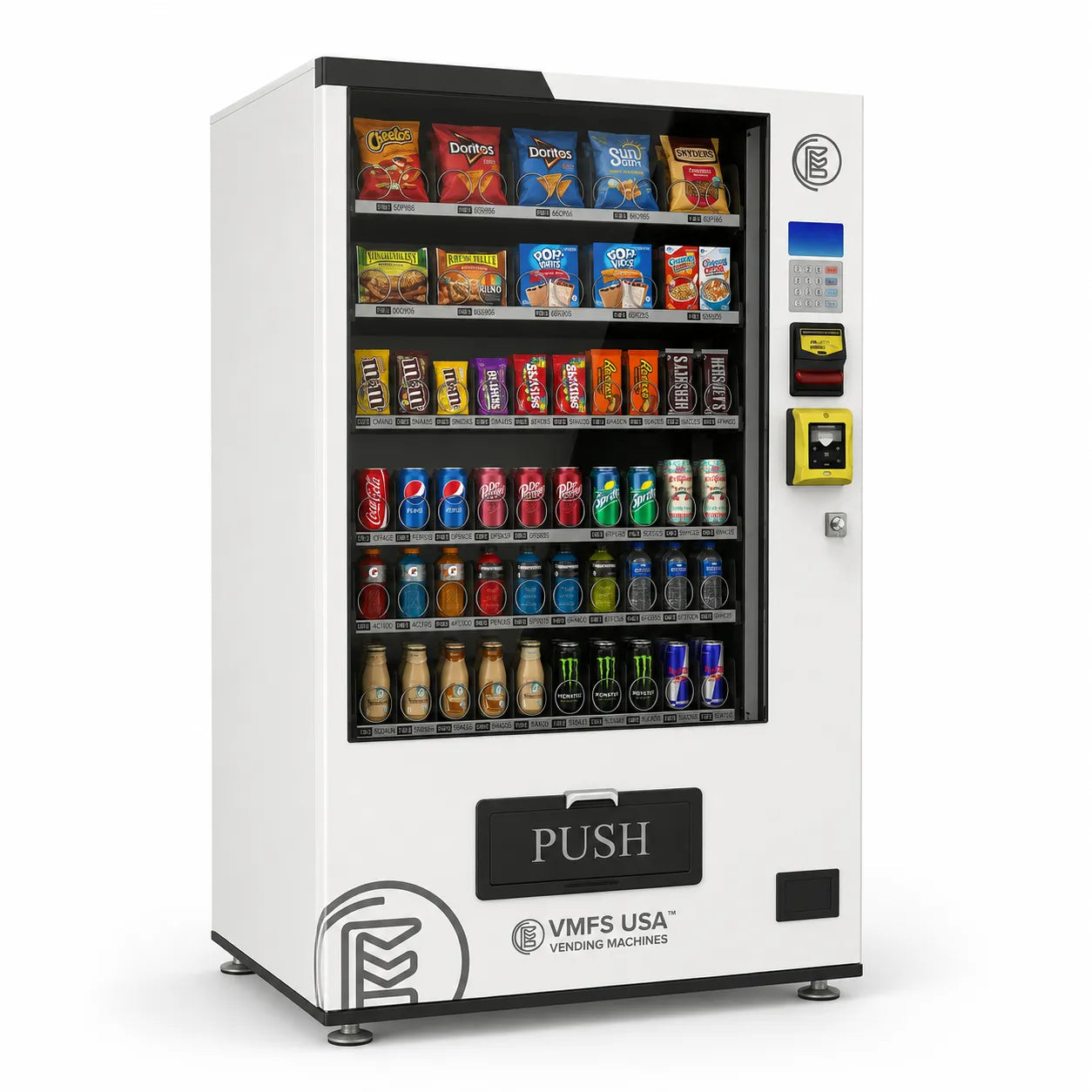
Share:
Coffee Vending Machine Cleaning and Maintenance: The Complete Guide
Coffee Vending Machine Parts: The Complete Guide