


La instalación de una máquina expendedora de café requiere adaptar las especificaciones eléctricas, de agua y de drenaje de la unidad a la ubicación antes de la entrega, ya que realizar modificaciones en el lugar tras la llegada de la máquina causa la mayoría de los retrasos de configuración evitables. Esta guía cubre los requisitos exactos de energía, plomería y espacio, la secuencia de instalación paso a paso y la lista de verificación previa a la instalación que utilizan los operadores para que la máquina dispense correctamente desde el primer día.
Tabla de contenidos
- Planificación del sitio previa a la instalación
- Requisitos eléctricos y de energía
- Requisitos de suministro de agua y drenaje
- Requisitos de espacio y despeje
- Proceso de instalación paso a paso
- Máquinas con conexión a red vs. sin conexión
- Consideraciones sobre permisos y cumplimiento
- Resumen de requisitos de instalación
- Pruebas y calibración post-instalación
- Preguntas frecuentes
Planificación del sitio previa a la instalación
La planificación del sitio antes de la instalación determina si una máquina expendedora de café funcionará correctamente desde el primer día, ya que las discrepancias de energía, agua y espacio descubiertas después de la entrega provocan retrasos en la instalación que pueden durar días en lugar de horas. Un estudio del sitio debe confirmar el tipo de toma de corriente y amperaje, la proximidad de la línea de agua, el acceso al drenaje y la capacidad de carga del piso antes de que la máquina sea enviada.
Esta etapa de planificación se conecta directamente con la decisión más amplia de dónde y cómo encaja una máquina en una ruta de máquinas expendedoras de café, ya que la viabilidad de la instalación en una ubicación determinada afecta si vale la pena dar servicio a esa parada. Los operadores que evalúen nuevas ubicaciones también deben consultar los datos actuales del mercado de máquinas expendedoras de café para priorizar sitios con un alto tráfico peatonal y una logística de instalación sencilla.
El proceso para máquinas expendedoras de café caliente y máquinas expendedoras de café helado es prácticamente el mismo.
Estudio de energía
Confirme la disponibilidad de un circuito dedicado y la clasificación de amperaje antes de la entrega para evitar cambios de cableado en el sitio.
Acceso al agua
Identifique la línea de agua potable más cercana para unidades conectadas a la red, o confirme la logística de recarga de depósito para modelos sin conexión.
Revisión de piso y espacio
Verifique la capacidad de carga del piso y el espacio de despeje para acceso de servicio, apertura de puertas y ventilación.
Planificación del drenaje
Confirme el enrutamiento del drenaje por gravedad o asistido por bomba para máquinas conectadas a la red, a fin de evitar problemas de desbordamiento.
Requisitos eléctricos y de energía
Los requisitos eléctricos para las máquinas expendedoras de café comerciales suelen requerir un circuito dedicado de 120V o 208–240V, dependiendo del tamaño de la máquina y la potencia del elemento calefactor, ya que compartir un circuito con otros equipos de alto consumo causa caídas de voltaje que provocan fallos en la calefacción. La mayoría de las unidades comerciales de una sola taza consumen de 13 a 20 amperios al arrancar, reduciéndose a un consumo sostenido menor una vez que la caldera alcanza la temperatura.
Un circuito dedicado —no una toma de corriente compartida— es una práctica estándar para cualquier máquina que procese más de 100 tazas al día. La instalación en un circuito compartido o subdimensionado es una causa principal de los códigos de error de temperatura cubiertos en la guía de solución de problemas de máquinas expendedoras de café, ya que una potencia insuficiente impide que la caldera alcance y mantenga la temperatura de preparación.
Voltaje y amperaje por tipo de máquina
Las unidades compactas de oficina generalmente funcionan con circuitos domésticos estándar de 120V, mientras que las máquinas comerciales de alto volumen con calderas más grandes requieren energía trifásica de 208–240V. Confirmar esta especificación con el panel eléctrico existente del sitio antes de la instalación evita una costosa visita de un electricista.
Requisitos de suministro de agua y drenaje
Los requisitos de suministro de agua dependen totalmente de si la máquina está conectada a la red o alimentada por depósito: las unidades conectadas necesitan una línea de agua potable directa clasificada para la demanda de flujo de la máquina, mientras que las unidades con depósito solo necesitan un punto de acceso para recarga y disponibilidad de personal para el llenado manual. El drenaje, cuando corresponda, debe manejar tanto el agua residual de la preparación como cualquier desbordamiento del sistema de la bandeja de goteo.
Especificaciones de la línea de agua para instalaciones con conexión
Las máquinas conectadas a la red suelen requerir una conexión de línea de agua de 1/4 de pulgada o 3/8 de pulgada con una válvula de cierre y, en regiones con agua dura, un filtro en línea instalado aguas arriba de la máquina. La ubicación de este filtro es fundamental: protege la caldera de la acumulación de sarro tratada en la guía de limpieza y mantenimiento, prolongando la vida útil de los componentes desde el momento en que se instala la máquina.
Enrutamiento del drenaje
El drenaje por gravedad funciona cuando la máquina se coloca sobre un drenaje de piso accesible; de lo contrario, un kit de drenaje asistido por bomba enruta el agua residual a la línea de drenaje más cercana. Omitir un drenaje adecuado en una unidad conectada a la red provoca el desbordamiento de la bandeja de goteo, que es una de las llamadas de servicio post-instalación más comunes.
Requisitos de espacio y despeje
Los requisitos de espacio y despeje protegen tanto el acceso de servicio como la operación segura, ya que un espacio insuficiente restringe la ventilación alrededor del compresor y los componentes de calefacción, aumentando la temperatura operativa interna y acortando la vida útil de las piezas.
- Despeje trasero: La mayoría de las unidades comerciales necesitan de 4 a 6 pulgadas de espacio trasero para ventilación y enrutamiento de cables.
- Despeje lateral: Al menos un lado debe permitir la apertura total de la puerta para el reabastecimiento y el acceso de servicio.
- Despeje superior: Confirme que la altura del techo acomoda la máquina más varias pulgadas para el acceso al filtro o a la tolva desde la parte superior.
- Capacidad de carga del piso: Las máquinas comerciales más grandes pueden pesar entre 300 y 500 libras cuando están completamente surtidas, lo que requiere un soporte de piso adecuado, especialmente en niveles superiores de edificios.
Consejo de colocación: Las máquinas instaladas en pasillos de alto tráfico necesitan un espacio frontal adicional más allá de la especificación mínima, ya que el espacio de espera de los clientes afecta directamente la velocidad de la transacción y la accesibilidad percibida.
Proceso de instalación paso a paso
El proceso de instalación sigue una secuencia fija independientemente del modelo de máquina: preparación del sitio, colocación física, conexión de servicios públicos, diagnóstico de encendido y calibración. Omitir o reordenar estos pasos es la causa más común de llamadas de servicio evitables durante el primer día.
| Paso | Tarea | Duración típica |
|---|---|---|
| 1 | Confirmar que el sitio cumple con las especificaciones de energía, agua y espacio | Pre-entrega |
| 2 | Posicionar la máquina y nivelar usando las patas ajustables | 15–20 minutos |
| 3 | Conectar la energía al circuito dedicado | 10 minutos |
| 4 | Conectar la línea de agua y el drenaje (solo unidades con conexión) | 30–45 minutos |
| 5 | Encender y ejecutar la autocomprobación de diagnóstico | 10–15 minutos |
| 6 | Cargar ingredientes, vasos y calibrar la dosificación | 20–30 minutos |
| 7 | Ejecutar ciclos de prueba y confirmar la conectividad del sistema de pago | 15–20 minutos |
Máquinas con conexión a red vs. sin conexión
Elegir entre una máquina expendedora de café con conexión a la red o sin ella afecta tanto la complejidad de la instalación como los requisitos de mano de obra continua. Las unidades conectadas se enlazan directamente a una línea de agua para una operación continua; las unidades sin conexión dependen de un depósito interno que requiere llenado manual.
Máquinas conectadas a la red — Ventajas
- Sin llenado manual, soportando un mayor volumen diario de tazas
- Presión y suministro de agua constantes para ubicaciones de alto tráfico
- Menores costos operativos de mano de obra una vez instalada
Máquinas conectadas a la red — Limitaciones
- Requiere instalación profesional de línea de agua y drenaje
- Menos flexible si la máquina necesita ser reubicada más tarde
Máquinas sin conexión a la red — Ventajas
- Instalación sencilla: solo conexión eléctrica
- Completamente portátil y fácil de reubicar entre sitios
Máquinas sin conexión a la red — Limitaciones
- Requiere llenado manual regular, limitando la capacidad sin supervisión
- Riesgo de vaciado durante períodos de alto volumen sin monitoreo
Los operadores que comparan opciones para un hogar o una oficina pequeña suelen comenzar con la guía de las mejores máquinas de café para oficina en casa, mientras que las ubicaciones comerciales de alto volumen generalmente prefieren instalaciones conectadas a la red para un servicio ininterrumpido.
Consideraciones sobre permisos y cumplimiento
Los requisitos de permisos para la instalación de máquinas expendedoras de café varían según el municipio y dependen principalmente de si la instalación implica nuevos circuitos eléctricos o modificaciones de plomería. Una máquina enchufada a tomas de corriente estándar existentes generalmente no requiere permiso, mientras que agregar un circuito dedicado o una nueva línea de agua suele estar sujeto a los códigos locales de electricidad y plomería.
Los administradores de propiedades comerciales y operadores de franquicias que evalúan una nueva ubicación deben confirmar los requisitos de códigos locales al principio del proceso de planificación; esto es especialmente relevante para cualquiera que siga un modelo de franquicia de máquinas expendedoras de café, donde las especificaciones de instalación estandarizadas aún deben pasar la inspección local en cada sitio individual.
Resumen de requisitos de instalación
Esta referencia consolidada resume los requisitos principales que los operadores deben tener confirmados antes de que una máquina sea enviada a una nueva ubicación.
| Requisito | Especificación estándar |
|---|---|
| Circuito eléctrico | Dedicado de 120V o 208–240V, 13–20 amperios según el modelo |
| Línea de agua (unidades con conexión) | Línea de 1/4" o 3/8" de agua potable con válvula de cierre y filtro en línea |
| Drenaje (unidades con conexión) | Drenaje por gravedad o asistido por bomba al drenaje de piso más cercano |
| Despeje trasero | 4–6 pulgadas para ventilación y enrutamiento de cables |
| Capacidad de carga del piso | Soporte para 300–500 lbs completamente surtida |
| Conectividad de red | Wi-Fi o ethernet para procesamiento de pagos sin efectivo |
Pruebas y calibración post-instalación
Las pruebas post-instalación confirman que cada subsistema funcione correctamente antes de que la máquina entre en funcionamiento, ya que un fallo detectado durante la calibración cuesta minutos de arreglar, mientras que el mismo fallo descubierto después de que comiencen las transacciones de los clientes cuesta tanto ingresos como reputación. Las pruebas deben ejecutar múltiples ciclos completos de preparación en cada opción de bebida, verificar la autorización de pago de extremo a extremo y confirmar la precisión de la dispensación de vasos e ingredientes.
Este paso también establece la base para futuros diagnósticos; entender cómo funcionan mecánicamente las máquinas expendedoras de café facilita reconocer cuándo una lectura durante las pruebas cae fuera del rango normal. Los operadores también deben confirmar que comprenden las piezas principales de la máquina expendedora de café involucradas en esta secuencia de prueba, ya que los problemas de calibración a menudo se deben a un solo componente en lugar de un fallo sistémico.
¿Listo para instalar una nueva máquina expendedora de café?
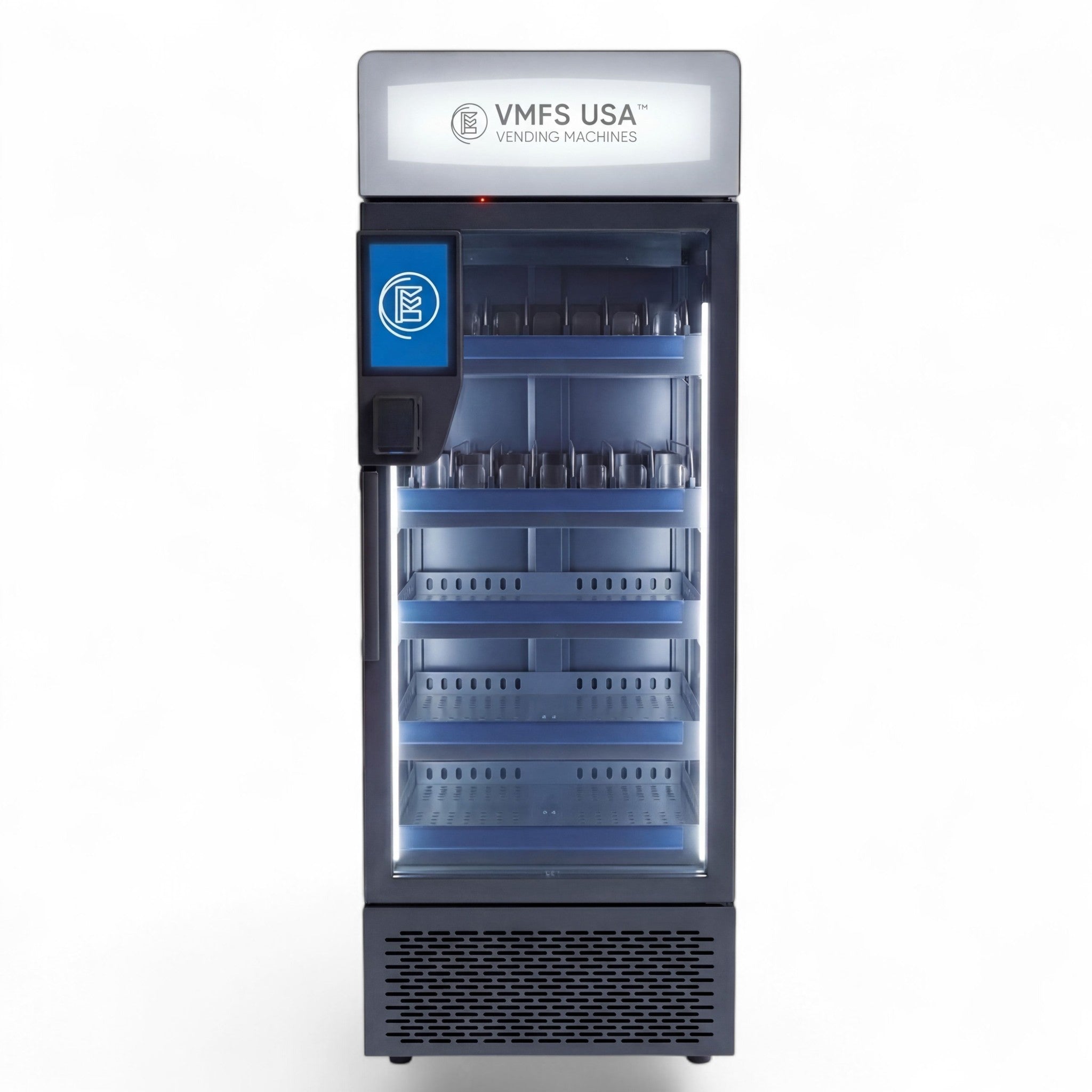
Explore la línea de máquinas expendedoras de café comerciales de VMFS USA, diseñadas para una instalación sencilla y un rendimiento confiable desde el primer día.
Comprar máquinas expendedoras de café
Compartir:
Repuestos para máquinas expendedoras de café: la guía completa
Insumos para máquinas de café: La guía completa