



Design the perfect vending solution for your location and customers.

Sales, inventory and alerts for your whole route, from one machine to a fleet.
Answer a few questions about your location, products and budget and get a shortlist.
Estimate revenue, payback period and margin before you buy.
Sales, setup help, warranty and parts from the VMFS USA team.
Join the VMFS newsletter and step into a thriving network dedicated to collective success.
One signup. Endless possibilities.
How unattended machines cook and hold hot food safely, what they can realistically serve, where they earn, and the rules that separate hot food from every other vending category.
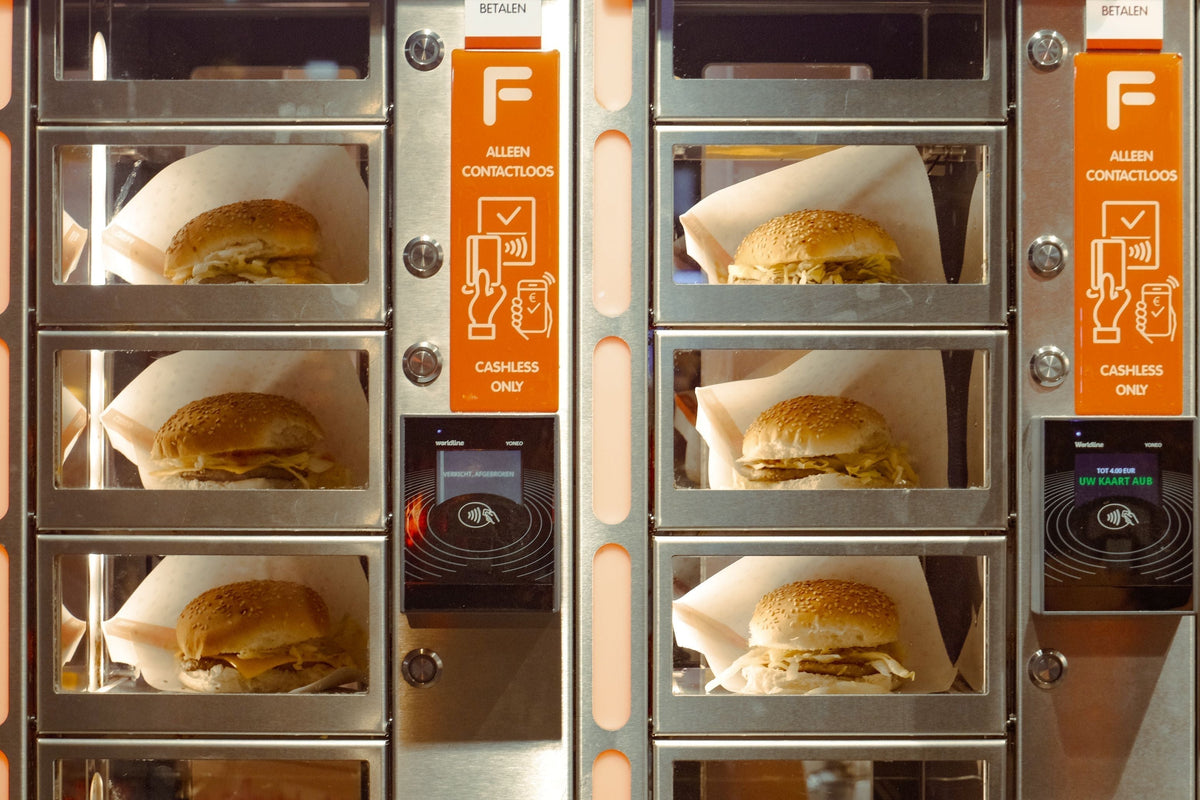
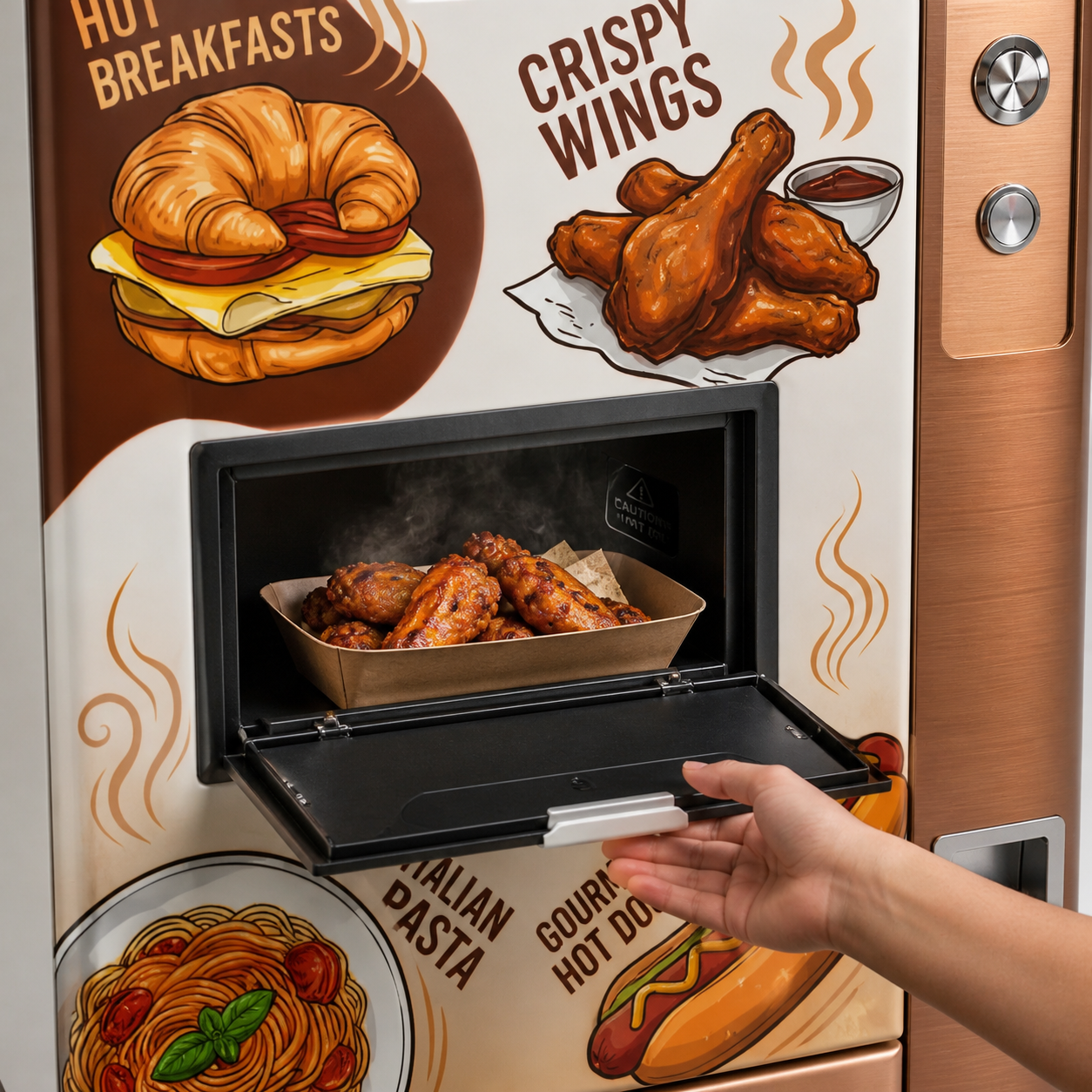
A burger vending machine is an unattended kiosk that stores, heats, and dispenses a finished hot sandwich without a member of staff involved at any point. The customer selects, pays, waits a short cook cycle, and collects a hot product from the delivery bay.
That description hides the hard part. A snack machine has one job, which is to move a sealed package from a slot to a tray. A hot food unit has to hold raw or frozen product at a safe temperature, cook it to a safe internal temperature, keep it there for the seconds between cooking and collection, and prove all of that happened. It is closer to a small unattended kitchen than to a vending machine, and everything about how it is built, permitted, and serviced follows from that.
Most people meet the category through the burger, because a burger in a machine is the version that gets filmed and shared. The category is considerably wider than that, and the burger is usually not the item that carries a route. It sits inside the broader family of vending machines, and specifically within food vending machines.
The demand driver is not novelty. It is the collapse of staffed food service hours in buildings that never stopped operating.
Corporate canteens shortened their hours and in many buildings closed entirely. Hospital cafeterias serve daytime hours in facilities that run continuously. Distribution centres, manufacturing plants, transit hubs, and university campuses all carry meaningful overnight populations with no realistic food option once the kitchen shuts. Meanwhile hiring a person to serve forty meals between eleven at night and five in the morning has stopped being economically sensible almost everywhere.
That gap is what a hot food vending machine fills. The US and Canada hot food vending industry is estimated at around $5.5 billion in 2026 and forecast to grow at roughly 6.6% annually through the next decade, with sandwiches leading adoption at about 30% of the category, precisely because they suit rapid heating.
The competition for an overnight hot food machine is not another machine. It is a bag of chips, a vending sandwich that has been refrigerated since Tuesday, or nothing at all.
Why unattended hot food converts differently from snacksThat framing matters commercially. In a building with a functioning cafeteria you are the fallback. In a building where the kitchen closed at three, you are the only option for the next fourteen hours, and volume reflects it.
There are four approaches in production use, and they behave very differently. Anyone evaluating a vending machine burger should understand which one they are buying, because it determines the cook time, the product quality, and the maintenance load.
Fastest and simplest. A sealed or covered product is heated in a cavity inside the cabinet. Cook cycles are short, typically under two minutes. The weakness is texture, since microwaving struggles with anything that should be crisp. Best suited to sandwiches, wraps, and saucy items.
Hot air circulated at speed. Slower than microwave but far better on texture, which is why it dominates pizza and pastry applications. Needs venting and generates more heat load in the surrounding room, which becomes a siting consideration.
Heat applied directly to the product surface. Produces the closest result to a kitchen and the strongest browning, and carries the highest cleaning burden by a wide margin because fat and residue accumulate on the contact surface.
The upstream decision. Frozen product gives long shelf life and fewer service visits but needs a longer cook cycle. Chilled product cooks faster and tastes better, and shortens your restocking window to a few days. Most routes run frozen for exactly this reason.
A snack purchase is instant. A hot food purchase is not, and every second of cook time is a second the customer is standing there. Beyond roughly ninety seconds you start losing people who arrived undecided, and in a busy period you create a queue in front of a machine designed for one person at a time.
This is why cook time matters more than menu breadth in high traffic sites, and why the strongest placements are ones where people are already waiting, such as a break room, a transit platform, or a hospital corridor at three in the morning.
Cooking is a controllable event. Holding is a continuous obligation. A machine that heats a product perfectly and then leaves it sitting in a delivery bay for four minutes while the customer finishes a phone call has a food safety problem, not a quality problem. Any credible unit either dispenses immediately on completion or holds within a controlled and monitored temperature band, and logs it.
This is the section most articles on this topic skip, and it is the one that decides whether you can operate at all.
Time and temperature control for safety food, usually written TCS, is the regulatory category covering products that support rapid bacterial growth. Cooked meat, poultry, dairy, cooked rice, and cut vegetables all qualify. A burger is squarely inside it.
The governing concept is the temperature danger zone, the band between roughly 41°F and 135°F where bacterial growth accelerates. Product must move through that zone quickly and must not sit in it. In practical terms hot food is generally held at or above 135°F to 140°F and cold product at or below 41°F, and the machine has to make both true continuously rather than on average.
NSF/ANSI 25 sets the food protection and sanitation requirements for the materials, design, construction, and performance of food and beverage vending machines. The 2023 revision specifically added language covering the dispensing of TCS food, which tells you how seriously the category is now treated.
The practical consequence for an operator is straightforward. Health authorities will expect equipment that meets a recognised standard, and asking a supplier for certification detail is a reasonable question that separates serious equipment from imported units with no documentation behind them.
Expect questions about holding temperatures and how they are recorded, what happens on a power failure, how often the unit is cleaned and by whom, where product is stored between restocking runs, and who holds food handler certification. A written log kept at the site is the item most commonly missing. If a component does fail, support and replacement parts matter more in this category than any other, because downtime means scrapped product.
Remote temperature visibility turns most of this from a paperwork exercise into a dashboard. Machine level monitoring through VMFS Cloud is genuinely load bearing in this category rather than a convenience, because a temperature excursion you learn about the next morning is a scrapped load of product.
Footprint decisions in this category are unusually consequential, because a hot food unit needs power, clearance, and often ventilation that a snack machine does not.
| Format | Typical Use | Strength | Constraint |
|---|---|---|---|
| Compact heated unit | Small break rooms, offices, convenience counters | Fits where floor space does not exist | Low capacity, frequent restocking |
| Boxed meal unit | Plants, clinics, mid size sites MOST COMMON | Balance of capacity and footprint | Needs a dedicated circuit |
| Full size hot food unit | Hospitals, transit, campuses, 24 hour sites | Highest capacity and menu range | Space, power, and clearance demands |
| Chilled food unit | Sites needing meals plus drinks and snacks | One service visit covers everything | Higher complexity per cabinet |
| Micro market with heating | Large facilities above roughly 200 staff | Widest range, best perceived value | Needs secured space, not a corridor |
A mini hot food vending machine is the format most first time buyers ask about, and it is genuinely useful in small break rooms where a full cabinet simply will not fit. The trade is capacity. Low capacity means frequent restocking, and restocking labour is the largest hidden cost in hot food vending, so a compact unit only makes sense where the site cannot physically take a larger one.
Sites needing meals alongside drinks and snacks are usually better served by a combo vending machine beside the hot unit, and larger facilities frequently outgrow single cabinets entirely and move to a micro market.
Hot food units carry requirements a snack machine does not. Configuration is settled before shipping.
The qualifying question for a vending machine for hot food is not foot traffic. It is how many hours the site has hungry people and no staffed food service.
Unstaffed hours. Count them honestly. A site with eighteen unstaffed hours a day and two hundred people on site beats a site with four hundred people and a canteen open all day.
Power and clearance. Hot food units draw more than snack machines and generally need a dedicated circuit rather than a shared outlet behind a microwave and a fridge. Ventilation clearance is a real constraint with convection systems, and it is far cheaper to find that out on a site walk than on delivery day.
Distance to alternatives. If there is a 24 hour option within a five minute walk, you are a convenience play. If the nearest hot food is a fifteen minute drive, the economics change completely and so should your pricing. Our location matching service assesses this before you commit, and larger institutional buyers are handled through enterprise placements.
If you are moving quickly, some vending machines are ready to ship rather than built to order, and every unit comes with a warranty and support from the Customer Success Team, which matters more in hot food than anywhere else because downtime here means scrapped product rather than lost sales.
Hot food sits at the top of the vending compliance ladder. A snack machine dispenses sealed shelf stable goods and is treated lightly in most jurisdictions. A hot food vending machine stores, cooks, and dispenses TCS food, which is food service in the language of nearly every state and county code.
Two items deserve specific attention. Commissary requirements appear in many counties for open food operations, meaning you need a licensed location where product is stored and equipment cleaned, which is not your garage. Allergen disclosure applies at the point of selection, and a hot sandwich typically carries several of the major allergens at once.
Hot food has a launch problem the other categories do not. People have low expectations of machine food, and they hold those expectations until something changes their mind. The first ten days decide whether the machine becomes a habit or a curiosity.
Stand at the machine during a shift change and hand out product. This is the only vending category where tasting genuinely converts, because the objection is quality and quality cannot be argued, only demonstrated.
Shift briefing, internal email, notice board. Overnight staff are the audience that matters and they are the hardest to reach through anything except the employer's own channel.
People abandon a purchase when they do not know how long they will be standing there. A visible countdown converts noticeably better than an unexplained wait.
Breakfast items before a morning changeover, meals through the night. Watch two weeks of data, then cut whatever is not moving. Payment mix should be settled in the same window through the payment system setup.
Branding the cabinet to the host site helps more here than in most categories, because a machine that looks like part of the facility is trusted more than one that looks like an outside intrusion, and custom wrap options cover that. For campaign work and local search presence, VMarketed builds marketing specifically for vending operators rather than adapting retail playbooks.
If you are new to the category entirely, the guide to starting a vending business covers the fundamentals, the knowledge base goes deeper on operations, and the ROI calculator will model a specific site before you commit. Not sure which unit fits the building? Take the machine finder quiz, or configure a multi unit setup with the food vending system builder.
VMFS USA supplies vending machines to operators across all 50 states, with configuration settled before shipping, white glove delivery, warranty, and financing on every unit.
White Glove Delivery · Warranty Included · VMFS Cloud · How to start a vending business

Compartir:
Custom Vending Machine Manufacturers: What They Do and Why It Matters
How a Protein Shake Vending Machine Works: The 2026 Operator Guide