




Design the perfect vending solution for your location and customers.

Join the VMFS newsletter and step into a thriving network dedicated to collective success.
One signup. Endless possibilities.
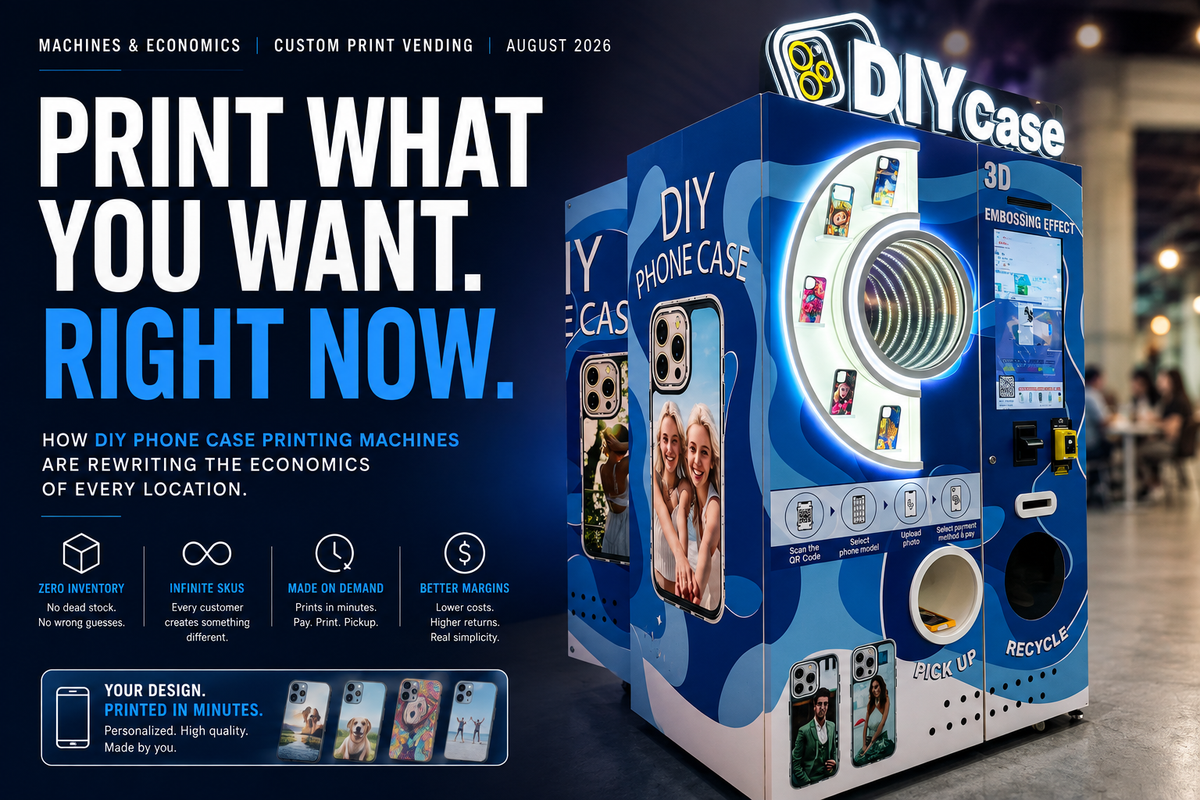
A phone case vending machine is a UV printer with a payment terminal attached: the customer scans a QR code, picks their phone model, uploads a photo and pays, and the machine prints that image onto a blank case and drops it into the pickup hatch in roughly two to three minutes.
This guide explains how the hardware works, what blanks, ink and printheads cost, where the format earns, why phone model coverage and customer uploads are the two real risks, and whether VMFS USA sells one (it does not list one today, and we say what to do instead).
A phone case vending machine works by printing the customer's own image onto a blank case after they pay, instead of dispensing a product that was made in advance. Every other vending machine assumes the product exists before the sale: somebody upstream guessed what people would want, bought it, loaded it and hoped. This format removes the guess, because the product does not exist until the customer orders it.
We first looked closely at these machines on the show floor at Venditalia, and the photographs in this article are our own. What stood out was not the print quality or the cabinet. It was how quickly strangers understood the machine with no help at all, and how many of them stopped to watch somebody else's case being made.

The flow printed on the front of most machines is four or five steps, and the simplicity is deliberate because it has to work for somebody standing in public who has never seen one before. The customer scans a QR code, which moves the whole design session onto their own phone. They pick their phone model, upload a photo from their camera roll, crop and position it against an on-screen preview that shows where the camera cutout falls, and pay. The screen then shows an order number while the machine prints, and the finished case drops into the pickup hatch.
Vendors publish similar timings. Sweet Robo describes its Case BOT as producing a case in about two minutes, and Balaji Wireless describes its Custom Case Kiosk as running from scan to finished case in about three minutes. Both flows run in the phone's browser rather than a downloaded app, which matters more than it sounds: there is no account to create, no keyboard on a shared touchscreen, and the customer's entire photo library is already in their hand.

Inside, a phone case vending machine is a small UV flatbed printer rather than a conventional vending mechanism. There are no spiral coils and no elevator platform. There is a stack of blank cases sorted by model, a jig that holds the selected blank in register, a printhead that lays down ink, and a UV light source that cures the ink as it is printed. Balaji describes its kiosk as printing CMYK ink directly onto the case shell and curing it under UV light, followed by an automatic color and adhesion check before the case is released.
UV curing is why the result is dry and handleable the moment it drops into the hatch. Several machines we saw also offered a raised, embossed finish rather than a flat print, and that is the detail that moves a printed case from novelty to something people want to keep. Print quality is not a feature of this product; it is the product. A customer compares the case against the photo on their own screen, which they know intimately, so a soft or washed-out print fails regardless of how good everything else about the machine is.
A phone case vending machine is best understood as a printer with a payment terminal, and the phone case is just the blank it happens to be loaded with. We saw this most clearly standing in front of a bank of these machines: beside the case printer was an identical-looking unit with the same screen, the same QR code and the same upload flow, except that what came out of the bottom was a personalised jigsaw puzzle.
Break the machine down and there are four parts, and three of them do not care what you sell. The upload flow on the customer's phone is identical for a case or a puzzle. The preview and crop step is the same software problem. The printer is the real capability and the expensive part of the unit. Only the stack of blanks differs, and the blank is what decides which business you are in. Every other machine in a catalog of specialty vending machines is defined by what it holds. This one is defined by what it can do.

That framing changes how an operator should evaluate the category. On several measures the puzzle is a stronger product than the case. It fits everybody, so there is no compatibility problem. Its blanks do not lose value when a new handset launches. It is usually bought as a gift for somebody else, which lifts the price people accept. And a slightly soft image is obvious on a glossy case held at arm's length but forgiving across a puzzle, which matters when customers supply their own photographs.
Those five tests (does it fit everybody, does the stock hold its value, is it a gift, does it carry feeling, does it forgive an imperfect image) form a checklist for any blank you consider. The same thinking applies to merchandise and apparel vending, where the cabinet matters less than the product decision behind it.
| Blank | Why it works | Venues it suits |
|---|---|---|
| Phone cases | High perceived value, strong impulse purchase | Malls, airports, campuses |
| Jigsaw puzzles | Fits everybody, no obsolescence, bought as a gift | Attractions, malls, family venues |
| Photo blocks and framed prints | Pure gift purchase, no fit issues | Tourist sites, zoos, aquariums |
| Luggage tags | Useful and bought at the moment of need | Airports, hotels, transit |
| Keyrings and small tokens | Low price point, easy yes for a parent | Family venues, events |
| Drinkware and mugs | Established gift category with obvious use | Malls, campuses, workplaces |
Whether a specific machine can take more than one kind of blank is a hardware question, not a software one. A unit built around phone case jigs may need different fixtures, print height or curing settings for a puzzle or a mug, so confirm the accepted range before you buy rather than after you want to expand.
A phone case vending machine runs on a few dollars of material per sale and sells a one-off product with no shop price to compare it against, so its gross margin per case is high, but the machine price, commission, consumables and throughput decide whether a site actually pays. Neither of the two US vendors we reviewed publishes a machine price; both ask buyers to request a quote, so any payback figure you see in vendor marketing depends on a number they have not shown.
The published inputs are still useful. Sweet Robo states that its cases sell for around $20 to $30 and that a blank costs roughly $2. Alibaba's buying guide for UV-printable cases lists bulk prices of $1.50 to $3.00 per unit for orders of 50 or more, with single units at $3 to $8. Balaji says carrier stores retail its MagSafe case at a $50 MSRP, lists refilling ink at $170 about every four months, and puts printhead service life at about two years for roughly $1,000.
| Input | Published figure | Source |
|---|---|---|
| Blank case cost | About $2 per blank; $1.50 to $3.00 in bulk (50+) | Sweet Robo; Alibaba buying guide |
| Retail price per case | Around $20 to $30; $50 MSRP for a MagSafe case at carrier stores | Sweet Robo; Balaji Wireless |
| Ink | $170 refill about every four months | Balaji Wireless |
| Printhead | About two-year service life, about $1,000 | Balaji Wireless |
| Print time | About 2 minutes (Case BOT); about 3 minutes scan to case (CCK) | Sweet Robo; Balaji Wireless |
| Power | 600 W max; one dedicated 120V/15A outlet | Sweet Robo; Balaji Wireless |
| Location commission | Typically 5% to 25% of revenue | NerdWallet |
The useful calculation is what is left from one case after the costs vendor calculators exclude. Sweet Robo's own example shows $22.80 of gross profit per case at a 91% margin, and it states plainly that the figure is before venue rent or revenue share, card fees and taxes. Balaji's default calculator shows about $40.20 gross per case at a $50 price. Both are materials-only views.
Here is an illustrative case at $25, using the published inputs above. The blank costs about $2. Balaji's page cites one owner averaging 3.5 cases a day; at that pace a $170 ink refill every four months spreads over roughly 420 cases, or about $0.40 each, and a $1,000 printhead over two years spreads over roughly 2,550 cases, or about $0.39 each. A 15% location commission, inside the typical 5% to 25% range, takes $3.75. That leaves about $18.45 per case before card processing, reprints, insurance, financing and your own service time. Check how your location deal is structured in our guide to how revenue is split between operator, location and supplier.
No reference price: a customer looking at a bottle of water in a machine knows what it costs in the shop downstairs. Nobody knows what a case with their own dog printed on it should cost, because it did not exist until they ordered it. That is why this format can hold a price that would be impossible on a commodity, and why the price test matters more than the cost test.
The number that decides a site is the most orders one machine can physically complete in its busiest window, because this format is limited by print time rather than by demand. Take the full cycle per customer (choosing, cropping, paying, printing and collecting), then divide your peak trading window by it. At a six-minute cycle and a genuine three-hour peak, one machine caps at 30 orders, and that assumes somebody is ready the instant the last order finishes, which never happens.
This is why the machines we saw stood in banks. A second unit does more than double capacity: a visible queue turns people away, while a bank with a free unit does not. The QR flow helps too, because the next person can design on their own phone while the machine finishes the order in front. Faster blanks change the ceiling entirely, which is an argument for pairing a quick product with a slower one. Size a site for its peak, not its average, and test the result in the VMFS ROI calculator before you sign anything.
Want a print-on-demand machine built for a specific venue?
VMFS USA scopes custom builds around the product, the site and how customers pay.
Talk About a Custom BuildA phone case vending machine holds no finished goods, so it has no dead stock in the usual sense, but its blank inventory is tied to specific handset models and loses relevance every time new phones launch. Ask any experienced operator what erodes margin and you hear the same list: products that seemed like a good idea in March and are still sitting there in September, guessing wrong about what a location wants, and capital tied up in stock that is quietly becoming worthless. A print machine deletes most of that list, because a blank has no flavor, no trend and no expiry date.
No wrong guesses
The customer brings the design with them. You never predict which artwork will sell at a given site.
No expiry
Nothing in the cabinet has a shelf life, unlike a food route where date-expired stock is pulled every visit.
Light restocking
Blanks stack tightly and weigh little next to cases of drinks, which cuts labor and vehicle time across a route.
One input, endless SKUs
A single blank becomes a different product every time it is used, so the range is never the limiting factor.
The catch is model coverage. Sweet Robo says its machine holds up to 42 phone models, or 294 to 336 cases. Balaji's kiosk holds 770 cases across 77 slots supporting up to 77 device SKUs. That sounds like plenty until you count how many models a single brand releases. Apple's own model list shows five iPhone models introduced in 2025 alone (iPhone 17, 17 Pro, 17 Pro Max, iPhone Air and iPhone 16e), and every model needs its own blank because camera cutouts and dimensions differ.
Brand share tells you where to start. StatCounter's September 2026 data puts Apple at 53.58% of US mobile devices and Samsung at 28.11%, with Motorola at 3.49% and Google at 3.16%. A machine stocked for the last few generations of iPhone and Galaxy covers most of the people walking past it; the long tail is where a customer gets told their phone is unsupported, and that customer rarely comes back. Plan a blank refresh every autumn as a standing task, budget for blanks of older models you will eventually write off, and watch which models actually sell at each site rather than stocking evenly.
Operator tip: MagSafe and non-MagSafe versions of the same phone are usually separate blanks. If a machine offers both, as several do, each model can occupy two slots, which halves your effective model coverage.
Phone case vending machines work best where people already have a few minutes to spare and a reason to buy a keepsake: malls, airports, campuses, theme parks and tourist attractions. Sweet Robo lists malls, electronics and phone stores, airports, universities, theme parks and tourist attractions, and that matches what we saw. Print time sets the location list. A machine that needs minutes, not seconds, belongs where people browse or wait, and it actively struggles in commuter corridors where foot traffic is high but nobody will stop.
The machine also does its own marketing, which no snack machine has ever done. Watching your own photo appear on a physical object is inherently watchable, and the result is something the buyer immediately shows to whoever they are with. On the show floor one person would start an order, two or three others would drift over, and some of those onlookers became the next queue. The wait, which looks like a weakness on paper, is doing advertising work. Position the machine where that audience can gather without blocking a walkway.

Banks read as a destination. Three lit machines side by side look like a small shop somebody walks toward; one machine in a corridor is a vending machine somebody walks past. A bank also raises the basket, because a customer waiting for a case sees the puzzle or keyring machine beside it, and it means one landlord conversation, one site visit and one power run instead of three. Our guide to the best vending locations covers the wider site types, and the steps to scout and pitch a location apply here with one extra question: how long do people actually stay? If you want help finding sites with that kind of dwell time, VPlaced screens for it, and VMFS offers location matching for buyers.
The site has to supply clean power, a reliable private network connection and a sheltered, climate-stable spot. Balaji asks for one dedicated 120V/15A outlet within six feet, prefers Ethernet over private Wi-Fi or a 4G SIM, and says never to rely on shared mall Wi-Fi. It also specifies roughly 1.5 m by 1.5 m of floor space including service clearance and a height of 2.5 m or less. Sweet Robo lists a 600 W maximum draw and a footprint of 47.5 by 38 inches. Dust and humidity degrade print quality, so an indoor position is a requirement rather than a preference. Settle whether you pay commission, rent or free placement before the machine arrives, because a print machine's revenue arrives in weekend spikes that a flat rent may or may not suit.
A phone case vending machine needs printer maintenance (daily head care, ink management and eventual printhead replacement) on top of the usual restocking and cleaning, and that is a different skill set from servicing a coil machine. Mimaki's guidance for its UJF-706 UV printers is a useful benchmark for how fussy UV heads can be: shake the white ink cartridge daily, run a normal cleaning on the white head at least once a day even if white ink is not being used, run a white maintenance routine weekly because white ink settles faster than other colors, and clean the wiper after each job.
Kiosk vendors automate much of this. Balaji says its machine should stay powered on around the clock because the printheads self-clean while idle, and it describes a monthly visit of about 15 minutes to wipe the screen, restock low slots and empty the waste jar, plus an ink refill roughly every four months. Sweet Robo's app sends low-stock and machine-health alerts. Treat those intervals as vendor claims to confirm, and ask who attends when a head fails, because a printhead fault is not a jammed spiral. It is a dead unit until somebody who understands printers arrives. Our general guide to routine vending machine maintenance covers the cabinet, payment and cleaning side.

Failed prints are a cost line of their own. A jammed bag of chips can be resold; a case printed with somebody's family photo cannot be sold to anyone else. Low-resolution uploads are the most common cause of disappointment, and customers blame the machine, so prefer software that warns when an image will print poorly. Decide your reprint and refund policy before launch, write it on the machine and in the upload flow, and track reprints per site. This is the point where the format stops behaving like vending and starts behaving like retail customer service.
When a customer uploads an image they do not own, your machine is the thing that makes the physical copy, so you need upload terms, screening and a takedown process in place before the first order. Under 17 U.S.C. 106, the copyright owner holds the exclusive right to reproduce a work and to distribute copies of it to the public by sale. A machine that prints a cartoon character, a team logo or a photographer's image onto a case and sells it is doing both, even though the customer chose the image.
The stakes are not theoretical. Under 17 U.S.C. 504(c), statutory damages run from $750 to $30,000 per work infringed, a court can raise that to as much as $150,000 for willful infringement, and it can lower it to $200 for an infringer who proves they had no reason to believe they were infringing. Trademarks add a second layer: the USPTO describes a trademark as any word, phrase, symbol or design that identifies a brand's goods or services and sets them apart from competitors, and brand logos and character names printed on a product are exactly that.
Do not assume the online "notice and takedown" safe harbor covers a kiosk. Section 512(c) limits liability for a service provider for material stored on its system "at the direction of a user", and it requires a designated agent registered with the Copyright Office and quick removal after a proper notice. Whether that protection extends to a machine that physically manufactures and sells a copy is a question for a lawyer, not a vendor brochure. Neither vendor page we reviewed explains how uploads are screened; Balaji lists the question in its FAQ and describes its built-in templates as rights-clean, which is not the same as screening customer photos.
A practical baseline is to require customers to confirm they own or have permission for the image, block obvious logos and characters with automated screening where the software supports it, keep an internal takedown log, and publish what happens to uploaded photos and how long they are kept. VAdviced can draft upload terms for this category, and it is worth forming an LLC and reviewing your vending machine insurance before the machine takes its first order.
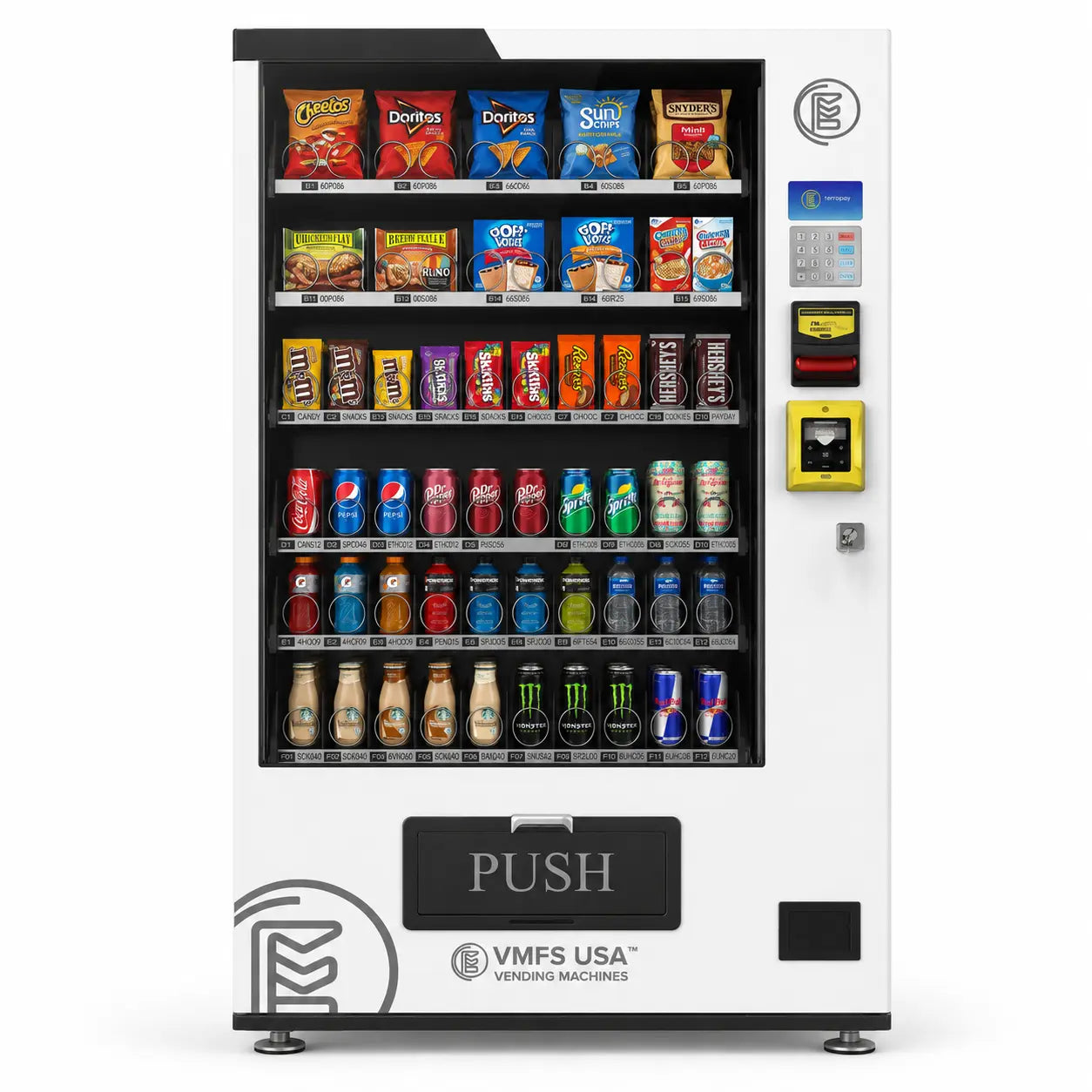
Phone case vending trades the inventory risk of conventional vending for printer upkeep, model churn and content risk, so it suits operators who want a high-ticket, low-volume product and are comfortable with more technical service. Conventional vending sells a commodity and competes on convenience, which anchors its price to the nearest shop. A print machine sells something that did not exist before the customer asked for it, so nobody nearby can undercut it.
| Factor | Conventional vending | Phone case printing |
|---|---|---|
| What you stock | Finished goods | Blanks and ink |
| Dead stock risk | Constant | Low, but blanks age with phone models |
| Price anchoring | The shop down the hall | None, the product is unique |
| Transaction time | Seconds | Minutes |
| Draws a crowd | Rarely | Routinely |
| Maintenance | Mechanical, occasional | Printer upkeep, scheduled |
| Legal exposure | Food and age rules | Copyright and trademark on uploads |
Advantages
Limitations
Payment is the one area where the two formats look alike. Both depend on a reliable card reader, and on a print machine most orders are paid by card or phone wallet, although some models also take bills. Our guide to choosing a cashless payment system applies directly.
No. VMFS USA does not currently list a phone case printing vending machine for sale, and we would rather say so than imply otherwise. Our range of specialty machines covers formats such as trading card, perfume, flower, boba tea, pharmacy and electronics vending, but none of the active products prints on demand. Earlier versions of this article described the format as if it were part of our lineup; it is not a stock product today.
There are two routes if you want to sell phone cases through a machine. If you want ready-made cases, chargers and cables, the Electronics Vending Machine (from $7,950) is built for boxed accessories with an elevator that protects fragile items. If you want personalised printing, or a machine built around a particular blank or venue, that is a custom vending machine conversation: tell us what you want to print and where it is going, and we will tell you plainly what we can build and what it would cost. Our custom vending machine cost guide explains how those quotes are structured, and the interface style will be familiar from our touch screen vending machines.
Standard VMFS machines carry a one-year parts warranty, with two- and three-year extensions on some models; the warranty page lists what is covered, and any custom build's coverage is confirmed in its quote. Buyers spreading the cost can review VMFS financing options.
Before buying a phone case vending machine from any supplier, get written answers on accepted blanks, real cycle time, consumable costs, service response and content screening, because several of these are hard to change after delivery.
Order matters. Settle the location brief first, because print time rules out many otherwise good sites. Get the upload terms in place before the machine accepts its first order rather than after a complaint. Then plan the launch properly, because the first weekend of a machine like this draws attention you will not get again.
Looking for a machine that stands out at a premium venue?
Browse the VMFS specialty range, from trading card to perfume and flower vending.
Shop Specialty Machines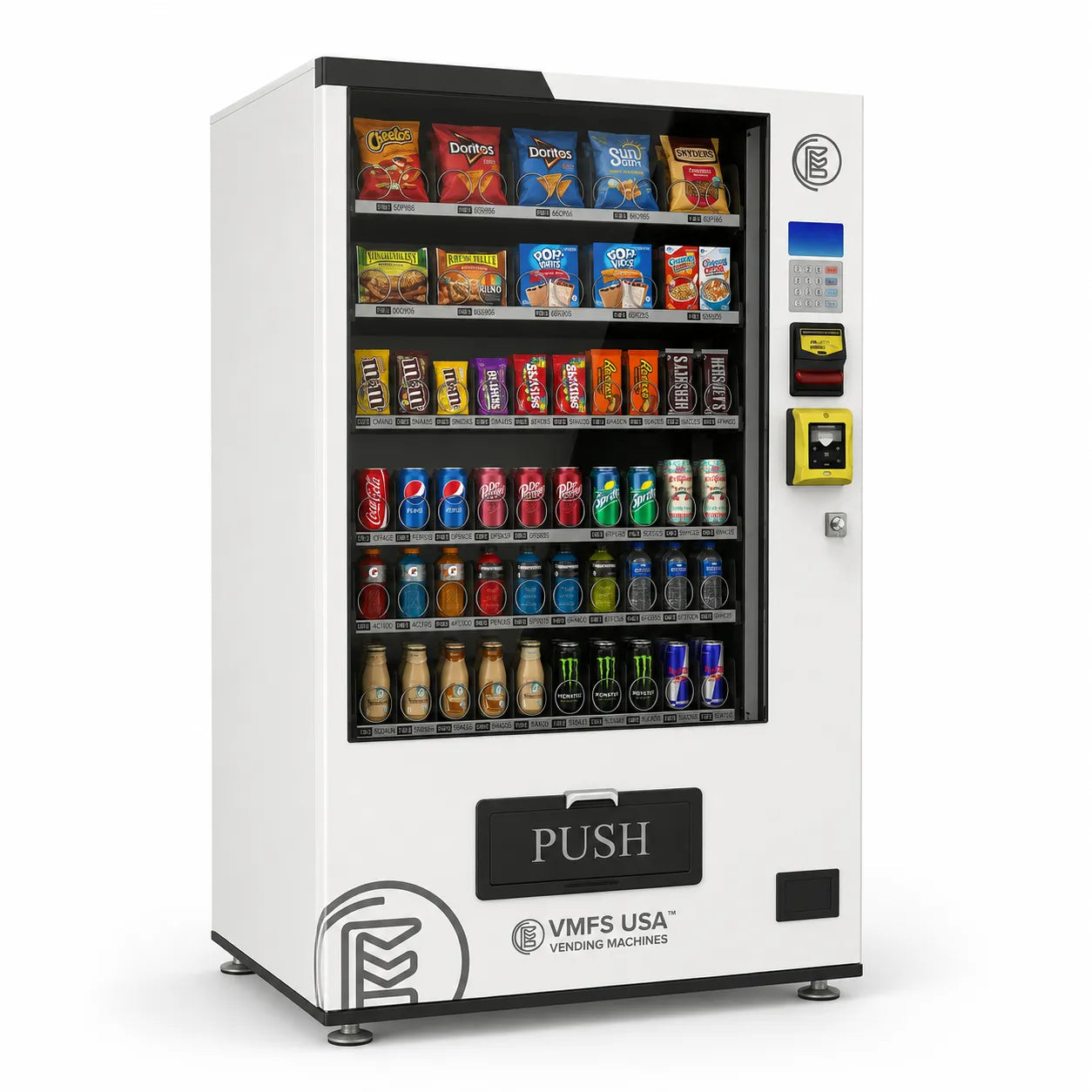
Share:
Berlin Cracked Protein Shake Vending in 2011. America Is Still Watching People Make a Mess on a Bench.
How to Become a Vending Machine Operator: Complete Guide