




Design the perfect vending solution for your location and customers.

Join the VMFS newsletter and step into a thriving network dedicated to collective success.
One signup. Endless possibilities.
Machines & Economics | Protein Shake Vending | By the VMFS USA Team | August 2026
Walk into any changing room in America at half six in the evening and you will see the same thing. Someone crouched over a bench, shaker bottle wedged between their knees, tipping powder from a plastic tub while a scoop goes missing somewhere in the bottom. Powder on the floor. Powder on the bench. A bottle that will not get properly washed until Thursday.
Every gym owner in the country knows this scene. Most have simply accepted it. And that acceptance is costing them more money than almost anything else happening inside the building.
Because here is what the numbers say. Roughly 65 percent of gym members drink a protein shake right after training. Fewer than 20 percent actually bring one with them. That gap, forty five points wide, is people who want the product, are standing in your building, have money in their pocket, and cannot buy it from you. It is also, incidentally, the reason gyms are one of the strongest vending locations in the country.
Where this comes from: we build and supply vending systems, and we have pilot machines running across the United States on exactly this hardware right now. What follows is the European story, the economics, and what we are learning from those pilots as we build the American version.

The world's first protein shake vending machine went into operation in Berlin in 2011. Not a prototype, not a concept at a trade show. A real machine, in a real gym, selling real shakes to real members.
That was fifteen years ago. Since then the format has been refined, argued over, redesigned and refined again across the German, British, Dutch and Scandinavian markets until it stopped being a novelty and became furniture. Walk into a serious European gym today and a shake machine in the corner is about as remarkable as a water fountain, sitting alongside the drinks and snack vending machines everyone already expects.
Meanwhile, in the largest fitness market on the planet, most gyms are still watching members make a mess on a bench.
That is not a criticism of American operators. It is an enormous opportunity, and it is the reason we are so interested in this category right now.
This part matters enormously, because it is the exact mistake the American market is about to make, and skipping it is worth real money.
The obvious first move is to put ready to drink protein bottles in a standard spiral machine. It is cheap, the hardware already exists, and it looks like a solution. European gyms did it extensively, and it went badly. The bottles sat there. They became shelf warmers. Revenue was thin, product turned over slowly, and members quietly decided the shakes were not very good, because frequently they were not: heavily preserved, thin, often skimmed milk based, and nothing like what someone would mix for themselves.
So a lot of gyms concluded that shake sales simply did not work and stopped altogether. Which is how you end up back at the bench with the powder on the floor.
The lesson Europe paid for and America can have free: the problem was never demand. The problem was the product. Members do not want a preserved bottle that has been sitting in a spiral for six weeks. They want the shake they would have made themselves, without the mess and without carrying a tub of powder to the gym.

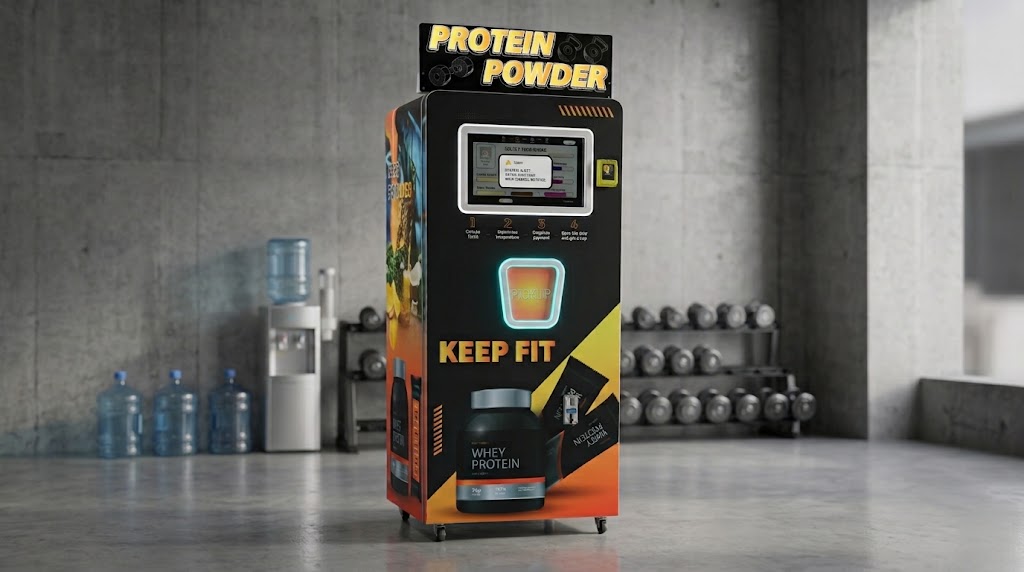
The machines that won in Europe do something fundamentally different from a vending cabinet. They do not store finished product at all. They store powder in sealed hoppers and build the drink when somebody orders it.
The sequence, roughly:
Then it cleans itself. This is the unglamorous engineering that decides whether a machine survives in the field, because anything mixing dairy or plant protein with water needs automated rinse cycles on the lines and the mixing chamber. Get that wrong and you have a hygiene problem within a fortnight, and potentially a conversation with your health department that our partners at VAdviced would much rather help you avoid than resolve. Get it right and the machine runs largely unattended between restocks.
A well specified unit will serve several hundred drinks a day, which is far more headroom than most single gym sites will ever need.
Let us be clear that everything below is illustrative rather than a promise. Your results depend on your location, your traffic, your pricing and your sourcing. But the shape of this category's economics is genuinely unusual, and it is worth understanding why.
Buying protein in bulk powder and selling it by the serving is one of the better margin structures in automated retail. Industry figures for fresh mixing machines commonly cite gross margins in the 40 to 70 percent range, against thinner numbers for pre bottled product where you are paying somebody else to have already done the mixing, bottling, preserving and shipping of mostly water.
| Bottles in a spiral machine | Fresh mixing machine | |
|---|---|---|
| What you buy | Finished product, mostly water | Bulk powder |
| Gross margin | Thin | Commonly cited at 40 to 70 percent |
| Shelf life risk | Real, bottles expire | Powder lasts, minimal waste |
| Restock weight | Heavy, you are hauling water | Light, powder only |
| Product quality | Preserved, often disappointing | Made to order, fresh |
| Maintenance | Almost none | Real, needs cleaning cycles |
Notice the restock line, because operators underestimate it constantly, and it is worth weighing when you compare builds across the units we have ready to ship. Selling bottled drinks means physically carrying water into a building several times a month. Selling powder means carrying a fraction of that weight for the same number of servings. Over a year, across a route, that is a meaningful difference in labour and vehicle cost.
Published figures for strong gym placements put monthly net profit in the region of 2,500 to 3,500 dollars for a single well sited machine, with payback periods commonly discussed in the range of six to fourteen months depending on traffic and pricing. Treat those as a shape rather than a forecast, but the shape is a good one.

We have written before about what to stock in a gym vending machine, and shakes sit at the top of that list for reasons that go well beyond foot traffic.
Twenty four hour gyms deserve special mention. The staffed smoothie bar closes. The machine does not. Anyone training at eleven at night or five in the morning has exactly one option, and it is yours. Getting through the door at those gyms is its own skill, covered in how to get vending machines into gyms. Our guide on making money with a gym vending machine goes deeper on the site economics, and finding the right gyms in the first place is what our partners at VPlaced do.
It would be easy to assume you can lift a European machine, put it on a boat, and sell it here. That assumption is exactly why several attempts at this category have stalled in the US, and it is the reason we are running pilots rather than simply importing.
The differences are real:

We have pilot machines running across the United States on this hardware right now, and that is a deliberate choice rather than a marketing line. You cannot learn what an American gym needs from a spec sheet written in another market. You learn it by putting machines in front of American members and watching what actually happens.
What we are measuring:
That last one has been the most valuable. Operators and gym owners consistently raise things a European engineering team had no reason to consider, and every one of those notes feeds into the specification we are building.
Our position, plainly: Europe spent fifteen years learning this category the expensive way. We would rather inherit that knowledge, add what the American market actually demands, and build the version this country deserves rather than the version that happened to arrive here first.
We would rather you hear these from us than discover them in month three.

If you are a gym owner, the fastest way to understand the opportunity is to stand near your changing room at peak hour and count the shaker bottles. Then count how many members walked out with nothing. That second number is your machine.
If you are an operator, the sequence is straightforward. Get the machine specification right for your product and your sites, secure gyms with genuine traffic and long opening hours through VPlaced, sort the licensing and food rules before you switch on with VAdviced, and market it properly to members in the first month while it is still novel, which is where a media kit and ongoing social earn their keep.
On our side, you can explore the beverage vending machine range or browse and buy from the full lineup. In stock units typically ship within 7 to 21 days and carry a one year parts warranty. If you own a gym rather than operate machines, you can list your site directly with VPlaced, and for getting members to notice the machine on day one rather than month three, VMarketed handles launch and local visibility.
And if you want to talk about the pilot programme specifically, or you run a gym that would be a genuinely good test site, we would like to hear from you. That is not a throwaway line. The machines we are building for this market are being shaped by the people already using them.
The margin structure is one of the strongest in automated retail, because you buy protein in bulk powder and sell it by the serving rather than paying to ship finished bottles of mostly water. Published figures for fresh mixing machines commonly cite gross margins between 40 and 70 percent, with well sited gym placements discussed in the region of 2,500 to 3,500 dollars monthly net. Your own results depend on traffic, pricing and sourcing.
For gyms, almost always. European operators tried bottles in spiral machines extensively and found them slow moving with disappointing product quality, to the point that many gyms abandoned shake sales entirely. Fresh mixing solves the quality problem, improves margin, cuts waste and makes restocking far lighter.
Around a minute from selection to collection on a well specified machine, with the drink chilled and properly whipped rather than lumpy. That is faster than most staffed smoothie bars and available at hours when no bar is open.
More than a snack machine and less than people fear. Good units run automated rinse cycles on the mixing chamber and lines, which handles the bulk of it, but this is a wet product system and it needs scheduled attention. Machines without proper self cleaning develop hygiene problems quickly, so it is worth checking that specification carefully before buying.
Purely timing. The first protein shake vending machine went into operation in Berlin in 2011 and the format has had fifteen years to mature across European gyms. The American market is only now moving on it, which is precisely why the opportunity here is unusually open right now.
Let Us Build America's Version
We have pilots running across the country and we are specifying protein shake machines around what American gyms actually need. Tell us about your site and let us talk.
Browse the Machines
Share:
What Does a Vending Machine Operator Do? Operational & Financial Guide
Phone Case Vending Machines: How They Work and the Real Economics