


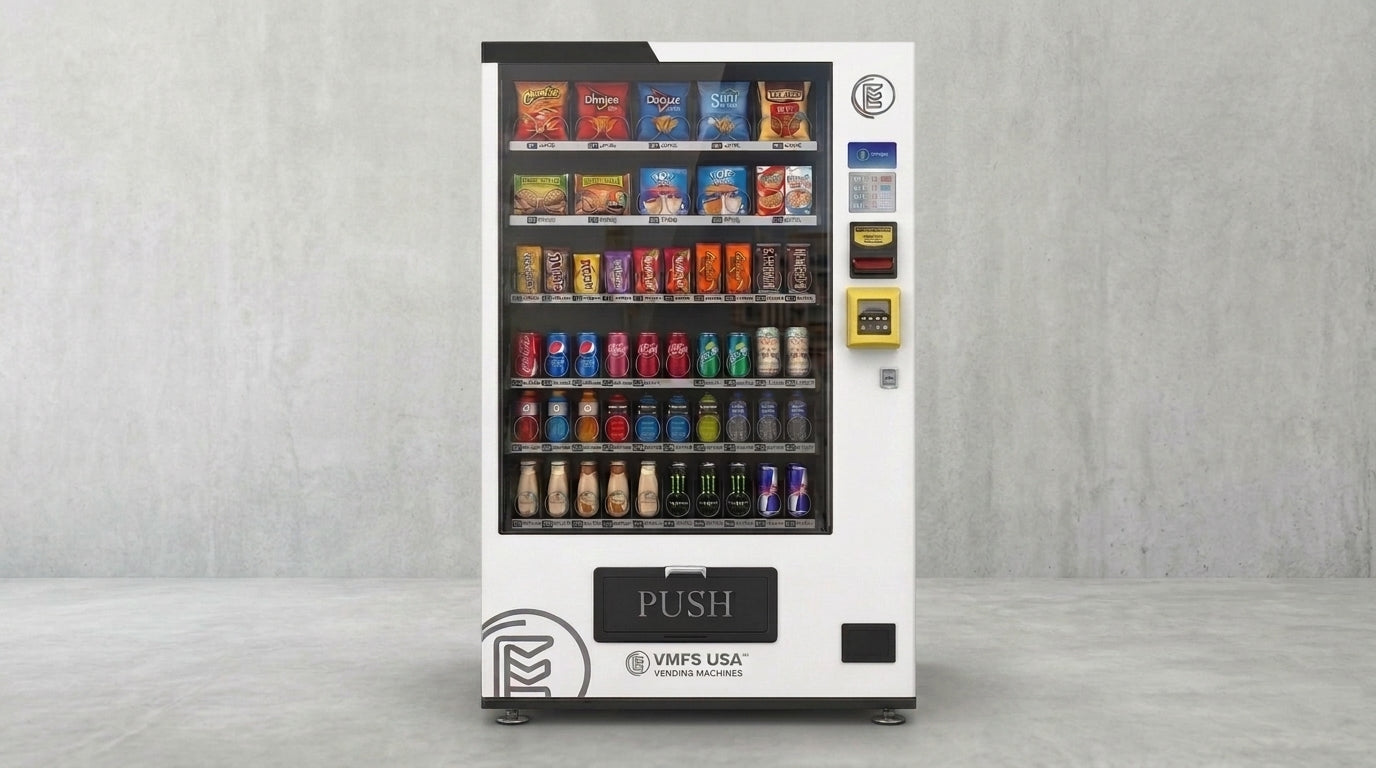


Design the perfect vending solution for your location and customers.

Join the VMFS newsletter and step into a thriving network dedicated to collective success.
One signup. Endless possibilities.
How to become a vending machine operator starts with choosing a profitable business model, securing the right locations, selecting suitable machines, handling licensing and taxes, and building a reliable restocking and maintenance system. A vending route can be started with one machine and expanded into a multi-location operation, but profitability depends far more on location quality, product selection, operating costs, and route efficiency than on simply owning vending machines.

The U.S. Small Business Administration lists business structure, registration, tax IDs, licenses, permits, vending machine insurance, and startup-cost planning among the core steps involved in launching a small business. It also specifically identifies vending machines as an activity that can be subject to state and local licensing requirements.
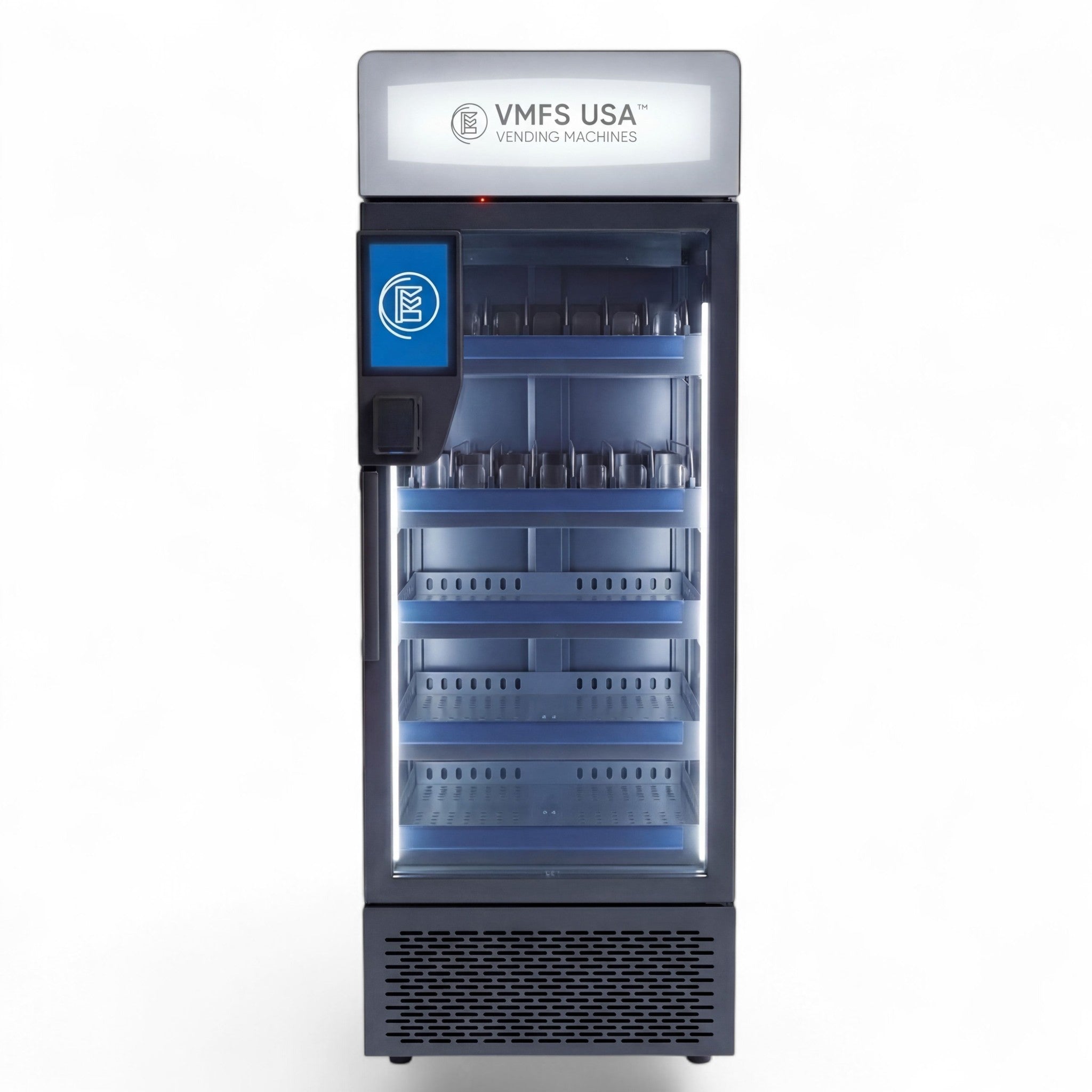
For equipment, operators can research machines, payment systems, refrigerated units, specialty machines, and new or refurbished equipment through VMFS USA.
Operator rule: A vending machine is an asset. A vending route is the business. The goal is not to own machines; it is to build profitable locations that can be serviced efficiently.
Before purchasing equipment, determine what type of vending business you want to operate and which customers you intend to serve.
Common markets include offices, apartment buildings, hotels, manufacturing facilities, hospitals, schools, gyms, laundromats, transportation facilities, entertainment venues, and specialty retail environments.
Start by researching foot traffic, customer demographics, operating hours, existing vending competition, average transaction value, product demand, security, accessibility, and location economics.
A location with 1,000 visitors is not automatically better than one with 300. The purchasing behavior of those visitors matters more than raw foot traffic.
There are several ways to enter the industry.
| Model | Best for | Main advantage | Main challenge |
|---|---|---|---|
| Traditional snack and drink vending | Beginners | Broad consumer demand | Competitive locations |
| Healthy vending | Offices, gyms, healthcare | Higher-value positioning | Product selection |
| Micro-market | Offices and workplaces | Larger product assortment | Higher operational complexity |
| Specialty vending | Niche audiences | Differentiation | Smaller target market |
| Smart vending | Premium locations | Remote monitoring and data | Higher equipment cost |
| Bulk vending | Low-cost entry | Simple machines | Lower revenue per location |
| Used-machine route | Budget-conscious operators | Lower equipment cost | Repairs and reliability |
The best model is the one that matches the location. A refrigerated beverage machine makes sense in a manufacturing facility, while a specialty machine may perform better in an entertainment venue.
There is no universal vending machine startup cost because equipment, inventory, transportation, permits, payment systems, insurance, and location requirements vary significantly.
The SBA recommends separating one-time startup expenses from recurring operating expenses and calculating costs before launching.
For a first machine, your budget may include:
| Expense category | What to budget for |
|---|---|
| Vending machine | New, refurbished, or used equipment |
| Initial inventory | Products needed for the first several service cycles |
| Card reader | Cashless payment capability |
| Delivery | Transportation and installation |
| Business registration | Entity formation and state/local fees |
| Licenses and permits | Requirements based on location and products |
| Insurance | General liability and other appropriate coverage |
| Location costs | Commission, rent, or other agreement terms |
| Working capital | Repairs, inventory, fuel, and unexpected expenses |
| Marketing | Sales materials, website, outreach, and prospecting |
Do not spend your entire budget on the machine. Working capital is what keeps the machine operating after installation.
Snack and drink machines remain the simplest model for many new operators because consumers already understand the purchasing process.
The strongest locations often combine predictable traffic with recurring demand. Employees at workplaces, residents in apartment communities, and visitors at hotels can generate repeat purchases because the same customers encounter the machine frequently.
For equipment selection, compare machine capacity, dimensions, refrigeration requirements, payment compatibility, energy consumption, telemetry, warranty coverage, and parts availability rather than focusing only on purchase price.
Specialty vending allows operators to target a specific customer need.
Examples include electronics accessories, personal-care products, toys, collectibles, and trading cards. Pokémon vending is one example of a highly specialized model, where product authenticity, supply availability, security, pricing, and replenishment become particularly important.
Operators considering this niche can review the complete Pokémon card vending machine operator guide before committing capital.
Smart vending machines use technologies such as telemetry, digital displays, remote monitoring, cashless payments, inventory data, and sometimes computer vision or other AI-powered systems.
For operators, the value of smart vending is not simply the word "AI." The technology matters when it reduces route visits, improves inventory visibility, increases payment options, or provides better sales data.
See What Is an AI Vending Machine? for a deeper explanation of the technology.

A mediocre machine in an excellent location can outperform an expensive machine in a weak location.
The strongest vending locations generally have consistent traffic, dwell time, recurring customers, limited nearby alternatives, suitable machine placement, and an audience that purchases the products being offered.
Potential locations include:
| Location type | Potential vending demand |
|---|---|
| Manufacturing facilities | High demand for drinks and snacks during shifts |
| Corporate offices | Coffee, beverages, snacks, and healthier options |
| Apartment communities | Convenience products and everyday essentials |
| Hotels | Snacks, beverages, personal-care products |
| Gyms | Water, sports drinks, protein products |
| Laundromats | Snacks, beverages, laundry-related products |
| Hospitals and healthcare facilities | Extended-hours convenience |
| Schools and colleges | Snacks, drinks, and specialty products |
| Auto dealerships | Customer and employee convenience |
| Specialty venues | Niche products matched to visitors |
For more location ideas, this guide to places that need vending machines provides a broader location framework.
Do not judge a location from a single visit.
Measure traffic at different times, identify the people who actually use the facility, inspect competing food options, ask about existing vending contracts, and determine who controls placement decisions.
Also examine the physical environment. The machine needs adequate electrical access, safe positioning, customer visibility, service access, and an accessible path.
Under the ADA Standards, where vending machines are provided, at least one of each type at a location must comply with applicable accessibility requirements.
Operators do not need to own commercial real estate to build a vending route. They can approach property managers, business owners, facility managers, gyms, hotels, offices, and other organizations that have suitable customer traffic.
If you own a property and want to have a vending machine installed, connect with qualified vending operators through VPlaced.
Machine selection should follow the location analysis, not happen before it. A beverage machine requires refrigeration and different capacity planning from a snack machine. A specialty machine may need different security features, product compartments, or payment technology. When comparing machines, evaluate:
Product capacity
Machine dimensions and weight
Refrigeration
Energy consumption
Payment compatibility
Remote monitoring
Warranty and serviceability
Parts availability
Security
ADA considerations
Operators can research available vending equipment through VMFS USA.
Product selection should reflect the people using the machine. An office with health-conscious employees may support bottled water, low-sugar beverages, protein products, and better-for-you snacks. A manufacturing facility with long shifts may generate stronger demand for energy drinks, larger beverages, salty snacks, and filling products. Start with a controlled assortment rather than filling every selection with different products. Track:
Units sold → revenue → gross margin → stockouts → expiration → customer feedback.
After several service cycles, replace weak sellers with products showing stronger demand.
Vending pricing must account for product cost, payment processing fees, spoilage, commissions, fuel, repairs, taxes, and other route expenses. A product that appears profitable at the shelf level can become unattractive after location commission and operating expenses.
The correct question is not "How much can I charge?" It is "What price produces acceptable margin while maintaining sales velocity?"
A vending operation can be structured as a sole proprietorship, LLC, partnership, or corporation depending on ownership, liability, taxation, and growth plans.
For many independent operators, an LLC is worth evaluating because it can create a separate legal entity and provide liability protections that may not exist when operating personally. The right structure depends on the circumstances and should be reviewed with qualified legal and tax professionals.
If you plan to operate multiple machines and want to establish an LLC, see Form an LLC for a vending machine business.
There is no single nationwide "vending machine license" that covers every operator. Requirements vary by state, county, city, business structure, machine type, and products sold. The SBA specifically notes that vending machines can be regulated at the state and local level.
Depending on the jurisdiction, an operator may need business registration, sales-tax registration, vending permits, food-related permits, local business licenses, or other approvals.
Food vending can introduce additional regulatory considerations. For example, FDA calorie-labeling rules apply to operators who own or operate 20 or more vending machines, subject to the rule's requirements and exemptions.
Keep business and personal finances separate. Establish appropriate bookkeeping, track machine-level revenue and expenses, and retain purchase and operating records.
Common financial categories include inventory, machine depreciation, repairs, fuel, payment processing, insurance, commissions, software, storage, advertising, and professional services. Insurance should also be evaluated before placing machines in third-party properties.
A written vending location agreement should define who owns the machine, where it will be installed, access rights, term length, termination rights, maintenance responsibilities, utilities, insurance, commissions, damage liability, and removal procedures. Revenue-sharing arrangements are common, but the percentage alone does not determine whether a location is profitable.
For example, a location demanding a high commission may still be attractive if sales volume is exceptional. A low-commission location can be unprofitable if the machine rarely sells.
Before signing, review termination clauses, exclusivity, renewal language, payment obligations, and liability provisions. Operators dealing with complex agreements can review common vending machine placement contract red flags.
Restocking should be based on sales data instead of a fixed schedule whenever possible. A machine selling quickly should receive more frequent service. A slow machine may need fewer visits or a different product mix.
Every service visit should have a purpose: replenish inventory, rotate products, clean the machine, inspect equipment, verify payment functionality, remove expired products, and record relevant sales or inventory information.
A basic operator dashboard should track:
| Metric | Why it matters |
|---|---|
| Revenue per machine | Measures sales performance |
| Gross margin | Shows product economics |
| Stockouts | Identifies lost sales |
| Service frequency | Determines route efficiency |
| Payment failures | Reveals transaction problems |
| Product-level sales | Guides inventory decisions |
| Repair costs | Identifies poor-performing equipment |
| Location commission | Measures site economics |
| Net contribution | Shows whether the location is worth keeping |
The objective is profit per route hour, not simply revenue per machine.
Property managers and business owners usually care about convenience, cleanliness, reliability, customer satisfaction, and minimal management responsibilities.
Your pitch should explain what you provide, where the machine will go, how often it will be serviced, what happens when products sell out, how repairs are handled, and whether the property receives rent or revenue share.
A structured location pitch is often more effective than simply asking, "Can I put a vending machine here?"
For property-manager outreach, see this guide to pitching property managers for vending placement.
Cold email, phone outreach, local prospecting, referrals, and direct visits can all generate location leads.
Create a prospect list containing the business name, decision-maker, location, estimated traffic, existing vending provider, contact information, outreach status, and follow-up date.
For corporate accounts, this cold-emailing guide for winning corporate vending accounts can help structure the sales process.
The right choice depends on capital, technical ability, warranty needs, and the reliability required by the location.
| Factor | New machine | Used machine |
|---|---|---|
| Initial cost | Higher | Lower |
| Warranty | Usually stronger | Often limited |
| Technology | Newer | May be outdated |
| Reliability | Generally more predictable | Depends heavily on condition |
| Payment upgrades | Usually easier | May require retrofitting |
| Maintenance risk | Lower initially | Potentially higher |
| Best for | Long-term operators | Budget-conscious entry |
A used machine can be a smart purchase when its refrigeration, motors, control board, bill validator, coin mechanism, display, and payment system are in good condition.
Before purchasing used equipment, inspect it carefully and confirm replacement parts are available. This guide to buying a used vending machine covers the main considerations.
| Advantage | Why it matters |
|---|---|
| Flexible operations | Routes can be scheduled around other commitments |
| Scalable model | Additional profitable locations can expand revenue |
| Repeat purchases | Good locations generate recurring customer demand |
| Multiple niches | Operators can specialize by product or location |
| Automation potential | Cashless payments and telemetry reduce manual work |
| Challenge | Operational impact |
|---|---|
| Location acquisition | Weak locations can make good equipment unprofitable |
| Inventory management | Poor rotation creates spoilage and stockouts |
| Repairs | Equipment failures can interrupt sales |
| Route driving | Inefficient routes increase fuel and labor costs |
| Competition | High-quality locations may already have operators |
| Compliance | Requirements vary across jurisdictions |
Vending is not truly passive. It becomes more automated and scalable as systems improve, but someone still has to manage inventory, equipment, locations, finances, and customer issues.
This is one of the most expensive beginner mistakes. An operator can purchase a machine, discover that the intended location is unavailable, and then hold equipment that generates no revenue. Secure the location—or have a strong placement strategy—before committing significant capital.
Foot traffic without purchasing intent is weak evidence. A busy hallway may generate less revenue than a smaller workplace where customers spend eight hours every day.
Cashless transactions can increase convenience but introduce processing fees and equipment costs. These expenses must be included when calculating net profitability.
More products do not automatically mean more sales. Inventory should reflect actual demand. Slow-moving products occupy valuable capacity and can increase spoilage.
Each machine has its own economics. Analyze machines individually and identify locations that consistently underperform. Relocating an underperforming machine can sometimes create more value than repeatedly changing its product mix.
A route becomes more efficient when machines are located close enough together that one service trip can handle multiple accounts. Ten machines spread across several cities may be less attractive operationally than ten machines concentrated within a manageable service area.
Route density reduces fuel consumption, driving time, and labor requirements. That makes location clustering one of the most important concepts for operators planning to scale.
An operator should not hire a route driver simply because the business has several machines. Hiring makes sense when the value of the operator's freed-up time and increased route capacity exceeds wages, payroll costs, training, management, and other employment expenses.
The same principle applies to warehouses, inventory staff, sales representatives, and route-management software.
A scalable vending operation needs systems for:
Lead generation → location contracts → machine installation → inventory purchasing → route scheduling → restocking → maintenance → accounting → performance analysis.
Once those systems are repeatable, adding machines becomes an operational decision rather than a completely new business-building exercise.

Start with one clearly defined vending model, research local licensing requirements, secure a suitable location, purchase an appropriate machine, establish suppliers, and create a repeatable restocking process. Starting with one or a few machines lets you learn route economics before committing to a large equipment investment.
There is no fixed startup cost because machine type, location, permits, inventory, payment systems, insurance, and transportation vary. Build a complete budget covering equipment plus several months of working capital rather than spending the entire budget on the machine.
A vending business can be profitable when machines are placed in locations with sufficient recurring demand and the operator controls inventory, route, maintenance, and location costs. Profitability should be evaluated at the individual-machine and location level, not by machine revenue alone.
An LLC is not universally required simply because you operate vending machines. Business structure requirements and advantages depend on your circumstances, state, tax situation, liability exposure, and growth plans; the SBA recommends evaluating business structure and registration requirements before launch.
Licenses and permits depend on the state, county, city, machine type, and products sold. Vending machines can be regulated locally, so operators should verify requirements with the relevant state and local agencies before placing machines.
Strong candidates include workplaces, manufacturing facilities, apartment communities, hotels, gyms, laundromats, healthcare facilities, schools, and specialty venues. The best location combines recurring traffic, customer demand, suitable placement, security, accessibility, and limited competition.
A used machine can reduce initial capital requirements, while a new machine generally provides newer technology, stronger warranty coverage, and more predictable reliability. Inspect used equipment carefully and verify that parts and payment-system upgrades remain available.
Cashless payments are highly useful because customers increasingly expect card and contactless payment options. Operators should compare transaction fees, reader costs, connectivity requirements, and compatibility with the machine before choosing a payment provider.
Restocking frequency depends on sales volume, machine capacity, product mix, and location traffic. High-volume locations may require several service visits per week, while slower machines may need much less frequent service; sales data should determine the schedule.
Yes, a small vending route can be operated part-time, particularly when locations are close together and machines have reliable cashless payments or remote monitoring. The workload increases as the number of machines, service frequency, driving distance, and product assortment grow.

Share:
Phone Case Vending Machines: How They Work and the Real Economics
Vending Machine Repair Jobs - Salary and Work Explained