




Design the perfect vending solution for your location and customers.

Join the VMFS newsletter and step into a thriving network dedicated to collective success.
One signup. Endless possibilities.
A perfume vending machine business can be profitable because the fragrance in a single spray costs cents while you set the price: at the $142 Dior charges for a 100 ml bottle of Sauvage, a typical 0.1 ml spray uses about 14 cents of perfume. Whether that margin turns into real income depends on how many sprays a location sells, the venue's commission, card fees and how well you control refills.
This guide works through the cost per spray, revenue scenarios with every cost included, bottle and decant vending, trademark and FDA (MoCRA) rules, the locations that sell, and the two VMFS perfume machines at $3,000 and $4,000.

A perfume vending machine sells fragrance without staff in one of two ways: it either sells a timed spray of perfume or cologne that the customer applies on the spot, or it dispenses a packaged bottle, mini or sample the customer takes away. The two models share a cabinet and a payment reader, but they have very different costs, inventory risk and legal exposure, so the first decision in a perfume vending machine business is which one you are running.
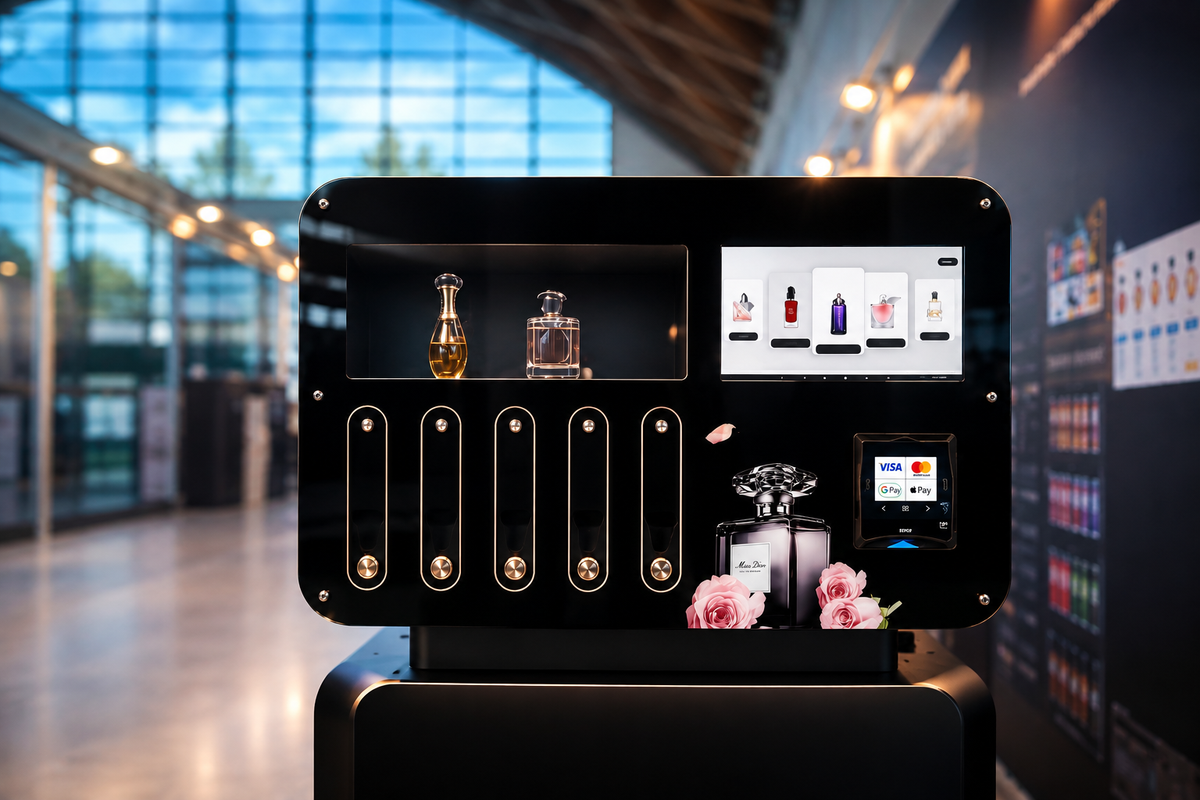
Spray machines hold several fragrances in internal bottles or cartridges, each connected to its own spray module. The customer picks a scent, pays, holds a wrist or neck in front of the nozzle and the machine releases a metered, timed spray. Nothing leaves the machine except the mist, so there is no product to drop, break or steal from a delivery bin. The VMFS perfume spray vending machine works this way with five spray modules and push-button selection, and the smart touch screen perfume vending machine adds a 10-inch touchscreen and per-fragrance spray counting. This is the format people usually mean when they search for a cologne vending machine or a vending machine that sprays cologne in a club restroom.
The economics follow from the format. You sell the same bottle hundreds or thousands of times, one small dose at a time, and the price is set per spray rather than per bottle. That turns a $100-plus retail product into a low-ticket impulse purchase, which is exactly why the model suits nightlife, gyms and event venues where people want to freshen up for a moment rather than buy a full bottle.
Bottle vending is closer to classic retail. The machine stores boxed full-size bottles, travel sprays, rollerballs or sample vials on shelves or coils and delivers one per sale, ideally through an elevator or gentle-drop mechanism so glass does not break. The ticket is higher, but so is the cash tied up in inventory, and every unit carries the price risk of a product you bought before you knew whether it would sell. Decant vending, where an operator splits large bottles into small vials, adds legal questions covered later in this guide.
Spray per use
Sells a metered spray. Low ticket, very low product cost per sale, nothing physical leaves the machine. Best for clubs, restrooms, gyms and events.
Full bottle or mini
Sells sealed retail product. Higher ticket and inventory cost, needs a gentle delivery system. Best for malls, airports, hotels and boutiques.
Decants and samples
Sells small vials filled from large bottles. Attractive per-ml pricing, but the filling step carries trademark and FDA facility questions.
Yes, perfume vending machines can be profitable, mainly because the product cost of a spray is small relative to the price an operator can charge, but profit is earned per location rather than guaranteed by the category. A machine that sells a handful of sprays a week will not pay back its cabinet, while the same machine outside a busy nightclub restroom can recover its cost within months. The margin structure is strong; the volume is what you have to find.
Demand for fragrance is not the constraint. Circana reported that US prestige fragrance dollar sales grew 5% in 2025 and closed the year as the second-largest segment of prestige beauty, while mass-market fragrance was the fastest-growing mass beauty category at 15% dollar growth. Circana also noted that the popularity of mini sizes remained influential, which matters to anyone selling fragrance in small doses. People are buying fragrance and they are comfortable buying it in small formats; a vending machine simply puts that purchase at the moment someone wants it.
Compared with snack or drink vending, spray vending removes three cost lines that eat into food operators' profit: spoilage, refrigeration and heavy restocking labor. Perfume is shelf stable, the machines run at room temperature, and a refill visit means topping up five bottles rather than loading dozens of coils. The trade-off is that revenue per transaction is small and depends on impulse, so the location and the price point have to be right. For the general framework operators use to judge any machine, see our guide on whether vending machines are profitable.
Short answer: the perfume vending machine business has unusually low product cost per sale and almost no spoilage. Profit comes down to sprays per day, the venue's cut and card fees, so model those three before you buy a machine.
Cost per spray is the fragrance price per milliliter multiplied by the milliliters in one spray, and for designer fragrance at full retail it usually lands well under 20 cents. Everything else in a spray machine's profit and loss is either fixed (the machine) or a percentage of sales (commission and card fees), so this one number tells you how much of each sale you keep before overhead.
Two inputs matter. The first is spray volume. A standard atomizer delivers roughly 0.07 to 0.10 ml per press, which works out to about 1,000 to 1,500 sprays from a 100 ml bottle, according to fragrance house Marc-Antoine Barrois. Vending machines use a timed spray instead of a hand pump, so the dose is whatever the machine is set to deliver: VMFS rates the smart touch screen model's 120 ml bottles at up to roughly 2,000 sprays each, or about 0.06 ml per spray. The second input is what you pay for the fragrance. Dior lists Sauvage Eau de Toilette at $142 for 3.4 oz (100 ml), or $1.42 per ml at full retail.
| Fragrance cost basis | Cost per ml | At 0.10 ml per spray | At 0.06 ml per spray |
|---|---|---|---|
| Designer EDT at full retail ($142 per 100 ml) | $1.42 | about $0.14 | about $0.09 |
| Same bottle bought at half of retail (illustrative) | $0.71 | about $0.07 | about $0.04 |
| Your own price: bottle cost ÷ bottle ml | your figure | × 0.10 | × 0.06 |
The table shows why spray vending margins look so large on paper. At $1 a spray, full-retail designer fragrance at 0.1 ml is about 14% of the sale; at $2 a spray it is about 7%. Even if you buy every bottle at list price, the fragrance is a small share of revenue. The practical lesson is that shaving a few cents off fragrance cost matters less than getting the spray volume right: a timer set too long wastes product and irritates customers, while one set too short makes the purchase feel like poor value. Measure your own machine by weighing or measuring a bottle before and after a counted run of sprays, then use the real figure in your model.
Spray volume also sets your refill rhythm. A 100 ml bottle at 0.1 ml per spray lasts about 1,000 sprays; at 25 sprays a day spread across five scents, each bottle would last months. That long interval is one reason spray vending is attractive to part-time operators, and it is why the VMFS Cloud spray counts matter more than a fixed visit schedule.
A spray machine's monthly profit is sprays sold × price per spray, minus location commission, card processing and fragrance cost, and the result swings widely with traffic. The scenarios below use the full-retail cost of about $0.142 per 0.1 ml spray from the previous section, a 20% location commission and a 5% card fee, so they lean conservative on costs. They exclude your time, travel and any financing payment, which you should add for your own route.
The cost assumptions are grounded in published ranges. NerdWallet reports that location owners typically receive 5% to 25% of revenue as a commission, and Televend puts card acquiring fees at roughly 2% to 5% of a transaction plus a fixed fee per transaction. Using the top of the fee range and a commission near the top of the commission range keeps the model honest. For how commission deals are usually structured, see our breakdown of the vending machine revenue split between operator, location and supplier.
| Sprays per day | Price per spray | Monthly revenue (30 days) | Commission 20% + card fee 5% | Fragrance cost | Monthly profit before your time | Months to recover $3,450 |
|---|---|---|---|---|---|---|
| 10 | $1 | $300 | $75 | $42.60 | $182.40 | about 19 |
| 10 | $2 | $600 | $150 | $42.60 | $407.40 | about 8.5 |
| 25 | $1 | $750 | $187.50 | $106.50 | $456.00 | about 7.6 |
| 25 | $2 | $1,500 | $375 | $106.50 | $1,018.50 | about 3.4 |
| 50 | $1 | $1,500 | $375 | $213 | $912.00 | about 3.8 |
| 50 | $2 | $3,000 | $750 | $213 | $2,037.00 | about 1.7 |
The $3,450 payback figure is the $3,000 perfume spray vending machine plus the $450 credit card reader VMFS lists as an upgrade on the product page. Two things stand out. First, price per spray moves profit more than anything else you control, because commission and fees scale with revenue but fragrance cost does not. Second, a slow location is a real loss even with high margins: ten $1 sprays a day takes well over a year to recover the machine. For comparison, VMFS shows estimated revenue of $400 to $900 a month for the spray model and $800 to $1,600 a month for the touchscreen model on the live product pages, noted as based on operator-reported data; treat those as ranges to test, not promises.
Small tickets have a specific weakness: the fixed per-transaction part of card processing takes a bigger bite out of a $1 sale than a $5 one. There are three common fixes. You can price higher at premium venues, where a refined scent at $2 or more meets little resistance. You can sell multi-spray packages, the way Scentphony's machines in Singapore malls sell two sprays per $1 purchase, according to Vending Times. Or you can keep coin and bill acceptance so small buyers pay cash, which both VMFS machines support. Our cashless payment systems guide explains fee structures and readers in more detail.
Test prices deliberately. Change one variable at a time, run it for two to four weeks, and compare sprays per day and revenue per day rather than gut feel. A machine that sells fewer sprays at $2 can still earn more than one selling more at $1, as the table shows. The operator pricing guide covers how to set and test vending prices across a route.

Bottle vending earns more per sale than spray vending but ties up far more capital and carries inventory risk, so its profit depends on sourcing price and sell-through rather than on cost per spray. The math per unit is simple: selling price minus landed product cost, minus commission and card fees as a percentage of the selling price. What makes it harder is that you pay for every bottle before it sells, and a scent that does not move is cash sitting in a cabinet.
Use this formula for each item: profit per unit = price − product cost − (commission % + card fee %) × price. Then multiply by realistic weekly sell-through, not by machine capacity. A full machine is not a sales forecast. Start with fewer SKUs, track what sells, and reorder only proven scents. Mini sizes, travel sprays and rollerballs lower the ticket to an impulse level and fit Circana's observation that minis remained influential in 2025.
Hardware matters more for bottles than for sprays. Glass bottles need a delivery system that does not drop them onto a hard bin, which is why operators selling boxed fragrance look at elevator vending machines or touchscreen cosmetics vending machines built for beauty and personal care products. Decants add another layer: filling small vials from large bottles is a manufacturing step under federal cosmetics law and a trademark risk if quality slips, both covered below.
Spray per use: advantages
Spray per use: limitations
Compare perfume and specialty vending machines
See the VMFS perfume spray and touchscreen perfume machines alongside other specialty formats, with live prices.
Browse specialty machinesThe main startup cost of a spray-based perfume vending machine business is the machine itself: VMFS sells the perfume spray vending machine for $3,000 and the smart touch screen perfume vending machine for $4,000, with first-fill fragrance, optional upgrades and any location setup on top. Bottle-based setups cost more because both the hardware and the opening inventory are larger. For a full market price comparison across machine types, read how much a perfume vending machine costs.
| VMFS machine | Price | Format | Key specs |
|---|---|---|---|
| Perfume Spray Vending Machine | $3,000 | Spray per use | 5 spray modules, timed spray, push buttons, coin, bill and card support, 40.6 × 23.6 × 10.6 in, about 66 lbs |
| Smart Touch Screen Perfume Vending Machine | $4,000 | Spray per use | 5 spray modules, 10-inch touchscreen, 120 ml bottles (up to about 2,000 sprays each), spray counts in VMFS Cloud, coin and card support, 17.7 × 28.7 × 7.9 in countertop unit |
| Mini Cosmetics Vending Machine | $4,968 | Boxed bottles and minis | 32-inch HD touchscreen, compact steel cabinet, remote monitoring, cashless payments |
| Cosmetics Vending Machine | $5,950 | Boxed bottles and minis | Touchscreen cabinet built for beauty and personal care products in boutiques, malls and airports |
| Smart Elevator Vending Machine | $8,650 | Packaged products | Elevator delivery for gentle handling, 21.5-inch touchscreen, cloud connectivity |
On the spray models, the product pages list optional upgrades that change the budget: a credit card reader at $450, a bill acceptor at $450, a custom wrap at $600, a 4G module at $95 (SIM not included) and an extra year of warranty at $250. Both spray machines carry the standard VMFS warranty of one year on parts and labor, and both show a 6 to 12 week lead time depending on availability, so plan placements around delivery rather than signing a venue for next week. If you would rather spread the cost, VMFS offers vending machine financing, with monthly payments shown on each product page.

Beyond hardware, budget for the first fill of five fragrances, general liability insurance, any local business license, and a reserve for the first slow months while you test the location. Insurance and entity questions are covered in our vending machine insurance guide and in whether you need an LLC for a vending business. Run your own numbers in the VMFS ROI calculator before you commit, using a sprays-per-day figure you would be comfortable defending to a lender.

You can generally resell genuine branded fragrance you bought legitimately, but you cannot imply that the brand sponsors your machine, and repackaging into decants weakens that protection if quality suffers. That is the core of the trademark position for operators, and it shapes both what you load and how you label the machine.
A trademark identifies the source of goods. Under the first sale doctrine, a reseller of genuine trademarked goods is generally allowed to resell them. Loeb & Loeb's 2025 analysis of fragrance decanting sets out the limits that matter here: resellers may use a brand name descriptively, only as much as needed to identify the product, and may not use the mark in a way that implies affiliation or sponsorship. Using the designer's imagery or emphasizing the brand in marketing typically crosses into false association. The same analysis notes that the first sale doctrine does not shield resellers when the quality of the resold product is compromised, and that decanting often degrades fragrance.
For a spray machine, that translates into practical rules. Buy fragrance from sources that give you an invoice, so you can show the product is genuine. Name the scent in plain text on the selection panel or screen if you want to, but do not put the designer's logo, campaign images or a "presented by" style message on the cabinet or touchscreen unless you have a written agreement. Keep the bottles sealed and stored properly until they go into the machine, since a degraded scent is both a customer complaint and a legal risk. And if you want to run "inspired by" or dupe fragrances, get advice first, because comparative claims that lean on a famous brand name raise trademark questions of their own.
Private label is the cleanest alternative. Fragrance you commission and sell under your own name avoids most brand-use questions, at the cost of brand pull at the machine and new responsibilities under FDA rules, because your name on the label makes you the responsible person. A middle path is a sponsorship deal in which a fragrance brand supplies product for a module in exchange for exposure, which turns the brand-use question into a contract. VAdviced can help structure supplier, sponsorship and placement agreements.
Perfume is a cosmetic under US law, so the Modernization of Cosmetics Regulation Act of 2022 (MoCRA) applies to the companies that make, fill and label it, but an operator who only places sealed, branded retail bottles into a spray machine is usually not the regulated manufacturer. FDA states plainly that a product applied to the body to make a person more attractive is a cosmetic, and fragrance fits that definition. Where you sit under MoCRA depends on whether you manufacture, fill or put your name on the product.
FDA describes MoCRA as the most significant expansion of its authority over cosmetics since 1938. Its core obligations fall on two groups. Facilities that manufacture or process cosmetics must register with FDA and renew every two years. The responsible person, meaning the manufacturer, packer or distributor whose name appears on the label, must list each product with its ingredients, keep records substantiating safety, and report serious adverse events to FDA within 15 business days.
The statute's definition of a facility matters for decant sellers. The law excludes cosmetic retailers unless they manufacture or process products not sold directly to consumers at that location, and it excludes establishments that only label, relabel, package, repackage, hold or distribute. But it also says packaging and repackaging do not include filling a product container with a cosmetic. Filling vials from a bulk bottle is therefore not covered by the packaging exclusion, which is why a decant operation should check whether it counts as a facility. Small businesses get relief: responsible persons and facilities with average US cosmetic sales under $1,000,000 a year over the previous three years, adjusted for inflation, are exempt from registration, listing and good manufacturing practice requirements, though not from duties such as adverse event reporting.
| Your setup | Likely MoCRA role | What to do |
|---|---|---|
| Spray machine loaded with genuine, labeled retail bottles | Seller of another company's product; the brand is the responsible person | Keep invoices, store properly, pass any reaction reports to the brand |
| Decants or vials you fill and label | Possibly a facility (filling) and the responsible person (your name on label) | Check the small-business exemption, label correctly, set up adverse event reporting |
| Private-label fragrance made for you | Responsible person; the contract manufacturer is the facility | Confirm listing, safety substantiation and labeling with your manufacturer |
Labeling and customer safety come next. FDA allows fragrance ingredients to be listed simply as "Fragrance" and notes that some fragrance components can cause allergic reactions or sensitivities for some people. A short notice on the machine, such as a "patch test first if you have fragrance sensitivities" line and a contact phone number, is a sensible courtesy, and it gives customers somewhere to report a reaction. Venues with shared air, such as small restrooms or gyms, may also ask you to limit spray volume.
State and local rules are lighter than for food vending, because perfume generally does not trigger food-vending health licenses, but they are not zero. Expect a general business license, sales tax registration where per-spray or bottle sales are taxable, and any building or landlord rules for wall mounting and power. Our guide to vending machine permits in the United States explains how to check state and city requirements. This section is general information, not legal advice.
The best locations for a perfume vending machine are indoor spots where people are about to be seen and have a few seconds to spare: nightclubs and bars, restrooms in busy venues, malls, gyms, hotels and event spaces. Fragrance is an impulse purchase tied to an occasion, so dwell time and the moment matter more than raw foot traffic. VMFS lists malls, hotels, boutiques and salons, nightlife venues and bars, gyms and fitness studios, and event spaces as target locations for its perfume machines, all indoors.
| Location | Why it sells | Best format | Watch out for |
|---|---|---|---|
| Nightclubs and bars | Customers freshen up before and during a night out; repeat visits through the evening | Spray, wall or counter unit | Vandalism risk, late-night card declines, venue cut |
| Restrooms in busy venues | Captive moment in front of a mirror | Wall-mounted spray | Single-gender rooms halve your audience; humidity and heat |
| Malls and shopping centers | High traffic and fragrance-browsing mindset | Touchscreen spray or bottle/mini machine | Mall rent and leasing rules |
| Gyms and fitness studios | Post-workout spray in the locker area | Spray | Shared air in small rooms; humidity |
| Hotels and resorts | Guests heading out to dinner or meetings; gift buying | Touchscreen spray or minis | Lower volume, premium pricing needed |
| Events and venues | Peak demand on event nights; sponsorship potential | Spray with branded wrap | Short placements, moving the unit |
Restrooms deserve a specific note. They are often the highest-converting spot in a club, but they are also humid, and fragrance degrades faster with heat and light, so keep the cabinet away from hand dryers and direct sun. If the machine is wall mounted or on a counter, keep the controls within the accessible reach range; the 2010 ADA Standards set a forward or side reach range of 15 to 48 inches above the floor and require at least one of each type of vending machine provided to be accessible. Gyms follow similar logic, and our gym vending machine guide covers placement and pricing in fitness locations.
Before you sign, ask the venue for real traffic data, opening hours and the customer mix, and agree on the commission, power, insurance and removal terms in writing. Our guide on how to scout and pitch a vending machine location walks through the pitch and the questions to ask. VPlaced matches operators with location owners looking for machines, and VMFS location matching can help place a perfume machine where fragrance impulse and foot traffic line up.
A perfume spray machine needs little routine maintenance: refill each fragrance before it runs dry, clean the nozzles and front panel, empty cash if you accept it, and check the card reader. There are no trays, coils or refrigeration, so the mechanical failure points of a snack machine simply are not there, and VMFS describes both spray models as tray-free designs built for low maintenance.
Refill timing should follow data rather than a calendar. The smart touch screen model counts every spray per fragrance and shows it in VMFS Cloud, so you can see which scent is running low and which is barely used, then plan a single visit that refills the busy bottle and swaps out the slow one. On the push-button model, a simple log of sprays sold from your payment reports gives a similar picture. Rotate one of the five modules seasonally or for events to keep regular customers trying something new.
Product care is the part operators underestimate. Fragrance breaks down faster with heat, light and humidity, which is why perfumers recommend dry, cool storage away from sunlight. Store backup bottles in their boxes, out of hot vehicles, and do not overfill the machine with stock that will sit for months. Wipe nozzles regularly so dried residue does not block the spray or distort the dose, and test each module after a refill. A broader checklist for cabinets, readers and locks is in our vending machine maintenance guide.

Beyond spray sales, a perfume machine is a sampling channel for fragrance brands, an amenity for venues and, on screen-equipped models, a small advertising display. Each of those can add revenue or strengthen a placement deal, which is worth knowing when you negotiate with a location or a brand.
For fragrance brands, a machine puts a scent on skin in places where a counter could never justify the rent, and a paid spray is a stronger signal of interest than a free tester. A brand can sponsor one of the five modules, rotate a launch scent through a set of venues and read the spray counts as early demand data. For venues, a self-serve fragrance option is an amenity that costs them floor space but no staff, and the commission turns a few square feet near a mirror or entrance into income.
Screens add a media layer. A touchscreen or display base can run brand videos and promotions between sales, turning the cabinet into a small digital sign in a high-traffic spot. If advertising revenue is part of your plan, look at VMFS advertising vending machines and the vending machine advertising network, and keep the brand-use rules above in mind: running a brand's campaign needs that brand's permission. For shoppers, the appeal is simple: no sales pressure, no waiting for a counter and access at the moment they want it, which is why the format fits a vending machine so naturally.
Find a location for your perfume machine
VMFS location matching helps operators place fragrance machines in venues with the right traffic and audience.
Get location matching
Share:
Cashless Payment Systems for Coffee Vending Machines: The Complete Operational & Tech Guide
Snack Vending Machine Common Issues and Solutions