


The best outdoor vending machines are built and designated by their manufacturer for exterior use: a sealed or rain-guarded steel cabinet, refrigeration that can hold temperature outside, anti-pry doors, a payment area shielded from weather and a power connection protected by a GFCI. A break-room machine moved outdoors is not one of them, and under the VMFS warranty policy, using an indoor model outdoors voids the warranty.
This buyer guide explains what outdoor-rated should mean on a spec sheet, what the electrical code expects at the outlet, which security, display and payment features matter outside, and how the four active VMFS outdoor models compare on price and specs, with a checklist to use before you order.
What Makes a Vending Machine Outdoor-Rated?
A vending machine is outdoor-rated when its manufacturer designed it for exterior placement and says so in its listing and documentation, not when a seller calls it rugged. The UL safety standard for vending machines, UL 751, states in its scope that these machines are intended for indoor use only, unless they have been investigated for outdoor use or for use in a protected location designated by the manufacturer. Machines that vend only refrigerated products, and the refrigerated section of a combo machine, are evaluated to UL 541. That scope sentence is the most useful filter in outdoor buying: if the documentation does not mention outdoor or protected-location use, assume the machine was built for a lobby.
Outdoor builds then add protection where weather and people attack a machine first. Moisture gets in through ventilation, door seams and payment cutouts. Sun heats the cabinet and fades the front. Dust and salt air corrode hinges and condenser coils. The public pulls, kicks and pries at anything that looks loose. The features below are the ones worth checking on any spec sheet, including ours, and each one maps to a failure that indoor machines suffer outside.
Rain canopy and guards
A hood over the front keeps direct rain off the glass, keypad and card reader, the openings where water does the most damage.
Sealed electronics
Waterproof covers or sealed compartments around the controller, payment hardware and power supply stop moisture before it reaches a board.
Corrosion-resistant steel
A thick steel cabinet with a corrosion-resistant finish resists rust, impact and the bending that ruins door alignment and seals.
Impact-resistant front
Tempered glass or polycarbonate in a steel frame, rather than a light indoor window, survives impacts and attempted break-ins.
Protected payment area
A recessed or covered bezel protects the reader from rain and makes skimming and prying harder.
Climate-matched temperature control
Refrigeration with headroom for summer heat, and heating where winters freeze, keeps product sellable year round.
How to read an IP rating
An IP rating is a two-digit code from IEC 60529 that grades how well an enclosure keeps out solids (the first digit) and water (the second digit). According to Interpower's summary of IEC 60529, a first digit of 6 means dust-tight, a second digit of 5 means protection from jetting water and a second digit of 4 means protection from splashed water. The VMFS Outdoor Wall Mount is the one model in the current outdoor vending machines lineup whose product page states an enclosure rating: IP65, described as dust-tight and sealed against water jets, for covered exterior walls. The other outdoor models describe their protection by feature (canopy, waterproof component covers, a moisture- and UV-protected exterior) rather than by code, so ask for test documentation if a numeric rating matters to your site or to a host's procurement team. Treat the words weatherproof and waterproof the same way: they describe intent, and only a rating or a listing tells you what was tested.
Can a Regular Vending Machine Be Placed Outside?
A regular indoor vending machine should not be placed outside, even under a roof, unless its manufacturer approves that location. The listing scope above is one reason. Workplace electrical rules point the same way: OSHA's general electrical standard requires listed or labeled equipment to be installed and used in accordance with the instructions included in its listing, and it keeps equipment out of damp or wet locations unless the equipment is identified for that environment (29 CFR 1910.303(b)(2) and (b)(6)). Those rules are written for employers, but they are a sensible benchmark for any machine wired into a public space.
The financial reason is simpler. The VMFS warranty policy states that using an indoor model in any outdoor or semi-outdoor environment will void the warranty. The same policy excludes damage from vandalism, third-party tampering, flooding and power surges, which are exactly the risks an exterior placement raises. An indoor unit outside therefore carries the most risk with the least coverage, and the repair bill for a corroded controller or a failed compressor lands entirely on the operator.
Warranty check: semi-outdoor counts. A carport, open breezeway, covered patio or pool deck is not indoors, so choose an outdoor model for any spot that is not fully inside the building.
Do shelters and enclosures make an indoor machine safe outside?
A vending machine shelter or enclosure reduces exposure, but it does not turn an indoor machine into an outdoor one. A roof and three walls keep direct rain off the glass and shade the cabinet, yet humid air, temperature swings and wind-driven dust still reach the ventilation and electronics, and the warranty position does not change. Shelters, canopies and security cages make the most sense around a machine that is already built for exterior use, where they extend its service life and cut call-outs. Our guide to the vending machine cage covers when that extra steel is worth the cost.
Match the Machine to the Exposure Level
The right outdoor machine depends first on how exposed the exact spot is, because a machine under a deep storefront overhang and one in an open parking lot fail in different ways. Rate the site as covered, semi-exposed or fully exposed before you compare models, then match the build to that rating. Most outdoor problems trace back to one of three mismatches: the machine type does not suit the product, the build does not suit the exposure, or the placement does not suit the public-access risk.
| Exposure level | Typical sites | What the build needs | VMFS fit |
|---|---|---|---|
| Covered (deep overhang, canopy, covered walkway) | Storefront entrances, gas station canopies, hotel pool decks | Sealed cabinet, protected payment area, shade on the display | Outdoor Wall Mount (IP65, covered placement only) or either outdoor combo |
| Semi-exposed (short awning, open sides) | Campus walkways, apartment amenity areas, car wash waiting zones | Rain canopy on the machine, waterproof component covers, corrosion-resistant finish | Smart Outdoor Combo (built-in rainproof canopy) or Seaga ENV5C Outdoor |
| Fully exposed (open sky, direct sun) | Parks, sports fields, transit stops, parking lots | Exterior-rated cabinet, refrigeration sized for heat, added shade, strongest anti-vandal package | Seaga ENV5C Outdoor or a site-specified build, plus a shade structure |
Then check the spot itself. Choose a visible position rather than a hidden corner, light it for evening traffic, stay within view of existing cameras, keep the machine out of sprinkler spray and roof run-off paths, and set it on a level, stable surface so the door seals and delivery mechanism stay aligned. Confirm there is room for the service door to swing fully open and for air to circulate behind the cabinet. Our outdoor vending machine locations guide goes deeper on site selection, and VPlaced matches operators with host locations if you do not have one yet.
Which machine type fits which outdoor location?
Combo machines are the usual first outdoor purchase because they sell snacks and cold drinks from one footprint and let you shift the mix once sales data arrives. Snack-only machines suit shelf-stable products in shaded spots, while drink-led placements need refrigeration that can hold temperature through summer afternoons. If you are new to touchscreen formats, our explainer on what a smart combo vending machine is covers how they differ from classic coil machines. Use the table below as a starting point and adjust after the first few weeks of real sales.
| Outdoor location | What usually sells | Machine type | Placement note |
|---|---|---|---|
| Parks and recreation areas | Water, sports drinks, salty snacks, candy | Drinks or combo | Shade and visibility matter most |
| Campuses and walkways | Energy drinks, water, grab-and-go snacks | Combo | Heavy traffic; prioritize durability and fast cashless checkout |
| Stadium and venue entrances | Beverages, fast snacks, impulse items | Drinks or combo | Peak rushes; contactless payment reduces walk-aways |
| Transit stops and stations | Water, snacks, small essentials | Combo | High public access; strongest anti-vandal build |
| Car washes and auto centers | Drinks, snacks, car care basics | Combo | Place near the waiting area, away from spray |
| Storefront exteriors | Drinks, snacks, high-turnover packaged items | Wall mount or combo | Covered walls suit the IP65 wall mount |
| Apartment communities | Snacks, drinks, late-night essentials | Combo | Controlled access lowers risk; still light the spot |
| Industrial yards and job sites | Energy drinks, water, hearty snacks | Combo | Dust and heavy use; protect vents and keep it level |
Temperature Range, Refrigeration and Freezing Weather
An outdoor machine has to hold product temperature while the air around it swings from summer sun to winter nights, so check two numbers before you buy: the cabinet temperature range and the ambient temperature range the machine is rated to operate in. Cold drinks only need to be cold, but refrigerated food has a hard limit: FoodSafety.gov recommends keeping refrigerated food at 40°F or below and frozen food at 0°F or below. VMFS lists the Smart Outdoor Combo's cabinet as adjustable from 39°F to 77°F depending on the product, and the Seaga ENV5C Outdoor uses R-290 refrigeration for its refrigerated drink section.
The ambient operating range is the figure most outdoor listings, VMFS pages included, do not publish, because it depends on shade, airflow and the configuration ordered. Ask for it in writing for your climate. In hot regions, sun on the cabinet and blocked condenser airflow are the usual reasons a machine cannot hold temperature, so keep the clearance the manufacturer specifies around the unit, avoid reflective walls and afternoon sun where you can, and add shade. In cold regions the risk reverses: a cooling-only system cannot warm the cabinet, so bottled and canned drinks can freeze, burst and jam the delivery path. Ask whether the build includes a cabinet heater or a heated configuration. Build Your Outdoor Vending Machine is configured as refrigerated, frozen, heated or ambient during the build conversation, based on the product mix and the site.
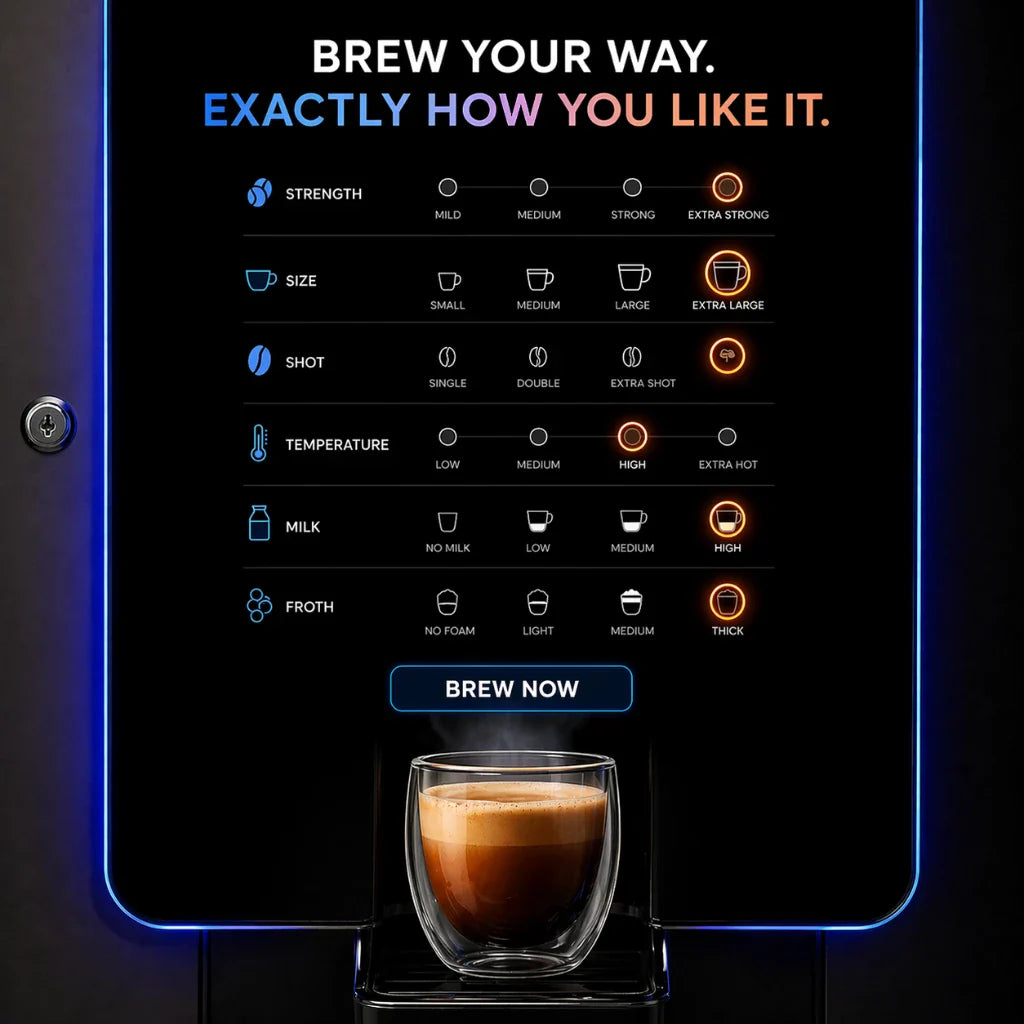
Hot drinks are a special case. None of the four active VMFS outdoor models is a hot-drink brewer, so for outdoor coffee demand the practical options are to place one of our coffee vending machines inside the nearest building entrance, where the warranty still applies, or to discuss a heated build with VMFS for packaged hot products. Our analysis of how outdoor vending machines perform covers how heat, cold and humidity affect running costs and stock choice in more depth.
Power, GFCI and Electrical Requirements
An outdoor vending machine needs a grounded outlet on a GFCI-protected circuit, inside a weatherproof receptacle enclosure, installed to the electrical code your city has adopted. The National Electrical Code (NFPA 70) lists vending machines among the appliances that require ground-fault circuit-interrupter protection under section 422.5(A) of the 2023 edition, for equipment rated 150 volts or less to ground and 60 amperes or less, as ExpertCE's code summary explains. The GFCI device must be readily accessible for testing, so a GFCI receptacle hidden behind a 600-pound machine does not comply. Earlier editions handled vending machines in section 422.51, which, as IAEI Magazine records, required cord-and-plug vending machines manufactured or remanufactured on or after January 1, 2005 to have GFCI protection built into the attachment plug or within 12 inches of it.
The receptacle matters as much as the circuit. NEC 406.9(B)(1) requires 15- and 20-ampere, 125- and 250-volt receptacles in wet locations to have an enclosure that is weatherproof whether or not a plug is inserted, and an outlet box hood used for that purpose must be listed and identified as extra duty, as Leviton explains. A vending machine stays plugged in around the clock, so that in-use cover is not optional at an exposed site.
Check each machine's requirements against the site before you order. The Smart Outdoor Combo runs on a standard 110V outlet; the Seaga ENV5C Outdoor is listed at 115 VAC, 60 Hz and 3.8 amps, with VMFS confirming outdoor-build electrical figures per order; and the Outdoor Wall Mount accepts 100 to 240V AC with a 160W maximum draw on a standard 15A outlet. The practical rules are the same everywhere: no extension cords, a licensed electrician for any new outdoor circuit, a dedicated circuit where the host can provide one, and surge protection, since the VMFS warranty excludes damage from power surges. Code editions and local amendments vary by city, so the local inspector has the final word.
Anti-Vandal and Security Features to Look For
An outdoor machine needs anti-pry doors, high-security locking, an impact-resistant front and a protected payment interface, because it trades unattended at hours when nobody is watching. On VMFS outdoor models that means a reinforced steel cabinet with a thickened door panel, anti-pry door design and reinforced locking on the Smart Outdoor Combo; a heavy-duty steel cabinet, tempered glass front and T-handle lock on the Seaga ENV5C Outdoor; and, on site-specified builds, anti-pry covers, multi-point locks, impact-resistant polycarbonate or steel windows and tamper-evident seals on service panels. Ask too whether the cabinet allows an external camera mount, because footage settles disputes with hosts and insurers.
Placement does as much as hardware. Lighting is one of the better-tested deterrents: an NBER randomized experiment that added street lights to New York City public housing developments found, at a minimum, a 36 percent reduction in nighttime outdoor index crimes. Put the machine where it is lit, visible and covered by cameras, and keep cash to a minimum, since a cashless-first machine is a less rewarding target. Because the VMFS warranty excludes vandalism and tampering, price vending machine insurance into the plan for exposed public sites. Our vending machine security guide covers locks, alarms, cameras and route procedures in depth.
Displays and Payment Hardware Outdoors
Outdoor screens and payment terminals have to stay readable and working through direct sun, rain and cold, so shade them, protect them and choose hardware made for unattended exterior use. These are the parts customers touch on every sale, and a washed-out screen or a wet card reader costs revenue faster than almost any other fault.
Displays in direct sunlight
Direct sun washes out ordinary screens and heats the panel behind them. The current VMFS outdoor lineup uses three display styles: a dynamic LCD/VFD screen with a back-lit Braille keypad on the Seaga ENV5C Outdoor, an interactive customer display on the Smart Outdoor Combo, and a 32-inch touchscreen across the full face of the Outdoor Wall Mount, which also plays video and image ads while idle. Orientation is the cheapest fix: face the screen away from afternoon sun or keep it under the canopy line. For site-specified builds VMFS quotes UV-resistant display panels. Ask any supplier for the screen's rated brightness and whether it is specified for direct sunlight, and look at it outdoors before you commit if you can.
Accessibility rules apply outside too. Under the ADA Standards, operable parts such as keypads, card slots and coin returns must sit within an unobstructed reach range of 15 to 48 inches, work with one hand and need no more than 5 pounds of force, according to the U.S. Access Board, which also notes that vending products themselves are not covered. VMFS lists the Smart Outdoor Combo as an ADA compliant design and the Seaga ENV5C Outdoor with a tactile Braille keypad and payment slots at reachable height. Concrete pads, curbs and shelters can push controls out of range, so measure after installation.
Payment hardware outdoors
Cashless acceptance is the default expectation outdoors. Cantaloupe's 2026 Micropayment Trends report found that 78% of vending sales were cashless in 2025, up from 73% the year before, with an average cashless ticket of $2.45 against $1.57 for cash. Outdoor readers should sit under the canopy or behind a protected bezel, accept contactless cards and phone wallets so customers spend seconds at the machine, and connect over cellular where Wi-Fi is unreliable. Check what is included in the price: the Smart Outdoor Combo and Outdoor Wall Mount list a $450 credit card reader upgrade, the Seaga ENV5C Outdoor lists a $550 Seaga card reader, and a 4G module is a $95 option (SIM not included) on the Smart Outdoor Combo and Wall Mount.
Budget the running costs as well. Our payment system page puts card processing at roughly 5.95% flat or about 2.5% plus $0.10 per transaction, with reader service fees of about $7.95 to $18.95 per device per month depending on the plan. VMFS Cloud works with every VMFS machine, and plans start at $7.99 per machine per month. Remote monitoring matters more outdoors than anywhere else, because nobody on site will report a fault, a warm cabinet or an empty coil. Our guides to cashless payment systems and the best card readers for vending machines compare the main options.
Best Outdoor Vending Machines From VMFS: Models and Prices
VMFS currently sells four outdoor models, and the best choice depends on exposure, product mix and whether you have wall or floor space: the Outdoor Wall Mount for covered walls, the Smart Outdoor Combo and Seaga ENV5C Outdoor for floor-standing snack-and-drink sales, and Build Your Outdoor Vending Machine for sites that need a specific temperature or security package. Prices below are list prices from the active product pages on October 19, 2026; upgrades are extra.
| Model | List price | Format and capacity | Temperature | Weather protection | Power | Card reader |
|---|---|---|---|---|---|---|
| Outdoor Wall Mount | $6,450 | Wall mount, 12 slots, about 200 units | Ambient, covered placement | IP65 cabinet | 100–240V AC, 160W max, 15A outlet | $450 add-on |
| Build Your Outdoor Vending Machine | From $6,500 | Site-specified outdoor system | Refrigerated, frozen, heated or ambient | Rain guards, sealed electronics, set per site | Confirmed at site assessment | Specified at order |
| Smart Outdoor Combo Weatherproof | $6,950 | Floor combo, about 60 selections, up to about 400 items | Refrigerated, 39–77°F | Rainproof canopy, waterproof component covers | 110V standard outlet | $450 upgrade |
| Outdoor Seaga ENV5C Combo | $7,950 | Floor combo, 36 selections, 371 items | Refrigerated drinks, R-290 | Moisture- and UV-protected steel cabinet, tempered glass | 115 VAC, 60 Hz, 3.8 A | $550 upgrade |
Smart Outdoor Combo Vending Machine

The Smart Outdoor Combo Vending Machine ($6,950) is the all-weather pick for most semi-exposed sites. It pairs a reinforced all-steel cabinet and thickened door panel with a built-in rainproof canopy and waterproof covers over the payment and control areas, holds about 60 selections and up to about 400 items, and refrigerates from 39°F to 77°F. It measures 76.7 by 48.2 by 34.4 inches, weighs about 628 pounds, runs on a 110V outlet and connects to VMFS Cloud for sales, stock and alerts. Coin and bill acceptance and the card reader are each listed as $450 upgrades.
Outdoor Seaga ENV5C Combo Vending Machine

The Outdoor Seaga ENV5C Combo Vending Machine ($7,950) is the American-built option for operators who want a familiar coil platform and a domestic parts network. It holds 371 items across 36 selections (96 beverages, 110 snacks and 165 candy items), confirms every vend with sensors and refunds automatically if a product fails to drop, and is listed as UL Listed and NAMA certified. VMFS lists it at 73.5 by 39 by 36 inches, 630 pounds and 115 VAC, and notes that electrical, dimension and weight figures for the outdoor build are confirmed per order. An extra year of warranty is listed at $250.
Outdoor Wall Mount Vending Machine

The Outdoor Wall Mount Vending Machine ($6,450) suits covered exterior walls where a floor-standing machine will not fit, such as storefront entrances, gas station canopies, hotel pool decks and bar entrances. Its IP65 cabinet measures 49.2 by 24.3 by 17.4 inches and weighs about 198 pounds empty, with 12 adjustable slots holding about 200 units and a 32-inch touchscreen. It runs at ambient temperature, so it is for packaged, shelf-stable products, and VMFS advises keeping it away from high heat, high humidity and heavy dust and using a qualified installer to anchor it into structure. Card reader, bill acceptor, age verification and VMFS Cloud are add-on modules chosen at order, and our wall mount vending machines collection shows the indoor versions.
Build Your Outdoor Vending Machine
The outdoor builder starts at $6,500 and is the route for sites a standard cabinet does not fit: frozen or heated product, coastal salt air, remote sites that need cellular connectivity, or a higher security package. Weatherproofing, temperature configuration and security hardware are specified after a conversation about the site, and VMFS can also add rain guards, sealed electronics compartments and UV-resistant display panels to the quote. For unusual products or branded projects, a custom vending machine build goes further than any catalog option.
Compare every outdoor-ready model
See specs, upgrades and current prices for the full VMFS outdoor lineup in one place.
Shop Outdoor MachinesWhat an Outdoor Vending Machine Really Costs
A new outdoor vending machine from VMFS costs $6,450 to $7,950 at list price before upgrades, and the first-year total also includes payment hardware, site electrical work, software and card fees. Outdoor models cost more than an indoor vending machine of similar capacity because of the extra steel, sealing and climate headroom, so compare total cost at the site rather than sticker prices. The table collects the figures VMFS publishes today.
| Cost item | VMFS figure | Notes |
|---|---|---|
| Outdoor machine | $6,450–$7,950 | Four active models; the outdoor builder starts at $6,500 |
| Card reader | $450–$550 | $450 on the Smart Outdoor Combo and Wall Mount, $550 on the Seaga ENV5C |
| Coin and bill acceptor | $450–$550 | $450 upgrade on the Smart Outdoor Combo; the Seaga ENV5C page lists a $550 upgrade but also calls cash acceptance standard, so confirm in the quote |
| 4G module | $95 | SIM not included; Smart Outdoor Combo and Wall Mount |
| Extra warranty year | $250 | Listed on the Wall Mount and Seaga ENV5C; standard cover is a 1-year parts warranty |
| VMFS Cloud | From $7.99 per machine per month | Advertising Cloud $16; AI Cloud $39.99 |
| Card processing | About 5.95% or about 2.5% + $0.10 | Plus reader service of about $7.95–$18.95 per device per month |
| Custom wrap | $600–$850 | $600 on the Smart Outdoor Combo and Wall Mount, $850 on the Seaga ENV5C |
| Site electrical work | Quoted by your electrician | GFCI circuit, extra-duty in-use cover, any trenching or conduit |
Freight and timing belong in the budget too. VMFS ships throughout the United States; its shipping page says in-stock machines usually ship within 7 to 10 days and custom builds take around 45 days, while the outdoor product pages currently list 6 to 12 weeks for the Smart Outdoor Combo, Seaga ENV5C and Wall Mount (depending on availability) and 7 to 21 days for the outdoor builder, so confirm the window in your quote. If cash is tight, financing lets you buy the right build instead of compromising on protection, and our guide to how much a vending machine costs puts outdoor prices in context with the rest of the market.
Advantages of an outdoor-rated machine
- Trades 24/7 at sites with no opening hours, such as parks, forecourts and transit stops
- Keeps VMFS warranty coverage at exterior and semi-outdoor sites
- Canopy, seals and anti-pry hardware are built in rather than improvised
- Opens locations an indoor route cannot reach
Limitations to plan for
- Higher purchase price than comparable indoor machines
- Floor combos weigh over 600 pounds and need a level pad and an electrician
- Vandalism, flood and surge damage fall outside the warranty, so insurance matters
- Ambient operating limits are often unpublished; sales can swing with the seasons
Can You Put a Vending Machine Outside Your House?
You can put a vending machine outside your house only if your local zoning code and any homeowners association rules allow it, and many residential zones do not. Cities usually regulate commercial activity in residential districts through zoning and home-occupation rules, and some address vending machines directly. In a February 2022 case reported by FOX 13 in Utah, Saratoga Springs required a resident to remove a soda machine from his driveway under city code section 19.05.07, which states that outdoor vending machines are prohibited in all residential zones, with exceptions for HOA-maintained facilities such as clubhouses and pools. He faced a $25 daily fine if the machine stayed past the deadline.
Before you buy for a home site, call the city planning or zoning office, read your HOA covenants, and check whether you need a business license, sales tax registration and a food permit for what you plan to sell. Our guide to vending machine permits in the United States covers the state-level picture, and VAdviced helps operators with business setup and placement agreements. Even where it is legal, a driveway rarely has the foot traffic an outdoor machine needs to pay back, and the same outdoor build, GFCI and warranty rules apply as at a commercial site.
Outdoor Vending Machine Buying Checklist
Use this checklist to shortlist an outdoor machine in the order the decisions depend on each other: product, exposure, risk, power, payments and support.
- Decide what you will sell: snacks only, cold drinks, a combo mix, frozen product or age-restricted items.
- Rate the exact spot as covered, semi-exposed or fully exposed, and photograph it at midday and after dark.
- Get written confirmation that the model is designated for outdoor or protected-location use.
- Ask for any IP or enclosure rating, weather test documentation and the ambient operating temperature range.
- Check the cabinet temperature range against your products (40°F or below for refrigerated food).
- Confirm a readily accessible GFCI-protected outlet with an extra-duty in-use cover, and match the machine's voltage and amperage.
- Plan a level pad, anchoring, airflow clearance and room for the service door to swing.
- Match anti-pry doors, locks, glass and payment-area protection to the site's public-access risk.
- Choose payment hardware: a contactless reader, cash acceptance if the site needs it, and cellular connectivity if Wi-Fi is weak.
- Measure the keypad, card slot and coin return against the 15 to 48 inch ADA reach range after installation.
- Read the warranty exclusions and insure against vandalism, weather and surge damage.
- Confirm lead time, freight method and delivery access in the quote.
Questions to ask any outdoor vending supplier
Ask these before you pay a deposit, and ask for the answers in writing. Is this model listed for outdoor or protected-location use, and can I see the listing? What ambient temperature range does it operate in, and does it heat as well as cool? What IP or enclosure rating applies, if any? What electrical rating is on the nameplate? What exactly does the warranty exclude outdoors? Which payment and telemetry hardware is included in the price, and what are the monthly fees? Where are parts stocked, and how quickly do they ship? A supplier who answers with documents is a safer partner than one who answers with adjectives.
After installation, plan a tighter service routine than indoors: clean the condenser coils, check door gaskets and canopy seals, clear debris from vents and inspect the payment bezel for tampering on every visit. Our vending machine maintenance guide has a full schedule, and our guide to buying a vending machine covers the rest of the purchase process, from quotes to delivery.
Get an outdoor build matched to your site
Tell VMFS what you sell and how exposed the spot is, then set the temperature, security and payment package before you order.
Build Your Outdoor MachineFrequently Asked Questions
Sources
- UL Standards & Engagement — UL 751, Standard for Vending Machines (scope)
- OSHA — 29 CFR 1910.303, Electrical: General
- ExpertCE — GFCI Protection for Appliances, NEC 422.5 (2023 NEC)
- IAEI Magazine — Vending Machines (NEC 422.51 and 422.5), January/February 2014
- Leviton — Understanding While-in-Use Covers and NEC Requirements
- Interpower — Ingress Protection: Classifying the Degrees of Protection (IEC 60529)
- FoodSafety.gov — Cold Food Storage Charts
- U.S. Access Board — Guide to the ADA Standards, Chapter 3: Operable Parts
- Cantaloupe — Micropayment Trends Report 2026
- NBER Working Paper 25798 — Randomized street-lighting experiment in New York City public housing (2019)
- FOX 13 (Utah) — Saratoga Springs says no to man's Coca-Cola vending machine (February 8, 2022)
Share:
How To Start A Vending Machine Business In Colorado
Outdoor Vending Machine Locations Guide, Where Outdoor Machines Actually Perform