



Design the perfect vending solution for your location and customers.

Sales, inventory and alerts for your whole route, from one machine to a fleet.
Answer a few questions about your location, products and budget and get a shortlist.
Estimate revenue, payback period and margin before you buy.
Sales, setup help, warranty and parts from the VMFS USA team.
Join the VMFS newsletter and step into a thriving network dedicated to collective success.
One signup. Endless possibilities.
Machines & Economics | Pizza Vending | By the VMFS USA Team | September 2026
Every pizzeria in America runs the same business. Rent on a unit, a crew on the clock, a dining room, delivery drivers, and a trading window that opens around lunchtime and closes when the last order goes out. Everything outside those hours is a building sitting in the dark costing money.
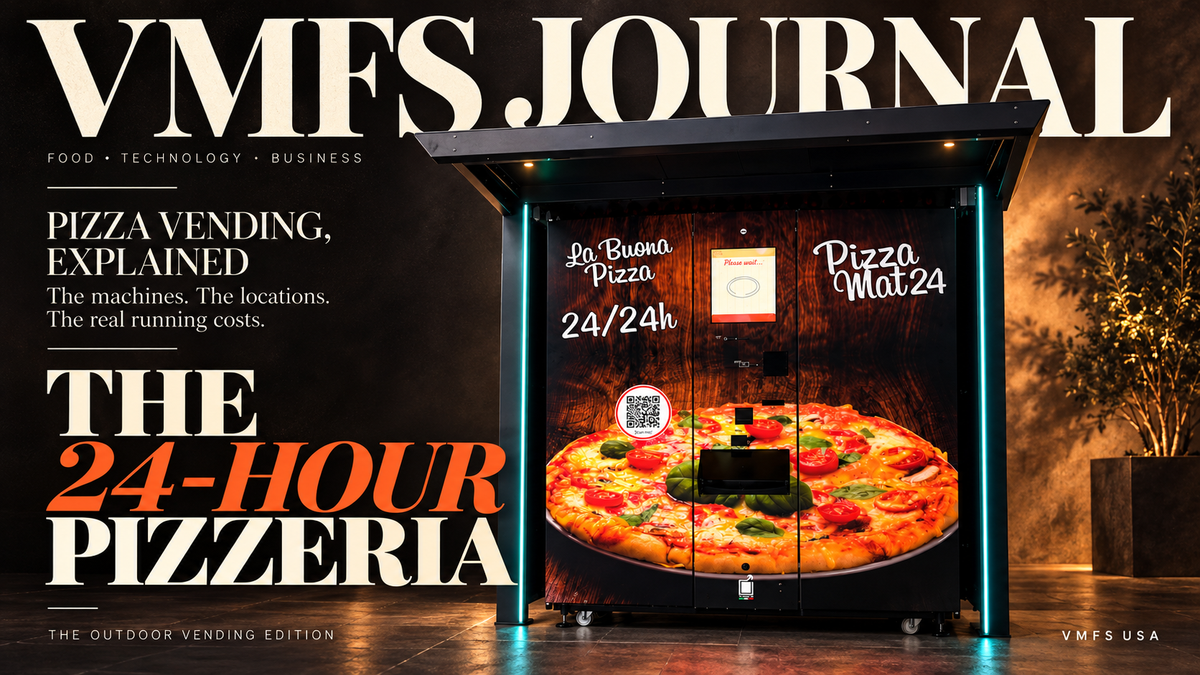
A pizza vending machine takes the one part of that business people actually pay for, the hot pizza, and separates it from all of the rest. No dining room, no crew, no closing time. A cabinet on a forecourt that stretches a service, or a brand, across every hour of the day.
We have covered hot food vending before. Pizza deserves its own conversation, because it behaves differently from every other hot product in this industry, and because an outdoor pizza vending machine is the only hot food format we have seen that genuinely works standing alone, in the weather, twenty four hours a day.
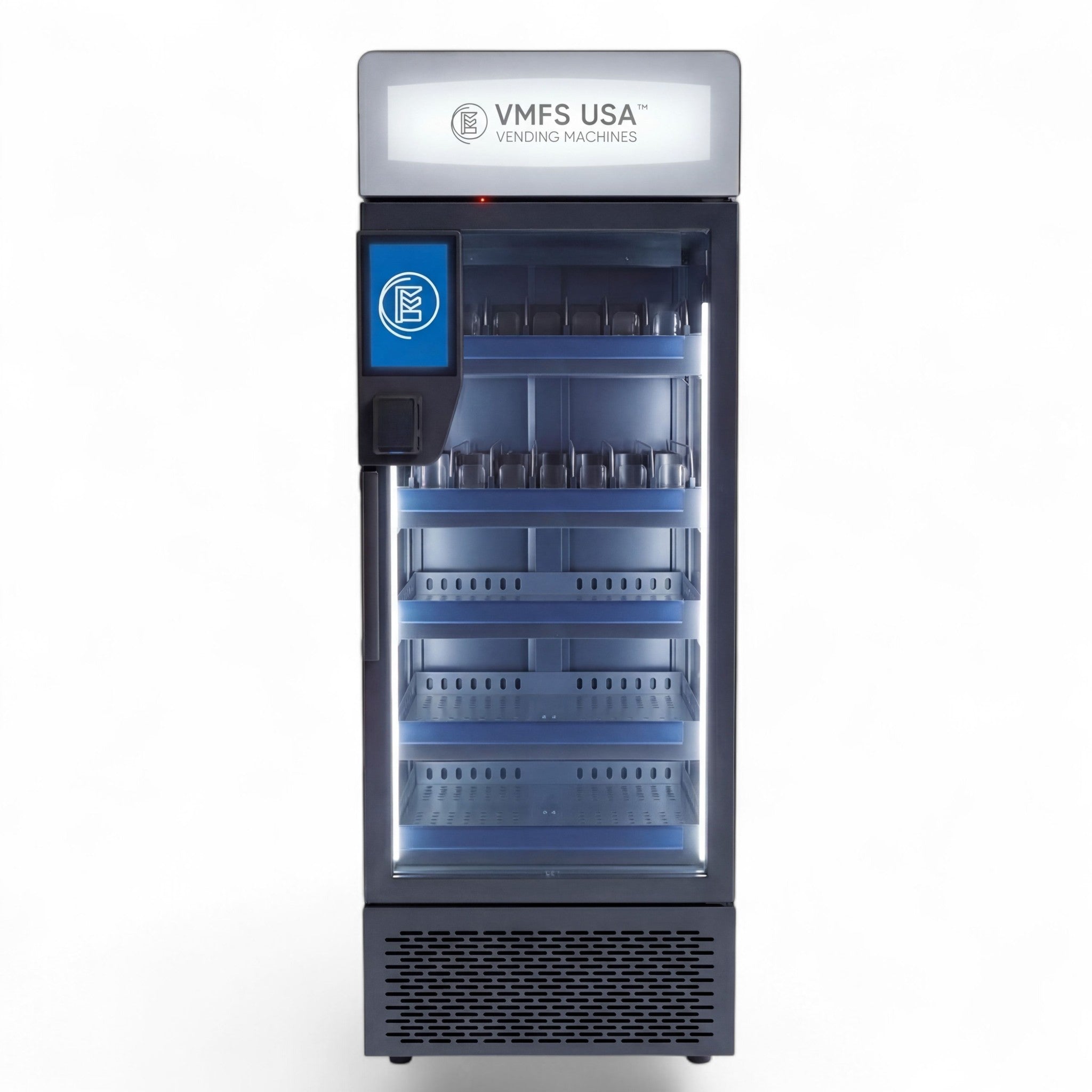
Where this comes from: we supply and operate vending machines across the United States, including hot food and outdoor rated formats. The photographs here are our own from the show floor.

Worth setting out plainly, because the assumption most people arrive with is a frozen pizza and a microwave, and that is not what these machines do.
The sequence in a modern unit runs like this:
Why the chilled and baked sequence matters so much: every failed attempt at hot food vending over the last thirty years involved holding food warm or reheating it from frozen. Both produce something technically hot and recognisably poor. Holding at chill and baking to order produces a pizza that came out of an oven four minutes ago, which is the only version of this anybody buys twice.
We have looked at a good deal of hot food vending, and pizza keeps outperforming the rest of the category for reasons that are structural rather than about taste.

An indoor pizza machine in an office lobby is a reasonable business. An outdoor pizza vending machine on a forecourt is a considerably better one, and the gap between them is larger than most operators assume.
Three things change at once:
The cost of that is engineering, and it is real. A genuine outdoor pizza vending machine needs a sealed and drained cabinet, active heating as well as cooling, a display readable in direct sun, a weather sealed payment terminal and reinforced construction. We have written at length about what separates a genuine outdoor vending machine from an indoor one with a weather claim attached, and every word of it applies here with a hot oven added to the equation.
People ask about the purchase price first and it is the less interesting number. This is a machine that refrigerates continuously and bakes at high temperature, and the operating profile reflects that.
| Cost line | What to plan for |
|---|---|
| Power | Refrigeration plus an oven is a serious electrical requirement. Confirm the supply at the site before ordering, not after delivery |
| Product supply | The hardest part of the business. A reliable producer of pizzas that survive chilling and bake well is worth more than the machine |
| Restocking | Dated fresh product, so a genuine route rather than an occasional visit. Frequency depends on shelf life and turnover |
| Waste | Real until you learn a site's demand. Time based markdown and proper rotation reduce it substantially without eliminating it |
| Cleaning | An oven that bakes cheese needs genuine cleaning on a schedule, which is more involved than wiping a snack cabinet |
| Permits and inspection | Heavier than snack vending. A machine cooking food sits in a different bracket with your health department |
Against that sits the pricing argument, which is strong. A pizza is benchmarked against a pizzeria rather than against a snack machine, so the ticket value is several times anything else on a typical route. That is what makes the higher operating cost work, and it is why this format can justify sites that would never carry a snack machine.
Three quite different buyers, wanting three different things from the same machine.
The existing pizzeria.
In our view the strongest case on the list. A machine on the exterior wall extends a restaurant from eight trading hours to twenty four, using product the kitchen already makes, under a brand customers already recognise. There is no new supply chain to build and no new product to develop. It is the same business, running while the lights are off.
The route operator.
Adding a high ticket machine to an existing route, usually at a site where a snack machine would be pointless. Needs a supply relationship with a producer, which is the piece to solve before buying anything.
The site owner.
A truck stop, campground, fuel station or industrial employer buying the machine themselves to serve a captive population overnight. Frequently the most motivated buyer, because they have been listening to complaints about it for years.

If we could get one point across to anybody considering this category, it would be this. The machine is the straightforward part. Everything difficult about a pizza vending operation happens before the pizza reaches the machine.
Which is precisely why an existing pizzeria is such a strong buyer for this format. They have solved the hardest part before they start.
A machine holding fresh pizza at chill temperature, unattended, outdoors, for days at a time, is carrying a food safety obligation that nobody is present to check.
All of which is what VMFS Cloud exists to handle, and why we treat remote monitoring as a requirement rather than an upgrade on any machine holding fresh food outdoors.
The menu inside the machine is a commercial decision that operators tend to make by instinct, and instinct points the wrong way. The temptation is to offer variety, because variety feels like it serves more people.
In a machine with finite capacity and dated product, variety is expensive. What performs is a short, deliberate list:
On price, the reference point is a pizzeria rather than a vending machine, and that framing is worth defending. Somebody buying a hot pizza at midnight is comparing it to what a takeaway would charge, not to what a candy bar costs. Pricing this product as though it were vending gives away the single biggest advantage the format has.
Solve supply first, because it decides everything else. Then choose the site, because whether it is genuinely a twenty four hour location determines whether an outdoor unit is worth its premium. Then settle permits and food safety documentation before switching on rather than after an inspection.
Placement for this format is unusual, since you are looking for overnight population rather than daytime footfall, and that is what our partners at VPlaced screen for. Presentation matters more than operators expect on a machine selling a premium hot product, which is VMarketed territory.
On our side, hot food formats sit within the food vending machine range alongside the touch screen units these are built on, and everything we carry is in the shop. What is ready to move now is in in stock units, typically shipping within 7 to 21 days with a one year parts warranty. If a pizzeria wants a machine finished in its own branding, that is a custom build conversation, and multi site programmes go through commercial.
Once a machine is live, listing it on VendingFinder is worth doing, because a hot pizza at one in the morning is exactly what somebody is searching for when nothing else is open.
Prepared pizzas are held refrigerated rather than frozen or kept warm. When somebody orders on the screen and pays, the machine moves that specific pizza into an oven, bakes it at high temperature in roughly three minutes, and delivers it boxed and hot through a heated hatch. Holding chilled and baking to order is what makes the result genuinely good.
In the right location it is one of the strongest formats in vending, because the ticket value is several times a snack machine and demand peaks overnight when nothing else is open. The difficulty is not the machine, it is securing a reliable producer whose pizza survives chilled storage and bakes consistently. Existing pizzerias have the largest advantage here.
The main lines are power, which is significant because the unit refrigerates continuously and bakes at high temperature, product supply, restocking on a genuine route because the product is dated, waste until you learn a site's demand, oven cleaning, and heavier permitting than snack vending. Against that, pizza carries pizzeria pricing rather than vending pricing.
Yes, and an outdoor pizza vending machine is where the format is strongest, because you trade every hour instead of a third of them. It requires a genuine outdoor specification: sealed and drained construction, active heating as well as cooling, a sun readable display, a weather sealed payment terminal and reinforced build. An indoor machine placed outside will not survive a single season.
The oven is the constraint, at roughly three minutes per pizza, which caps a single machine regardless of demand. At sites with a sharp evening peak that ceiling is reached quickly, and the only real answer is a second unit rather than a faster cycle.
A Pizzeria That Never Closes
We supply hot food and outdoor rated vending systems across the United States. Tell us about your site, your product and the weather it faces, and we will help you spec it properly.
See Food Vending Machines

Share:
How Much Is a Laundry Vending Machine? Complete Cost and Pricing Guide