




Design the perfect vending solution for your location and customers.

Join the VMFS newsletter and step into a thriving network dedicated to collective success.
One signup. Endless possibilities.
Machines & Performance | Outdoor Vending | By the VMFS USA Team | September 2026
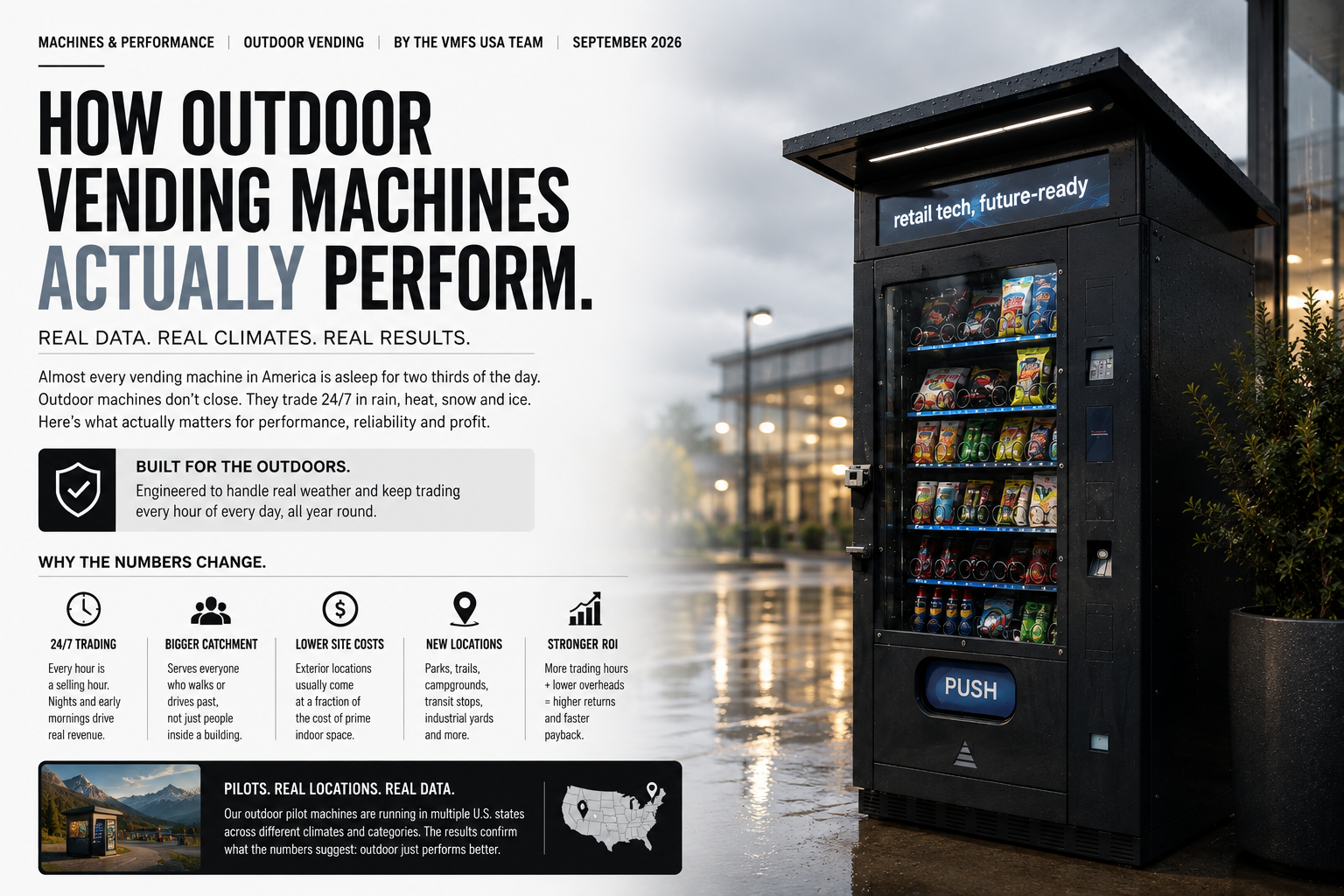
Almost every vending machine in America is asleep for two thirds of the day. The office closes, the gym locks up, the mall shutters, and the machine inside sits in the dark until somebody unlocks the building again. You paid for twenty four hours of equipment and you are trading maybe eight.
An outdoor machine does not have that problem. It never closes, it never waits for a key holder, and it does not care that the building behind it went dark at six. That is the entire argument for the category, and it is a strong one.
It is also the reason outdoor placement destroys equipment that was never built for it. We have outdoor pilots running in several US climates right now, and what follows is what actually determines whether one of these performs for years or fails in a season.
Where this comes from: we supply and operate vending machines across the United States and currently have outdoor pilot units running in a range of American climates. What follows is engineering and economics rather than brochure copy.

Start with why anybody bothers, because the case is stronger than most operators realise and it has very little to do with the product inside.
The point most operators miss: outdoor is not indoor vending in a tougher box. It is a different business model. You are buying access to hours and to people that indoor placement structurally cannot reach, and the engineering is simply the price of admission. It is worth comparing an outdoor rated build against a standard one across the specialty vending machines range to see where that premium actually goes.
Now the honest part. Outdoor placement is genuinely hard on equipment, and the failure modes are specific and predictable. Understanding them is what separates operators who run outdoor units for a decade from operators who try it once and never again.
1. Heat, and it is worse than the forecast says.
A dark cabinet in direct sun in Phoenix or Miami reaches internal temperatures far above ambient air. Refrigeration systems that cope easily in a lobby run continuously outdoors, which costs you electricity, shortens compressor life and eventually fails to hold temperature at all. This is the most common cause of outdoor failure in the southern half of the country and it is entirely predictable, and it is why refrigeration capacity is the first thing to interrogate across our refrigerated vending options.
2. Freezing, which is the opposite problem and just as bad.
Bottled drinks freeze and burst. Payment terminals slow down or stop responding. Screens dim and lag. Mechanisms stiffen. A machine intended for northern winters needs active heating, not merely insulation, and a unit sold as weatherproof without heating will simply stop working in January. Check that specification explicitly rather than assuming it, including on anything listed in in stock units.
3. Water, which finds every gap eventually.
Rain is manageable. Wind driven rain hitting a seam at an angle nobody tested is what causes problems, and so is the humidity that condenses inside a cabinet as temperatures swing overnight. Condensation on electronics is a slow killer that shows up months after installation, which is why it catches people out.

4. Sunlight on the screen.
An ordinary display is unreadable in direct sun, and a customer who cannot read the screen does not squint, they walk away. Outdoor rated screens with high brightness and anti glare treatment are not a luxury here, they are the difference between a machine that sells and one that people ignore all afternoon, so it is worth comparing display specifications across our touch screen vending machines.
5. UV degradation.
Years of sun fade graphics, yellow plastics and make seals brittle. A machine that looked sharp on installation can look neglected in eighteen months, and a tired looking machine sells less regardless of what is inside it.
6. People.
Unattended equipment in a public space attracts attention that indoor machines never receive. Reinforced construction, anti vandal glazing, robust locks and proper anchoring matter, and so does lighting and camera coverage at the site itself, which is a placement decision our partners at VPlaced screen for when they source outdoor sites.
There is an important distinction here that costs operators real money. Plenty of machines are described as suitable for covered outdoor use, meaning a sheltered doorway or a canopy. Far fewer are built for genuinely exposed installation. Ask which one you are buying, because the difference is enormous.
| Feature | Why it matters outdoors |
|---|---|
| Sealed, gasketed cabinet with drainage | Keeps wind driven rain out and lets any water that gets in escape |
| Active heating as well as cooling | Stops stock freezing and keeps electronics responsive in winter |
| Oversized refrigeration capacity | Holds temperature through afternoon heat without running flat out |
| High brightness anti glare screen | Readable in direct sun, which is when much of your traffic passes |
| Weather sealed payment terminal | The most exposed component and the one that stops sales when it fails |
| Reinforced build and anti vandal glazing | Unattended equipment in public space needs to survive attention |
| UV stable finishes | Keeps the machine looking maintained rather than abandoned |
| Remote monitoring and alerts | Nobody walks past this machine daily, so it has to tell you when something is wrong |
That last row deserves emphasis. An indoor machine in an office gets seen by a hundred people a day and somebody mentions a fault within hours. A machine on a trailhead can be dead for a week before anybody tells you. Remote monitoring is not a convenience feature outdoors, it is how the business functions, and it is worth checking across the outdoor vending machines range before you commit.

We have seen well built machines perform badly because of how they were installed, and modest machines perform well because somebody thought about the site. A few things worth getting right.
Something operators discover the hard way. Products that behave perfectly indoors misbehave outdoors, and the answer is usually to change the product rather than fight the environment.
That seasonal swing is also an argument for combination machines that can carry both, which you can compare across the beverage vending machine range alongside what is available immediately in in stock units.

We have outdoor units running in pilot across a spread of American climates, and the reasoning is straightforward. The United States is not one weather environment. A machine that performs beautifully through a Florida summer faces an entirely different problem in a Minnesota January, and a manufacturer's rating tells you very little about either.
What we are measuring:
The energy point has been the most useful finding so far. It rarely appears in a purchase decision and it turns out to matter considerably more than most people assume, particularly in hot climates where a machine can run its refrigeration almost continuously through the afternoon. An operator comparing two machines on purchase price alone can easily choose the one that costs more to run every month for the next decade.
We could list outdoor units across the VMFS USA catalog with a manufacturer's weather rating attached and leave operators to find out the rest themselves. Plenty of suppliers do exactly that. We would rather not, for a reason that becomes obvious the moment you look at a map.
A rating tells you a machine survived a controlled test. It does not tell you how it behaves through a Gulf Coast August, or whether its payment terminal still responds at minus ten in Minnesota, or what happens to the seals after two summers of direct sun in Arizona. Those are the questions an operator actually needs answered, and the only way to answer them honestly is to run machines in those places and watch.
What that has changed in how we specify these units:
Our position, plainly: outdoor is one of the strongest opportunities in American vending and one of the easiest to get wrong. We would rather send an operator to a properly matched machine, or tell them a site is not suitable, than sell a unit that fails in its second summer. The pilots exist so that advice is based on evidence rather than on a datasheet.
We are still adding pilot locations, particularly in climates we have less data on. If you have a site somewhere genuinely demanding, whether that is extreme heat, hard winters, coastal salt air or high humidity, we would like to hear about it. The machines currently available sit in the shop, and in stock units typically ship within 7 to 21 days.

Get the order right and outdoor is one of the strongest opportunities in vending. Get it wrong and it is an expensive lesson.
Choose the site before the machine, because orientation, shelter, power and signal shape which build you need. Our partners at VPlaced source outdoor sites and negotiate terms, and property owners with exterior wall space or forecourt can list it through their location owners page. Settle permits and zoning with VAdviced before installation rather than after a complaint. And because an outdoor machine is visible to everybody who passes rather than only to people inside a building, presentation is worth more here than anywhere else, which is VMarketed territory.
Once your machine is live, listing it on VendingFinder is worth doing, because outdoor machines are exactly the ones people search for when everything else is closed.
On our side, browse the outdoor range or the full shop. In stock units typically ship within 7 to 21 days and carry a one year parts warranty. If you have a site in an interesting climate and would make a good pilot location, we would like to hear from you.
Purpose built ones do, provided they are specified for the climate they are going into. That means oversized refrigeration for hot regions and active heating for cold ones, along with proper sealing and drainage. An indoor machine placed outside will not survive either extreme, regardless of how it looks on installation day.
In the right location, comfortably. You trade roughly three times the hours of a machine locked inside a building, you reach everybody passing rather than only those inside, and site costs are often lower. The premium buys you access to hours and to people that indoor placement structurally cannot reach.
Refrigeration struggling in sustained heat, followed closely by payment terminal problems in cold or humid conditions. Both are predictable and both come down to specification rather than bad luck, which is why matching the machine to the climate matters more than any other single decision.
A genuine outdoor rated unit does not require it, but any shelter available extends its life considerably and usually costs nothing. A canopy or overhang, and orientation away from the afternoon sun, reduce thermal and UV load substantially. Take shelter wherever the site offers it.
A Machine That Never Closes
We supply outdoor rated vending systems and have pilots running across a range of US climates. Tell us about your site and the weather it faces, and we will help you spec it properly.
Visit the Shop
Share:
Tracking Vending Machine ROI per Machine: The Complete Operator Guide
How Should Food in Vending Machines Be Dispensed? Standards & Automated Mechanics