


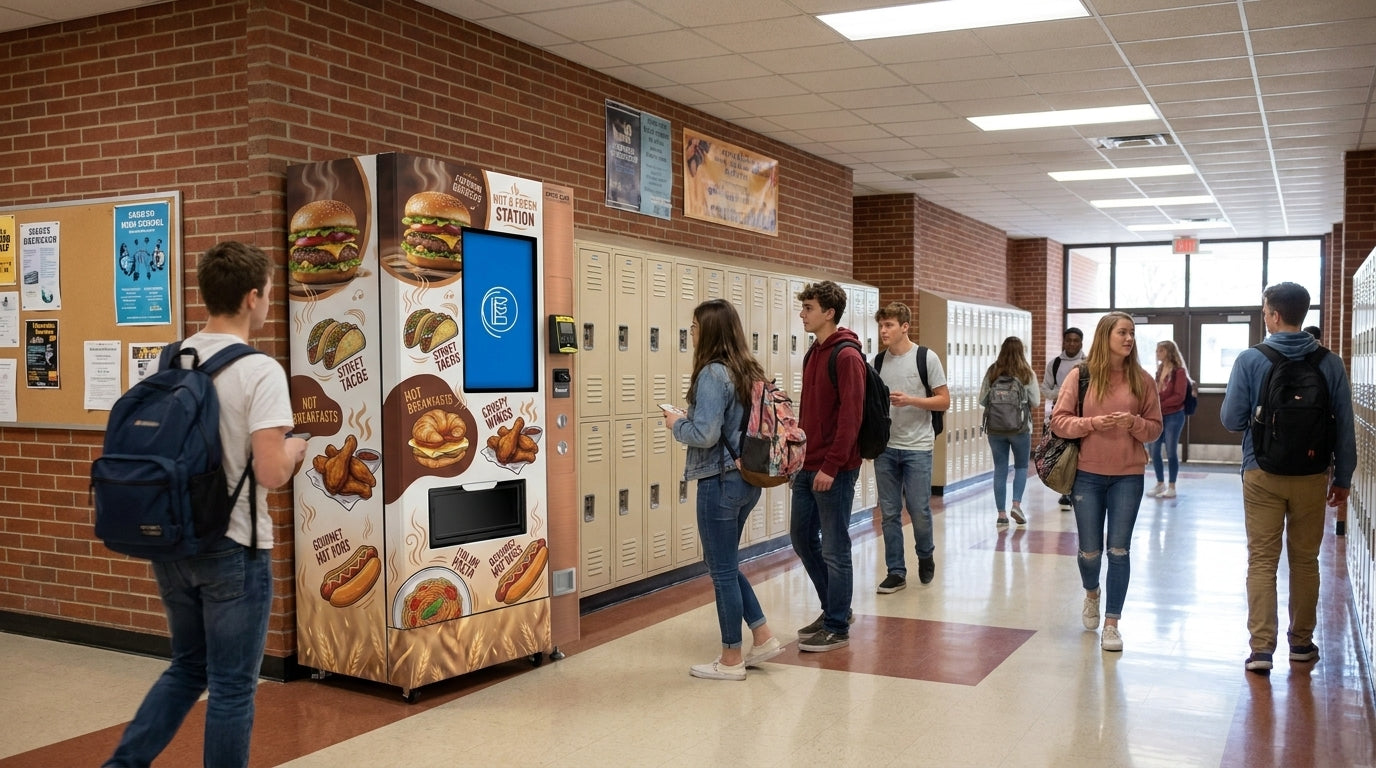


Design the perfect vending solution for your location and customers.

Join the VMFS newsletter and step into a thriving network dedicated to collective success.
One signup. Endless possibilities.
Food vending is the sale of food and beverages through self-service machines that hold, and sometimes heat or prepare, unit servings and dispense them to customers without a cashier, with the operator restocking the machine on a route rather than after every sale.
This guide explains what food vending means in plain language and in US food law, the line between snack machines and regulated perishable-food machines, how hot, cold and frozen machines work, which permits and labeling rules apply, and how operators make the numbers work with real VMFS hardware.
Food vending is automated, unattended retail of food: a machine stores ready-to-eat items, takes payment and releases one serving at a time, and an operator refills it on a schedule. The category covers everything from a glass-front snack machine selling chips and candy to refrigerated machines selling sandwiches and salads, freezer machines selling ice cream and frozen meals, and hot food units that heat a meal or a pizza after the customer pays.
The phrase has two meanings in the US, and it helps to separate them early. In many city codes, "food vending" refers to street vendors, carts and food trucks that sell in public spaces, which is why searches for the term often surface mobile food vendor licenses. In the vending industry, and in this guide, food vending means machine-based sales. The next section explains why the two are licensed so differently.
What makes machine food vending a distinct business is the combination of three things. The machine replaces the cashier, so the location can sell around the clock. The operator, not the property, owns the inventory risk and services the machine on a route. And when the menu includes perishable food, the machine itself has to enforce food safety, because no employee is standing beside it checking temperatures. That third point is what turns ordinary vending machines into regulated food equipment.
The National Automatic Merchandising Association (NAMA) defines vending machines for its industry census as self-service devices that automatically dispense a predetermined unit serving of snacks or beverages without having to be replenished after each use. That definition lines up closely with the one regulators use, which is the starting point for any operator trying to understand which rules apply.
Machine food vending and street food vending share a name but are regulated as different businesses: a vending machine is unattended equipment placed at a host site under an agreement, while a street food vendor is a person selling from a cart, stand or truck in a public space. That difference decides which permit you apply for, who inspects you and which equipment rules apply.
California shows how the street side works. The Street Vending Handbook from San Bernardino County Environmental Health, which cites the California Retail Food Code, SB 946 (2018) and SB 972 (2023), sorts sidewalk sellers into mobile food facilities. A compact mobile food operation is a seller working from a pushcart, stand, display, pedal-driven cart, wagon or other nonmotorized conveyance, and the county issues low-, medium- and high-risk cart permits depending on how much food preparation happens on the cart. Every cart tier requires plan check review with approved equipment, storage and servicing at an approved commissary and access to an approved restroom within 200 feet, with annual health permits of $282 for a low-risk cart and $426 for medium- and high-risk carts. Food trucks and trailers get their own permit, and the handbook notes that a motorized food vehicle is not treated as a street vendor at all.
None of that maps neatly onto a vending machine. A machine has no handwashing sink, no daily return to a commissary and no attendant, so regulators control it through equipment rules instead: temperature holding, an automatic shutoff for perishable food, protected dispensing doors and packaging that stays sealed from the commissary to the customer. The handbook does share one idea with vending law, though. It exempts very small operations of 25 square feet or less that sell only prepackaged, nonpotentially hazardous, properly labeled food from an approved source, or whole uncut produce, which mirrors the way the FDA Food Code treats packaged, shelf-stable vending.
| Factor | Machine food vending | Street food vending |
|---|---|---|
| Who sells | An unattended machine; the operator visits to restock and service | A vendor present at the cart, stand or truck |
| Where | Private host sites such as offices, hospitals, campuses and transit hubs | Sidewalks, parks and other public spaces, subject to city rules |
| Typical health approval | Vending machine license or food establishment permit, depending on the state | Mobile food facility permit for a cart, vehicle or trailer |
| Main food safety controls | Temperature holding, automatic shutoff, sealed packaging, date marking | Approved commissary, handwashing, approved equipment, end-of-day disposal of hazardous food |
| Hours | Can sell around the clock | Limited to when the vendor is working |
A food vending establishment is the regulated operation behind food vending: the machine, the room or area where it stands, and the facility that prepares or stores the food that goes into it. US law does not use one national term for it, but most state and local rules are built on the definitions in the FDA Food Code, so that is the place to start.
The FDA Food Code 2022 defines a "vending machine" as a self-service device that, upon insertion of a coin, paper currency, token, card, or key, or by electronic transaction or optional manual operation, dispenses unit servings of food in bulk or in packages without the necessity of replenishing the device between each vending operation. It defines a "vending machine location" as the room, enclosure, space, or area where one or more vending machines are installed and operated, including the storage areas and areas on the premises used to service and maintain the machines.
The Code then folds vending into its definition of a "food establishment." An operation that stores, prepares, packages, serves or vends food directly to the consumer is a food establishment, and the list of examples names a "vending location." The definition also includes an element of the operation, such as a transportation vehicle or a central preparation facility, that supplies a vending location, unless the vending location itself is permitted by the regulatory authority. In practice, that means the commissary where sandwiches are made and the van that carries them can fall inside the regulated operation, not just the machine on the wall.
The most important carve-out for operators is the exclusion. The Food Code says a food establishment does not include an establishment that offers only prepackaged foods that are not time/temperature control for safety (TCS) foods. A machine that sells only sealed chips, candy and canned soda may therefore sit outside the food-establishment definition in a jurisdiction that follows the model code closely, while a machine selling chicken wraps does not. The FDA describes the Food Code as a model offered for adoption by local, state and federal jurisdictions, so the exact wording that binds you is whatever your state or county adopted.

States take the same building blocks and arrange them differently, which is why a definition that is correct in one state can mislead you in the next. Three official examples show the range.
New York's sanitary code (10 NYCRR Subpart 14-5) defines a food vending machine as a self-service device that dispenses unit servings of food or beverage without replenishing between each vending operation. It separately defines a food vending machine commissary as the place where food, containers or supplies are processed or packaged for use in machines, and a food vending operation as the place where the machines are located. It also creates a "controlled-location vending machine" category for machines that dispense only nonpotentially hazardous food and can be serviced in a sanitary manner by an untrained person at the location.
Iowa takes a different route. Iowa Code 137F.1 uses nearly the same definitions of "vending machine" and "vending machine location," but it lists vending machine locations among the things that are not a "food establishment." Machines are licensed in their own right instead: Iowa Code 137F.6 sets a vending machine license fee of $50 for the first machine and $10 for each additional machine, and each licensed machine must carry a readily visible identification tag or decal with the licensee's business information.
Florida splits the question between statute and agency. Section 509.013 of the Florida Statutes excludes from the definition of a public food service establishment any vending machine that dispenses food or beverages other than potentially hazardous foods, as defined by division rule. The Division of Hotels and Restaurants (DBPR) still runs a vending machine license, and its guide requires an ambient air thermometer, an automatic shut-off that stops vending food not held at a proper temperature, a displayed DBPR decal and a passed opening inspection, with plan review for any device that cooks, heats, assembles or portions food. The takeaway for operators is simple: read your own state's definition before you assume a snack-only route or a fresh-food route is exempt.
| Source | How it defines food vending | What it means for an operator |
|---|---|---|
| FDA Food Code 2022 (model) | Vending machine and vending machine location defined; a vending location is a food establishment, including a commissary or vehicle that supplies it | Prepackaged non-TCS only operations are excluded; TCS food brings the machine, its storage areas and its supply chain under food rules |
| New York, 10 NYCRR 14-5.20 | Separate definitions for machine, commissary, food vending operation and controlled-location machine | Machines selling only nonpotentially hazardous food can qualify as controlled-location machines |
| Iowa Code 137F.1 and 137F.6 | Vending machine locations excluded from "food establishment"; machines licensed individually | $50 for the first machine, $10 for each additional, plus an ID tag or decal on every licensed machine |
| Florida Statutes 509.013 and DBPR | Non-potentially hazardous vending excluded from "public food service establishment"; DBPR licenses vending machines | Thermometer, automatic shut-off, decal, opening inspection and plan review for machines that cook or heat |
The single most useful question in food vending is whether the item needs time and temperature control for safety. The Food Code defines TCS food as food that requires time/temperature control to limit pathogenic microorganism growth or toxin formation, and it includes raw or heat-treated animal food, heat-treated plant food, cut melons, cut leafy greens and cut tomatoes, among others. Sandwiches with meat or cheese, salads, cooked pasta, burritos and yogurt-based items generally fall on the TCS side.
Shelf-stable snacks sit on the other side. Chips, pretzels, candy, crackers, granola bars and most canned or bottled drinks are designed to be safe at room temperature, and food in an unopened hermetically sealed container that is commercially processed for non-refrigerated storage is specifically excluded from the TCS definition. That is why a classic snack machine faces far lighter rules than a fresh-food machine, and why so many first-time operators start with snacks before moving into meals.
Crossing into TCS food changes four things at once. The machine needs refrigeration or hot holding plus an automatic shutoff. The food must come from an approved source, such as a licensed commissary or food processing plant, rather than a home kitchen. Ready-to-eat refrigerated items need date marking and disciplined rotation. And the permit, inspection and fee picture usually becomes more involved. Each of those adds cost and work, but each also opens higher-ticket meal sales that a snack-only machine cannot capture.
Quick test: if the item would be unsafe after sitting in a warm car for an afternoon, treat it as TCS food and plan for a refrigerated or hot holding machine with an automatic shutoff, an approved supplier and date-marked packaging.
Food vending machines fall into five practical groups: packaged snack and drink, refrigerated fresh food, frozen, hot food and specialty cooking machines, with door-open smart coolers as a newer format that can hold any of them. The right one depends on what the location will buy, how often you can service it and how much regulation you are ready to take on. VMFS USA groups its meal-capable hardware under food vending machines, and every model listed below is a currently active product at the price shown on vmfsusa.com in October 2026.
Packaged snack and drink
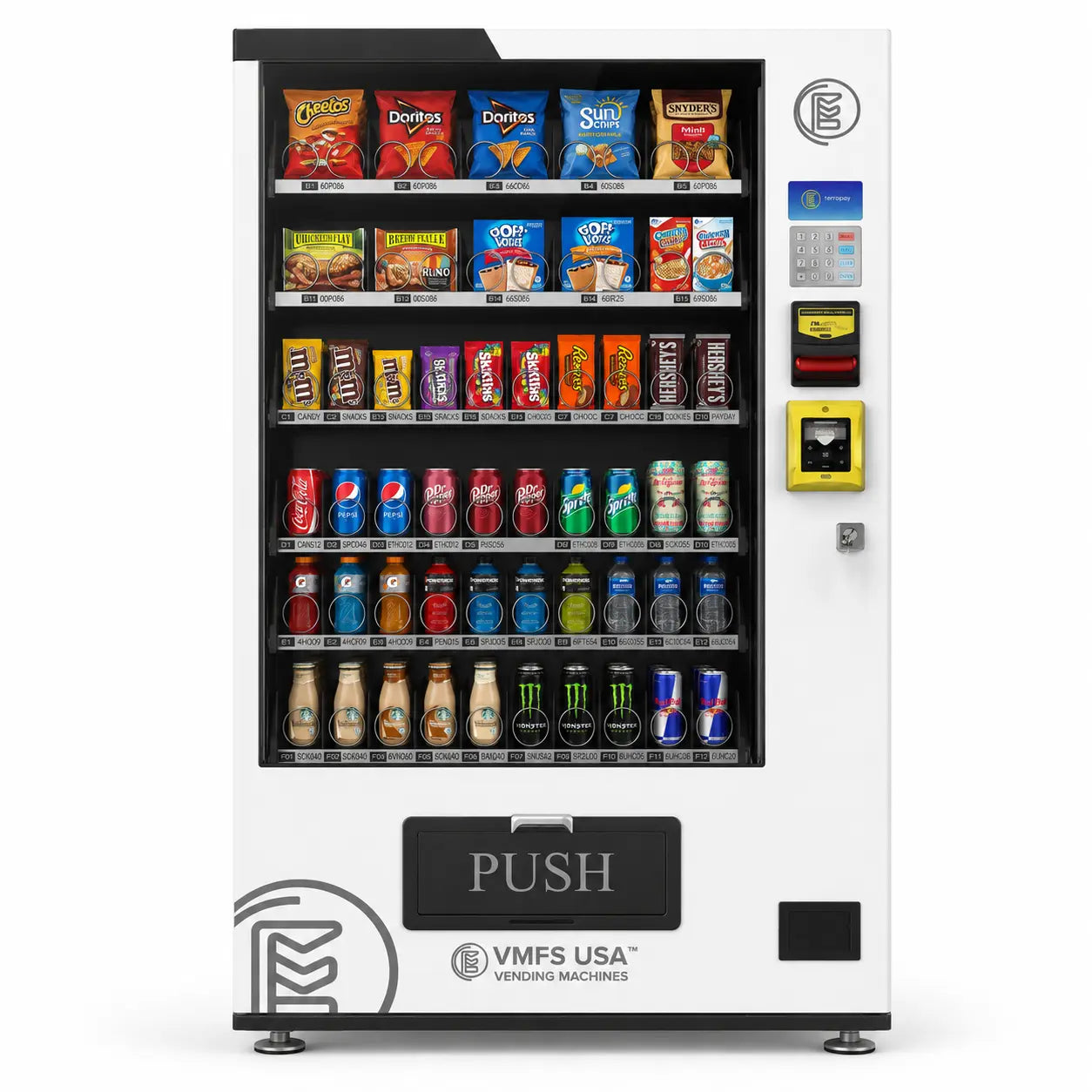
Spiral or coil machines for shelf-stable chips, candy, bars and sealed drinks. Lowest regulatory burden and the usual starting point for new operators.
Refrigerated fresh food
Chilled cabinets with elevator or gentle delivery for sandwiches, salads, yogurt and boxed meals that must stay at 41°F or below.
Frozen
Freezer machines for ice cream and frozen meals, usually with elevator delivery so the product never drops.
Hot food
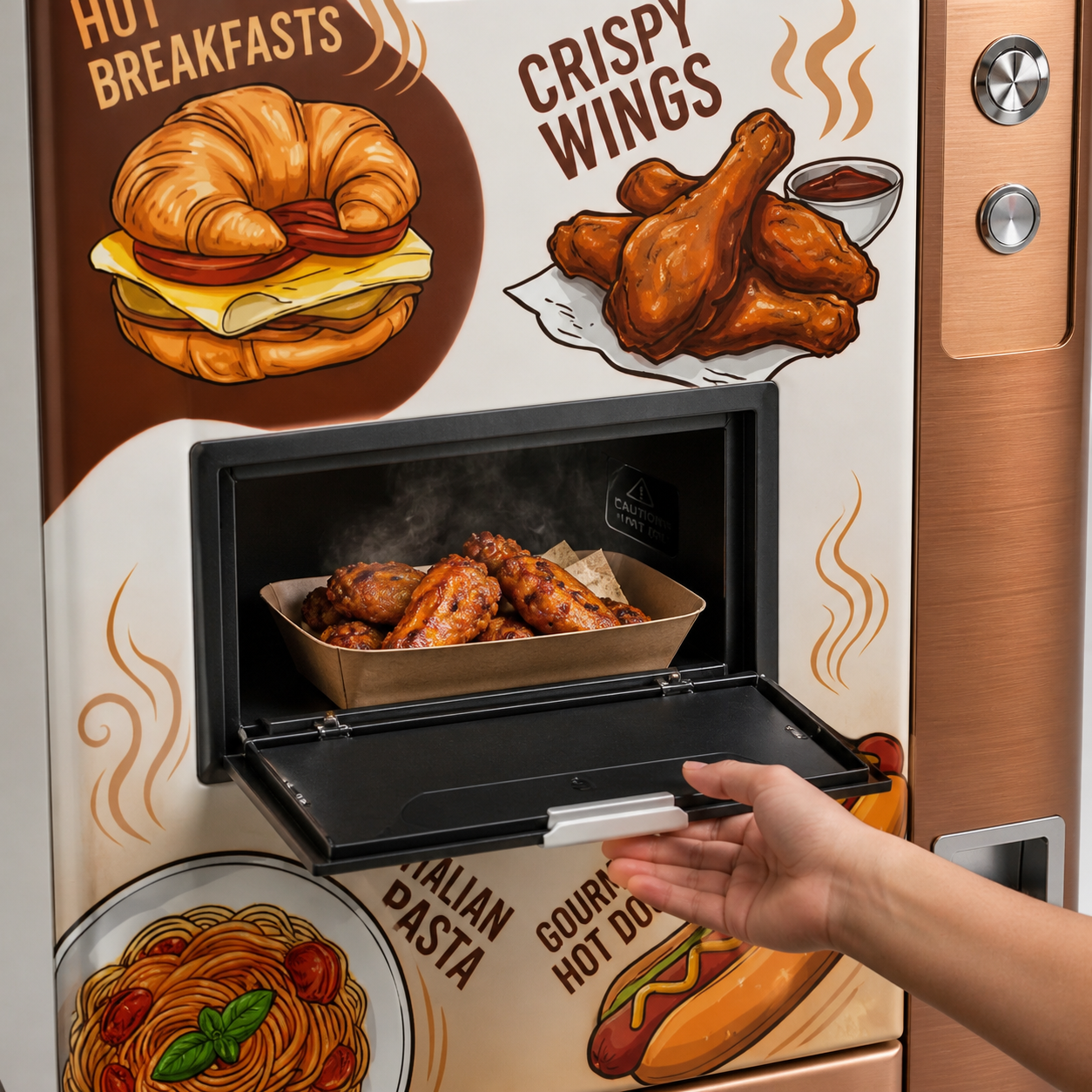
Refrigerated storage plus a built-in microwave heating stage that serves a hot meal after payment.
Specialty cooking
Purpose-built units such as pizza and ramen machines that heat or prepare one menu item on demand.
Door-open smart coolers
AI or weight-sensing coolers where the customer unlocks the door, takes items and is charged automatically.
Packaged snack and drink machines are where most food vending routes begin, because sealed, shelf-stable products need no temperature control for safety and the rules are lightest. They use spiral coils or shelves to hold chips, candy, crackers, bars and canned or bottled drinks, and they can sit in breakrooms, lobbies and waiting areas that would never support a fresh-food program. The trade-off is ticket size: a bag of chips earns far less per sale than a boxed lunch, so operators often pair a snack machine with a refrigerated or hot food machine at sites with meal demand.
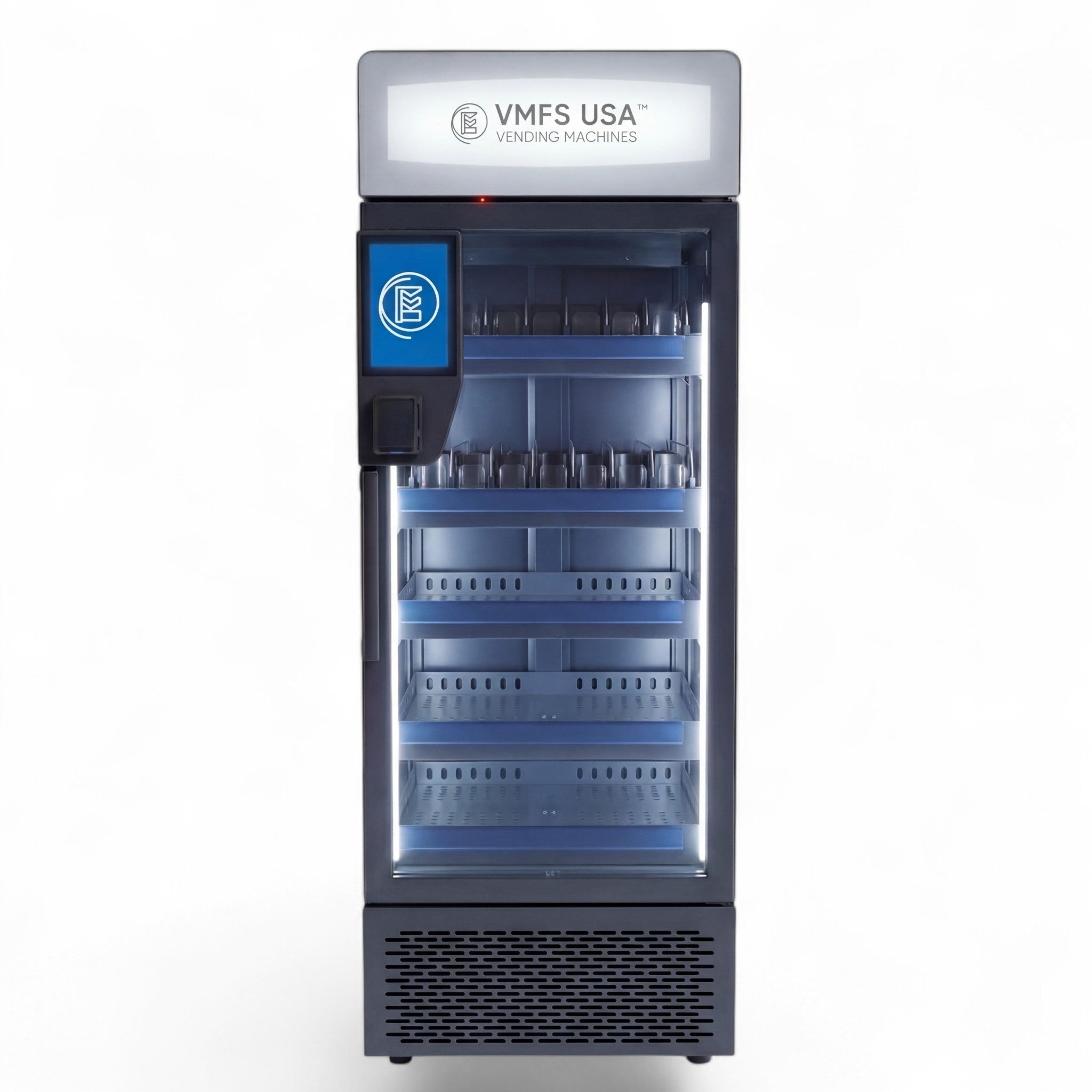
Refrigerated machines are the workhorse of fresh food vending. The Food Elevator Vending Machine is built for fragile, fresh and mixed items, using an elevator to carry each product to the pickup door, adjustable slot configurations and food-safe temperature control, and it is rated for indoor and outdoor locations. For a deeper look at the mechanics, the cold food vending machine work process guide walks through cooling, delivery and servicing. Freezer machines follow the same elevator logic at much lower temperatures; the frozen vending machines range covers ice cream and frozen food formats. The Frozen Ice Cream Vending Machine uses deep refrigeration, elevator delivery and adjustable storage for packaged ice cream and frozen foods, while the Big Freezer Vending Machine is built for mixed frozen inventory such as ice cream, frozen pizza and boxed meals in one cabinet.
Hot food machines keep meals chilled until purchase and then heat them. The Mini Hot Food Vending Machine combines refrigerated storage, microwave heating, food safety controls and cloud connectivity in a compact cabinet, while the larger Hot Foods and Lunch Box machines add elevator delivery, conveyor-based trays and a large touchscreen. Specialty units narrow the menu to one item: the Hotlo Pizza Vending Machine stores pizzas refrigerated at 37.4°F and heats each one to 167°F in a built-in heating unit, and the Ramen Noodle Vending Machine pairs a dedicated hot water module with cup noodles. If you are weighing this segment, read how hot food vending machines work before choosing a model.
| VMFS model | Food type | Key hardware | Starting price |
|---|---|---|---|
| AI Smart Combo Vending Machine | Grab-and-go snacks, drinks, packaged food | Tap to unlock, take items, automatic checkout | $3,950 |
| Food Elevator Vending Machine | Fresh and fragile refrigerated food | Elevator delivery, adjustable slots, food-safe temperature control | $8,950 |
| Ramen Noodle Vending Machine | Hot cup noodles | Dedicated hot water module, touchscreen, cashless | $9,950 |
| Frozen Ice Cream Vending Machine | Packaged ice cream and frozen foods | Deep refrigeration, elevator delivery, adjustable storage | $9,950 |
| Smart Elevator Advertising Vending Machine | Snacks, meals and drinks | Elevator delivery, refrigerated or ambient options, large touchscreen | From $10,650 |
| Big Freezer Vending Machine | Mixed frozen items, frozen pizza, boxed meals | High-capacity freezer storage for mixed product sizes | $11,950 |
| Mini Hot Food Vending Machine | Hot meals | Refrigerated storage, microwave heating, cloud connectivity | $12,450 |
| Hot Foods Vending Machine | Hot meals, sandwiches, boxed food | Elevator, conveyor trays, integrated microwave | $14,450 |
| Lunch Box Vending Machine | Boxed meals and hot food | Elevator, conveyor trays, integrated microwave | $14,450 |
| Hotlo Pizza Vending Machine | Hot pizza | Refrigerated storage at 37.4°F, built-in heating unit to 167°F | $14,950 |
Compare food vending machines
See refrigerated, hot food, pizza and ramen machines with current VMFS pricing and specs.
Shop food machinesA food vending machine works by holding food in a temperature-controlled cabinet, taking payment, moving the selected item to a pickup door without damaging it and, for TCS food, refusing to sell anything once it cannot prove the food stayed at a safe temperature. Each of those steps maps to a specific rule or design choice.
Temperature comes first. Under Food Code section 3-501.16, TCS food must be held at 135°F (57°C) or above, or at 41°F (5°C) or below. Section 4-204.112 requires the temperature sensor in a refrigerated unit to read the warmest part of the cabinet, and in a hot food unit the coolest part, so the reading reflects the worst spot rather than the best. Refrigerated ready-to-eat TCS food prepared and held for more than 24 hours must be date marked for a maximum of 7 days at 41°F or less, counting the day of preparation as Day 1.
The automatic shutoff is the feature people most often get wrong. Section 4-204.111 requires a machine vending TCS food to have an automatic control that stops it from vending if a power failure, mechanical failure or other condition means it cannot keep food at the required temperatures, and to stay stopped until the machine is serviced and restocked with food that was kept at safe temperatures. The 30-minute figure that circulates online comes from the second half of that section: when the shutoff is activated, a refrigerated machine's ambient air may not exceed 41°F for more than 30 minutes immediately after the machine is filled, serviced or restocked, and a hot holding machine may not fall below 135°F for more than 120 minutes after servicing. In other words, the 30 and 120 minutes are recovery windows after you open the door to restock, not a delay before the lock engages.
Delivery matters next. Spiral coils are fine for bags and bars but can crush a salad or tip a soup, so fresh and hot food machines use elevators, conveyor trays or pusher systems that carry the item down instead of dropping it. Our guide on how food in vending machines should be dispensed covers the trade-offs. The Food Code adds smaller requirements that inspectors do check: TCS food dispensed through a machine must stay in the package it was placed in at the food establishment or processing plant that prepared it, condiments at a vending machine location must be individually packaged or come from dispensers filled at an approved location, and the dispensing compartment of even a snack machine needs a self-closing door if it is outdoors without enclosure or available when no food employee is supervising it.
Connectivity ties it together. A machine that reports its temperature, sales and faults to a dashboard lets you see a cooling problem before the shutoff trips, and it tells you which items are selling so you can cut waste. VMFS Cloud works with every VMFS machine; plans start at $7.99 per machine per month for live inventory, real-time sales and fault and low-stock alerts. Routine servicing still matters, and the vending machine maintenance guide lays out what to check on each visit.
Most food vending operators need a general business registration, a sales tax registration and, once they sell TCS food, a food or vending permit from the state or county health authority, plus federal calorie labeling once they reach 20 machines. The exact list depends on where the machine stands, which is why state definitions matter so much.
Health permits are the part that varies most. Iowa licenses each machine at $50 for the first and $10 for each additional. Florida's DBPR fee schedule lists $21 for a full year and $15.50 for a half year for vending machines, with a $50 application fee for new licenses, and requires a sanitation and safety inspection before a new licensee opens. Other states license the operator, the commissary or the location instead. Before you buy a meal machine, call the health department that covers the address and ask three questions: does this machine need a permit, does my commissary need one, and will someone inspect the machine before it goes live. Our step-by-step guide on how to get a food vending license covers the application itself, and the broader vending machine permits guide covers business licenses and sales tax by state.
Calorie labeling is federal. Under 21 CFR 101.8, food sold from a vending machine is covered when the operator owns or operates 20 or more vending machines. Calorie declarations may go on a sign in close proximity to the item or selection button, in, on or adjacent to the machine, and on electronic machines with digital or LCD displays the calories must show before the customer makes a purchase. An item is not covered when the customer can see the calories, serving size and servings per container from the Nutrition Facts label before buying, in type at least 150 percent of the size required for the net quantity declaration. Touchscreen food machines make this easier because calories can sit on the product screen itself.
Business structure is separate from food law but worth settling early, since permits and leases are issued to a legal entity. Many operators form an LLC before applying; VAdviced explains how to form an LLC for a vending machine business if you have not done it yet.
Food vending sits between snack vending and micro markets: it sells meals like a micro market but keeps every item behind a locked cabinet like a snack machine. Choosing among them comes down to how many people the location serves, how much theft risk the host will accept and whether you can run a fresh-food supply chain.
Scale gives useful context. NAMA's 2022–2023 industry census estimated the convenience services industry at $26.6 billion in 2023, with vending still the largest segment at about $18.2 billion, served by roughly 10,450 vending operators and about 2.89 million vending points of sale. Micro markets grew from $2.4 billion in 2019 to an estimated $5.4 billion in 2023, and micro market operators reported that about 22% of their sales come from fresh or prepared foods and 10% from frozen foods. That fresh-food share is exactly the demand a refrigerated or hot food machine can capture in locations too small or too open for a full market. If a market is on your shortlist, compare it in the micro markets operator guide.
| Factor | Snack vending | Food vending (fresh, frozen, hot) | Micro market |
|---|---|---|---|
| Typical products | Shelf-stable snacks and drinks | Sandwiches, salads, boxed and hot meals, frozen items | Open shelves and coolers, fresh, frozen and snacks |
| Product security | Locked cabinet | Locked cabinet, item released after payment | Open access, self-checkout kiosk |
| Food safety controls | Self-closing door in some settings | Temperature holding, automatic shutoff, date marking | Cooler temperatures, date marking, kiosk controls |
| Typical permitting | Business and sales tax; health permit depends on state | Health or vending permit is common for TCS food | Health permit common; varies by jurisdiction |
| Best fit | Most locations, low servicing frequency | Captive sites with meal demand and no full kitchen | Controlled-access workplaces with steady headcount |
Advantages of food vending
Limitations of food vending
A food vending business makes money on the gap between what it pays for product and what customers pay at the machine, after location commission, card fees, spoilage and route costs. The model is the same as any vending route, but perishable food makes forecasting and waste control the deciding factors.
Supply is the first decision. TCS food has to come from an approved source, which usually means a licensed commissary, a contract food manufacturer or a distributor of sealed, labeled fresh items, not your own kitchen. The guide on where vending machines get their food lays out the channels. Shorter shelf lives mean you buy smaller quantities more often, and the 7-day date-mark limit for refrigerated ready-to-eat food caps how long a commissary-made item can sit in your machine.
Placement terms are the second. Hosts are typically paid a commission on sales; NerdWallet puts the usual range at 5% to 25% of revenue, and meal machines in captive sites such as hospitals, factories, distribution centers and dorms are where the stronger offers usually land. Our vending location scouting and pitching guide shows how to qualify a site before you commit a meal machine to it, and property managers looking for operators can list space on VPlaced.
Payments are the third. According to Cantaloupe's 2026 Micropayment Trends report, 78% of vending sales were cashless in 2025, up from 73% the year before, and the average cashless vending transaction was $2.45 against $1.57 for cash. Meals carry higher prices than snacks, so a reliable card and mobile wallet setup matters even more on a food machine; the cashless payment system guide compares readers and fees.
Waste control is the last and most important lever. Every unsold sandwich past its date is a direct loss, so successful operators start with a narrow menu, watch sell-through by item and by day, and cut or swap slow sellers quickly. Telemetry that shows stock and sales by slot turns that from guesswork into a weekly routine. For the purchase side of the equation, the food vending machine cost breakdown covers hardware, setup and running costs, and the hub on whether vending machines are profitable shows how to model revenue against those costs. VMFS machines carry a 1-year parts warranty under the written warranty policy.
The safest way to start food vending is to settle the legal and supply questions before you buy hardware, then launch one machine with a short menu and expand from real sales data. The order below avoids the most common and expensive mistake, which is owning a meal machine you cannot legally stock.
Operators moving straight into meals can follow the deeper playbook on starting a hot food vending machine business, and anyone comparing hardware budgets across categories can start with the overview of vending machine costs. Customers who ask about SNAP benefits will find the answer in our post on using food stamps at vending machines.
Need a location for your food machine?
VMFS location matching connects operators with hosts looking for vending and fresh-food service.
Get location matching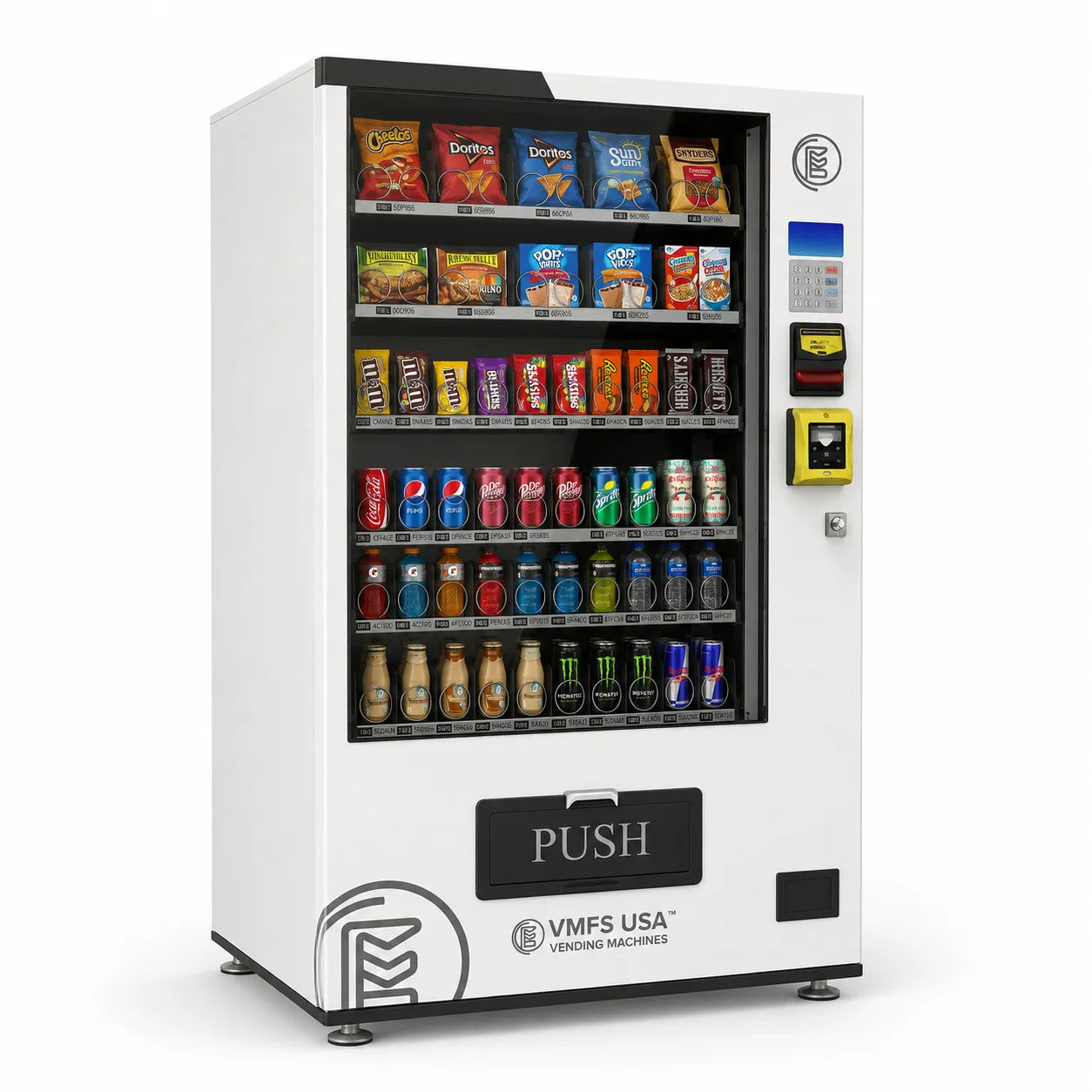
Share:
What is the Most Efficient Way to Brew Coffee in the Office? Complete Guide
Japanese Vending Machines: Why They Never Reached America