




Design the perfect vending solution for your location and customers.

Join the VMFS newsletter and step into a thriving network dedicated to collective success.
One signup. Endless possibilities.
Machines & Industry | Global Vending | By the VMFS USA Team | September 2026
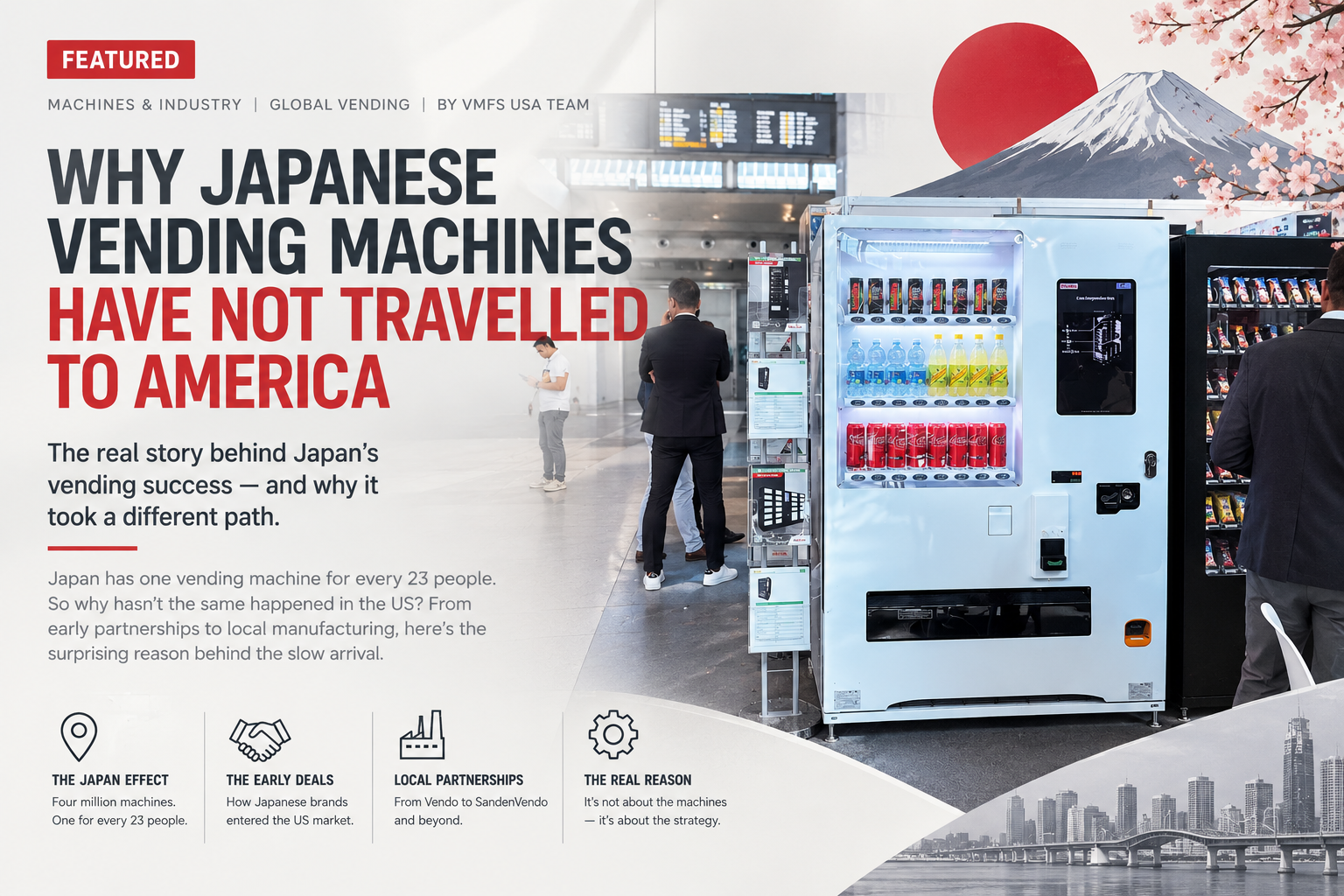
Japan has somewhere in the region of four million vending machines, roughly half of them selling canned and bottled drinks. That works out to about one machine for every twenty three people, the highest density anywhere on earth. They stand unattended on residential streets, on mountain paths, outside closed shops, lit all night, and almost nobody touches them.
Anybody who has visited comes home asking the same question. Why does America not have this? The machines are demonstrably better in several measurable ways, the manufacturers have been refining them for over fifty years, and the technology is not secret. Yet walk past the vending machines on an American street and you are looking at equipment that evolved along a completely separate branch.
The usual answer is that Americans are simply different. That answer is wrong, or at least badly incomplete. The real story is stranger and considerably more useful if you are buying equipment, and it starts with the fact that Japanese vending already came to America decades ago. It just did not arrive in the form anybody expected.
Where this comes from: we supply and operate vending equipment across the United States and currently run outdoor and specialty pilots in several US climates. This piece is about why hardware from one market often fails in another, which is a question we deal with practically rather than theoretically every time somebody asks us to spec a smart vending machine for a difficult site.

In 1937, two brothers founded The Vendo Company in Kansas City, Missouri. Over the following decades Vendo became one of the defining names in American cold drink vending, supplying machines to the major soft drink brands and producing a long run of innovations that ended up in almost every beverage vending machine built since.
The oil crisis of the 1970s hit the business hard. Vendo sold off most of its operations and retreated to beverage distribution. Then in 1988, Japan's Sanden Corporation acquired it. The company was recapitalised, restarted its engineering programme, and in 2005 moved its headquarters to Dallas and took the name SandenVendo America as a nod to its parent.
Sanden did the same thing in Europe. Rather than shipping Japanese machines across the world, it built and bought local capacity. Production in Casale in northern Italy dating back to the 1960s, subsidiaries in Germany, France, Belgium and Spain, and the acquisition of Vendhall in the United Kingdom in 2000.
This is the actual answer to the question. The Japanese vending industry did expand internationally, and it did it by acquiring local manufacturers and building region specific machines in region specific factories. The capital travelled. The engineering philosophy travelled. The machines themselves largely did not, and there are good reasons why.
There is a nice loop in this history too. Fuji Electric, which has led the Japanese vending market for over half a century, originally entered the business in the 1950s through a technical agreement to license vending technology from Seeburg, an American company. The technology travelled west to east, Japan refined it into something remarkable, and then returned not as exported cabinets but as ownership of American and European factories. A good deal of what sits in our in stock units today descends from that exchange in one direction or another.
Here is the detail that made us sit up, because it is the most concrete example we have found of why hardware does not simply cross borders.
In published engineering work on adapting its machines for the Chinese market, Fuji Electric noted that Japan sets its high temperature environmental test condition at 32 degrees Celsius, which is around 90 Fahrenheit. Because Japanese summers historically sat within that range, the company had never previously needed to verify machine operation in high temperature, high humidity conditions above 40 degrees Celsius, roughly 104 Fahrenheit.
Now think about an American summer. Phoenix, Las Vegas, Dallas, Houston, Miami, much of the interior west and the entire Gulf Coast spend weeks every year in exactly the conditions those machines were never validated for. And that is ambient air temperature, before you account for what happens inside a dark cabinet standing in direct sun on a forecourt.
This is not a criticism of Japanese engineering. It is superb engineering, optimised precisely for the conditions it was designed to face. That is exactly the problem. A machine tuned for a climate that tops out around 90 degrees is not a machine you want holding chilled product through a Texas August, which is why refrigeration capacity is the first specification we interrogate on anything destined for the southern half of the country and why our outdoor machines are specified by climate rather than as a single category.

The second reason is the one everybody senses but few people state precisely. Japan's vending density is not primarily a technology achievement. It rests on an unusually low rate of property crime, which allows machines to stand alone on a public street, full of stock and cash, overnight, without armour.
Remove that assumption and the entire economic model changes. American operators have historically not even considered standalone street side units, because the expected losses from vandalism and theft simply do not support it. The same caution applies across much of Europe.
That single difference cascades through the hardware:
None of this makes unattended outdoor retail impossible here. It makes it a different engineering and placement exercise, which is precisely what our partners at VPlaced screen for when they assess an exterior site: lighting, visibility, passive supervision and who is actually around at three in the morning.
This one is structural and it is the reason the two markets have produced such different equipment, yet it almost never comes up.
In Japan, a very large share of beverage machines are owned and operated by the beverage manufacturers themselves. The machine is a distribution channel for a drinks company, which means it can be optimised around one product category, standardised across hundreds of thousands of units, and justified on brand presence as much as on machine level profit.
In the United States, the buyer is far more often an independent operator running a route of mixed machines across unrelated sites. That operator needs flexibility, wants to carry several categories in one cabinet, cares intensely about restock efficiency across long drives, and has to justify every machine on its own returns.
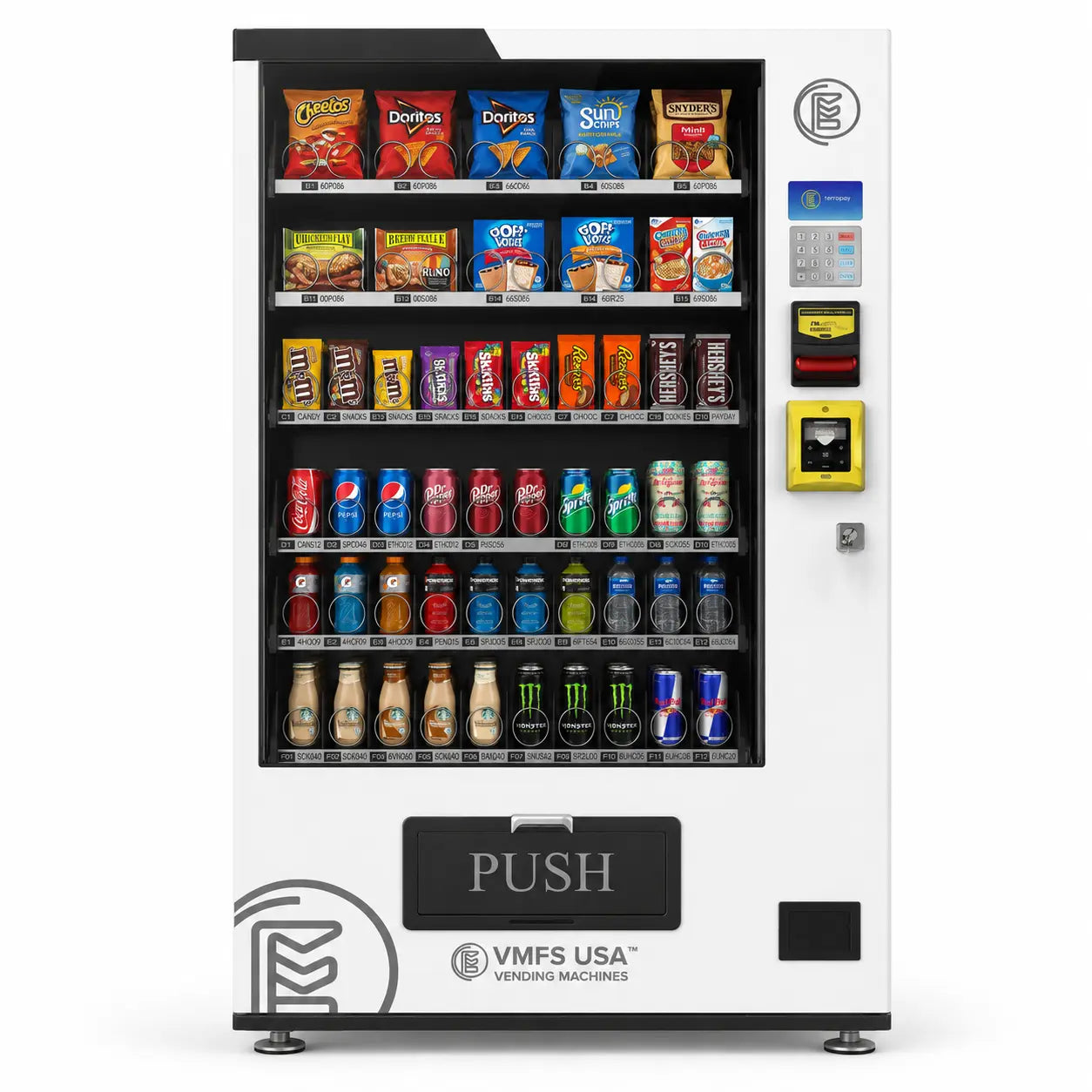
Those are different customers wanting different machines. A tall, elegant, single category beverage unit built for a Tokyo street corner is not what an operator in rural Michigan is looking for, which is part of why combination machines carrying both snacks and drinks have always sold better in this market than the specialised formats that dominate Japan.
Then there is a stack of unglamorous practical obstacles, each individually surmountable and collectively expensive enough to keep most manufacturers home.
| Barrier | Why it stops export |
|---|---|
| Electrical supply | Japan runs 100V and, unusually, two grid frequencies. American and European supply differs on both counts, which is a redesign rather than an adapter |
| Currency handling | Coin and note mechanisms are built around one country's currency. Every new market needs new hardware and new validation |
| Cashless standards | Japan built its own contactless ecosystem around transit cards. Exporting means certifying against entirely different payment schemes |
| Safety certification | Approval marks required in North America and Europe are separate processes with separate costs per model |
| Parts and service | A machine with no local spares network and no trained technicians is unsellable, however good it is |
| Route economics | Japanese density means short restock rounds. American routes cover distances that change what efficient machine design even means |
Any one of those is solvable. All of them together, for a manufacturer already serving a domestic market of several million installed machines, added up for decades to a straightforward business decision: stay home. That calculation is only now shifting, because the Japanese domestic market has matured and begun to decline, which gives those manufacturers a reason to look outward that they did not previously have.

The machine in the photographs above is a useful counterpoint, because it shows what happens when a market optimises for its own conditions rather than importing somebody else's.
It is a European automated kiosk, and next to a conventional glass front unit sits a bank of individually lit locker compartments dispensing beer multipacks and full cases. Japanese beverage machines are extraordinary at delivering a single chilled can, hot or cold, in seconds. They were never designed to hand somebody a twenty bottle case, because that was not the problem the Japanese market asked them to solve.
Locker formats answer a genuinely different question: how do you sell something too large, too heavy or too awkward to survive a spiral or a drop. Once you can do that, the range of what a machine can sell expands enormously, which is the same principle behind the locker and elevator systems in our specialty range.
The lesson is not that one region builds better machines. It is that every market's equipment is a fossil record of the constraints it grew up under, and copying the machine without understanding the constraint is how operators end up disappointed.
None of the above means there is nothing to learn. There is a great deal, and in our view it is the thinking rather than the cabinets that is worth importing.
The clearest example of that hot and cold thinking is canned hot coffee, probably the single most recognisable product in Japanese vending. UCC put the first mass produced canned coffee on sale in 1969, a milk coffee made to be drunk on the move. It was sold cold, which left beverage machines with the problem every drinks operator knows: strong summers and weak winters.
The fix arrived in 1973, when Pokka worked with Sankyo Electric, the company now called Sanden, to build a machine that could hold some columns hot and others cold at the same time, together with a can that could stay heated in the machine for long periods. Yes, that is the same Sanden that later bought Vendo in Kansas City. Ever since, Japanese operators switch a share of each machine's columns from cold to hot as autumn arrives, marked with red labels for hot and blue for cold, and a warm can of coffee doubles as a hand warmer on a winter train platform.
What makes the format work is that nothing is brewed. A Japanese coffee vending machine is really a beverage machine with heated columns: no water line, no grinder, no milk to clean and no cups. It restocks exactly like any other can, which is why it could spread to every street corner in the country.
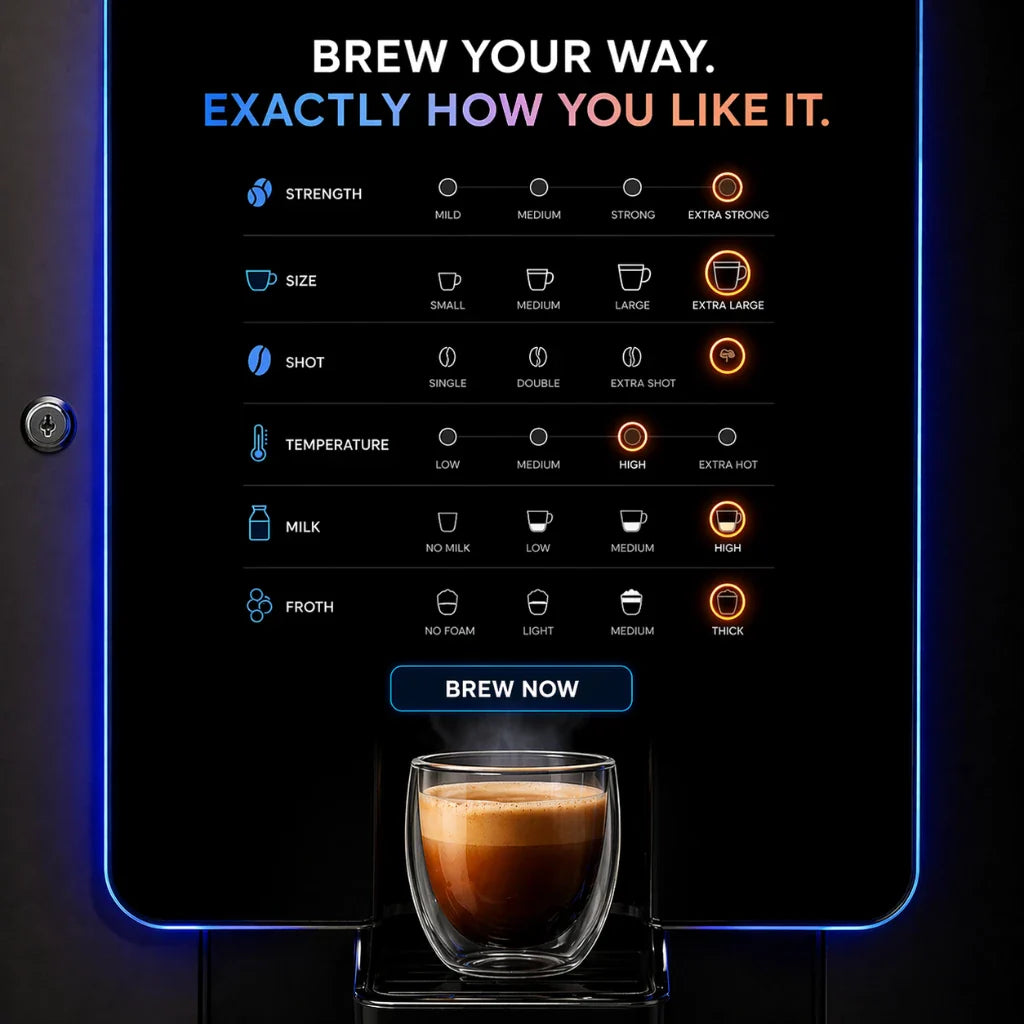
In America, hot coffee from a machine has mostly meant a different machine altogether, one that brews a fresh cup from beans or instant. That needs a water supply and more regular cleaning, but it serves a better cup and suits offices, hospitals, dealerships and campuses with steady indoor traffic. If that describes your site, you can compare the formats across our range of coffee vending machines.
Everything above is why we run pilot machines rather than shipping in whatever performs well somewhere else and hoping. It would be faster to import a well reviewed machine from another market and list it. It would also be a good way to sell operators equipment that fails in its second summer.
We currently have pilot units running across a spread of American climates and site types, and what we are measuring reflects exactly the failure modes this article has been describing:
That last line is the one that keeps producing surprises, and it is the same lesson Japanese manufacturers learned when they moved into China and discovered their machines had never been validated above 40 degrees. Nobody knows what a market needs until they put equipment in it and watch.
Our position, plainly: the goal is not to build an American copy of a Japanese machine. It is to take what those manufacturers proved about reliability, efficiency and unattended retail, and combine it with equipment actually engineered for American heat, American winters, American routes and American operators. That is what the pilots are for.
If you want to talk through a specific site, we would rather have that conversation before you buy than after. Everything we supply sits across the VMFS USA range, with in stock units shipping within 7 to 21 days under a one year parts warranty.
Getting the site right in the first place is work our partners at VPlaced do, and the permits that come with an exterior or public installation are handled by VAdviced. Once a machine is live, listing it on VendingFinder is how people find it when nothing else nearby is open.
We are also still adding pilot locations, particularly in demanding climates. If you have a site facing extreme heat, hard winters, coastal salt air or high humidity, we would genuinely like to hear about it.
A combination of factors rather than any single one. Very low property crime allows machines to stand unattended on public streets, high population density and expensive land make a machine's footprint economically attractive against a shop, and beverage manufacturers own and operate large fleets as a distribution channel. Together those produce roughly one machine for every twenty three people.
Partly they are, indirectly. Sanden acquired the American manufacturer Vendo in 1988 and builds machines here under SandenVendo America. What has not travelled is the hardware itself, because of electrical differences, currency and payment systems, certification requirements, service networks, and machines engineered around a climate and a crime environment that do not match this market.
They are outstanding at what they were designed for, which is delivering beverages reliably and efficiently in Japanese conditions. Whether they are better for an American site depends entirely on that site. A machine optimised for a climate topping out around 90 degrees is not the right choice for a Phoenix forecourt, however well built it is.
No. The domestic market has matured and installation numbers have been flat to declining for some years, which is exactly why Japanese manufacturers have become more interested in overseas markets than they were during the decades when the home market alone was enough.
The thinking rather than the hardware. Treating uptime as the product, taking energy efficiency seriously because running cost compounds, designing around the restocker rather than only the customer, and combining hot and cold in a single cabinet, which American vending has barely explored and which suits the seasonal swing outdoor operators face.
Built for This Market, Not Borrowed From Another
We run pilots across American climates so we can tell you what will actually survive your site rather than what performed well somewhere else. Tell us where the machine is going and what weather it faces.
Visit the Shop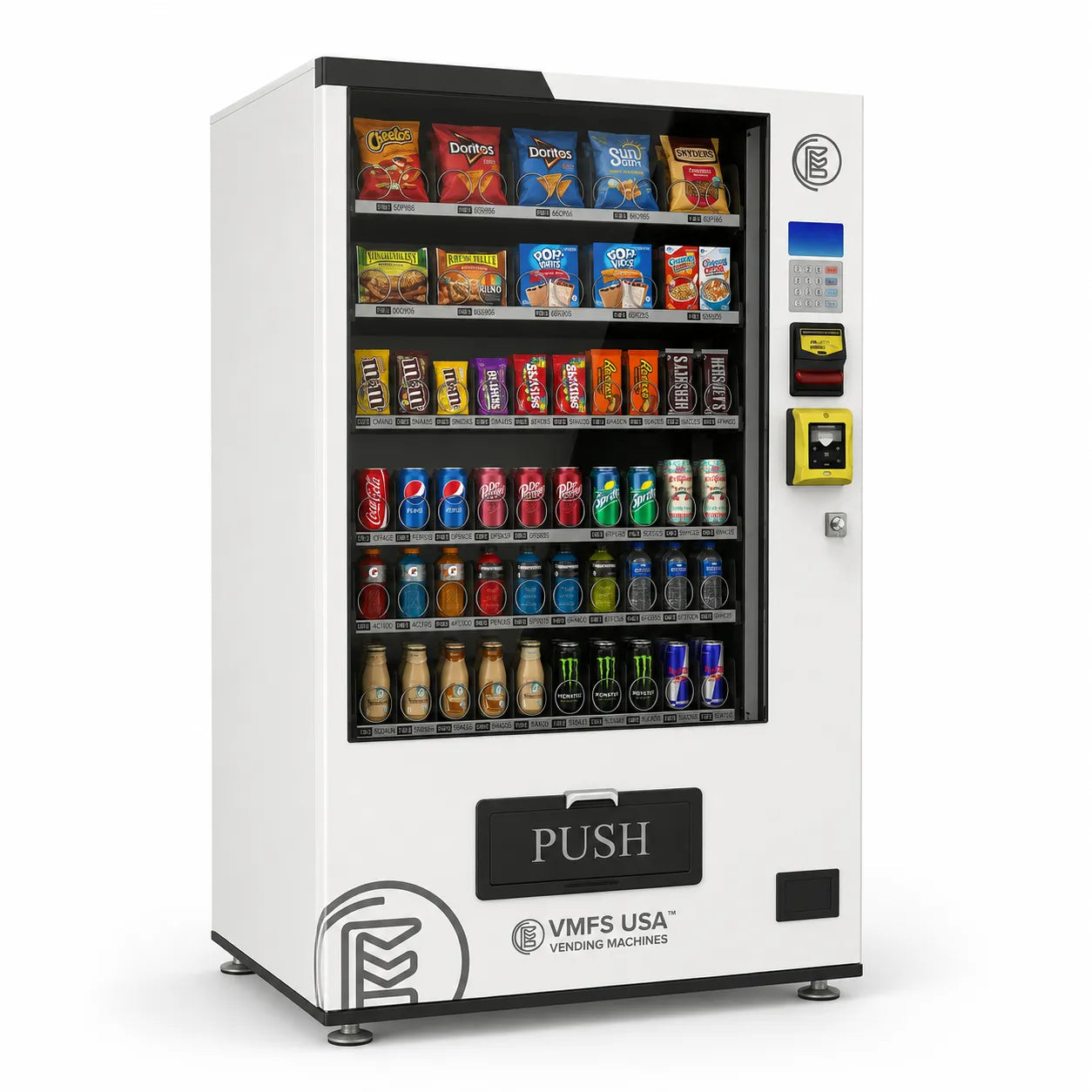
Share:
What Is Food Vending? Definition, Machine Types and US Rules
What is Food Vending Establishment? Legal Definition, Hardware and Business Overview