



Design the perfect vending solution for your location and customers.

Sales, inventory and alerts for your whole route, from one machine to a fleet.
Answer a few questions about your location, products and budget and get a shortlist.
Estimate revenue, payback period and margin before you buy.
Sales, setup help, warranty and parts from the VMFS USA team.
Join the VMFS newsletter and step into a thriving network dedicated to collective success.
One signup. Endless possibilities.
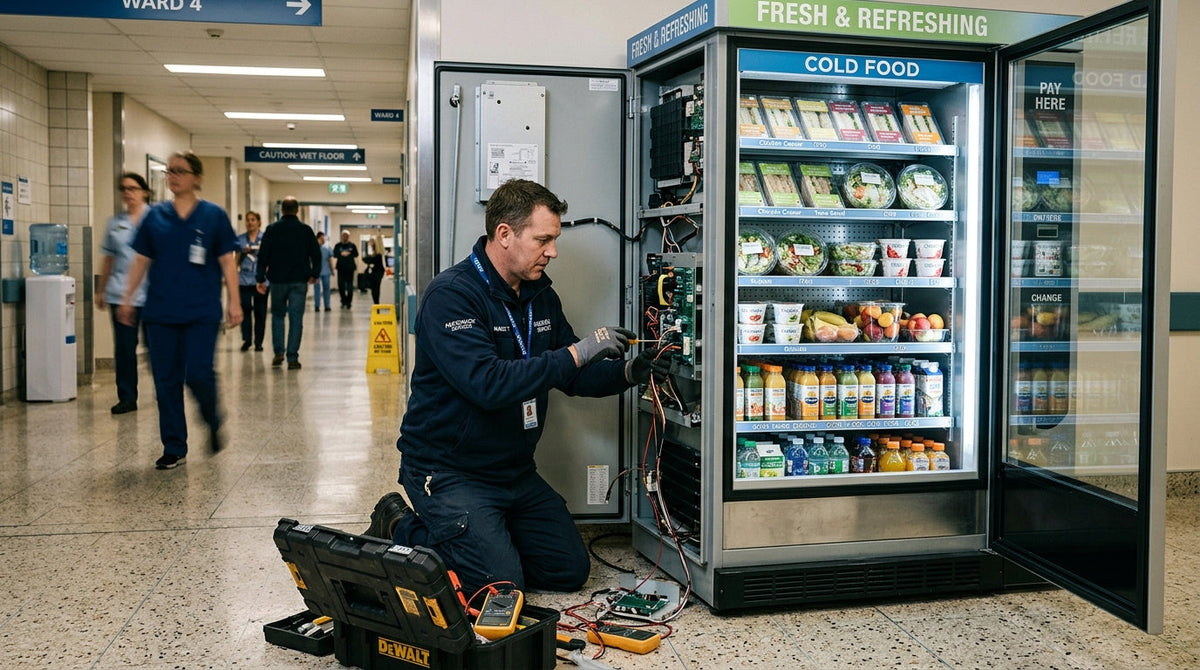
A cold food vending machine works by keeping perishable items inside a refrigerated compartment held below 41°F, using continuous sensor monitoring to maintain that temperature, and dispensing product only after payment authorization confirms the sale. This differs fundamentally from snack or drink vending, because food safety compliance depends entirely on the machine never letting stored product drift into the temperature danger zone where bacteria growth accelerates. This guide breaks down every component involved, from refrigeration engineering to the food safety standards these machines are built to meet.
Table of Contents
A cold food vending machine is a refrigerated retail unit that stores and dispenses perishable food items, such as sandwiches, salads, or prepared meals, while maintaining a continuous internal temperature cold enough to keep those items safe to eat until purchased. Unlike a snack machine, which stores shelf-stable product at room temperature, a cold food machine's entire design centers on an unbroken cold chain from the moment food is loaded to the moment it's dispensed.
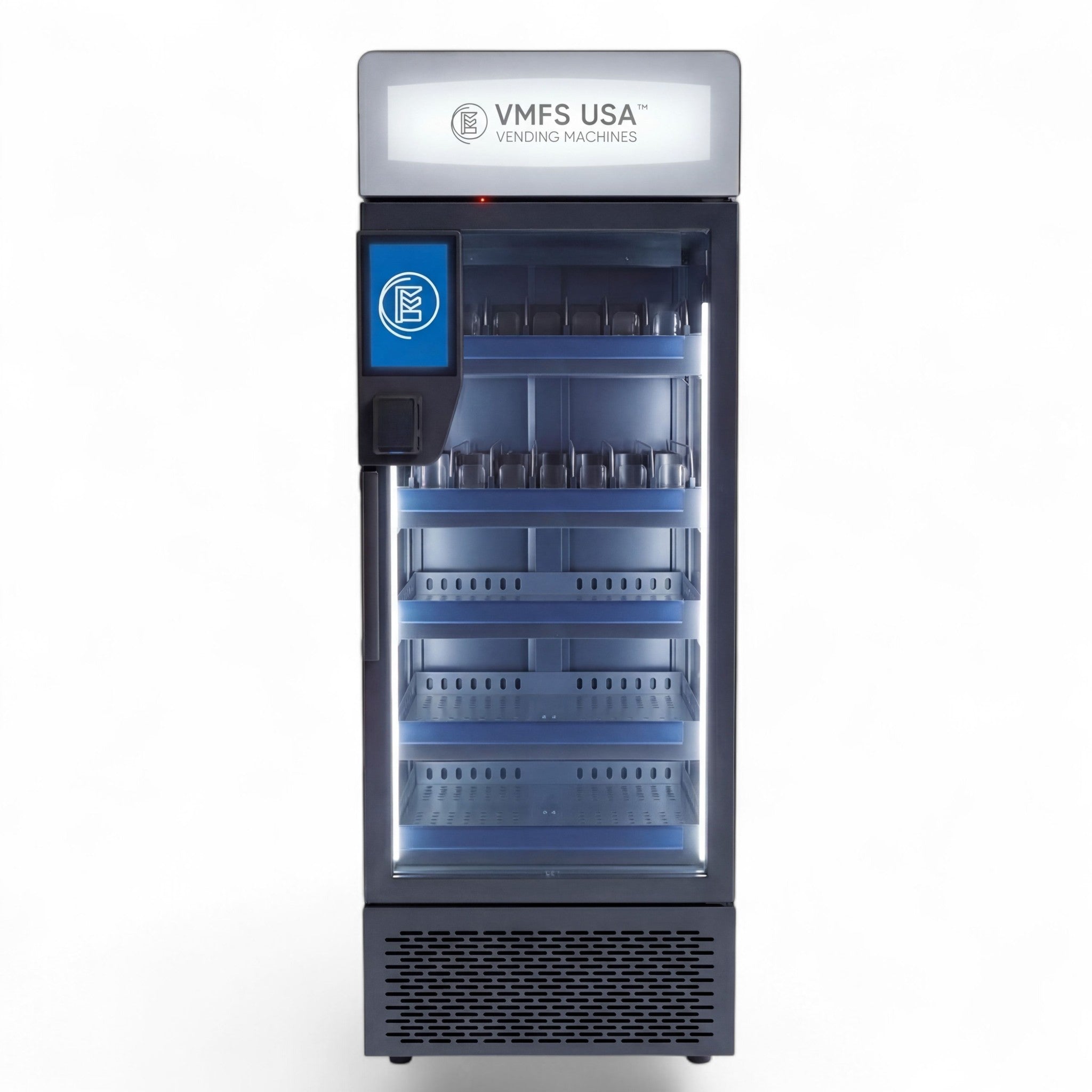
Three subsystems work together to keep stored food both safe and sellable: refrigeration hardware, temperature monitoring sensors, and a dispensing mechanism engineered not to disturb that cold environment during a sale.
A compressor-driven refrigeration system maintains internal temperature through a continuous cooling cycle, similar in principle to a commercial refrigerator but engineered to recover quickly after the door or dispensing opening briefly exposes the interior to room-temperature air during a transaction.
Digital temperature sensors track internal conditions continuously, and connected machines transmit this data to an operator's monitoring dashboard in real time, flagging any deviation before it becomes a food safety issue rather than after. This monitoring layer is what allows an operator to catch a failing compressor remotely instead of discovering spoiled inventory during a routine restock visit.
Cold food items typically dispense through a drop-shelf or robotic retrieval mechanism designed to minimize the time the refrigerated compartment stays open during a transaction, unlike a spiral coil built for shelf-stable snacks. This matters because every second the compartment is exposed to ambient air works against the refrigeration system's ability to hold a consistent temperature.
A general walkthrough of how to get food from a vending machine covers this process from the buyer's perspective in more everyday detail, useful context for locations introducing cold food vending to a new customer base for the first time.
Food safety compliance is the defining operational requirement for cold food vending, since perishable inventory carries real health risk if temperature control fails even briefly.
Perishable food must generally stay at or below 41°F to remain outside the temperature danger zone where bacterial growth accelerates, a standard drawn from FDA Food Code guidance that most state and local health departments adopt directly. Machines built for cold food vending are engineered to hold this threshold consistently, not just on average, since even brief excursions above it during peak-demand periods can compromise food safety.
Cold food inventory carries a defined shelf life far shorter than shelf-stable snacks, which means restocking schedules need to account for pull dates, not just sales velocity. First-in, first-out rotation during restocking prevents older inventory from sitting past its safe sell-by window, a discipline that matters more here than in almost any other vending category. A detailed breakdown of food safety rules for a food vending machine covers these compliance requirements in more depth for operators building a restocking protocol around them.
| Factor | Cold Food Vending Machine | Hot Food Vending Machine |
|---|---|---|
| Storage temperature | At or below 41°F | At or above 135°F, or heated at point of sale |
| Typical products | Sandwiches, salads, prepared meals | Pizza, burgers, ramen, hot entrees |
| Dispensing complexity | Retrieval only | Often includes an in-machine heating or cooking cycle |
| Shelf life management | Critical, short-dated inventory | Varies, some items cooked to order from frozen or shelf-stable state |
Cold vending machines commonly stock sandwiches, wraps, salads, yogurt, and prepared meal boxes, all products that stay safe and appealing when held at refrigerated temperature until purchase. Operators building a health-conscious product mix often reference healthy food options for vending machines alongside broader guidance on vending machines and healthy snacks, since cold vending is frequently the format operators use specifically to offer fresher, less processed options than a standard snack machine can support.
Cold food vending fills a gap standard snack machines can't, offering fresh, refrigerated meal options in locations without a staffed food service option nearby. This makes it a strong fit for offices, hospitals, and manufacturing facilities running shifts outside normal cafeteria hours, where demand for an actual meal, not just a snack, exists around the clock.
Compressor failure is the most serious fault a cold food machine can experience, since it directly threatens food safety rather than just causing an inconvenience, which is why remote temperature monitoring exists to flag this immediately rather than waiting for a scheduled visit. Door seal wear is a more common, lower-severity issue that gradually reduces cooling efficiency and is typically caught during routine maintenance before it becomes a temperature compliance problem. Dispensing jams, while less safety-critical, still require prompt attention since they can leave a compartment door open longer than intended, working against the refrigeration system's ability to hold temperature.
Cold food vending machines fall under health department oversight in virtually every jurisdiction, given that perishable food safety is exactly what health codes are designed to regulate, and licensing requirements can vary meaningfully by state. Licensing requirements for food vending machines in Indiana offers a useful state-specific example of how detailed this regulatory picture can get, and operators in other states should expect a comparably structured, if not identical, health permit process. Business formation matters here too; many food vending operators choose to form an LLC for their vending machine business given the added liability exposure that comes with selling perishable food, and confirming a registered agent for a vending machine business is in place ensures compliance correspondence, including health inspection notices, reaches the business reliably.
Placement success depends on finding locations with genuine meal-time demand and no convenient staffed alternative nearby, since cold food vending performs best where it's filling a real gap rather than competing directly with an existing cafeteria or restaurant. A detailed look at the best places for a food vending machine covers specific venue types worth targeting in more depth. Operators without a confirmed site can also list space requirements through VPlaced's location owner matching process, which connects operators with property owners directly rather than requiring venue-by-venue outreach.
Machine selection should account for expected demand volume, refrigerated slot capacity, and whether a location's traffic pattern favors grab-and-go items or larger meal formats. Matching configuration to actual demand at the chosen site avoids both wasted refrigerated capacity and lost sales from stockouts during peak meal windows.
Refrigeration must hold 41°F or below without interruption, even during peak sales.
Connected sensors flag compressor issues before food safety is compromised.
Shelf life management matters as much as sales velocity for cold inventory.
Frequently Asked Questions
(FAQ accordion code provided separately below for your WordPress HTML block.)
(Final CTA button section provided separately below to place at the end of this content.)
Shop refrigerated and hot food configurations built for reliable, health-code-ready operation.
Buy Food Vending MachineCompare configurations built for different food categories and locations.
It maintains an internal temperature at or below 41°F using a compressor-driven refrigeration system, with continuous sensor monitoring flagging any deviation before it becomes a food safety issue.
Perishable food should generally stay at or below 41°F, the threshold most state and local health departments use to keep food outside the temperature danger zone where bacteria growth accelerates.
A cold food machine stores perishable items at or below 41°F for retrieval only, while a hot food machine holds items at or above 135°F or includes an in-machine heating or cooking cycle.
Common products include sandwiches, wraps, salads, yogurt, and prepared meal boxes, all items that stay safe and appealing when held at refrigerated temperature until purchase.
Yes, cold food vending machines fall under health department oversight in virtually every jurisdiction, since perishable food safety is exactly what health codes are designed to regulate.
Operators follow first-in, first-out rotation during restocking, prioritizing pull dates over sales velocity alone to prevent older inventory from sitting past its safe sell-by window.
Connected machines transmit temperature data in real time, allowing operators to catch a failing compressor and pull the affected inventory before it poses a food safety risk.
They perform best in locations with genuine meal-time demand and no convenient staffed food option nearby, such as offices, hospitals, or manufacturing facilities running shifts outside cafeteria hours.
Yes, cold vending is frequently the format operators use to offer fresher, less processed meal options than a standard snack machine can support.
Yes, cold food items typically dispense through a drop-shelf or robotic retrieval mechanism built to minimize compartment exposure time, unlike a spiral coil used for shelf-stable snacks.
Share:
How to Get Food From a Vending Machine: A Complete Step-by-Step Guide
How to Use a Pokémon Vending Machine: Step-by-Step Guide