




Design the perfect vending solution for your location and customers.

Join the VMFS newsletter and step into a thriving network dedicated to collective success.
One signup. Endless possibilities.
A pizza vending machine works like a small, automated pizzeria in one cabinet. Pizzas are stored cold, a customer orders and pays on a touchscreen, the machine moves one pizza into a built-in oven or heating unit, and a few minutes later a hot, boxed pizza arrives in a locked pickup door. Some machines bake raw or frozen pies to order, one model makes dough from flour and water, and others heat pizzas that were cooked earlier and held cold.
This guide follows one order from start to finish and compares the four machine designs on the market. It covers the parts inside the cabinet, the FDA Food Code temperatures every hot pizza machine has to meet, the permits health departments ask for, and the real specs and price of the VMFS pizza machine, so an operator can judge whether the format suits a site.
A pizza vending machine is an unattended food machine that stores whole pizzas, heats or bakes one when it is ordered, and hands it to the customer in a box. It does what a counter, a cook and a cashier would do, but no one has to staff it. The customer deals only with a touchscreen, a payment reader and a pickup door.
It sits in a different category from snack and drink vending machines. A snack machine drops a shelf-stable bag from a spiral. A pizza machine handles a perishable food that has to stay cold until it is sold, then get hot enough to be safe and good to eat, all inside one cabinet. That puts it under food-safety rules written for restaurants and commissaries as well as the usual vending rules. Most of the engineering, and most of an operator's work, comes from that.
Pizza suits automation because it travels well in a box and reheats evenly. One menu item can cover several flavors with the same handling. In effect it is a small restaurant that never closes, provided the pizza is safe, consistent and priced well against the pizzeria down the road. If you are comparing pizza with other hot meals, the guide to how hot fast food vending machines work covers the wider category, and the full range of food vending machines shows the hardware choices side by side.

A pizza vending machine works in six steps: cold storage, ordering, payment, transfer to the heater, heating or baking, and delivery to a locked pickup door. Machines differ in what goes into the oven (raw dough, a frozen pie or a cooked pizza) and in how long heating takes, but the order of steps is close to the same across every model covered in this guide.
Before anyone orders, the pizzas sit boxed in an insulated, refrigerated section, or a freezer on frozen-format machines. The storage section keeps them out of the temperature range where bacteria grow quickly, and it is the main thing a health inspector checks. VMFS stores its pizzas at 37.4°F in modular storage boxes. PizzaForno holds up to 70 pizzas in its refrigerated section. Basil Street keeps flash-frozen pizzas frozen until they reach the oven floor.
The customer browses a short menu, usually cheese, pepperoni, a vegetable pie and one or two specialty flavors, on a touchscreen. A short menu speeds up the order and keeps stock simple. Some machines let the customer choose extra cheese, a gluten-free crust or another sauce. Machines that bake or heat pre-assembled pizzas offer a choice of flavors rather than build-your-own toppings, because each pizza was put together before it was loaded.
The machine takes payment by card, phone wallet or QR code, and on some models by cash, before it touches a pizza. Paying first means no pizza is heated for a customer who walks away. The payment hardware is the same type used in other modern machines, so the guide to cashless payment systems for vending machines applies here too.
A mechanism takes the selected box out of storage and carries it to the heating chamber. In the PizzaForno machine Axios reviewed, a robotic arm moves the pizza into the oven. VMFS uses a conveyor tray and an elevator delivery system that keeps boxes upright. The handoff happens inside the sealed cabinet, so the food is never exposed to the room.
The pizza is baked or heated in about three minutes on most bake-to-order machines. Manufacturers report "about three minutes" or "under three minutes" for PizzaForno, Basil Street and the Italian Let's Pizza machine. Oven types vary. Basil Street uses a sealed oven with convection heat on the toppings, and Let's Pizza uses an infrared oven. Heat-to-order machines bring a pizza that was already cooked back up to a safe serving temperature. The VMFS unit heats to 167°F, above the 165°F the FDA Food Code sets when cooked food is reheated for hot holding.
Once heating finishes, the machine boxes the pizza if it was not already boxed and delivers it to a pickup compartment. The door unlocks only when the box is in place. That protects the customer's hands from moving parts and keeps the order intact. Most machines do not slice the pizza. Axios noted that PizzaForno dispenses a single-use knife from a separate slot, a detail worth copying if your machine does not slice.
Timing to plan around: heating is only part of the wait. Add the time a customer spends ordering and the transfer inside the cabinet, and a single order usually takes several minutes from first tap to pickup. At sites where everyone breaks at once, the number of pizzas a machine can heat in parallel matters more than the bake time of a single pizza.
There are four common designs: machines that make pizza from scratch, machines that bake fresh refrigerated pies, machines that bake frozen pies, and machines that heat pre-cooked pizzas stored cold. The differences show up in how much labor happens off site, how long stock lasts and how the food-safety plan works. Price differences follow from those.
| Design | What goes in | Heating method (example) | Reported time | Example |
|---|---|---|---|---|
| Made from scratch | Flour, water and refrigerated toppings in sealed single portions | Infrared oven | Under 3 minutes | Let's Pizza (Italy) |
| Fresh bake-to-order | Raw pizzas assembled at a commissary, kept refrigerated | Built-in oven, robotic arm loading | About 3 minutes | PizzaForno (70 pizzas) |
| Frozen bake-to-order | Flash-frozen 10-inch pizzas | Sealed oven, convection heat on toppings | About 3 minutes | Basil Street (141 pizzas) |
| Refrigerated heat-to-order | Pre-made pizzas stored at 37.4°F | Built-in heating unit to 167°F, several at once | Staged ahead of peak demand | VMFS pizza vending machine (up to 240) |
A machine that makes pizza from scratch is the most impressive to watch, and the 2012 New Atlas report describes Let's Pizza mixing flour and water, kneading and rolling a roughly 10.5-inch crust, then adding toppings before baking. The trade-off is mechanical complexity: dough handling, flour dust and many moving parts all need cleaning and service.
Fresh bake-to-order machines move the dough work to a commissary. Axios reported that PizzaForno pizzas are assembled at a regional commissary, loaded uncooked, have a three-day shelf life and are restocked about three times a week. The bake looks and smells good at the machine, but the short shelf life ties the route to frequent deliveries.
Frozen machines stretch shelf life, so restocks can be less frequent. Food Business News reported in 2021 that each Basil Street kiosk holds 141 pizzas and cooks flash-frozen 10-inch pies in about three minutes. Frozen product also widens supplier choice, which the guide on where to buy pizza for vending machines covers brand by brand.
Refrigerated heat-to-order machines, the design VMFS sells, focus on throughput and simple handling. The pizza arrives already cooked, so the machine's job is to keep it cold, heat it safely and serve it fast, several at a time. The deeper quality and cost comparison between these formats is in frozen vs fresh-baked pizza vending machines.
Inside the cabinet are five systems: refrigerated storage, a transfer mechanism, a heating unit, a delivery chute with a locked door, and a controller with a touchscreen and payment hardware. Each one is a point where the machine can fail, so it helps to know what each does before you buy or service one.
Refrigerated storage
An insulated compartment with its own compressor keeps boxed pizzas cold until sale. On VMFS machines, storage is modular: boxes of 48 pizzas slide in and out.
Transfer mechanism
A robotic arm, conveyor or elevator moves one box from storage to the heater and on to the pickup door without opening the cabinet.
Heating unit
Infrared, convection or another built-in heater bakes raw or frozen pies or reheats cooked ones. Its electrical load decides what circuit the site needs.
Temperature sensors and shutoff
Sensors watch storage and heating temperatures. The Food Code requires an automatic control that stops sales if food cannot be held at safe temperatures.
Pickup compartment
A self-locking door opens only after the box is in place, so customers never reach into the mechanism or the heater.
Controller, screen and payments
A touchscreen menu, card reader and optional cash hardware, plus a connection over WiFi or cellular that reports sales and alerts.

The exploded view above shows how the VMFS cabinet is built: the door panel, five stacked storage boxes of boxed pizzas, the base unit, the leveling frame and the tower with the screen and payment reader. Modular storage matters in day-to-day operation. A route driver can pull a box, swap in a full one loaded at the commissary, and close the door, which keeps the time the cabinet stands open short.
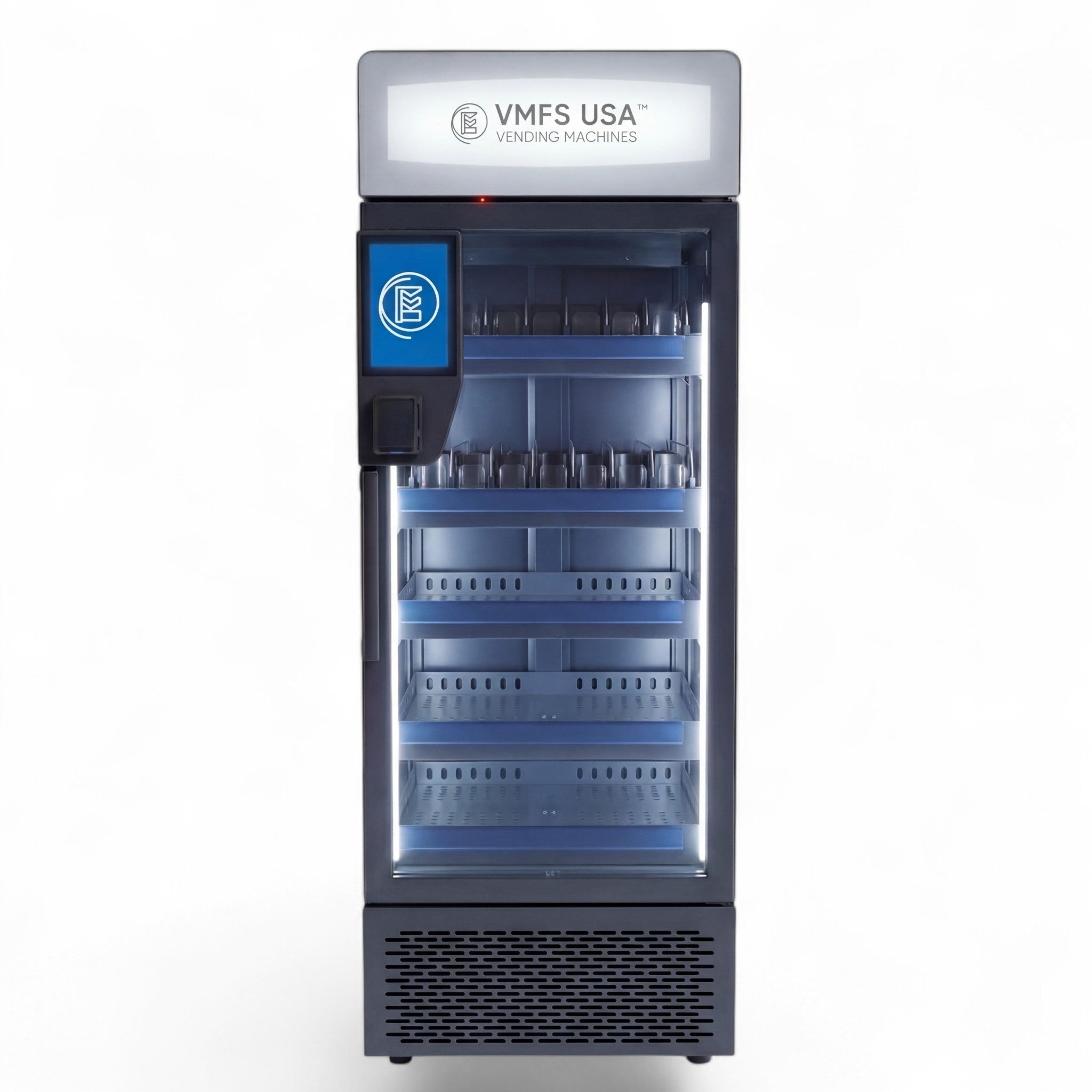
The VMFS pizza vending machine stores pre-made pizzas at 37.4°F, heats them to 167°F in a built-in heating unit, and delivers them upright by elevator to a pickup door. It is listed at $14,950. The machine does not make dough and is not a frozen machine. It is a refrigerated heat-to-order design built to serve a crowd on a short break.
Its main operating feature is batch heating. Instead of heating one pizza only after each payment, it can heat several pizzas at the same time ahead of peak demand and hold them at serving temperature, so they are ready at a scheduled pickup time. That fits a manufacturing plant with a 30-minute lunch, a campus between classes or a hotel at night. At those sites, the first ten minutes of a break decide whether people buy at all.
| Specification | VMFS pizza vending machine |
|---|---|
| Price (listed) | $14,950 |
| Storage | 48 pizzas per modular storage box, up to 5 boxes (240 pizzas maximum) |
| Storage temperature | 37.4°F, controlled refrigeration |
| Heating | Built-in heating unit, heats on demand to 167°F; heats several pizzas at once |
| Delivery | Conveyor tray and elevator delivery to the pickup area |
| Display | 32-inch touchscreen |
| Power | 110V or 230V single phase; 3-phase connection heats faster; rated power 3,400W |
| Dimensions | 80.7 in H × 58.3 in W × 28.9 in D, four adjustable leveling feet |
| Construction | Powder-coated galvanized steel and stainless steel |
| Payments | Credit card reader $450 add-on; coin and bill acceptor $450 add-on |
| Connectivity | WiFi, or 4G with the add-on module |
| Warranty | 1-year parts |
Remote management runs through VMFS Cloud. VMFS Cloud works with every VMFS machine, and plans start at $7.99 per machine per month (Basic $7.99, Advertising $16, AI Cloud $39.99). Remote pricing is part of the Advertising plan. On a pizza machine, the most useful feeds are storage-temperature alerts, heating-fault alerts and stock levels for each storage box, sent by text or email. A route driver then loads the van with the boxes each machine actually needs.
The machine carries a 1-year parts warranty from delivery. Delivery is by freight with an appointment, and the cabinet is 58.3 inches wide, so measure the narrowest doorway, hallway and elevator on the path from the truck to the final spot before ordering. Freight, lead time and white-glove options are on the shipping information page. The product page also showed the unit as sold out when this guide was updated, so confirm availability with the sales team.
Price is only one input. Food cost per pizza, card fees, location commission and route time decide the return. The pizza vending machine cost guide breaks down the total budget, and the analysis of how profitable a pizza vending machine is models sales and margins. If you want to spread the purchase, VMFS offers vending machine financing through partners with a soft credit check.
Compare hot food vending machines
See the pizza machine next to VMFS hot food, lunch box and ramen machines, with current prices and specs.
Browse food vending machinesA pizza vending machine must keep pizzas at 41°F or colder in storage, bring reheated pizza to at least 165°F, and hold any hot pizza at 135°F or above. Those numbers come from the FDA Food Code, the model food-safety code that state and local health agencies adopt, sometimes with changes. Your health department enforces its own version, so check the edition it uses.
The rules apply because a topped pizza is time/temperature control for safety (TCS) food. The Food Code's definition includes animal food that is raw or heat-treated, which covers cheese and meat toppings. TCS food has to be kept out of the 41°F to 135°F range, where pathogens can multiply, or tracked by time instead.
Section 3-501.16 requires TCS food to be held at 41°F or less, or at 135°F or above. A storage setpoint of 37.4°F, like the VMFS machine, leaves a few degrees of margin for door openings and restocking. Section 4-204.112 requires the temperature sensor in refrigerated equipment to read the warmest part of the unit, so an average reading cannot hide a warm corner.
Under section 3-403.11, food that was cooked, cooled and then reheated for hot holding must reach at least 165°F in all parts for 15 seconds. Microwave reheating also has to reach 165°F, and the food must be rotated or stirred, covered and left to stand covered for 2 minutes. There is an exception for ready-to-eat food commercially processed and packaged in an inspected food plant. It only has to reach 135°F when reheated for hot holding. Either way, the reheat must be rapid, with no more than 2 hours between 41°F and the target temperature. Heating to 167°F, as the VMFS unit does, clears the strictest of these numbers.
Section 4-204.111 is written for vending machines. A machine that vends TCS food must have an automatic control that stops sales after a power failure, a mechanical failure or anything else that stops it holding safe temperatures. Sales stay blocked until the machine is serviced and restocked. After a fill or restock, a refrigerated machine's air may not stay above 41°F for more than 30 minutes, and a hot-holding machine's may not stay below 135°F for more than 120 minutes. Refrigerated ready-to-eat TCS food made in a food establishment and held more than 24 hours must also be date marked and used within 7 days at 41°F or below. Section 3-501.18 says such food dispensed through a vending machine is discarded once it passes that limit.
Operator rule of thumb: treat the machine's shutoff log and temperature alerts as your inspection record. If storage alarms after a power cut, the Food Code expects the machine to stop selling until it is serviced and restocked with safely held food, not until it cools back down on its own.
Outdoor sites add weather, heat load and contamination concerns, and the Food Code requires self-closing dispensing doors in unprotected outdoor areas. The guide to outdoor pizza vending machines covers the extra steps.
Most US jurisdictions require a food vending license or permit for a machine that sells perishable food. A machine that cooks or heats food often needs a plan review before the license is issued. The details depend on the state, county and city. The pattern is consistent enough to plan for.
Florida, where VMFS is based, is a useful example. The Florida Department of Business and Professional Regulation (DBPR) licenses food vending machines and requires new licensees to pass a sanitation and safety inspection before opening. Its guide calls for an accurate, accessible ambient air thermometer, an automatic shutoff that prevents vending when food is not at proper temperature, and the license decal on the machine. It also says food storage and preparation must happen in an approved, licensed food service establishment, never a private residence. DBPR tells operators of machines that cook, heat, assemble or portion food to contact its plan review team before applying. A pizza machine falls in that group.
In practice, that means three things for a pizza route. First, the pizzas need an approved source: a licensed commissary, or a commercial manufacturer whose packaged product you load unopened. Second, expect an inspection of the machine itself, with the thermometer and shutoff working. Third, budget time for plan review if your jurisdiction requires it. The step-by-step process for getting a food vending license and the state-by-state overview of vending machine permits show what to file and roughly what it costs.
Federal calorie labeling applies once an operator owns or operates 20 or more vending machines, or registers voluntarily. Under 21 CFR 101.8, machines with digital or LCD displays must show the calorie declaration before the customer buys. Otherwise, calories can go on a sign in, on or next to the machine that is visible along with the food's name, price or selection number. A touchscreen pizza menu can show calories on each selection screen, which is the simplest way to comply.
A pizza vending machine needs regular restocks based on sales and shelf life, daily or weekly cleaning of the pickup area, and scheduled checks of the refrigeration, heater and mechanism. The work is lighter than running a kitchen, but it is not hands-off.
Restock frequency depends on the format and the date marks. A fresh bake-to-order machine with a three-day shelf life needs visits several times a week, which is why PizzaForno's restock rhythm in the Axios report was about three times a week. A frozen machine can go longer between visits. A refrigerated heat-to-order machine falls in between: the 7-day date-mark limit on establishment-prepared food sets the maximum, and sales usually set the real schedule. Modular storage boxes make each visit faster. Remove any box that is near its date, slide in a full one, check the temperature log and close up.
Cleaning focuses on the places customers and food touch. The pickup compartment and door need wiping on every visit. Crumbs and spills around the heater and transfer path need clearing on a schedule. The condenser coil on the refrigeration system needs regular dust removal, or storage temperatures drift on hot days. Machines that bake raw dough or make dough on board need more frequent deep cleaning than heat-to-order units, because flour and cheese build up near moving parts.
Preventive checks follow the same logic as any refrigerated machine, plus the heater: confirm setpoints, test the shutoff, check door seals and inspect the elevator or arm for wear. The general vending machine maintenance schedule is a good base. Remote alerts for temperature and heating faults mean a problem shows up on your phone before a customer finds a cold pizza.
A pizza vending machine needs a dedicated electrical circuit sized for its heater, enough floor space and door clearance for a large cabinet, and a reliable data connection for payments and alerts. Check all three before you sign a placement agreement, because each is expensive to fix after delivery.
Power is the most common surprise. The VMFS unit is rated at 3,400W and runs on 110V or 230V single phase, with a 3-phase option that heats faster. That is a much bigger load than a snack machine, so have an electrician confirm the circuit and outlet type at the exact spot. Space comes next. At 80.7 inches tall, 58.3 inches wide and 28.9 inches deep, the cabinet needs a level floor, ventilation around the refrigeration unit and a clear delivery path. Connectivity matters because card payments and alerts depend on it. WiFi works where the host offers a stable network, and the 4G module covers sites that do not.
Where the format works
What to plan for
Pizza vending machines work best where many people need a hot meal in a short window and good food options are closed or far away. Manufacturing plants, college campuses, hospitals, hotels, airports and large office or operations centers fit that pattern. A quiet lobby with steady but light traffic usually does not.
Plants and distribution centers are the clearest fit. Hundreds of workers share the same short break, the cafeteria may be limited or closed on night shifts, and a line at a counter uses up the break. Campuses and residence halls bring late-night demand. Hospitals have staff and visitors who need food outside cafeteria hours. Airports, train stations and bus terminals offer constant traffic from travelers who need a meal between connections. Office parks and large apartment complexes are newer markets, where the machine works as an on-site meal option without a kitchen.
The ranking in the guide to the best vending locations applies here with one adjustment: weigh shift patterns and meal-time headcount more heavily than total foot traffic. When you approach a facility manager, bring the food-safety facts from this guide. Hosts want to know who handles the permit, how temperature is monitored and what happens during a power cut. The playbook for how to scout and pitch a vending location shows how to present that, and VPlaced can source and vet plants, campuses and hotels for you before the machine ships.
Run your own numbers before committing. The vending ROI calculator lets you test pizzas per day, price and food cost against the machine price. That shows quickly whether a site needs one storage box or all five.
See the VMFS pizza vending machine
Refrigerated at 37.4°F, heated to 167°F, up to 240 pizzas per unit. View specs, add-ons and current price.
View the pizza machine
Share:
How Much is a Pizza Vending Machine? A Complete Cost Guide
How Much is a Pizza Vending Machine? A Complete Cost Guide