




Design the perfect vending solution for your location and customers.

Join the VMFS newsletter and step into a thriving network dedicated to collective success.
One signup. Endless possibilities.
Announcement | Hot Food Vending | By the VMFS USA Team | September 2026
It is two in the morning. Somewhere in your city a nurse has been on shift for nine hours, a line worker is halfway through a run, and a package handler is three trailers into a sort. All of them are wide awake, all of them are on the clock, and none of them can get a hot meal without leaving the building.
Around four percent of American workers clock in when everybody else is asleep. That is roughly 6.4 million people keeping the country running overnight, and for decades their warm option was a microwave burrito and a hopeful glance at the ingredients list.
We think that era is genuinely ending, and we are putting equipment behind that view. VMFS USA has hot food vending pilots running across the United States right now, in several site types and several climates, and this post is about what we are learning and why we believe this category is about to matter a great deal more than it currently does.
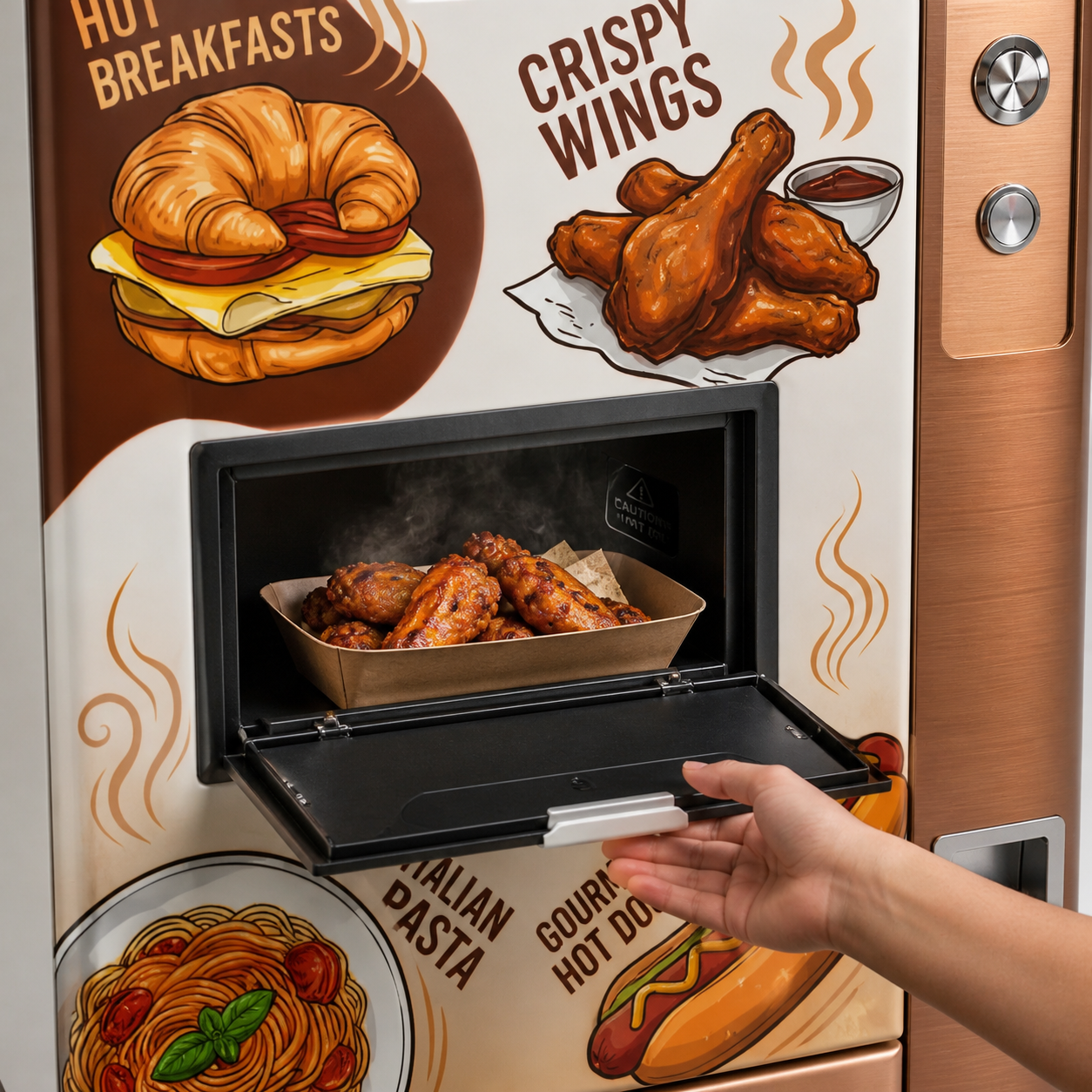
Where this comes from: we supply and operate vending machines across the United States and currently run pilot programmes across hot food, fresh beverage and specialty formats. The photographs here are our own, taken on the show floor at Venditalia.

Hot food vending has been attempted before and it has a poor reputation for good reason. The old approach was to hold food warm, which is a slow way to ruin it, or to hold it frozen and reheat, which produces something scalding at the edges and cold in the middle.
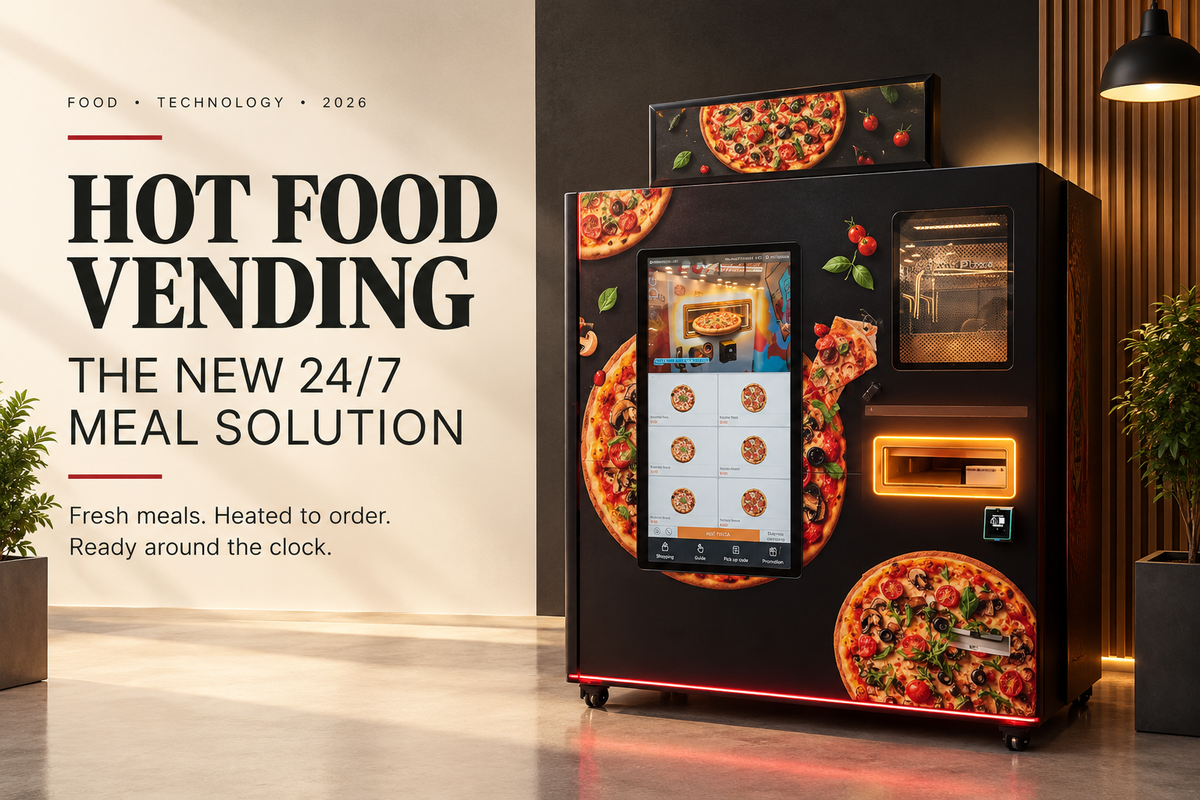
The current generation inverts the sequence. Meals sit chilled behind the glass, at refrigeration temperature, exactly as they would in a shop. Nothing is warm and nothing is frozen solid. When somebody pays, the machine takes that specific tray and heats it, and a few minutes later hands over pasta, pizza, ramen or a burrito that is hot the whole way through.
That distinction sounds small and it is the entire category. Chilled and heated to order tastes like food. Frozen and blasted does not, and every previous attempt at hot food vending failed on precisely that point rather than on demand.
Why this is the moment: hot food is one of the fastest climbing corners of the entire vending industry and is on track to nearly double across the country over the coming decade. Not because operators suddenly want to sell meals, but because the equipment finally produces something a night shift nurse will buy twice.
Everybody notices the touchscreen. The genuinely interesting engineering is behind the glass, and it explains why these machines can handle meals when a conventional cabinet cannot.
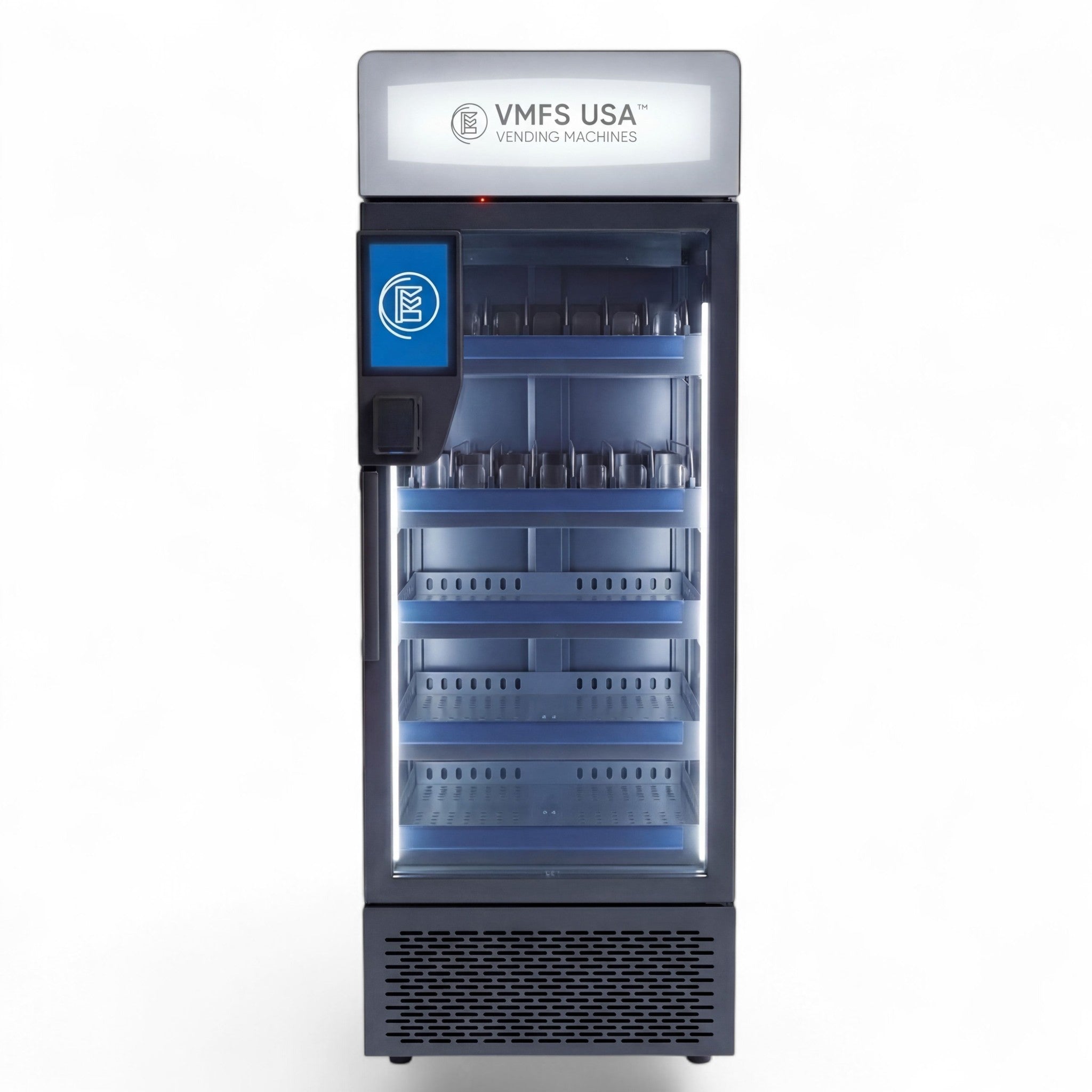
There are no spirals. Each shelf is a set of individually driven conveyor lanes, and a meal tray sits flat on a belt rather than hanging from a coil. When you buy, the belt advances and the tray moves forward and is delivered level. Nothing drops, nothing tips, nothing arrives with the sauce redistributed across the lid.
That single mechanical choice unlocks the category, because it means the machine can carry:

Look closely at the second photograph. Running along the front edge of every shelf is a lit strip, and on it every lane carries its own identifier, slot 001, slot 002, slot 011, slot 012, alongside a live digital price readout for that specific lane.
In a snack machine, pricing is largely uniform and a paper label is adequate. In a meal machine it is not, because a chicken pasta, a vegetarian bowl and a premium ramen have genuinely different costs and genuinely different margins, and they change as your supplier's pricing changes.
Per slot addressing gives an operator control that conventional vending simply does not offer:
Here is the part we would push hardest with any operator considering this category, because it is unglamorous and it decides whether the business works.
Selling fresh meals means every tray has a date on it. In a conventional machine that is a manual problem, and it is the problem that quietly kills food vending operations. A restocker loading a lane pushes new stock in behind old stock, or in front of it, depending on how the machine is built and how tired they are at the end of a route. Older product ends up trapped behind newer product, expires unsold, and either goes in a bin or, far worse, goes to a customer.
Conveyor lanes make first in first out a structural property of the machine rather than a discipline you hope your route driver maintains. Product loads at the back, sells from the front, and the belt enforces the order. The oldest tray in a lane is always the next one out, every time, without anybody having to think about it.
Why this is a food safety story as much as a waste story: combine enforced rotation with per lane date tracking and automatic markdown at a set hour, and expiry stops being something you manage after the fact. The machine sells the oldest item first, discounts it before it becomes a problem, and tells you what did not move. That is a materially different operation from hoping a label gets checked.

This is the part of the pilot programme that has surprised us most, and it changes how the entire conversation with a host site should go.
Every operator pitching a vending machine leads with revenue share. It is a reasonable offer and it is also a small number, and a facilities manager at a hospital or a plant has never once been promoted for negotiating a better commission on a snack machine.
What that manager genuinely cares about is that when there is nothing to eat on site, staff leave. They get in a car at two in the morning, drive to whatever is open, and come back well past the end of their break. Multiply that across a shift, across a year, and it is a real operational cost that everybody has quietly accepted as unavoidable.
A hot meal machine on site removes the reason to leave. In real deployments, sites putting hot food on the premises have seen food service labour costs fall by roughly a third. So the pitch is not about vending at all:
Building that argument into something a facilities director can take to their own leadership is where our colleagues at VMarketed earn their keep, and finding the sites where it lands hardest is what VPlaced does.
Hospitals and medical campuses.
The strongest environment we have seen. Night staff, visitors who have been in the building for hours, and around the clock emergency operations, against a cafeteria that closes and a coffee cart that was never meant to be dinner. The safety argument about keeping clinical staff on site is genuinely persuasive to the people who approve these decisions.
Factories, plants and distribution centres.
Shift crews who are frequently miles from anything open. This is where the break time argument is sharpest, because a thirty minute break that becomes fifty is a measurable production cost and every plant manager already knows it happens.
Universities.
Dorms, libraries and the late night study spaces no cafeteria has ever covered economically. Term time only, but the demand pattern during term is relentless and the audience has few alternatives at one in the morning.

Selling prepared meals means holding food at a safe temperature continuously, in a building where nobody from your company is present, for weeks at a time. That is the obligation underneath this whole category and it is not one to improvise around.
Our pilot machines report continuously through VMFS Cloud, and the point of that is not dashboards. It is that a temperature drift gets flagged long before it becomes a food safety question, and long before anybody has eaten anything. A machine that can detect an excursion, alert an operator, and stop selling is doing something a paper log fundamentally cannot.
What we monitor on every pilot unit:
Getting the permits and food safety documentation right alongside that is a separate exercise, and one our partners at VAdviced handle for operators entering this category, because a hot food machine sits in a heavier permitting bracket than a snack cabinet.
We run pilots rather than simply listing equipment because a specification written for another market tells you very little about what an American hospital at three in the morning actually needs. The gaps show up in details that never appear on a datasheet.
That final line keeps producing the most valuable findings, exactly as it has on our outdoor and fresh beverage programmes. Nobody knows what a market needs until equipment is in it and somebody is watching closely.

If you are considering this category, get the order right. Settle the site first, because hot food needs a genuinely round the clock population and a premium product in a quiet building will not work. Sort supply second, because it is harder than the machine. Then get the permits and food safety documentation in place before switching on rather than after.
On our side, you can look at the food vending and touch screen ranges, see what is ready to move in in stock units, or browse everything in the shop. In stock units typically ship within 7 to 21 days and carry a one year parts warranty. Once a machine is live, listing it on VendingFinder is worth doing, because a hot meal at two in the morning is exactly what somebody is searching for when nothing else is open.
We are also still adding pilot locations. If you run a hospital, plant, distribution centre or campus with a genuine overnight population and you would make a good test site, we would like to hear from you. The specification we are building for this market is being shaped by the sites already running these machines.
Meals are held chilled behind the glass at refrigeration temperature rather than kept warm or frozen. When somebody pays, the machine takes that specific tray and heats it, delivering a hot meal in a few minutes. Holding chilled and heating to order is the change that makes the food genuinely good rather than merely warm.
Because meals come in wide flat trays that a spiral handles badly and a drop ruins entirely. Conveyor lanes deliver a tray level, which means sauce heavy dishes, film sealed trays and fibre bowls all survive the journey. It also makes first in first out rotation structural rather than something a restocker has to remember.
Individual control over every lane. Different prices for different meals, changed remotely rather than with labels, plus time based markdown so ageing stock discounts automatically at a set hour. You also get lane level sales data showing precisely which meal sells at which hour, which is impossible to guess accurately.
Because it is not really a vending decision for them. When there is nothing to eat on site, staff drive off to find food and come back late. A hot meal machine removes that, and sites deploying hot food have seen food service labour costs fall by roughly a third. The revenue share is almost incidental next to that.
It is one of the fastest climbing parts of the industry and is on track to nearly double across the country over the coming decade. The underlying driver is that roughly 6.4 million Americans work overnight and have historically had almost no way to get a real meal during their shift.
Feed the Two A.M. Shift
We have hot food pilots running across the country and we are specifying these machines around what American sites actually need. Tell us about your location and the hours it keeps.
Visit the Shop
Share:
How to Fix Pokemon Vending Machine Card Reader - Technical Troubleshooting Guide
Office Coffee Machine Latte Calories: Complete Nutritional and Calibration Guide