


The vending machine customer experience is the few seconds between a person noticing your machine and walking away with a product, and it is set by four things you control: what they see first, what it costs, how easy it is to pay, and whether the product drops every time.
This guide turns peer-reviewed research on product placement, pricing, labels and machine design into practical moves for US operators. It also covers ADA reach rules, FDA calorie labeling, cashless payment data and a simple way to test changes on your own route.
What Shapes the Vending Machine Customer Experience?
The vending machine customer experience is shaped by four moments: finding the machine, choosing a product, paying, and receiving the item. A customer who walks up to a snack or drink machine is usually short on time and decides quickly, so friction at any one of those moments costs you the sale, and a bad outcome at the last one (a stuck product or a declined card with no refund path) costs you the customer.
That framing matters because operators tend to fix the parts they see on a route sheet, such as stock levels and prices, and ignore the parts the customer feels. A machine can be perfectly stocked and still underperform if the best sellers sit in the bottom row, the price is hidden until after selection, the card reader is slow, or the glass is smudged. Each of those is a small barrier, and small barriers add up when the whole decision takes a few seconds.
1. Find
Visibility, lighting, signage and a clear path to the machine. If people do not notice it, nothing else matters.
2. Choose
Product mix, row position, labels and price display. This is where choice architecture changes what sells.
3. Pay
Card, phone wallet or cash, plus how fast the reader responds. Payment options change both conversion and ticket size.
4. Receive
Reliable delivery, no jams, and a quick refund path when something fails. This moment decides whether they come back.
The rest of this guide walks through each moment, starting with how customers make the choice and what controlled studies show about influencing it.
How Vending Customers Actually Decide
Most vending purchases are habitual and fast: customers lean toward products they already know and like, and they choose from what is visible and convenient at that moment. A 2025 analysis of 13,709 real vending transactions found that product familiarity and price strongly influenced the choice of less healthy "vice" snacks, which is why a familiar brand in a familiar slot keeps selling with little help from you.
Habit is shaped by the location. Customer behavior at an office break room differs from a gym floor or a hospital waiting area, because the people, their schedules and their reasons for buying differ. Office workers often want coffee, drinks and something to get through the afternoon, which is why the menu ideas in our office vending guide lean toward beverages and better-for-you snacks. Gym members look for protein and hydration, and our gym vending guide covers that mix in detail. Entertainment venues and transit areas skew toward impulse snacks and cold drinks.
Peak times and restocking
Peak purchase times are the hours when foot traffic and sales concentrate, such as shift changes, lunch breaks or the minutes before a class or game. Knowing them matters because an empty best seller during a peak hour is a lost sale you never see on paper. Telemetry data shows exactly when each slot sells, so you can schedule visits before the rush rather than after it.
Seasonal shifts
Demand also moves with the seasons. Cold drinks and frozen treats tend to sell better in summer, while hot drinks and heartier snacks gain in colder months, and school calendars or holiday closures can change traffic at some sites. Treat these as patterns to confirm in your own sales data rather than rules, then adjust the planogram before the season turns, not after sales drop.
Changing tastes
Tastes change over time, not just by season. Requests for better-for-you products keep growing, and the research below shows that adding them does not have to cost revenue if you add them in the right way. Our healthy vending snacks guide lists products that meet common nutrition standards.
What Research Says About Placement, Pricing and Labels
Peer-reviewed studies show that what you put at eye level, how you price it and how you label it all measurably change what people buy from a vending machine, often without reducing total sales. Most of this research comes from public health teams trying to shift purchases toward healthier items, but the findings apply to any product you want to sell more of, because the same choice architecture is at work.
The table below summarizes controlled field studies with real sales data. Read the revenue column carefully: it is the part operators care about most, and the results are not all positive.
| Study | Setting | What changed | Result | Revenue effect |
|---|---|---|---|---|
| Perfetti et al., 2025 | 13,709 real transactions; workplaces, universities, hospitals | Analysis of row and side position | Healthier items on higher rows and the right-hand side were more likely to be chosen | Not reported |
| French et al., 2001 (CHIPS) | 55 machines in 12 schools and 12 worksites | 10%, 25% and 50% price cuts on low-fat snacks | Low-fat snack sales up 9%, 39% and 93% | Average profit per machine not affected |
| Appelhans et al., 2018 | 32,019 sales at three locations | 25-second delay on regular snacks; $0.25 discount or surcharge | Healthy share rose from 40.1% to 42.5% (delay), 43.0% (discount), 53.7% (surcharge on regular snacks) | Delay did not harm overall sales or revenue |
| Hua et al., 2017 | 56 machines on a university campus | Healthier products, 25% price cut and promotional signs, randomized | Healthier products plus signs worked in snack machines; price cut alone had no effect | Revenue up in snack machines with healthier products plus signs |
| Gibson et al., 2024 | 267 machines on government property in Philadelphia, 13 months | Four messaging systems compared | Traffic light labels cut unhealthy beverages sold by 30% vs. tax posters; little change in snack machines | Not reported in the abstract |
| Blake et al., 2021 | 51 beverage machines, four university campuses | Mix rules, traffic light labels, machine branding, placement review | Healthier drink volume up sharply; less healthy drink volume unchanged | Revenue 88.6% above predicted in month 13 |
| Grivois-Shah et al., 2018 | 23 Banner Health sites | Healthier share raised from 20% to 80% | Calories vended down 16.7% | Revenue and units unchanged |
| Wickramasekaran et al., 2018 | 359 machines, Los Angeles County facilities | 100% healthy product policy | Policy adherence rose for snacks and beverages | Snack revenue down 37%, beverage revenue down 34% |
| Blake et al., 2026 | 59 machines, four university campuses, two years | 20% price increase on unhealthy drinks; prominent price labels | Price increase had no impact; price labels alone raised the unhealthy share of volume | No significant revenue difference |
Product placement inside the machine
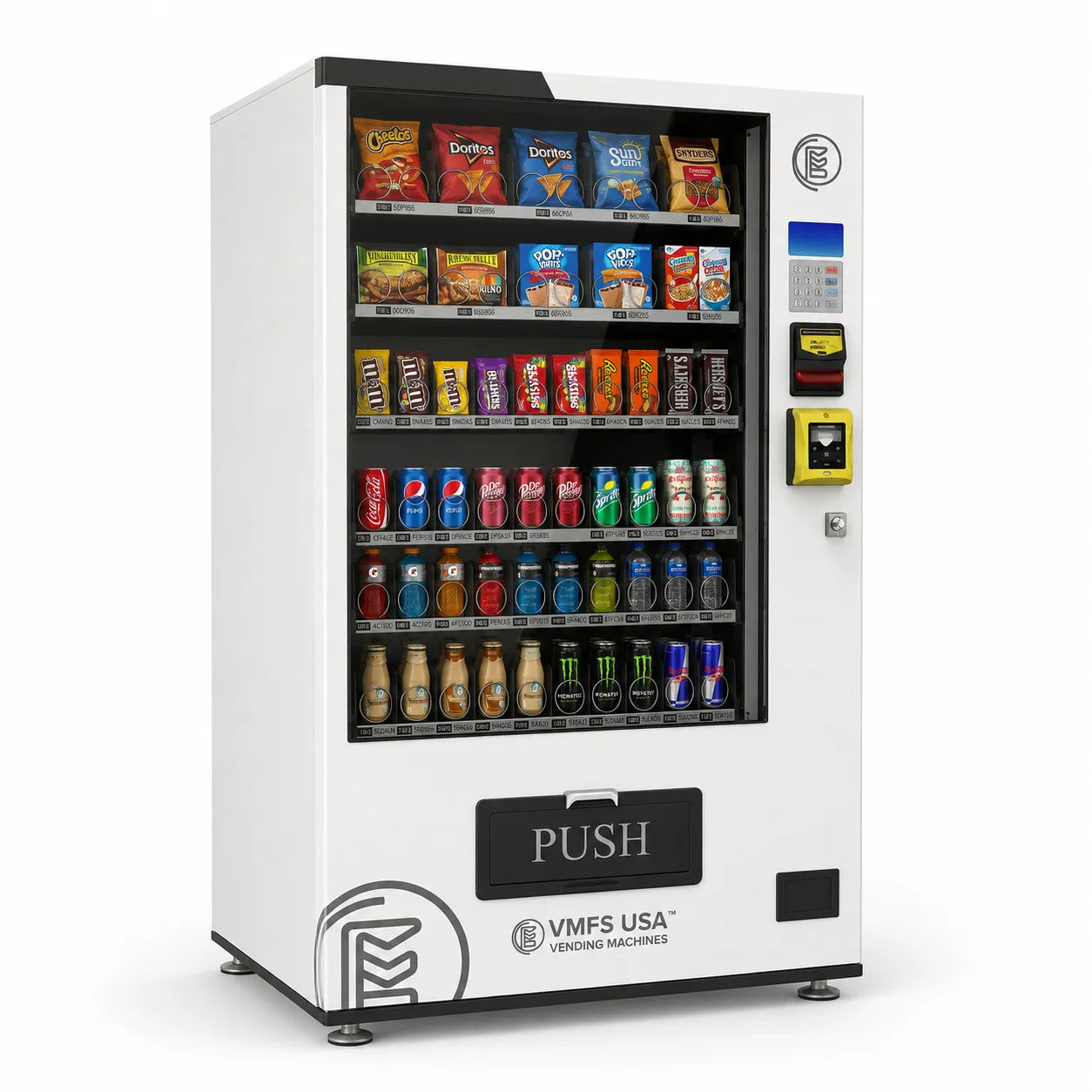
Position inside the machine changes what gets chosen. In the 2025 transaction study, healthier products placed on higher rows and on the right-hand side of the machine were more likely to be picked, and the effect varied between workplaces, universities and hospitals. For an operator, the practical rule is simple: the rows at eye level are your best real estate, so give them to the products you most want to move, whether that is a high-margin item, a new product you are testing or a better-for-you option a client asked for. Keep proven best sellers where regulars expect them, since familiar products sell on habit and do not need prime space to be found.
Pricing and price display
Relative price matters more than absolute price. In the CHIPS study, cutting the price of low-fat snacks by 10%, 25% and 50% lifted their sales by 9%, 39% and 93%, and average profit per machine was not affected. In the 2018 delay study, a $0.25 surcharge on regular snacks moved the healthy share from 40.1% to 53.7%, a larger effect than a $0.25 discount on healthy snacks. Price changes do not always work, though. A randomized campus trial found that a 25% price cut on its own did nothing, and a two-year Australian trial found that a 20% price increase on sugary drinks had no measurable effect. Large, prominent price labels in that trial actually raised the share of unhealthy drinks sold.
The lesson is to test pricing changes one machine group at a time instead of assuming a result. Price endings, two-tier cash and card prices and promotions are all worth trying, but measure them against a control machine. Our vending pricing guide covers how to set base prices and margins before you start adjusting.
Labels, signs and machine branding
Simple, easy-to-read labels change beverage choices more reliably than snack choices. The Philadelphia trial compared four messaging systems across 267 machines for 13 months: traffic light labels cut unhealthy beverage sales by 30% compared with tax posters, and labels showing the minutes of activity needed to burn off the calories cut them by 34%, but snack machines barely changed. In the campus trial, promotional signs mattered when healthier snacks were actually available, and that pairing increased snack machine revenue. The strongest commercial result came from a multicomponent approach at an Australian university, where mix rules, traffic light labels, health-themed machine branding and a review of machine placement were followed by beverage revenue 88.6% above the predicted trend in the 13th month. The front panel is part of that branding, which our vending machine branding guide covers.
How far to push
Adding choices works better than taking them away. Banner Health raised the healthier share of its machines from 20% to 80% with no change in revenue or units sold, while a Los Angeles County policy that required 100% healthy products saw snack and beverage revenue fall by 37% and 34%. If a client asks for a healthier machine, expand the healthier range, give it good rows and labels, and keep some familiar favorites. The healthy vending machines in our catalog are built for refrigerated and fresh menus that make that mix easier.
Operator takeaway: In the studies above, the changes that held revenue steady or raised it were more availability, better rows, clear labels and signs used together. The change that cut revenue was removing choice entirely. Test one change at a time against a control machine before you roll it out across a route.
Designing the Interface: Screens, Selection and Delivery
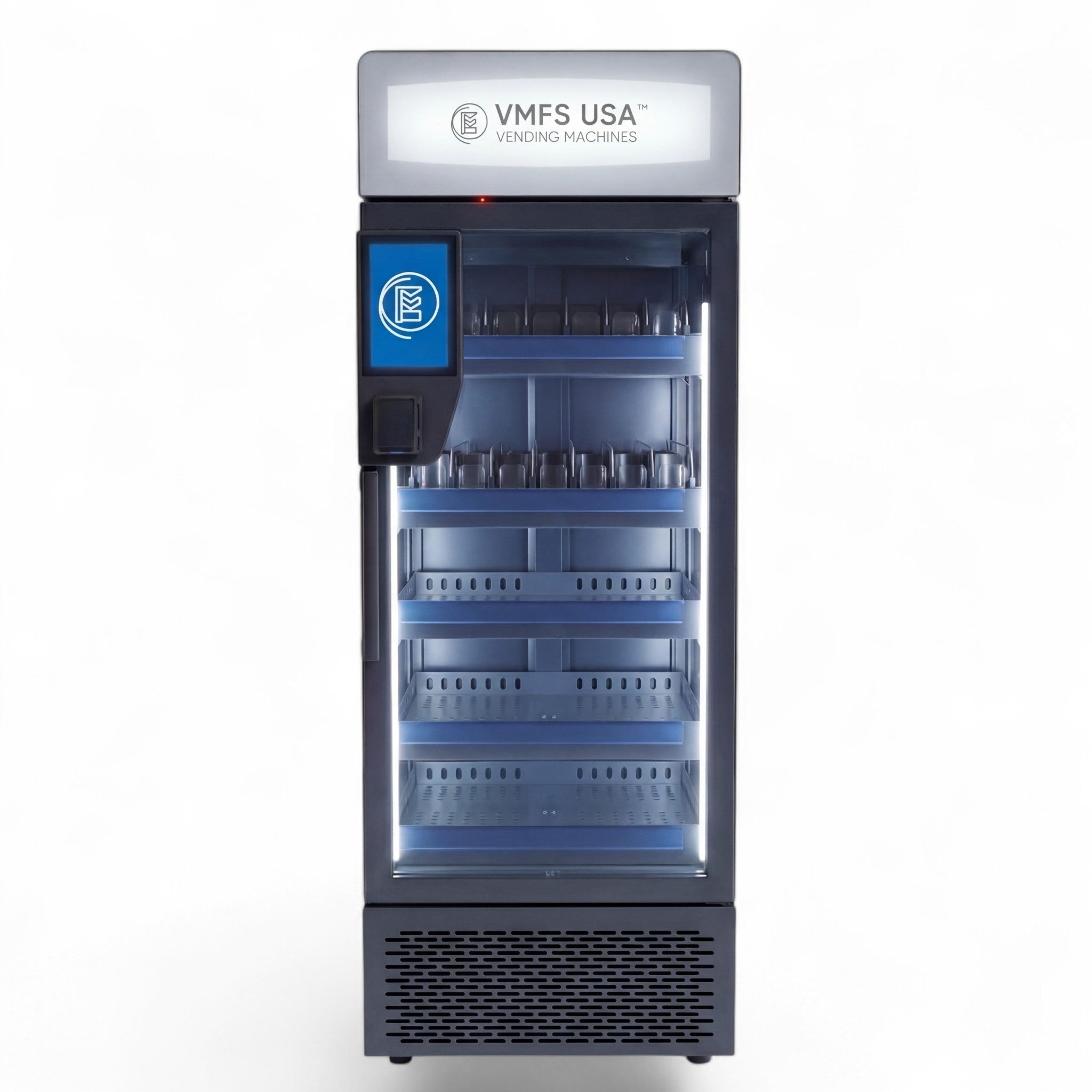
A good vending machine interface lets a first-time customer see the product, the price and how to pay before they touch anything, and then delivers the item without drama. Good vending machine design, from the customer's side, comes down to clarity and certainty: clear product views, readable prices, obvious next steps and a delivery system that does not drop or crush the product.
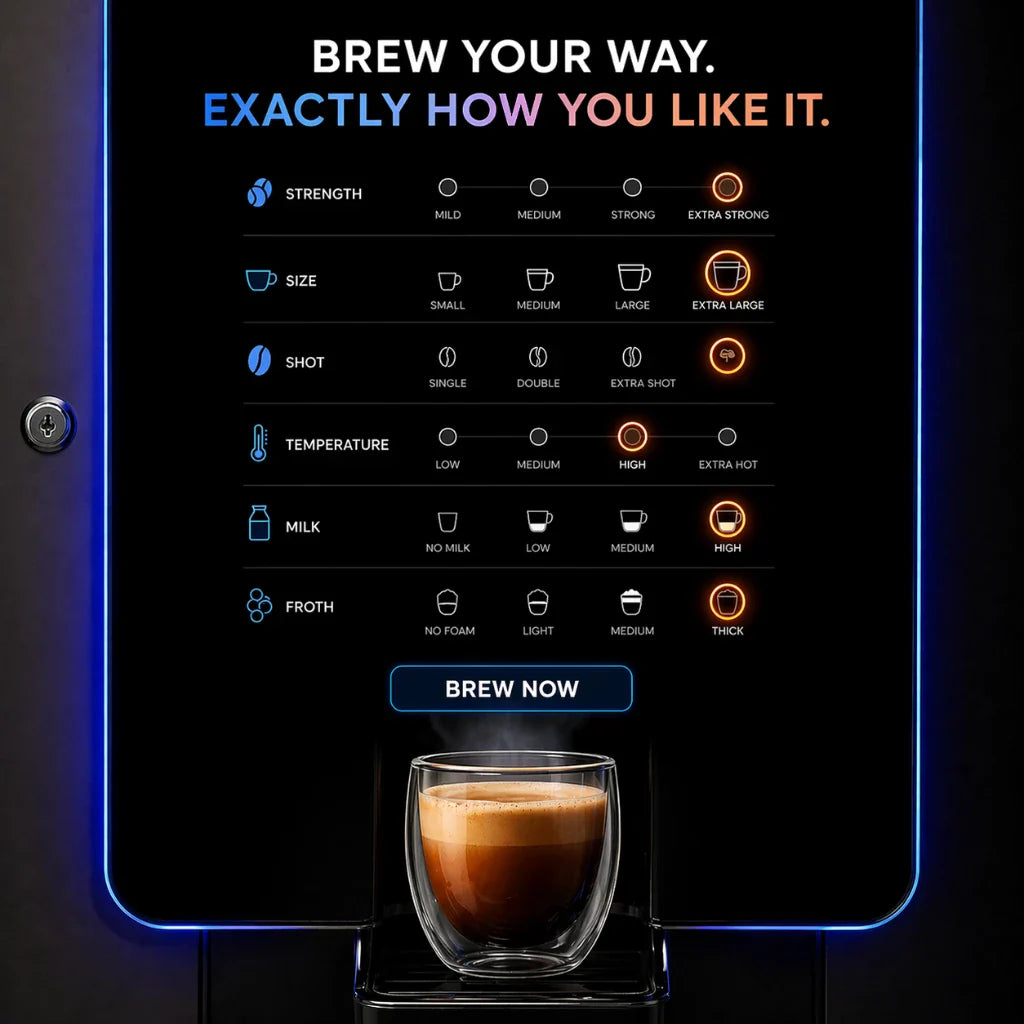
Touchscreens help when they add information or make selection easier, such as product photos, ingredients and allergens, calorie information, combo suggestions or short promotional loops. They hurt when they slow the purchase down with too many screens. Keep the default path to two or three taps, put the price on the first screen, and use the screen for content that answers a question the customer actually has. The machines in our touch screen vending machines collection range from the WallMount at $3,450 to the Seaga EnVision IQ, which lists a 49-inch interactive touchscreen, up to 450 items and 64 selections at $14,500.
Delivery that customers can trust
The delivery mechanism is part of the customer experience because a dropped glass bottle or a crushed sandwich is a failed sale. Elevator delivery lowers the product gently instead of dropping it, which is why it suits glass bottles, boxed food and fragile items. The Smart Elevator Vending Machine combines elevator delivery with a 21.5-inch HD touchscreen and cloud connectivity, starting at $8,650. Guaranteed-delivery sensors, such as the infrared system on the EnVision IQ, detect whether the product actually fell, which cuts down on the "I paid and got nothing" complaint.
Open-door AI machines
Open-door formats remove the selection step entirely. On the AI Grab & Go Cooler ($2,950), customers tap a card, open the door and take what they want, and VMFS lists billing in about 15 seconds at 99% recognition accuracy. Customers can pick up and compare items, which feels more like a store than a vending machine. The trade-off is a per-transaction AI fee and stricter shelf discipline, covered in our guide to how AI vending machines work. Our AI vending machines collection shows the current range.
Touchscreen and AI interfaces
- Room for product photos, nutrition and allergen information
- Promotions and combos can be shown at the moment of choice
- Open-door formats let customers handle and compare products
- Screen content can be updated remotely without a site visit
Trade-offs to plan for
- Higher purchase price than a basic spiral machine
- Too many screens slow the purchase and frustrate regulars
- AI machines carry a per-transaction recognition fee
- Screens need connectivity and occasional software attention
The Payment Experience and Why Cashless Lifts the Ticket
Cashless payment improves the vending customer experience because most people now expect to tap a card or phone, and cashless buyers spend more per transaction. According to Cantaloupe's 2026 Micropayment Trends Report, 78% of vending sales were cashless in 2025, up from 73% the year before, contactless payments made up 85% of cashless vending sales, and the average cashless transaction was $2.45 against $1.57 for cash.
Those numbers reflect who carries cash rather than a magic effect of the reader, but the operational point holds: a machine without a working card reader turns away most of the people standing in front of it. Accept cards and phone wallets on every machine, keep a bill validator where the location still has cash buyers, and make sure the reader responds quickly, because a slow authorization at a busy break feels much longer than it is. All of our vending machines with card readers are configured for this.
Payment friction also has a cost side. On the VMFS payment system page, card processing is shown at roughly 2.5% plus $0.10 or about 5.95% flat per transaction, depending on the plan, with reader service fees of about $7.95 to $18.95 per device per month. AI machines add a $0.07 recognition fee per completed sale, or $0.10 with optional weight sensors. The NEO GO and NEO PRO have no recognition fee. Our cashless payment systems guide compares readers and fee structures in more detail.
Watch the pre-authorization: Card readers place a temporary hold before a vend completes. If a product fails to drop and the hold lingers on a customer's statement, it reads as a charge. Clear refund instructions on the machine prevent most of these complaints.
Upgrade the customer-facing side of your machines
Touchscreen, elevator and AI machines with cashless payment built in, configured before they ship.
Shop Touch Screen MachinesAccessibility: ADA Rules for Vending Machines
Under the 2010 ADA Standards for Accessible Design, where vending machines are provided, at least one of each type must have operable parts that meet the accessibility requirements for reach and operation. In practice, that means a customer using a wheelchair must be able to reach the controls, payment device and product pickup, and operate them with one hand.
The numbers are specific. Operable parts must sit within the reach ranges in the standards, which set an unobstructed forward or side reach between 15 inches minimum and 48 inches maximum above the floor. They must be usable with one hand, without tight grasping, pinching or twisting of the wrist, and need no more than 5 pounds of force to activate. A clear floor space must be provided in front of the machine. The rule applies to each type of machine at a location, so a bank of identical snack machines needs one compliant unit, while a snack machine and a drink machine each need one.
Accessibility goes beyond the legal minimum. Customers include children, older adults and people with low vision or limited dexterity, and the same changes that help them help everyone: readable price labels, high-contrast screens, a payment device at a comfortable height and a pickup bin that does not require bending to the floor. Before you sign a placement, check the clear floor space and the path to the machine. If you are configuring a custom vending machine, specify control and reader heights early, because they are hard to change once the cabinet is built.
Calorie labeling is another customer-facing rule. The FDA requires operators who own or operate 20 or more vending machines to disclose calorie information for food sold from them, and for glass-front machines front-of-pack calorie declarations are acceptable when the type is at least 150% of the minimum size of the net weight declaration. Clear calorie information also supports the labeling strategies described in the research section.
Machine Placement and the Surrounding Environment
Placement shapes customer behavior before anyone reaches the screen: machines that sit in a visible, well-lit spot on a natural walking route get used more than machines tucked into a corner. Entrances, waiting rooms, break rooms and dining areas work because people pass them or wait near them, and waiting time is when impulse purchases happen.
The surrounding environment also sets expectations. A machine in a gym competes with the reason people are there, so protein and water fit, while a machine in a hospital waiting area serves stressed visitors at all hours who value reliability and simple payment. Our hubs on the best vending locations and on scouting and pitching a location cover how to evaluate traffic before you commit, and our location matching service can connect you with sites. Inside a site, small moves matter: turning the machine to face the main route, adding light above it, and keeping the area free of clutter make it easier to notice.
Cleanliness, Uptime and Trust
Customers trust a clean, working machine and avoid one that has failed them, so cleanliness and uptime are part of the customer experience, not just maintenance chores. Smudged glass, burnt-out lights, an "out of order" sign or a slot that swallowed someone's money last week all teach people to buy somewhere else.
A practical standard is to clean the glass, keypad or screen and pickup area at every service visit, check lighting and temperature, and test a vend with the card reader. Our vending machine maintenance guide lays out a full schedule, and our guide to common vending machine problems covers jams, payment errors and cooling faults. Between visits, telemetry closes the gap: VMFS Cloud sends alerts for jams, offline machines, door openings, temperature and payment reader problems, so you can fix a failure before it costs a day of sales and a few regular customers.
A visible refund and support path matters as much as the fix. Put a short label on every machine with a phone number or QR code, what to do if a product does not drop, and how quickly you respond. A customer who gets a fast refund usually comes back. A customer who gets nothing usually does not. For hardware problems, VMFS machines come with a 1-year parts warranty under our written warranty policy.
How to Measure and Test Customer Behavior
The most reliable way to understand your customers is to read your own sales data and run small controlled tests, the same way the researchers above did. Telemetry shows what sells, when and through which payment type. A controlled test shows whether a change you made caused the result.
VMFS Cloud works with every VMFS machine; plans start at $7.99 per machine per month. Basic includes live sales tracking, and the platform covers slot-level stock and machine alerts. The Advertising Cloud plan at $16 adds remote pricing and screen advertising, and AI Cloud is $39.99. Reports can be sliced by machine, location, product, payment type and time, which is what you need to spot peak hours, slow movers and seasonal shifts. Our guide to remote monitoring in vending machines explains how telemetry fits into route planning.
A simple test method for operators
- Pick one change. Move a product to an eye-level row, add a shelf label, change one price or add a promotional sign. Change only that.
- Pick a control. Use a similar machine at a similar site, or the same machine's sales for the previous four weeks, as the comparison.
- Run it long enough. Four to eight weeks smooths out weekly noise, and longer is better for seasonal products.
- Measure the right things. Track units and revenue for the target product and for the whole machine, so you see whether you grew sales or just moved them between slots.
- Keep or reverse. Roll out changes that lift total machine revenue, and reverse ones that only shift sales around.
Customer feedback fills in what sales data cannot show. A QR code on the machine that links to a short form ("What should we stock?" plus a refund request option) gives you product requests and complaints directly, and site contacts at offices or schools can share what employees or students ask for. Act on requests visibly, for example with a "now stocking" label, so people see their input matters. Our vending marketing strategies guide covers promotions, loyalty and seasonal campaigns you can test the same way.
A 30-Day Customer Experience Audit
A 30-day audit is the fastest way to find the friction your customers feel but never report. Walk each machine as a customer would, then use your sales data to confirm what you see. The checklist below covers the four moments in order.
- Find: Is the machine visible from the main walking route, well lit and free of clutter? Does the front panel say what it sells?
- Choose: Are your target products at eye level? Are prices visible before selection? Are calorie labels in place if you run 20 or more machines?
- Pay: Does the reader accept cards and phone wallets, and how long does an authorization take? Is the reader within the 15 to 48 inch reach range?
- Receive: How many vend failures or refund requests did each machine log last month? Is the refund contact on the machine?
- Data: Which slots sell out before your next visit, which have not sold in two weeks, and which hours drive most sales?
- Test: Choose one change per machine group for the next month and record the starting numbers.
Repeat the audit each quarter. Small fixes, such as moving one product, relabeling a row or replacing a slow reader, are cheap, and they compound across a route. For the bigger picture on margins and payback, see our guide to whether vending machines are profitable, or compare the current lineup of vending machines.
See what your customers are buying, in real time
VMFS Cloud tracks sales, stock and machine alerts across every VMFS machine, with plans from $7.99 per machine per month.
Explore VMFS CloudFrequently Asked Questions
Sources
- Perfetti et al. (2025), Snack dilemma: How vending machines influence choice of virtue and vice foods, Journal of Retailing and Consumer Services
- French et al. (2001), Pricing and promotion effects on low-fat vending snack purchases: the CHIPS Study, American Journal of Public Health
- Appelhans et al. (2018), Leveraging delay discounting for health: Can time delays influence food choice?, Appetite
- Hua et al. (2017), Health Promotion and Healthier Products Increase Vending Purchases: A Randomized Factorial Trial, Journal of the Academy of Nutrition and Dietetics
- Gibson et al. (2024), Comparison of Sales From Vending Machines With 4 Different Food and Beverage Messages: A Randomized Trial, JAMA Network Open
- Blake et al. (2021), Favorable Commercial and Health Behavior Impacts of a Healthy Vending Policy at an Australian University, Journal of the Academy of Nutrition and Dietetics
- Grivois-Shah et al. (2018), Impact of Healthy Vending Machine Options in a Large Community Health Organization, American Journal of Health Promotion
- Wickramasekaran et al. (2018), Health and Revenue Outcomes of a 100% Healthy Vending Machine Nutrition Policy in Los Angeles County, Journal of Public Health Management and Practice
- Blake et al. (2026), Price increase and price labelling effects on sugar-sweetened beverage vending sales: a factorial randomised controlled trial, International Journal of Behavioral Nutrition and Physical Activity
- Cantaloupe, 2026 Micropayment Trends Report
- U.S. Department of Justice, 2010 ADA Standards for Accessible Design (228.1, 308, 309)
- U.S. Food and Drug Administration, Vending Machine Labeling Requirements
Share:
Bouncing Back: Overcoming Challenges in the Vending Machine Industry
Bouncing Back: Overcoming Challenges in the Vending Machine Industry