


A Pokémon vending machine business is an independent operation in which you buy a trading card vending machine, stock it with authentic sealed Pokémon TCG product, place it in a venue with collector foot traffic and share a percentage of sales with the host. You cannot buy or franchise one of the official machines run by The Pokémon Company International, so every independent operator starts with their own hardware, inventory and location agreements.
This guide walks through the full launch: how independent machines differ from the official network, which machine type fits which products, real VMFS prices, sourcing, pricing math, locations, contracts, taxes, trademarks and the daily routine that keeps a card machine selling.
What Is a Pokémon Vending Machine Business?
A Pokémon vending machine business is a small unattended retail operation that sells sealed Pokémon Trading Card Game products, such as booster packs, booster bundles, tins and Elite Trainer Boxes, from a machine you own. The machine takes payment, releases the product and records the sale, while you handle buying stock, restocking, pricing, servicing the cabinet and paying the venue its commission. It works like any other vending machine route, except that the product is a collectible with release-driven demand rather than a snack with a sell-by date.
Two very different kinds of machine share the name, and confusing them is the most common mistake new operators make. The official machines collectors see in grocery stores belong to The Pokémon Company International (TPCi). Independent machines belong to operators, card shops and venue owners, and they can be placed almost anywhere a host agrees to it. Both use a touchscreen or keypad, cashless payment and a delivery bay, but ownership, pricing, product range and support are completely separate. For the buyer-side view of the purchase flow, see our guide to how Pokémon vending machines work.
| Feature | Official TPCi machine | Independent operator machine |
|---|---|---|
| Owner | The Pokémon Company International | You (or a card shop, venue or route operator) |
| Can you buy one? | No; TPCi says there are no plans to sell them | Yes, from commercial vending suppliers |
| Typical placement | Grocery stores and selected retail sites | Card and comic shops, arcades, malls, entertainment venues |
| Products | Sealed Pokémon TCG products | Sealed Pokémon plus other TCGs, sports cards, graded cards, accessories |
| Pricing | Standard retail pricing | Set by the operator |
| Payment | Mostly cashless (cards and mobile wallets) | Cashless, cash or both, depending on configuration |
| Branding | Official Pokémon branding | Neutral; no Pokémon logos without a license |
| Support | TPCi vending support team | The operator's posted phone number or QR code |
Demand behind the category is large and still growing. The Pokémon Company's fiscal year ended February 2026 closed with net sales of ¥531.4 billion, up 29.3%, according to the company's published financial notice as reported by Gamebiz. Trading cards are one of several businesses inside that figure, so treat it as a signal of franchise strength, not as a forecast for any one machine. What matters for an operator is narrower: whether a specific venue has enough collectors walking past, and whether you can keep the right sealed product in the slots.
Can You Own a Pokémon Vending Machine?
Yes, you can own a Pokémon vending machine, but not an official one. TPCi's support FAQ states that all of its Pokémon Automated Retail vending machines are owned and operated by The Pokémon Company International and that there are no plans to sell them. Owning one therefore means buying an independent trading card vending machine and stocking it with genuine product you purchase yourself.
The official network is growing, which shapes where independents fit. Wargamer, citing PokéBeach counts, reported about 200 official machines in 2024, 1,473 in May 2025 and 1,871 across 28 states in May 2026, with 562 machines added and 207 removed or relocated over that last year. Those machines sit mainly in grocery stores and sell at retail pricing. That leaves card and comic shops, arcades, family entertainment centers, malls, campuses and event venues to independent operators, and it means collectors in many towns already know what a card vending machine is before they see yours.
The official program also shows the problems you will inherit. The Los Altos Town Crier reported in April 2025 that about 400 official machines nationwide were shut down until software updates restricting how many cards one person could buy were installed, after a designer who worked on the machines described scalpers buying out machines and reselling on eBay. An independent operator controls pricing and purchase limits directly, so you can design around that behavior from day one instead of reacting to it. Collectors looking for the official kiosks rather than a business can use our guide on how to find official Pokémon vending machines.
No affiliation: VMFS USA is not affiliated with, sponsored by or endorsed by The Pokémon Company International or Nintendo. VMFS machines are independent trading card vending machines that can sell genuine Pokémon TCG products you buy through legitimate channels.
How to Start a Pokémon Vending Machine Business in 7 Steps
To start a Pokémon vending machine business, form the entity and tax registrations first, then choose a machine that fits your product mix, line up authentic inventory, sign a written location agreement, and launch with a monitored pilot. Operators who reverse that order often end up with a machine in the garage and no signed host, or a signed host who asks for a business name and certificate of insurance the operator does not have yet.
1. Register the business and get an EIN
Form your entity (most single operators choose an LLC) and get an Employer Identification Number from the IRS, which is free and issued online immediately if the application is approved. Hosts typically want a registered business name on the agreement and on the commission payments, and your card processor and bank will ask for the same details. Our LLC guide for vending operators covers the entity choice in depth.
2. Register for sales tax and local permits
Card packs are taxable retail goods in states that charge sales tax, so register with your state's revenue department before the first sale and check whether your city or county requires a vending license or machine decal. Requirements and fees vary by jurisdiction; our overview of vending machine permits in the United States explains how licensing works across states.
3. Choose the machine type
Match the dispensing method to your products. Coil machines suit flat packs and blisters; elevator machines lower boxes, tins and graded cards to the delivery bay instead of dropping them. The next section compares the options and the current VMFS lineup.
4. Line up authentic inventory
Open accounts with legitimate suppliers before the machine arrives, and budget for a full first load plus a reserve for the next release. Counterfeit or resealed product is the fastest way to lose a host and a customer base, so verification belongs in your receiving routine, not just your supplier choice.
5. Secure a location in writing
Pitch venues where collectors already gather and agree on commission, term, power, insurance and exit terms in a written contract before the machine ships. Our guide to scouting and pitching a vending location covers how to research a venue and pitch the owner.
6. Install, test and set up telemetry
Run several test vends with every payment method and every product size, confirm the delivery bay releases each format cleanly, and connect the machine to remote monitoring so you can see sales by slot. Note the support phone number or QR code on the cabinet so buyers contact you, not the host's staff.
7. Run a pilot, then scale
Treat the first eight to twelve weeks as a measured pilot: track sales per slot, sell-through after each restock and which formats move at that venue. Add a second machine only after the first location's numbers justify it, and use those numbers when you pitch the next host.
Choosing a Machine: Coil vs Elevator Delivery
The right machine is the one whose dispensing method protects the products you plan to sell: coil machines work for flat booster packs and blisters, while elevator machines are the safer choice for Elite Trainer Boxes, sealed boxes, tins and graded cards. VMFS explains the difference on its trading card builder page: with a coil system the product is rotated off the shelf and falls into the bin, while with an elevator system it is gently lowered to the dispensing hatch.
That difference drives both price and product range. A dented corner on a booster pack is a nuisance; a crushed Elite Trainer Box or a cracked slab case is a refund request and a bad review in a local collector group. Elevator delivery adds cost because it adds a moving platform, sensors and a heavier cabinet, but it opens the higher-ticket formats that make each restock trip worth more. Coil machines cost less, take less floor space and can hang on a wall, which makes them a sensible first unit for a card shop that mainly sells packs at the counter.
Wall-mount coil (packs and blisters)
VMFS lists 15 slots, about 150 items, a 32-inch touchscreen and 132 lbs. Fits counters, hallways and first-time operators selling packs only.
Standard elevator (mixed assortment)
Listed at 56 slots and 300 to 800 items with keypad operation. Handles ETBs and sealed boxes for card and game shop floors.
Premium advertising (high traffic)
Listed at 54 slots, about 650 items and a 55-inch touchscreen that can run on-screen ads. Built for malls, arcades and trade shows.
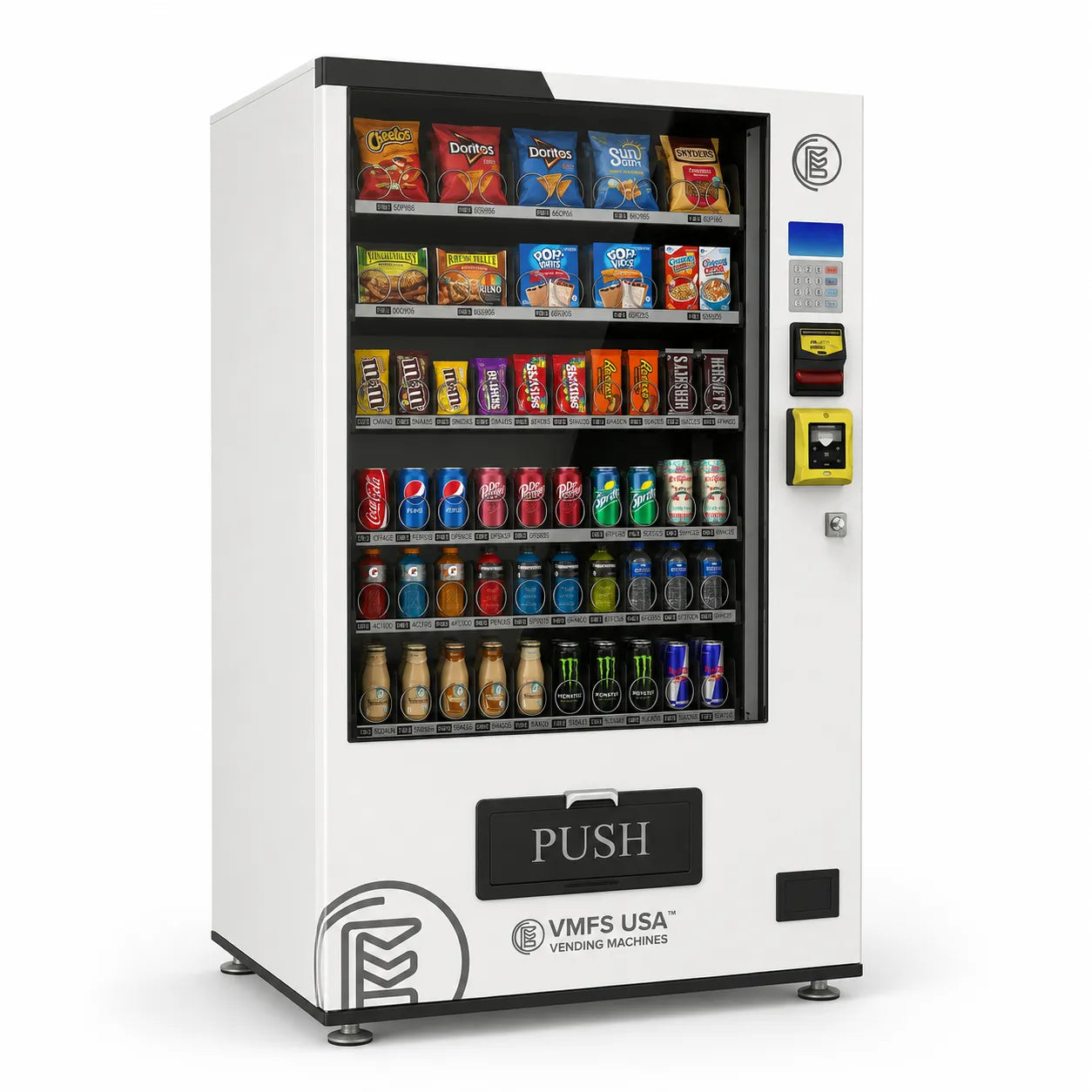
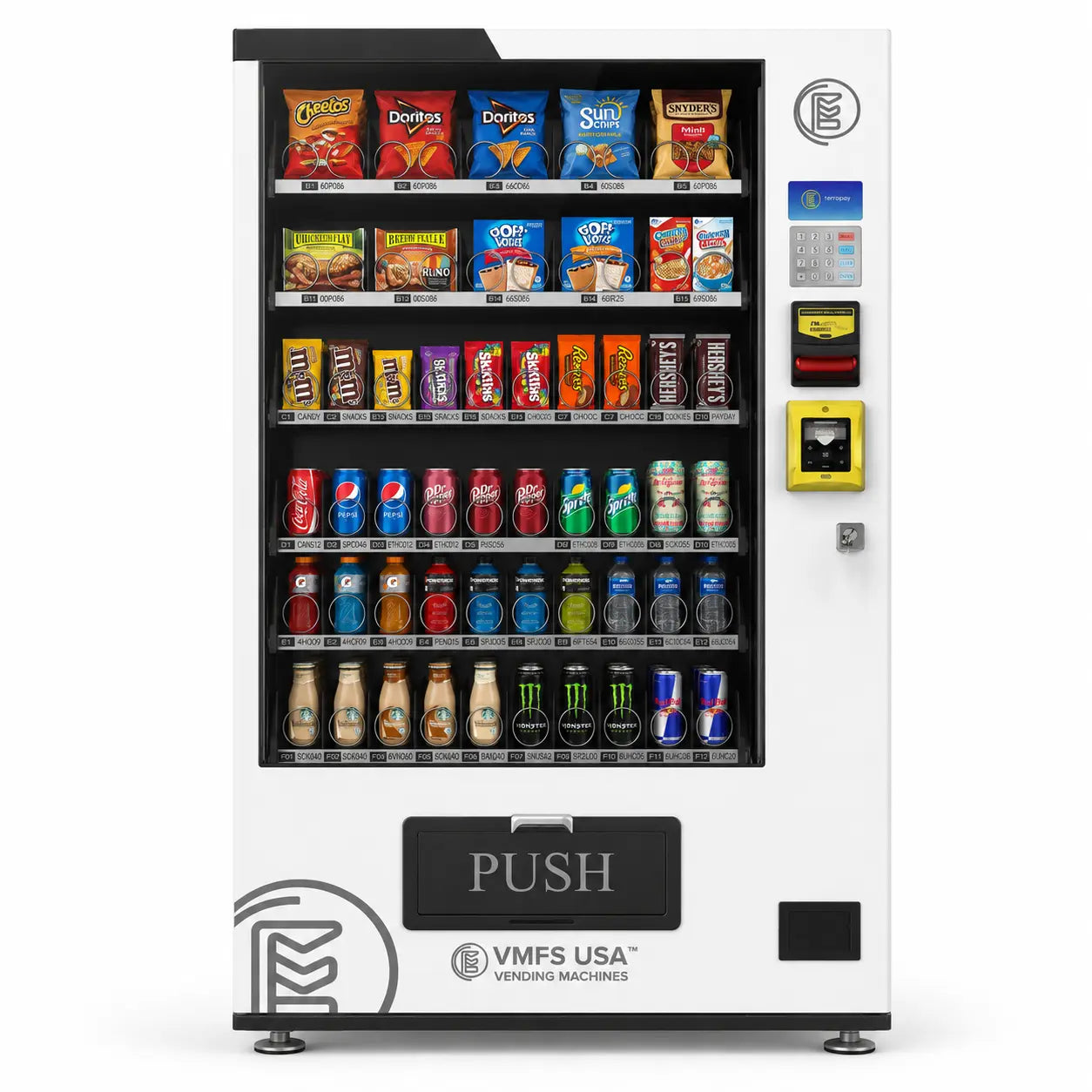
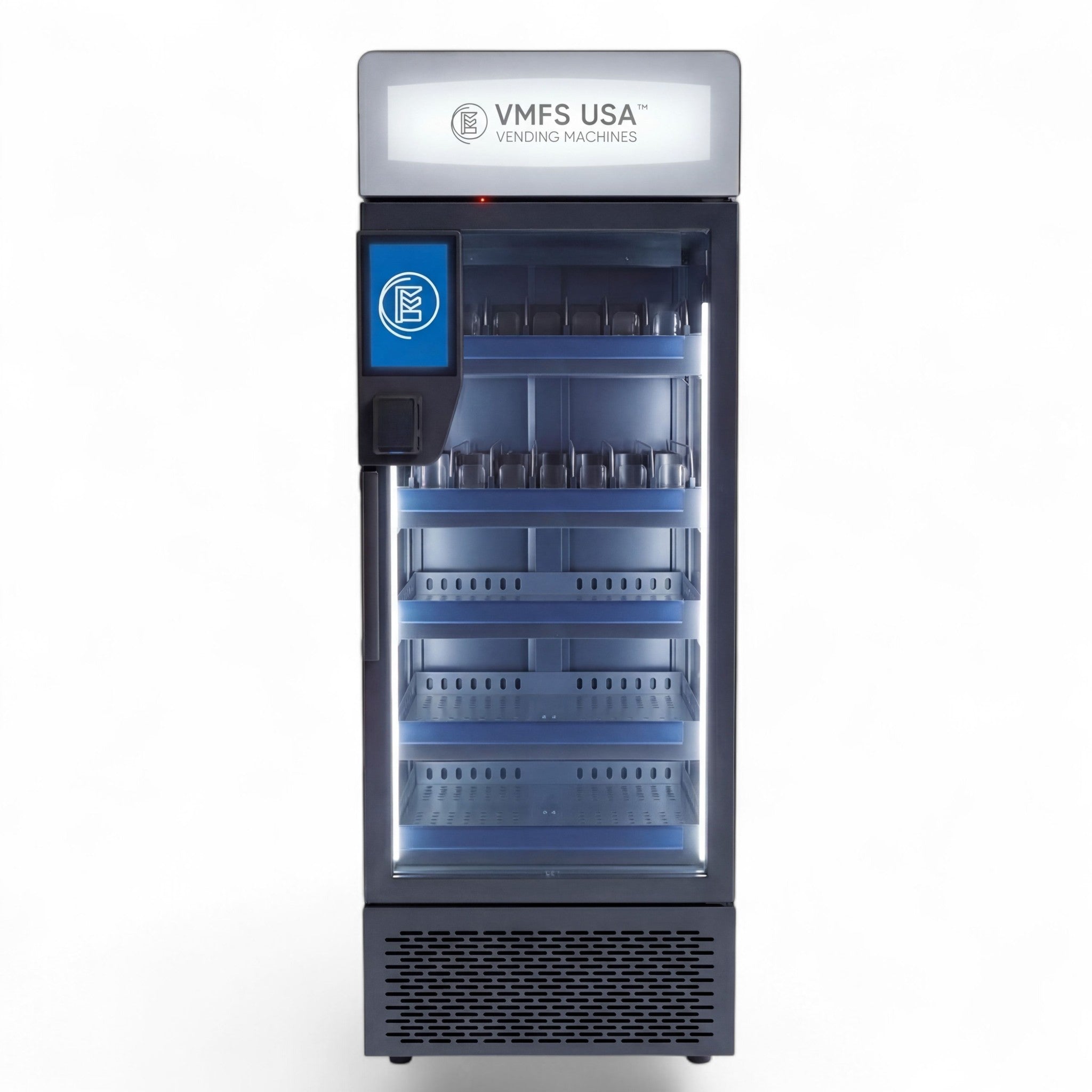
All three types run at ambient temperature with no cooling system, which keeps power draw simple, and VMFS delivers them fully assembled to all 50 states. Every VMFS machine carries a 1-year parts warranty, with extended coverage available on some models. The table below lists the current trading card lineup with prices from the live product pages; prices change, so confirm on each page before you budget.
| VMFS model | Starting price | What the product page lists | Best fit |
|---|---|---|---|
| Build Your Trading Card Vending Machine | From $3,800 | Configurator with wall-mount, standard and premium advertising types; cash, cashless or both | First machine, card shops, testing a venue |
| Trading Card Vending Machine | $9,395 | Elevator delivery, up to 600 products, reinforced steel cabinet with anti-vandal locking | Hobby stores, arcades, mixed packs and boxes |
| PRO XL Trading Card Vending Machine | $10,995 | Up to 800 packs across 8 configurable trays | High-traffic venues and conventions |
| TCG Vending Machine | $13,275 | 54 slots, about 650 items, 55-inch touchscreen, elevator delivery | Malls and entertainment sites selling packs, tins and graded cards |
| Panini Sports Card Vending Machine | $9,395 | Built for Panini NFL, NBA, soccer, UFC and multi-sport releases | Adding sports cards next to a Pokémon machine |
If you want one cabinet that sells Pokémon next to other games and sports cards, the Trading Card Vending Machine is the steel workhorse of the range, while the Pokémon card vending machine with the 55-inch screen is the showpiece for venues where visibility sells. For a wider look at the category beyond Pokémon, read our trading card vending machines guide.
Startup Costs and Ongoing Fees
A Pokémon vending machine business costs the machine price plus a first inventory load, freight, business setup, insurance and any add-ons such as a card reader or wrap; on the VMFS trading card lineup the machine alone runs from $3,800 to $13,275. Inventory is the line most first-time operators underestimate, because a machine that launches half full looks abandoned and sells less than the same machine fully stocked.
Card readers deserve a specific check. On the current product pages, VMFS lists a credit card reader as a paid upgrade on several trading card models ($450 on the TCG and PRO XL machines, $550 on the Trading Card Vending Machine), and the builder offers it as an add-on. Read each product page before you assume a reader is in the box. For the fuller cost picture across every format, see our breakdown of Pokémon vending machine prices.
| Cost line | One-time or recurring | What to budget |
|---|---|---|
| Machine | One-time | $3,800 to $13,275 on the VMFS trading card lineup |
| Card reader and cash acceptor upgrades | One-time | $450 to $550 each where listed as an upgrade |
| Freight | One-time | Priced by delivery ZIP code |
| First inventory load | One-time, then rolling | Enough to fill every slot plus a reserve for the next release |
| Entity, EIN and sales tax registration | One-time | EIN is free from the IRS; state filing fees vary |
| Card reader service | Monthly | About $7.95 to $18.95 per device, depending on provider and plan |
| Card processing | Per sale | About 3% to 6% of the sale (for example ~2.5% + $0.10 or ~5.95% flat) |
| VMFS Cloud | Monthly | Plans start at $7.99 per machine per month |
| Insurance | Monthly | Insureon reports a $37 median for general liability and $58 for a business owner's policy |
| Location commission | Per sale | Typically 5% to 25% of revenue |
Financing can spread the machine cost so that more cash stays available for inventory. VMFS offers flexible financing options, including pay-in-four plans on smaller amounts and monthly plans, and the TCG Vending Machine page shows financing from $369 per month. Our guide on how to finance a vending machine covers the wider set of financing routes.
Configure your trading card vending machine
Pick wall-mount, standard or premium advertising, add payment options and see the price update as you build.
Start your buildSourcing Authentic Sealed Pokémon Product
Source only factory-sealed product you can trace to a legitimate supplier, and keep the invoices: authenticity is what keeps your host, your buyers and your legal footing intact. Resale of genuine branded goods is generally allowed in the US, but that protection depends on the goods being genuine and on the first sale having been authorized by the brand owner, as the law firm Gordon Rees Scully Mansukhani explains in its overview of the first sale doctrine.
Wholesale access is the hard part. TPCi's support site says it does not offer licensing or wholesale pricing to smaller retailers for its merchandise, and that Pokémon TCG cards are "distributed through our existing partnerships with mass-market retailers." In practice independent operators buy from established hobby distributors that will document their source, from specialist sealed-product sellers, or from retail and allocation channels when supply is tight. VMFS also stocks factory-sealed Pokémon booster boxes and bundles that ship from Miami, which helps when you need an opening load alongside the machine.
Receiving checklist: buy only from suppliers who issue proper invoices; reject cases with re-taped seams, loose or bubbled shrink-wrap, mismatched print quality or weights that differ from the rest of the case; photograph each delivery; and record lot details against the slots you load so a complaint can be traced in minutes.
Supply also changes with the release cycle. New sets sell through fastest, older sets slow down, and allocation limits can cap how much of a hot product you can buy at once. Plan inventory around the release calendar the same way a card shop does: order your share of each new set early, keep a reserve of steady sellers such as booster bundles and Elite Trainer Boxes, and avoid overbuying a single set you cannot rotate out.
Pricing and Unit Economics
Price each product so that every sale covers its landed cost, the host's commission, card processing and a share of your fixed costs, and then check the result against what collectors pay at retail. Official machines sell at standard retail pricing; OriginalPricing lists typical ranges of $4.49 to $6.99 for a single booster pack, $24.99 to $29.99 for a booster bundle and $44.99 to $59.99 for an Elite Trainer Box. An independent machine can charge more for convenience and availability, but buyers compare, so a price far above local shelves slows sell-through.
The cleanest way to price is contribution per sale: sale price minus product cost minus commission minus processing. The table below runs that formula with example inputs. They are illustrations to show the method, not benchmarks; replace every number with your own invoices, your host's commission and your processor's rate.
| Line (example inputs) | Booster pack | Elite Trainer Box |
|---|---|---|
| Vend price | $10.00 | $70.00 |
| Landed product cost | $5.50 | $45.00 |
| Host commission at 15% of sale | $1.50 | $10.50 |
| Card processing at 5% of sale | $0.50 | $3.50 |
| Contribution per sale | $2.50 | $11.00 |
| Sales needed to cover $55 of monthly fixed costs | 22 | 5 |
The $55 of fixed costs in the example combines a VMFS Cloud Basic plan ($7.99), a card reader service plan near $9.95 and a $37 general liability premium. Two lessons come out of the math. First, the higher-ticket formats carry far more dollars per vend even at a lower percentage margin, which is why an elevator machine that can sell boxes safely changes the economics. Second, commission and processing are charged on the sale price, so raising prices raises those costs too. To turn the contribution into a payback estimate, divide the machine price by the monthly contribution after fixed costs; our vending ROI calculator does this with your own inputs, and the Pokémon vending profitability breakdown goes deeper on profit.
Remember sales tax when you set prices. Decide whether your displayed price includes tax and configure the machine accordingly, because the tax you collect is owed to the state whether or not you priced it in. Cashless payment helps higher prices work: Cantaloupe's 2026 Micropayment Trends report found that 78% of vending sales were cashless in 2025, up from 73%, with an average cashless ticket of $2.45 against $1.57 for cash. Our operator pricing guide explains how operators set product prices.
Finding and Securing a Location
The best locations for a Pokémon vending machine are venues where collectors already spend time and the host benefits from extending card sales beyond staffed hours: card and comic shops, game stores, arcades, family entertainment centers, malls near gaming retailers, college unions and event venues. Foot traffic matters, but the right traffic matters more; a busy office lobby will usually sell fewer packs than a smaller game store with a regular tournament crowd.
Card shops are a special case worth pitching first. A machine lets the shop sell sealed product after closing and during busy events without adding staff, and it keeps high-theft items behind steel instead of on an open shelf. Arcades and entertainment centers bring families and repeat visits. Malls add visibility, which is where a large touchscreen pays off. For a ranked look at venues across all machine types, see our guide to the best vending locations, and property owners who want an operator to bring a machine can apply through VMFS location matching or VPlaced for location owners.
What the location agreement should cover
Put the deal in writing before the machine ships. NerdWallet puts the typical host commission at 5% to 25% of the machine's revenue, and the agreement should say whether that percentage applies to gross or net sales and how often it is paid. It should also cover the placement spot and power outlet, who insures what, access hours for restocking, the term and renewal, notice periods for either side to end the deal, and what happens if a machine is damaged on site. A clause that lets you move an underperforming machine protects you from being locked into a weak spot. Our vending machine contract template gives you a starting document.
Day-to-Day Operations: Restocks, Release Weeks and Purchase Limits
Running a Pokémon vending machine day to day comes down to restocking before slots empty, reconciling sales with inventory, keeping the cabinet and payment hardware working, and planning for release weeks when demand spikes. The routine is lighter than a snack route because card product does not expire, but stockouts cost more because collectors who find an empty machine go elsewhere.
Restock from data, not guesswork
Telemetry tells you which slots are emptying and how fast, so each trip carries the right product. VMFS Cloud works with every VMFS machine; plans start at $7.99 per machine per month (Basic), with remote pricing and screen advertising in the $16 Advertising plan and computer-vision features in the $39.99 AI Cloud plan. Track sell-through per slot each week, give more slots to the formats that move, and rotate slow sellers out. Our Pokémon vending machine restock schedule guide covers par levels, pick lists and multi-machine routes in detail.
Plan for release weeks
New set launches bring the biggest demand of the year for card machines. Order early, have product in hand before launch day, schedule an extra restock visit in the first week, and use remote pricing to adjust if a product runs hot. Communicate with your host about expected crowds, because a line in front of the machine is also a line in front of their counter.
Set purchase limits and protect the cabinet
Scalpers target any machine that sells in-demand product below what it fetches online, which is what pushed the official network to add per-buyer limits. As an independent operator you can cap units per transaction on hot products, price at a level that reflects demand, and keep high-value stock in locked elevator cabinets. Inspect locks, glass and the card reader on every visit, and investigate any gap between recorded sales and missing stock. Our Pokémon vending machine maintenance schedule and guide to common Pokémon vending issues cover the service routine and the faults operators see most.
Legal Setup: Entity, Taxes, Insurance and Trademarks
Selling genuine Pokémon cards from a vending machine is generally legal in the US, provided you register the business, collect and remit sales tax, carry appropriate insurance, and do not use Pokémon trademarks in a way that suggests the machine is official. Each of those pieces is routine on its own; problems arise when operators skip one because the machine is small.
Business entity
Your entity decides how much personal exposure you carry and how profits are taxed. The SBA notes that a sole proprietor "can be held personally liable for the debts and obligations of the business," while LLCs "protect you from personal liability in most instances." That is why most vending operators form an LLC.
| Entity | Personal liability protection | Common fit |
|---|---|---|
| Sole proprietorship | None | Testing a single machine with minimal paperwork |
| Partnership | Limited, depending on type | Two or more co-owners splitting a route |
| LLC | Generally yes | Most solo and small-team operators |
| S corporation election | Yes (through the underlying entity) | Operators with steady profits weighing payroll-tax planning |
| C corporation | Yes | Larger multi-location companies raising outside capital |
Taxes and permits
Get your EIN, register for sales tax with your state, and confirm local vending licensing. The SBA points out that the need for a state tax ID "ties directly to whether your business must pay state taxes" and that tax obligations differ at the state and local levels. Keep sales reports from your telemetry or card processor; they double as your sales tax records and your commission statements for the host.
Insurance
Most hosts ask for a certificate of insurance before installation. Insureon reports a median of $37 per month for general liability and $58 per month for a business owner's policy among vending machine operators, with common limits of $1 million per occurrence and $2 million aggregate. A business owner's policy can also cover the machine and inventory, which matters when a single cabinet holds thousands of dollars of sealed product.
Trademarks and branding
Pokémon names and logos are trademarks of their owners, and the USPTO explains that a trademark identifies the source of goods. You may sell genuine products and describe what is inside the machine, but Gordon Rees notes that resellers cannot use a mark in promotional materials or advertising in a way that suggests an affiliation with the owner. Use neutral wording such as "Trading Cards" or "TCG Vending," skip character art and logos on wraps and signs, and add a plain "Not affiliated with The Pokémon Company" line. Avoid mystery or resealed packs: repackaging genuine goods without clear notice falls outside first-sale protection. For a deeper legal walkthrough, VAdviced covers whether you can legally sell Pokémon in a vending machine; for anything state-specific, ask a licensed attorney.
Pros and Cons of a Pokémon Vending Machine Business
A Pokémon vending machine business suits operators who want a non-perishable, collector-driven product with high dollar value per vend, and who can handle the inventory capital and release-cycle swings that come with it. The trade-off is simple: card product is easier to store than food and sells at higher tickets, but it is also more expensive to stock and more attractive to thieves and scalpers.
Advantages
- Sealed card product does not spoil, so unsold stock keeps its value longer than snacks
- Higher ticket per vend than typical snack and drink sales
- Release cycles create predictable demand peaks you can plan for
- No staff needed at the venue; hosts earn a commission without handling stock
- Telemetry and remote pricing let one person manage several machines
Limitations
- Inventory ties up more cash per slot than snack vending
- Wholesale access and allocations can be tight on hot sets
- Scalping, theft and counterfeit risk need active controls
- Strict trademark limits on how you brand and advertise the machine
- Results depend heavily on the venue's collector traffic
If the venue fits and you can fund a full first load, the business is straightforward to run with a weekly routine. Before buying, read our guide to buying a Pokémon vending machine to compare suppliers and terms, and check general vending economics in our analysis of whether vending machines are profitable.
Run the numbers for your venue
Enter your expected sales, prices and commission to estimate monthly profit and payback before you order.
Open the ROI calculatorFrequently Asked Questions
Sources
- Pokémon Center Support (TPCi) — Pokémon Automated Retail Vending Machine FAQ
- Pokémon Center Support (TPCi) — Where can I find information about distributors?
- Wargamer (May 2026) — Pokémon TCG vending machine counts citing PokéBeach
- Los Altos Town Crier (April 2025) — New Pokémon trading card machines cause quite a stir
- Gamebiz (June 2026) — The Pokémon Company results for the fiscal year ended February 2026 (Japanese)
- OriginalPricing (2026) — Pokémon vending machine prices
- Cantaloupe — 2026 Micropayment Trends Report
- NerdWallet — How to start a vending machine business
- Insureon — Vending machine operator insurance cost
- IRS — Get an employer identification number
- U.S. Small Business Administration — Launch your business (structure, licenses, state tax IDs)
- USPTO — What is a trademark?
- Gordon Rees Scully Mansukhani (January 2025) — First sale doctrine limitations
Share:
ID Scanner for Vending Machines: The 2026 Operator Guide
Arkansas Vape Laws: Is a Vape Vending Machine Legal?