




Design the perfect vending solution for your location and customers.

Join the VMFS newsletter and step into a thriving network dedicated to collective success.
One signup. Endless possibilities.
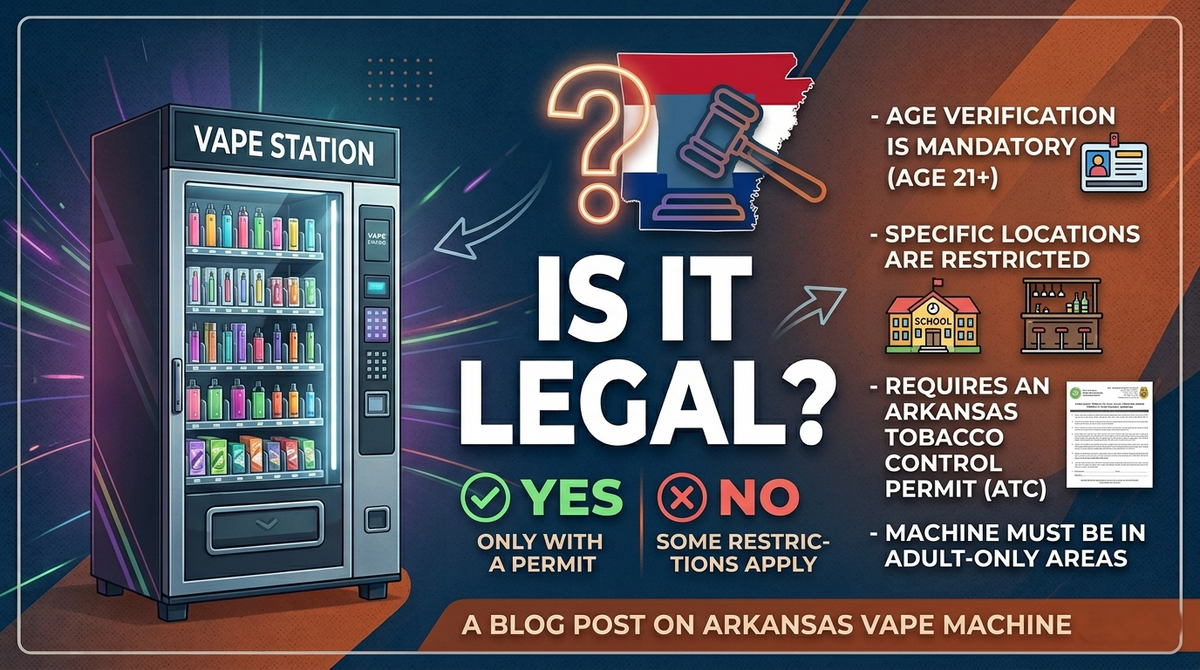
The short answer is yes. Vape vending machines are legal to own and operate in Arkansas. The longer answer is that Arkansas has some of the most clearly defined and actively enforced vape vending laws in the country, and operating outside those rules carries serious penalties. A permit violation can cost $2,000. Stocking a non-approved product after November 2025 costs $1,000 per product found in violation. And those numbers stack per machine, per product, per inspection visit.
If you are considering placing vape vending machines in Arkansas, this guide walks through every legal requirement in plain language: where you can legally place a machine, which permits you need before your first sale, what Arkansas Act 590 means for your product selection, what age verification system the law expects, and how to build a compliant operation from the ground up.
For operators who want legal and compliance guidance specific to their situation before placing equipment, vAdvised works directly with vending operators on exactly these questions across all 50 states.
Arkansas law is unusually specific about where a vape vending machine can physically sit. Under Ark. Code Ann. § 5-27-227(h), a vending machine dispensing vapor products, alternative nicotine products, or e-liquids may only be placed in one of three qualifying environments. If a location does not match one of these three categories, the machine cannot legally operate there. Period.
A restricted area within a factory, business, office, or other structure to which the general public does not have access. Think employee-only break rooms in manufacturing facilities, private office environments with controlled entry, or back-of-house areas at large employers. The key requirement is that the general public cannot enter. A break room accessible to visitors, delivery drivers, or customers does not qualify.
Permitted premises that hold an on-premises alcohol consumption permit and restrict entry to persons 21 and older. This covers bars, nightclubs, adult lounges, and private clubs where minors cannot legally enter. The venue must already hold its alcohol permit and must actively restrict entry by age. A restaurant that serves alcohol but admits families does not qualify. A bar with a 21-plus door policy does.
Any location where the vending machine is under the continuous supervision of the owner or an employee. This option gives operators the most flexibility in theory, but the supervision requirement is not passive. An employee must be present and able to intervene at the machine. A machine in a convenience store where an employee works the counter qualifies. A machine in a stockroom that gets checked twice a day does not.
| Location Type | Qualifies Under Arkansas Law? | Notes |
|---|---|---|
| Bar or nightclub (21+ entry) | Yes | Must hold on-premises alcohol permit and restrict minors |
| Employee-only break room (no public access) | Yes | General public must have no access to the area |
| Supervised retail location with staff present | Yes | Employee must be able to supervise the machine actively |
| Hotel lobby or public corridor | No | Public access disqualifies the location |
| Restaurant that serves alcohol but admits families | No | Mixed-age access disqualifies regardless of alcohol license |
| Unsupervised standalone retail placement | No | No active employee supervision means no compliance |
| Gym, airport, shopping center | No | Public access environment |
No operator can legally sell vapor products, alternative nicotine products, or e-liquids through a vending machine in Arkansas without first obtaining an Arkansas Vendor Permit from the Department of Finance and Administration, Arkansas Tobacco Control division. Selling before the permit arrives is a criminal offense under Arkansas law. Not a fine. A criminal offense.
The permit fee is $100, paid by check or money order to Arkansas Tobacco Control. No cash is accepted. In addition to the permit fee, operators must file a surety bond with Arkansas Tobacco Control. The bond amount scales based on the number of vending machines you operate. This is a meaningful cost that new operators frequently miss when budgeting their route. For operators using flexible vending machine financing to fund their initial equipment purchase, the bond requirement should be factored into the total startup cost from the beginning.
The application must be notarized and submitted with supporting documents. Required materials include a color copy of a government-issued ID for all owners, members, and partners, a copy of your Arkansas Sales and Use Tax certificate, a complete listing of all vending machine locations with physical addresses, and any applicable business formation documents if operating as an LLC, corporation, or partnership.
The permit is not transferable. If you acquire an existing vending route or buy machines from another operator, you cannot use their permit. You must apply for and receive your own permit before stocking or operating any machine.
Once permitted, operators must report any change of machine location to Arkansas Tobacco Control within 30 days of the move. Adding a new machine requires filing notification of the new location. The permit must be conspicuously posted on the front of each vending machine. Records of all product purchases and sales must be kept for a minimum of three years and made available to Arkansas Tobacco Control agents on request. Inspections occur without advance notice.
Permit violations carry escalating penalties. A first violation within 48 months results in a fine up to $250. A second violation brings up to $500 and a license suspension of up to two days. By the fifth violation, the fine reaches $2,000 and license revocation becomes possible. These are per-incident consequences, not annual caps.
Arkansas Act 590, signed in April 2025, is the most significant change to vape vending law in the state in years. It established a state-managed directory of legal vaping products, tied product eligibility to FDA Premarket Tobacco Product Application status, and created criminal penalties for knowingly possessing unlisted products. Arkansas became the first U.S. state to ban personal possession of non-approved vaping products, making it one of the most aggressive product-control frameworks in the country.
To appear in Arkansas's approved directory and therefore be legal to stock in your machines, a product must meet one of three criteria: it received FDA marketing authorization (a Marketing Granted Order), it had a PMTA submitted to the FDA by the September 8, 2020 deadline and that application is still pending or under appeal, or it was commercially available in the U.S. market on or before August 8, 2016.
The Arkansas Tobacco Control directory was published after November 1, 2025. Products not on that directory cannot legally be sold in Arkansas after that date. Businesses found stocking non-listed products face fines of $1,000 per product in violation. For an operator running five machines with ten non-compliant SKUs each, that is $50,000 in potential fines from a single inspection visit.
Before stocking any vape vending machines for sale in Arkansas, verify every product SKU against the current Arkansas Tobacco Control manufacturer directory at dfa.arkansas.gov. Do not assume a product that sold legally before November 2025 is still on the approved list. The directory is the only source of truth. Products purchased from licensed wholesalers but not on the directory are still a violation.
Operators managing multiple state markets should note that Act 590 makes Arkansas one of twelve states with PMTA registry laws as of 2025. Managing product compliance across states with different approved lists is a meaningful operational challenge. The compliance advisory team at vAdvised helps multi-state operators track these directory requirements and build product review processes that prevent costly violations before they happen.
Federal Tobacco 21 law sets the minimum age at 21 for all vapor product purchases nationwide. Arkansas enforces this at the state level through its placement restrictions: only adult-only or supervised locations qualify, which structurally prevents most minor access scenarios before the machine even activates.
But placement restrictions alone do not satisfy compliance. The machine itself must have a functional age verification vending machine system to confirm buyer age at the point of purchase. Arkansas Tobacco Control checks require that employees at supervised locations or venues confirm age before any sale completes. For unsupervised adult-only venue placements, an automated age verification system is the practical standard.
A compliant id verifying vending machine reads the 2D barcode on a government-issued driver's license, confirms the date of birth meets the 21-plus threshold, checks that the ID has not expired, and generates a verification log timestamped to the transaction. The machine locks the vend mechanism until verification passes. A customer who presents an expired ID, an ID belonging to someone else, or no ID at all cannot complete the purchase.
Basic barcode scanners handle the date of birth and expiration check. Advanced systems add fake ID detection algorithms that flag formatting anomalies in barcode data. The most secure deployments use biometric face matching, where the customer's live image is compared to the photo on the ID before the sale completes. For high-risk or high-volume Arkansas placements, a vending machine with age verification that combines barcode scanning with fake ID detection is the appropriate minimum standard.
Arkansas Tobacco Control agents conduct unannounced inspections and compliance checks. An age verification vending machine for sale that verifies age but does not log each verification attempt gives you no defensible record when an inspector asks for documentation. Every serious Arkansas vape vending operation should use a scanner system that generates timestamped verification logs stored in a cloud-accessible platform, not just on the machine itself.
The cloud vending management platform enables operators to access verification logs, sales records, and machine status remotely from one dashboard, which is exactly what Arkansas compliance documentation requires. Inspectors who show up expecting records get them immediately rather than after a site visit delay.
Arkansas imposes an excise tax on vapor products at $1.00 per milliliter of e-liquid as of 2025. This is collected at the distributor level and typically passed through to retail pricing. For a standard 2ml disposable vape retailing at $20 to $25, the underlying excise tax is $2.00. That is not an operator cost directly, but it flows into your wholesale cost from permitted distributors and affects your margin math.
Operators must also collect and remit standard Arkansas sales tax on all vending machine sales. The sales and use tax permit from the Arkansas DFA is a required document in your vendor permit application, so this registration must happen before the vendor permit can issue.
You must purchase all products from a permitted Arkansas wholesaler. Sourcing product from out-of-state distributors who are not permitted in Arkansas is a separate violation, regardless of whether the product appears on the state directory.
Running through the full compliance stack in the right order prevents the situation where a machine is placed, stocked, and generating revenue before the permits are in place. That situation is a criminal offense in Arkansas, not an administrative oversight.
Register an LLC or corporation with the Arkansas Secretary of State before applying for any permit. Online filings typically process within two business days. Many serious location owners, particularly bars and nightclubs, will not sign a placement agreement with an unincorporated individual. An LLC also protects your personal assets from business liability.
Apply through the Arkansas DFA at dfa.arkansas.gov. This permit is a required attachment to your vendor permit application and must be in hand before the vendor application can be processed.
Submit the completed, notarized ATC vendor permit application to Arkansas Tobacco Control at 101 East Capitol Ave., Suite 401, Little Rock, AR 72201. Include the $100 check or money order, the surety bond, color copies of all owner IDs, your sales tax certificate, your complete list of proposed machine locations, and any business formation documents. Do not purchase or stock machines until the permit arrives.
Before finalizing your wholesale order, cross-reference every product against the Arkansas Tobacco Control manufacturer directory. Purchase exclusively from permitted Arkansas wholesalers. Do not stock any product not appearing in the directory regardless of its legal status in other states.
Choose new vending machines that support integrated id verification vending machine hardware at the factory level rather than retrofitted aftermarket additions. Factory-integrated age verification eliminates compatibility gaps between scanner hardware and the vend control mechanism. Verify that the machine connects to a cloud management system for remote compliance log access.
For operators building their first Arkansas route, flexible vending machine financing allows you to acquire compliant equipment without depleting the working capital needed for permit fees, surety bonds, and initial product inventory. Starting with the right machine from day one is significantly cheaper than retrofitting a non-compliant unit after placement.
Only approach locations that qualify under one of the three Arkansas placement categories. Document the qualifying basis in your placement agreement. For bars and nightclubs, confirm their on-premises alcohol permit and their 21-plus entry policy in writing. For restricted-area placements, confirm in the agreement that the area is not accessible to the general public. These written records matter if a placement is ever challenged during an inspection.
Operators who want pre-qualified location matching in Arkansas can work with vending placement services that evaluate location compliance before connecting operators with accounts.
Post the vendor permit conspicuously on the front of each machine. Arkansas law requires this. Post "No Sales to Minors" signage at each vending location as required by Arkansas Tobacco Control regulations. Display your operator contact information on the machine so inspectors and the public can reach you.
Keep all product purchase invoices and sales records for three years minimum. Report any machine relocation to Arkansas Tobacco Control within 30 days. Notify ATC when you add new machines not previously listed on your permit application. Use your cloud vending management platform to maintain verification logs and sales data accessible on demand without requiring a site visit.
Arkansas enforces its vape vending laws actively. The Arkansas Tobacco Control Board maintains a public record of all permits issued, suspended, denied, and revoked. Enforcement consequences escalate quickly for repeat violations within a 48-month window.
| Violation Number (within 48 months) | Maximum Fine | License Consequence |
|---|---|---|
| First violation | $250 | None |
| Second violation | $500 | Suspension up to 2 days |
| Third violation | $1,000 | Suspension up to 7 days |
| Fourth violation | $2,000 | Suspension up to 14 days |
| Fifth violation | $2,000 | Possible license revocation |
| Stocking non-directory product (Act 590) | $1,000 per product | Product seizure |
| Selling without a permit | Criminal offense | Criminal prosecution |
Operators who are unsure whether their current setup meets Arkansas requirements, or who are building a compliance review before their first inspection, should consult with a specialist before their next machine placement. The team at vAdvised provides operator-specific compliance reviews covering permit status, product eligibility, placement qualification, and age verification system adequacy across Arkansas and other regulated markets.
The compliance burden in Arkansas is real. The placement restrictions are stricter than most states. Act 590 adds a product-level verification requirement that does not exist in less regulated markets. The penalty structure is aggressive.
That said, the operators who navigate this correctly face significantly less competition than operators in states with looser enforcement. Most of the unqualified, underpermitted, and poorly stocked machines that populate other markets simply cannot survive the Arkansas compliance environment. Operators who run compliant placements at qualifying bars, nightclubs, and restricted facilities own accounts with very little competitive pressure and very predictable revenue.
A well-placed vape vending machine at a qualifying Arkansas bar generates $1,500 to $3,000 per month in gross revenue at standard pricing. At a 50 to 60 percent gross margin on compliant product, the net income per machine justifies the compliance investment many times over. The operators making real money from vape vending machines for sale in regulated states like Arkansas are not the ones who cut corners. They are the ones who did the compliance work first and built routes that enforcement cannot touch.
If you are ready to buy vending machines for an Arkansas vape route, start with the permit application and the ATC product directory before a single machine ships. The compliance stack is not complicated when you run through it in order. What makes it expensive is discovering it after the fact.
Yes, with strict conditions. Under Ark. Code Ann. § 5-27-227(h), vape vending machines may only be placed in restricted areas not open to the public, 21-plus alcohol-licensed premises, or locations under direct employee supervision. Operating outside these three location categories is illegal regardless of what age verification or permits you hold.
You need an Arkansas Vendor Permit issued by the Department of Finance and Administration, Arkansas Tobacco Control division. The permit fee is $100. You also need a surety bond scaled to the number of machines you operate, an Arkansas Sales and Use Tax permit, and a notarized application with a complete list of all machine locations. Selling before the permit arrives is a criminal offense.
Act 590, signed in April 2025, established a state-managed directory of approved vaping products based on FDA PMTA status. Only products on that directory may be legally sold in Arkansas after November 1, 2025. Stocking non-listed products carries fines of $1,000 per product per inspection. Before placing any machine in Arkansas, verify every product SKU against the current Arkansas Tobacco Control manufacturer directory at dfa.arkansas.gov.
Arkansas does not specify a particular scanner model but requires that age verification prevents sales to persons under 21 at all times. For unsupervised 21-plus venue placements, an automated age verifying vending machines system with ID scanning and compliance log generation is the practical standard. For supervised locations, an employee must be able to confirm age before each sale. Compliance logs that document every verification attempt provide your legal defense record during inspections.
The vAdvised compliance advisory service works with vending operators on permit requirements, product compliance reviews, placement qualification, and age verification system adequacy across Arkansas and all 50 states. For operators building their first Arkansas route or conducting a compliance review of an existing operation, that consultation is worth completing before the next inspection visit rather than after it.

Share:
Pokémon Card Vending Machine: The Complete 2026 Operator Guide
What Licenses and Permits Are Required to Sell Vape Products via Vending Machines in Arkansas?