




Design the perfect vending solution for your location and customers.

Join the VMFS newsletter and step into a thriving network dedicated to collective success.
One signup. Endless possibilities.
One operator placed three vape vending machines in Arkansas bars. Machines were running, product was selling, and revenue was coming in. The problem: no vendor permit had been issued yet. Under Arkansas law, that is not a permit violation. It is a criminal offense. The machines were seized, the product was confiscated, and the operator faced prosecution before the route had generated enough revenue to cover a single month of expenses.
Arkansas is one of the most clearly regulated vape vending markets in the United States. The permit stack is specific, sequential, and non-negotiable. Miss any step and you are not just out of compliance — you are potentially facing criminal liability, product seizure, and permanent permit denial. This guide covers every license and permit required to legally sell vape products through a vending machine in Arkansas, what each one costs, how to apply, and what the penalties look like when operators skip steps.
For operators who want a compliance review specific to their Arkansas operation before placing equipment, vAdvised works with vending operators on permit applications, product eligibility verification, and placement qualification across all 50 states.
Arkansas does not have one vape vending permit. It has a layered stack of registrations, each issued by a different agency, each required before the next step can happen. Operators who try to short-circuit this sequence end up either blocked from obtaining permits or operating illegally. Run through them in order.
Before any permit application can be filed, your business must exist as a registered legal entity in Arkansas. The Arkansas Secretary of State Business Services Division handles this. LLCs file Articles of Organization. Corporations file Articles of Incorporation. Online filings typically process within two business days. In-person filings can be processed while you wait.
Operating as a sole proprietor is technically permitted, but it creates two practical problems for Arkansas vape vending operators. First, many qualifying locations — particularly bars, nightclubs, and private clubs — will not sign placement agreements with an unincorporated individual. They require a formal business entity as a condition of placement. Second, a sole proprietor has no legal separation between personal and business assets, which means every fine, every seizure, and every penalty exposure lands on you personally.
An LLC creates the legal firewall that keeps business liabilities out of your personal finances. Given that Arkansas penalties for permit violations include fines up to $2,000 per incident and that Act 590 violations run $1,000 per product per inspection, operating without that protection is a meaningful personal financial risk. Forming an LLC before your first permit application costs $50 to $100 in filing fees and takes two days. That step is worth completing before anything else.
Operators buying new vending machines for their first Arkansas route should also confirm that the LLC is in place before the equipment ships. Placement agreements, permit applications, and surety bonds all require a legal business name and designation. Having that in place from the start avoids delays mid-process.
The Arkansas Sales and Use Tax Permit is issued by the Department of Finance and Administration through the Excise Tax division at dfa.arkansas.gov. It authorizes your business to collect and remit Arkansas sales tax on vending machine transactions. This permit is not optional and it is not just a revenue formality. It is a required attachment to the Arkansas Vendor Permit application. Without it, your vendor permit application will not be processed.
Applications are filed online through the DFA portal. The process is straightforward and typically completes within a few days of submission. The business name, address, and business designation on the sales tax certificate must match the information on your vendor permit application exactly. Mismatches are one of the most common reasons vendor permit applications come back incomplete.
Once issued, the sales tax permit requires ongoing filing of sales tax returns. Vending machine sales are taxable transactions in Arkansas. The standard Arkansas sales tax rate applies to every sale your machine completes. This is a separate obligation from the excise tax on vapor products, which is collected at the distributor level and flows through your wholesale cost. Both apply to every transaction your machine generates.
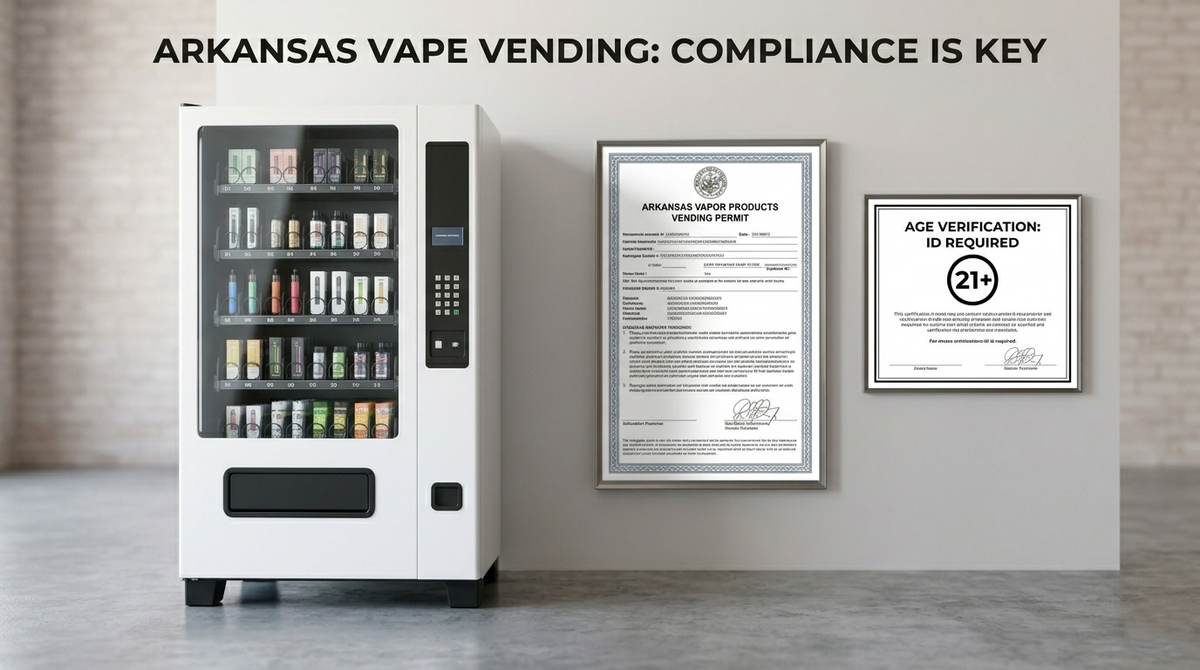
The Arkansas Vendor Permit, issued by Arkansas Tobacco Control (ATC), is the core license that authorizes you to sell tobacco products, vapor products, alternative nicotine products, and e-liquid products through permitted vending machines in Arkansas. Without this permit in your physical possession, you cannot legally purchase, stock, or operate a vape vending machine in the state. That prohibition is statutory and enforced criminally, not just administratively.
This permit covers all vape vending machines for sale and in operation under your business. It is not issued per machine. One permit covers your full route, but each machine location must be listed on the application and kept current with ATC throughout the permit period.
The permit fee is $100, paid by check or money order made out to Arkansas Tobacco Control. No cash is accepted under any circumstances. The fee is non-refundable. If your application is denied, the fee is not returned.
In addition to the permit fee, every Arkansas vending permit holder must file a surety bond with Arkansas Tobacco Control. The bond amount scales with the number of vending machines you operate. The Tobacco Vending Bond Form is available on the ATC website. This is a meaningful startup cost that many new operators overlook when projecting their route expenses. For operators using flexible vending machine financing to fund equipment purchases, the surety bond should be included in the total capital requirement from the beginning of the financial model, not discovered after equipment has already been ordered.
The vendor permit application must be fully completed, notarized by a notary public, and submitted with all required supporting documents. Incomplete applications are not processed. Required documentation includes:
| Required Document | Notes |
|---|---|
| Completed, notarized vendor permit application (ATC-V1) | Must be signed by owner, corporate officer, or managing member |
| $100 check or money order to Arkansas Tobacco Control | No cash accepted |
| Surety bond (amount based on number of machines) | Tobacco Vending Bond Form from ATC website |
| Color copies of government-issued ID for all owners, members, partners | Driver's licenses, state IDs, passports, military IDs all accepted |
| Copy of Arkansas Sales and Use Tax certificate | Business name and address must match application exactly |
| Complete listing of all vending machine locations with physical addresses | P.O. Boxes not accepted. Must be numeric address plus street name |
| Articles of Organization, Incorporation, or Partnership Agreement (if applicable) | Required for LLC, corporation, or partnership applicants |
| Lease agreement, bill of sale, or purchasing agreement (if applicable) | Required if purchasing an existing business with machines |
Completed applications are mailed to Arkansas Tobacco Control, 101 East Capitol Ave., Suite 401, Little Rock, AR 72201. The ATC lobby is open Monday through Friday, 8:00 AM to 5:00 PM, excluding holidays, for in-person drop-offs. ATC communicates primarily by email, so ensure the email address on your application is current and actively monitored.
Arkansas Vendor Permits do not transfer between owners. If you acquire an existing vending route, buy machines from another operator, or purchase a business that includes permitted vending machines, you must apply for and receive your own permit before purchasing, stocking, or operating any machine. The previous owner's permit has no legal effect on your operation. Operating under a prior owner's permit, intentionally or not, is a violation.
Age verification in Arkansas vape vending is not just best practice. It is a legal requirement embedded in the placement conditions that make your operation legal in the first place. Under Ark. Code Ann. § 5-27-227(h), machines must operate in locations that structurally prevent minors from accessing them: restricted areas, 21-plus alcohol-licensed venues, or directly supervised locations. Age verification at the machine is the documented proof that your compliance posture holds at the point of purchase.
Arkansas Tobacco Control agents conduct unannounced compliance checks. A check that finds your age verification vending machine inactive, bypassed, or unlogged is a compliance failure regardless of where the machine is placed. The verification system has to work every time, and the logs have to exist to prove it did.
A compliant id verification vending machine reads the 2D barcode on a government-issued ID, confirms the customer is 21 or older, verifies the ID has not expired, and locks the vend mechanism until verification passes. The system must generate a timestamped log of each verification attempt and its outcome. That log is your documentation record for inspections.
Basic barcode scanners satisfy the mechanical requirement. For higher-risk placements or higher-volume locations, a scanner with fake ID detection algorithms adds a meaningful layer of protection. These systems perform more than 100 checks on barcode data formatting and flag anomalies that suggest a tampered or fraudulent document. For the most secure deployments, biometric face-matching systems confirm that the person presenting the ID matches the photo on it, closing the borrowed-ID gap entirely.
An age verification vending machine for sale with factory-integrated ID scanning eliminates the compatibility questions that arise when aftermarket scanner modules are retrofitted to standard machines. Factory integration means a single warranty, a single software platform, and a verified connection between the scanner and the vend control mechanism.
When an Arkansas Tobacco Control agent arrives for an inspection and requests verification logs, those records need to be available immediately. Operators running their machines through a cloud vending management platform can pull verification logs, sales records, and machine status from any device without needing to be on-site. That capability is the difference between a smooth inspection and a delayed response that itself signals a compliance problem.
Arkansas Act 590, signed in April 2025, established a state manufacturer directory of approved vaping products tied to FDA Premarket Tobacco Product Application status. Only products listed in the Arkansas Tobacco Control manufacturer directory may legally be sold in Arkansas after November 1, 2025. Stocking non-listed products carries fines of $1,000 per product found in violation during an inspection.
Product compliance under Act 590 is not technically a separate permit. But it functions as a permit-level obligation because non-compliance triggers the same penalty structure as permit violations, it is enforced by the same ATC agents who conduct permit compliance checks, and it affects the legal standing of your entire operation — not just the individual product.
Before ordering any product for your Arkansas machines, cross-reference every SKU against the current Arkansas Tobacco Control manufacturer directory at dfa.arkansas.gov. The directory lists products that have received FDA marketing authorization, have a PMTA pending or under appeal submitted before the September 8, 2020 deadline, or were commercially available before August 8, 2016. Products that do not meet one of these three criteria are not on the list and cannot be stocked.
Purchase exclusively from permitted Arkansas wholesalers. A product that appears on the state directory but was purchased from an unpermitted out-of-state distributor is still a violation. The sourcing chain matters as much as the product itself.
Operators managing product compliance across multiple states, where each state has its own approved list and product requirements, should build a formal quarterly product review into their operations. The compliance advisory team at vAdvised helps multi-state operators track directory changes, manufacturer updates, and product removal from approved lists before those changes become inspection findings.
Getting the permits is the starting point, not the finish line. Arkansas imposes ongoing obligations that continue throughout the life of your operation. Missing any of them creates the same exposure as missing the original permit requirement.
When you move a machine from one location to another, you must notify Arkansas Tobacco Control within 30 days of the change. The notification must state the former location and the new physical address. When you add a machine not previously listed on your permit application, you must file a notification of the new location before operating it.
The vendor permit requires annual renewal. Before renewal, you must provide ATC with proof that your surety bond remains in force, either through a reinstatement notice or a letter from the bond company confirming the coverage and its termination date. A permit renewal submitted without valid bond documentation will not be processed.
All product purchase invoices and sales records must be retained for a minimum of three years. These records must be made available to ATC agents on request during inspections. ATC agents and federal tobacco control agents conduct periodic inspections without advance notice. Records that cannot be produced on demand are treated as absent, not delayed.
The vendor permit must be posted conspicuously on the front of each vending machine. "No Sales to Minors" signage must be displayed at each vending location. Operator contact information must appear on every machine. These are visible compliance signals that inspectors look for immediately on arrival. A machine without posted documentation draws immediate scrutiny regardless of whether the underlying permits are valid.
The Arkansas penalty structure escalates steeply for repeat violations. First violations within a 48-month window carry fines up to $250. Second violations add a license suspension of up to two days on top of a $500 fine. By the fourth violation, the fine reaches $2,000 with a 14-day suspension. A fifth violation within the same 48-month window carries a possible license revocation and a $2,000 fine. Revocation means no permit, no operation, and a public record of the revocation maintained by the Arkansas Tobacco Control Board.
The most severe consequence is operating without any permit at all. Arkansas law treats this as a criminal offense, not an administrative infraction. Product is subject to seizure. The operator faces prosecution. For an operation that has not yet generated meaningful revenue, the legal costs of this situation can exceed the total projected income from the route.
Operators who are unsure about their current permit status, who have recently acquired machines from another operator, or who are expanding into Arkansas from another state should complete a compliance review before their next placement. The vAdvised permit advisory service covers permit status verification, product eligibility review, placement qualification assessment, and age verification system adequacy for Arkansas and every other regulated state market.
The equipment you choose determines how much of your compliance burden is built-in versus manually managed. A purpose-built vending machine age verification system integrated at the factory generates the compliance data Arkansas requires automatically. An aftermarket scanner retrofitted to a standard machine introduces compatibility questions, split warranty coverage, and integration gaps that can leave verification logs incomplete.
When you buy vending machines for Arkansas vape vending, confirm three things before purchase. First, the machine supports MDB Level 3 communication so the scanner controls the vend mechanism directly. Second, the scanner connects to a cloud platform that stores verification logs remotely rather than only on the machine itself. Third, the machine's compliance data output is accessible in a format that can be produced on demand during an inspection without requiring a site visit.
Operators building their first Arkansas route should also confirm that their equipment choices match the placement environment. A id verifying vending machine placed in a bar needs different physical dimensions and security specifications than one placed in a restricted employee break room. Getting the right machine for the right location from the start is significantly cheaper than discovering a mismatch after the placement agreement is signed and the machine is installed.
For operators managing the capital side of a new Arkansas route, flexible vending machine financing allows compliant equipment purchases without depleting the working capital needed for permit fees, surety bonds, initial product inventory, and compliance infrastructure. Starting with the right equipment is the decision that shapes every operational and compliance outcome that follows.
The Arkansas Vendor Permit fee is $100, paid by check or money order to Arkansas Tobacco Control. In addition, operators must file a surety bond with ATC, the amount of which scales based on the number of machines operated. A Sales and Use Tax permit from the DFA is also required, at no separate filing fee, but the registration must be completed and the certificate attached to the vendor permit application. Total startup permit costs, including the bond and LLC formation, typically run $300 to $600 before equipment.
No. The Arkansas Vendor Permit covers your full operation under one permit. However, every machine location must be listed on the application at the time of filing, and any new machine added after permit issuance must be reported to ATC before it begins operating. Location changes must be reported within 30 days of the move.
No. Arkansas Vendor Permits are not transferable and cannot be used by any person or business other than the named permit holder. Operating under another operator's permit, even temporarily, is a violation. The permit you need is your own, and you must have it in your physical possession before purchasing, stocking, or operating any machine.
Only products listed in the Arkansas Tobacco Control manufacturer directory may be stocked after November 1, 2025. The directory is published on the ATC website at dfa.arkansas.gov. Verify every SKU before ordering. Purchase from permitted Arkansas wholesalers only. Products from unpermitted distributors are a violation regardless of directory status.
Arkansas requires that vape vending machines prevent sales to persons under 21 at all times. For unsupervised 21-plus venue placements, an automated age verifying vending machines system with ID scanning and timestamped verification logs is the operational standard. The system must actively deny non-qualifying purchases and generate a log accessible during inspections. Compliance log access through a cloud vending management platform allows immediate documentation retrieval during unannounced ATC inspections.
The vAdvised compliance advisory service supports vending operators through Arkansas permit applications, product eligibility verification, placement qualification reviews, and age verification system selection. For new operators unfamiliar with the ATC application process or existing operators conducting a compliance review, that support is worth accessing before the first placement rather than after the first inspection finding.


Share:
Is It Legal to Own a Vape Vending Machine in Arkansas?
ID Scanner for Business: How They Work, What Types Exist, and Which One Your Business Actually Needs