




Design the perfect vending solution for your location and customers.

Join the VMFS newsletter and step into a thriving network dedicated to collective success.
One signup. Endless possibilities.
Yes, vending machines are allowed in schools, but anything sold to students on campus from midnight until 30 minutes after the school day ends must meet the USDA Smart Snacks nutrition standards. Run that way, school vending machines give students and staff a fast, compliant snack and drink option and return a commission to the school, which public contracts put at roughly 20% to 35% of gross sales.
This guide covers the benefits and the research behind the concerns, the Smart Snacks rules by grade level, when machines can operate, what schools and PTAs actually earn, how district vending contracts work, and how colleges differ from K-12, with VMFS USA machines and current prices for operators who want to bid.
Vending machines are allowed in U.S. schools, and federal rules regulate what they sell rather than whether they exist. Any school that takes part in the National School Lunch Program or School Breakfast Program falls under 7 CFR 210.11, the competitive food rule better known as Smart Snacks in School. It covers every food and beverage sold to students on the school campus during the school day other than the reimbursable meal itself, so a hallway snack machine, a school store and an à la carte line are all held to the same nutrition standards.
The federal rule is a floor. The regulation lets state agencies and local educational agencies add restrictions of their own, and districts usually do this through their local school wellness policy, which can limit machine hours, require water in every beverage machine or keep machines away from the cafeteria during lunch. The district is also responsible for records showing that items sold outside the food service department comply, and at a minimum those records include receipts, nutrition labels or product specifications. For an operator, that means the planogram and the paperwork both have to be ready before the first machine is installed.
The practical answer to "can you put vending machines in schools" is therefore yes, with three conditions: the product mix must meet Smart Snacks for student-accessible machines, the placement and hours must fit the district's wellness policy, and the agreement normally runs through the district's procurement office rather than an individual principal. The vending permits and licensing rules that apply to any location, such as sales tax registration and local health permits, still apply on top of school policy.
The main benefits of vending machines in schools are reliable access to food and drinks outside meal times, a tool for steering students toward healthier choices, and a revenue stream for school programs that requires little staff time. Each benefit depends on how the program is run, which is why the evidence matters more than the sales pitch.
Access outside meal service
Students in early classes, sports and after-school clubs can get water, milk or a snack when the cafeteria is closed.
Healthier defaults
Because what is sold shapes what younger students eat, a compliant machine replaces candy and soda with better options.
Program revenue
Commission checks fund clubs, athletics, field trips and equipment without a bake sale or volunteer hours.
Staff convenience
Teachers and staff get coffee, drinks and snacks between classes, meetings and late events.
Convenience is the most immediate benefit because school schedules leave little room for long breaks. Students with packed days of classes, practice and tutoring need something quick between commitments, and a machine near the gym or a main hallway avoids a trip off campus or a long line during a short lunch period. Teachers juggling classes, grading and meetings use the same machines for a drink or a snack, and staff who stay late for events, parent conferences or games have an option when other food service is closed. Machines can also carry everyday items students forget, such as stationery or hygiene products, which is a useful add-on in middle and high schools.
Healthy vending machines in schools can support a school's wellness goals instead of undermining them, because what is available influences what children eat. A national study of 6th to 10th graders found that in the younger grades, vending machine content was linked to diet in both directions: schools whose machines sold fruit or vegetables saw more of that intake, and schools whose machines sold sweets saw more sweets. Stocking whole-grain snacks, fruit cups, yogurt, water, milk and low-sugar beverages turns the machine into part of nutrition education. Schools can also include gluten-free, nut-free or vegan items for students with dietary restrictions, as long as each item still passes the Smart Snacks limits.
Revenue is the benefit most administrators ask about, and it comes from a commission on gross sales paid by the operator. The operator owns the equipment, buys the inventory, restocks, repairs and collects, so the school earns without managing stock. Districts can direct the money to extracurricular activities, athletics, arts, classroom resources and events such as field trips. Actual amounts vary widely, and the revenue section below uses public district records rather than estimates.
Machines can take pressure off the cafeteria by serving grab-and-go demand outside meal periods, which lets food service staff focus on full meals. They should complement school meals, not compete with them: the federal rule bars exempt fundraiser foods from being sold in the food service area during meal service, and many wellness policies go further. Where the school food authority runs the machines itself, the vending menu can add items the lunch line does not serve, such as protein snacks or smoothie-style drinks that meet the standards.
The main concern about vending machines in schools is that they historically sold low-nutrient snacks and sugary drinks that can raise students' calorie intake and compete with school meals. That concern is grounded in data collected before the Smart Snacks rule was published in 2013, and newer research shows the rules changed the mix without eliminating every problem.
In the 2005-06 Health Behavior in School-aged Children survey, 83% of the 152 schools studied had vending machines that primarily sold foods of minimal nutritional value such as soft drinks, chips and sweets. Among 6th to 8th graders, what the machines sold was associated with what students reported eating, while no significant effect showed up among 9th and 10th graders. A separate national study of 287 public schools and 2,228 children from the 2004-05 school year found that, among middle school students, the availability of low-nutrient, energy-dense foods in vending machines in or near the food service area was associated with a higher BMI z-score. Together these studies explain why critics argued that vending machines should not be allowed in schools and why federal standards targeted competitive foods.
The post-Smart Snacks picture is better but not perfect. A national sample of 90 middle and high schools published in 2024 found that 80% sold competitive foods and that, on average, 75% of the 840 unique products documented were compliant with Smart Snacks. Compliance was higher when the food service department oversaw competitive foods than when principals, student groups or outside vendors did (77% versus 59%). For an operator bidding on a school contract, that last finding is the key takeaway: a vendor who brings a verified compliant planogram and documentation closes the gap that the research identifies.
Why vending machines should be allowed in schools
Why some argue they should not be
The balanced answer to "should vending machines be allowed in schools" is that the machine itself is neutral. The product mix, the hours and the oversight decide whether it helps or hurts, and those are exactly the things a district contract can specify.
Smart Snacks rules require every snack and beverage sold to students during the school day to pass a food-group test and a set of calorie, sodium, fat and sugar limits. The USDA describes the regulation as applying to foods sold à la carte, in the school store, in vending machines and in any other venue where food is sold to students.
To qualify, a snack must first be a whole-grain-rich grain product (50% or more whole grains by weight, or a whole grain as the first ingredient), have a fruit, vegetable, dairy or protein food as its first ingredient, or be a combination food containing at least 1/4 cup of fruit or vegetable. It then has to meet the nutrient limits in the table below, which apply to the item as packaged.
| Standard | Snacks and side items | Entrée items |
|---|---|---|
| Calories | 200 or fewer per item | 350 or fewer per item |
| Sodium | 200 mg or less | 480 mg or less |
| Total fat | 35% of calories or less | 35% of calories or less |
| Saturated fat | Less than 10% of calories | Less than 10% of calories |
| Total sugars | 35% of weight or less | 35% of weight or less |
| Caffeine | Not allowed for elementary and middle school students (trace natural amounts excepted); allowed for high school students | |
There are targeted exemptions. Plain fresh, frozen and canned fruit in water or juice is exempt from the nutrient limits, nuts and seeds are exempt from the fat limits but not the calorie and sodium limits, and dried fruit with nuts and no added sweeteners or fat is exempt from fat and sugar limits. Mixed trail mix and peanut-butter crackers do not get the nut exemption, which trips up many vending menus. Sugar-free gum is exempt at the district's discretion.
Already covered in depth: our guide to healthy vending machine snacks walks through the full Smart Snacks standards with product examples, merchandising and pricing for healthy items, so this article sticks to what is specific to schools.
What you can stock in school vending machines depends mainly on grade level, because Smart Snacks sets different beverage lists and portion sizes for elementary, middle and high schools while food limits are the same for every grade apart from caffeine. Drinks are where most compliance mistakes happen, so plan the beverage columns first.
| Beverage | Elementary | Middle school | High school |
|---|---|---|---|
| Plain or plain carbonated water | Any size | Any size | Any size |
| Milk and milk substitutes that meet school meal standards | Up to 8 fl oz | Up to 12 fl oz | Up to 12 fl oz |
| 100% fruit or vegetable juice, or juice diluted with water, no added sweeteners | Up to 8 fl oz | Up to 12 fl oz | Up to 12 fl oz |
| Calorie-free flavored water | Not allowed | Not allowed | Up to 20 fl oz |
| Other drinks under 5 calories per 8 fl oz (or 10 or fewer per 20 fl oz) | Not allowed | Not allowed | Up to 20 fl oz |
| Lower-calorie drinks, 40 or fewer calories per 8 fl oz or 60 per 12 fl oz | Not allowed | Not allowed | Up to 12 fl oz |
For elementary schools, a beverage machine is effectively water, 8-ounce milk and 8-ounce 100% juice, and snacks should be portion-controlled, caffeine-free items such as whole-grain crackers, fruit cups, applesauce pouches and plain popcorn that pass the limits. Many elementary schools skip student vending entirely and place machines only in staff areas.
For middle schools, the beverage list is the same as elementary with a 12-ounce cap on milk and juice, and caffeine is still out. Common compliant options include whole-grain baked chips, reduced-fat cheese sticks in a refrigerated machine, yogurt, single-serve nuts and seeds, and whole-grain cereal bars that pass the sugar test.
For high schools, the menu opens up to zero-calorie flavored waters and diet drinks up to 20 ounces, lower-calorie sports and tea drinks up to 12 ounces, and caffeinated products. Regular full-sugar soda is not allowed during the school day, while diet soda can fit the under-5-calorie category if the district's policy permits it. High school is where combo and refrigerated machines earn their keep, since students buy drinks, protein snacks and grab-and-go food together. For product ideas that also sell, see our analysis of what sells best in vending machines and filter it through the table above.
Staff machines follow different rules. In one Florida district's 2026 vending solicitation, the district stated that Smart Snacks guidelines apply solely to student vending machines, while its wellness policy governs machines in restricted staff areas. That lets an operator place a broader menu, including coffee and regular snacks, in a teachers' lounge that students cannot access.
School vending machines can operate at any hour, but Smart Snacks applies to student sales from midnight before the school day until 30 minutes after the official school day ends, anywhere on campus that students can access. Outside that window, federal standards no longer apply, although many district wellness policies extend their own rules to after-school events.
The federal definition of school campus is every area under the school's jurisdiction that is accessible to students during the school day. A machine in a locked staff lounge is outside it, while a machine in a hallway, gym lobby or cafeteria is inside it. That gives operators three practical options for after-hours sales at games and evening events: keep a compliant menu all day, use a separate machine in a space students cannot access during the day, or use a machine with scheduled column locking so non-compliant items only vend after the window closes, if the district allows it.
Fundraisers are the one carve-out. The regulation allows infrequent school-sponsored fundraisers to sell foods that do not meet the standards, but each state agency sets how often those exempt fundraisers may happen, and exempt foods cannot be sold in the food service area during meal service. A vending machine is not a fundraiser event, so this exemption does not cover routine machine sales.
Placement drives both compliance and sales. Typical high-traffic spots are hallways near the cafeteria, gymnasiums and athletic facilities, libraries, student commons and teacher lounges, with power and a data connection available. Districts often reserve the right to move or remove machines, and some solicitations require vendors to handle relocation at their own cost, so ask about the electrical and data drops before quoting equipment. If you are new to approaching institutions, our guide on how to scout and pitch a vending machine location covers the decision-makers and the proposal itself.
Schools usually earn a commission of roughly 20% to 35% of gross vending sales, paid monthly by the operator, and total dollars depend on enrollment, machine count, prices and how much of the menu students actually want. Public records give real numbers instead of the round figures that circulate online.
| Institution (public record) | What it shows |
|---|---|
| Howard County Public Schools, MD (public information response) | All district machines: $92,804 in sales and $18,757.48 commission (April 2023 to February 2024); $68,932.80 in sales and $13,932.28 commission (March to August 2024). About 20% of gross sales. |
| St. Lucie Public Schools, FL (RFP 26-15, beverage vending) | Current beverage commission 35%; current prices $2.25 to $3.25 per drink; vendors may include a card fee in their proposal. |
| Las Positas College, CA (RFP 21/22-07) | Commission 28.1% of gross sales on about $22,124 in annual reported sales across 11 machine placements. |
Two lessons come out of those records. First, the commission percentage matters less than the sales base: a whole county school system produced roughly $161,700 in sales over 17 months across all its machines, which is meaningful program money at the district level but modest per school. Second, a community college with nearly 10,000 students generated about $22,000 a year, a reminder that enrollment alone does not guarantee sales; placement and product mix do much of the work. Schools should treat vending as a steady supplement, not a budget line that replaces fundraising.
Healthier standards do not have to cost schools money over time. A study of 11 Massachusetts districts that adopted standards similar to Smart Snacks in 2012 found school food revenues fell by $15.40 per student in the first year, driven by lost competitive food sales, but overall revenues rebounded by the second year and school lunch participation rose 15% among students eligible for reduced-price meals. Operators who switch a school to a compliant menu should expect an adjustment period and plan product rotation to win students back.
Who receives the money depends on who holds the contract and on district policy. Commission can flow to the food service department, the district's general or activity funds, an individual school or a PTA or booster club, and the rules differ by state and district, so operators should confirm the payee and reporting format in writing during contracting. For how commission compares with rent or free placement at other locations, see our breakdown of the vending revenue split between operator, location and supplier.
Build a Smart Snacks-ready school machine
Combo, beverage and refrigerated machines that handle 8 oz milk, water and compliant snacks, with card readers and remote reporting.
Shop Healthy Vending MachinesMost school vending is awarded through a district request for proposals (RFP) or bid, not by a handshake with a principal, and the winning vendor signs a multi-year contract that defines commission, equipment, products, service and reporting. Districts frequently grant one vendor exclusive rights, as both the Missouri and Florida solicitations described below do for at least part of their vending.
Recent solicitations show what districts ask for. A 2025 Missouri district bid required the vendor to hold title to all machines, install and relocate them at its own cost, add card readers alongside cash and coin equipment at the vendor's expense on machines agreed with the district, and state the commission as a single percentage of total gross sales, paid by the 15th of the following month. The same bid required monthly sales reports by machine, building, payment type and product, non-reset sales counters, inventory records the district can audit, and annual review of any price increase. A Florida district's 2026 beverage RFP added background screening and ID badges for every route employee, deliveries only while staff are on site, and general liability coverage of $1 million per occurrence and $2 million aggregate. A California community college RFP asked bidders for a monthly commission percentage plus a guaranteed minimum annual commission, on a three-year term with two optional one-year renewals.
For operators, winning these contracts is about documentation as much as price. Bring a product list with brand, size and vend price for every item, nutrition documentation showing Smart Snacks compliance, equipment specifications including energy features, a service schedule and response times, sample monthly reports from your telemetry platform, and certificates of insurance. A ready-made vending machine contract template helps you check clauses such as termination for convenience, exclusivity and price-change approval, and our guide to vending contract renewal covers how to keep the account at the end of the term.
College and university vending is not covered by Smart Snacks, which applies to schools in the federal school meal programs, so campuses set their own product, hour and payment rules. That makes higher education closer to an office or public-venue account, with residence halls, libraries and athletic buildings that can run machines around the clock.
| Factor | K-12 schools | Colleges and universities |
|---|---|---|
| Nutrition rules | Federal Smart Snacks plus state and district policy for student machines | Campus or state policy only; some adopt healthy-vending percentages |
| Hours | Standards apply midnight to 30 minutes after school ends | Often 24/7 in residence halls and libraries |
| Products | Grade-based beverage lists; no caffeine below high school | Full range, including coffee, energy drinks and fresh food |
| Payment | Cash, card and mobile wallets | Campus ID accounts, meal-plan dollars, cards and mobile wallets |
| Seasonality | School-year calendar, quiet summers | Semester calendar; some campuses shut machines down in summer |
Some colleges impose healthy-vending rules anyway. The California community college RFP above requires bidders to meet California's 5 a Day healthy vending standards: at least half of foods and beverages must meet nutrition criteria, those items must be priced the same as or lower than the rest, and they must sit in the top third of the machine at eye level. Universities also tend to care about energy use and sustainability; SUNY Geneseo, for instance, fits campus machines with power-saving controls and shuts unused machines down completely during the summer.
For operators, the trade-off is volume versus control. Colleges bring longer operating hours and fewer product restrictions, but students spread their spending across dining halls, markets and off-campus options. A residence hall machine that sells breakfast items, energy drinks and late-night snacks can outperform one in a classroom building, while K-12 traffic is concentrated in a few predictable windows. Campuses with a dining contractor may also prefer micro markets or AI smart coolers in high-traffic buildings.
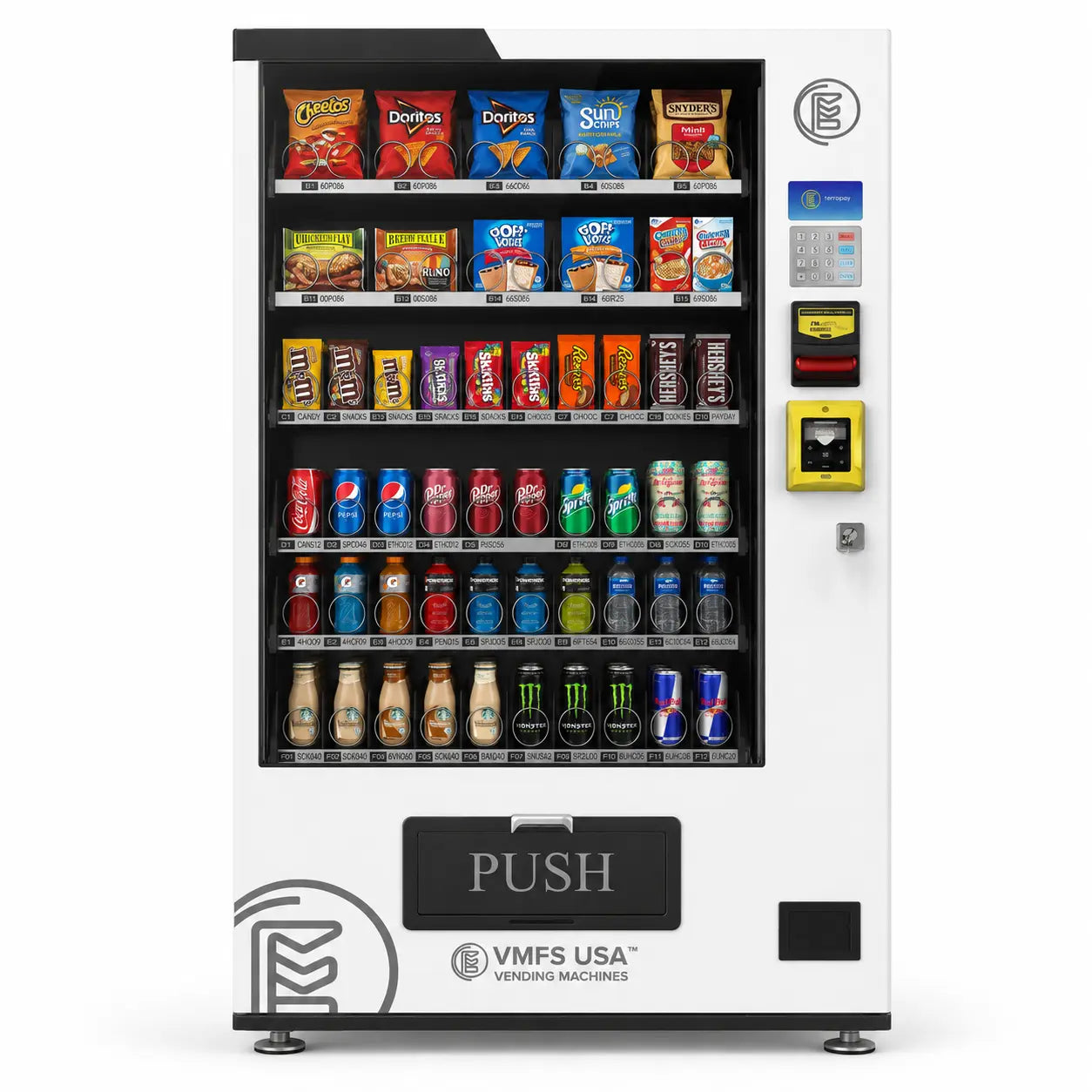
The best vending machines for schools are compact combo machines for smaller buildings, refrigerated beverage machines that vend 8-ounce to 20-ounce containers for grade-specific drink rules, and smart or refrigerated units for fresh, compliant food in high schools and colleges. All of the models below are active in the VMFS USA healthy vending machines collection; prices are the listed prices on vmfsusa.com in October 2026.
| Machine | Listed price | School fit |
|---|---|---|
| Seaga QB2200 Snack & Soda | $2,999 | Slim combo with about 330 items for small schools, staff lounges and tight hallways |
| Seaga QuickBreak QB4000 Combo | $4,450 | Compact, ADA-compliant combo with up to 424 snacks and drinks in one footprint |
| Smart Combo Vending Machine | $4,650 to $4,950 | Up to 60 adjustable slots, modern payments and cloud management for compliance reporting |
| Water Bottle Vending Machine | $4,950 | Refrigerated bottled water and drinks with adjustable channels, near gyms and fields |
| Seaga Prosper Beverage | $5,450 | Compact drink machine for 8 oz to 20 oz cans and bottles, up to 18 selections |
| Seaga ENV5B Refrigerated Beverage | $6,450 | 40 selections and 240 items, 8.3 oz to 20 oz containers, optional cashless and sales reporting |
| Seaga ENV5C Combo Merchandiser | $6,495 | Full-size, American-built combo with up to 371 items for cafeterias and commons |
| Smart Elevator Vending Machine | $8,650 to $8,950 | Refrigerated with elevator delivery and a 21.5-inch touchscreen for yogurt, milk and fragile items |
| AI Smart Fridge Vending Machine | $9,950 to $12,650 | Grab-and-go refrigerated fresh food with visual recognition and weight sensing, best for high schools and campuses |
Match the machine to the menu. Packaged whole-grain snacks fit standard snack vending machines, water, milk and juice need refrigerated drink vending machines whose columns handle 8-ounce containers for younger grades, and smaller schools usually get the most from combo vending machines that put both in one footprint. Fresh items such as yogurt, salads and fruit cups belong in fridge vending machines with reliable temperature control, and touchscreen smart vending machines can display nutrition information at the point of sale. If cash flow is the constraint, VMFS offers equipment financing so an operator can match payments to a new contract's revenue.
School vending machines should accept cards and mobile wallets, and on college campuses they should also accept the student ID account, because cashless payments now make up most vending sales and recent district solicitations require card readers. Cantaloupe's 2026 micropayment report found that 78% of U.S. vending sales were cashless in 2025, with an average cashless ticket of $2.45 against $1.57 for cash.
In K-12, card readers are increasingly a contract requirement rather than an option. The Missouri bid described above required credit and debit acceptance in addition to bill and coin equipment, with the card readers paid for by the vendor, and the Florida RFP allowed bidders to include a card fee in their proposals. Keeping a bill validator and coin mechanism still matters in elementary and middle schools, where younger students may not have cards of their own.
Colleges go further by linking vending to campus accounts. At SUNY Geneseo, every campus machine has a card reader that accepts meal-plan Retail Dollars, optional Campus Cash, a faculty and staff account, Apple Pay, Google Pay, Samsung Pay and credit cards, with Retail Dollars capped at $50 per day to protect students whose ID is lost or stolen. Operators bidding on campus contracts should confirm which card-system provider the university uses and whether the reader must integrate with it.
Cashless telemetry also solves the documentation problem. A connected reader paired with VMFS Cloud reports sales by machine and product, which is the same breakdown districts request in monthly reports and audits. See the VMFS payment system options, browse vending machines with card readers, or read our full guide to cashless payment systems for vending machines for reader hardware, fees and setup.
To get vending machines in a school, start with the district rather than the building: confirm the wellness policy and any existing exclusive contract, then either respond to the district's RFP or propose a pilot that the district can approve. The steps differ slightly depending on whether you are a school leader or an operator.
Check with the district business office whether a vending contract already exists, since many districts give one vendor exclusive rights and individual schools must use it. If not, ask the district to issue a solicitation or approve a vendor, and put the requirements in writing: Smart Snacks compliance for student machines, hours, locations, commission rate and payee, monthly reporting and service response times. Survey students and staff about what they want, and review sales data each term to swap out slow items.
Treat school accounts as long-term contracts. Build a compliant planogram for each grade level, price your commission from realistic volumes, budget for background checks, insurance and card readers, and show how you will document compliance. Our guide to whether vending machines are profitable helps model the per-machine numbers, and the VMFS location matching service can help if you want vetted placements beyond schools while you build your bid history. Plan routine vending machine maintenance around the school calendar so machines are cleaned and restocked before the first day back.
New operators can start with a single vending machines placement in a staff lounge or a private school, where approvals are simpler, and use the sales history and service record from that account to compete for district contracts later.
Bidding on a school or campus contract?
Get a quote on compliant combo, beverage and refrigerated machines with card readers and remote reporting built in.
Request a Quote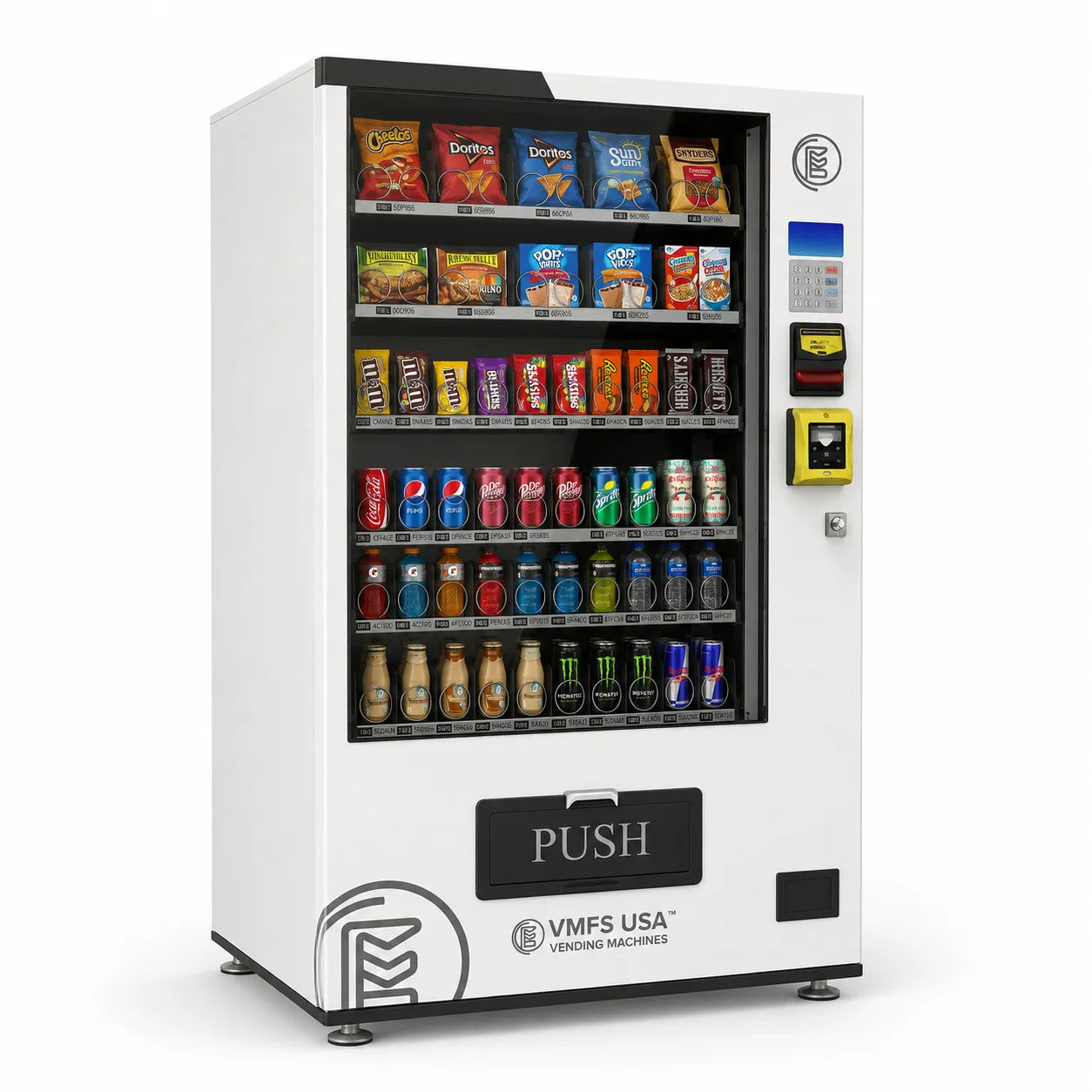
Share:
Vending Machine for Big Items: Large-Item Specs, Uses and Costs
Vending Machine for Big Items: Large-Item Specs, Uses and Costs