




Design the perfect vending solution for your location and customers.

Join the VMFS newsletter and step into a thriving network dedicated to collective success.
One signup. Endless possibilities.
A vending machine for big items is a cabinet built to sell or issue products that a spiral coil cannot handle: boxed electronics, PPE, tools, apparel and other bulky or high-value goods. Instead of dropping product from a coil, it moves each item with an elevator, a conveyor, a locker door or a robotic picker so the item reaches the customer intact.
This guide explains what counts as a large item, how each dispensing method works, the real size and weight limits on active VMFS machines, where industrial and retail operators use them, how to secure them, and what large-item vending costs to buy and run.
In vending, a large item is anything too big, heavy, fragile or valuable to push off a standard spiral coil, which in practice means boxed goods, tools, apparel and equipment rather than chips and cans. A coil machine advances product by turning a wire spiral until the item falls into the bin. That works for light, flexible snack bags. It fails when the box is wider than the coil pitch, too tall for the shelf, heavy enough to break on impact, or worth enough that one damaged vend wipes out the profit on a dozen sales.
So "large" is defined by the machine's delivery path as much as by the product. A pair of boxed earbuds is small, but it still needs a gentle delivery because a crushed box cannot be sold at full price. A safety vest is light but bulky. A cordless drill is heavy and expensive, and a company may want it back at the end of the shift. Each of these pushes you away from standard vending machines and toward elevator, conveyor, locker or robotic designs.
Electronics and accessories
Chargers, cables, earbuds, power banks, headsets and boxed tablets for airports, campuses, hotels and offices.
PPE and safety gear
Gloves, safety glasses, earplugs, respirators, face shields and high-visibility vests on plant and warehouse floors.
Tools and MRO supplies
Cutting tools, abrasives, batteries, measuring instruments and power tools issued or checked out by badge.
Apparel and merchandise
T-shirts, socks, hats and branded merchandise at stadiums, gyms, team stores and events.
Books and media
Paperbacks, study guides, course packs and gift cards on campuses, in libraries and at transit stops.
Auto parts and fluids
Wiper blades, bulbs, fuses, fluids and phone chargers for fleet yards, dealer service lanes and truck stops.
Retail pickup and lockers
Online orders, replacement parts and IT swaps collected with a code instead of at a counter.
Medical and OTC kits
First-aid kits, over-the-counter medicine and hygiene products in clinics, hospitals and public buildings.
Two very different buyers use these machines. Operators sell the products for profit, so they care about margin per slot, payment acceptance and how often the machine needs restocking. Employers and institutions issue items to staff, students or contractors, often at no charge to the user, and they buy the machine for control and data: who took what, when, and how much it cost the department. A third model sits between them: check-out and return, where a tablet, camera or power tool is borrowed and has to come back. Deciding which of the three you are running is the first step, because it changes the mechanism, the access method and the software you need.
Large-item machines use one of four delivery methods: an elevator that lifts each product off its tray and lowers it to the pickup port, locker doors that unlock a single compartment, conveyor belts that push boxed goods forward, or a robotic picker that retrieves items from shelving. Many machines combine two of them, most often conveyor lanes feeding an elevator.
In an elevator machine, the customer selects an item, the lift platform rises to that tray, the lane pushes the product onto the platform, and the platform lowers it to the pickup port instead of letting it fall. Photocell sensors confirm the item actually arrived before the sale closes, so a failed vend does not charge the customer. Because nothing drops, glass bottles, boxed electronics, cosmetics and trading cards arrive intact. VMFS builds its premium range around this method; the step-by-step mechanics are covered in our guide to how elevator vending machines work, and the tray side is explained in elevator delivery and modular shelving.
Elevator delivery: advantages
Elevator delivery: limitations
A locker machine is a bank of individually locked compartments, and each door opens only for the person who paid, scanned a badge or entered a code. Because the customer reaches into the compartment, the item never travels through a chute, so lockers handle the biggest and most irregular items: boxed laptops, hard hats, coveralls, power tools and assembled kits. Lockers are also the natural format for check-out and return, since a user can put an item back and the system logs it. For scale, MSC Industrial's ControlPoint locker lists doors 12.5 in wide and 19.7 in deep, in heights up to 20.2 in, with each locker rated for up to 165 lb. The trade-off is density: one compartment usually holds one item or one kit, so a locker bank holds far fewer units than an elevator cabinet of the same footprint.
Conveyor lanes use a flat belt or pusher to move boxed products forward on a level surface, which keeps flat-bottomed boxes upright and lets lanes be set to the exact width of the package. On their own, conveyor lanes still end in a drop, so for fragile goods they are paired with an elevator. The electronics vending machine from VMFS works this way, with conveyor trays feeding a soft elevator.
Robotic machines use an X-Y gantry or a robotic arm to pick items from open shelving and carry them to a delivery door. They are the most flexible format for mixed shapes and the closest thing to an automated store, but they are also the most expensive to buy and the most specialized to service. For most operators, an elevator cabinet or a locker bank covers the same products at a lower cost of ownership.
| Mechanism | Best for | Capacity per footprint | Check-out and return | Main trade-off |
|---|---|---|---|---|
| Elevator (lift) | Boxed electronics, bottles, cards, cosmetics, packaged goods | High | No | Item must clear the pickup chute |
| Locker | Oversized, irregular or returnable items, kits, online-order pickup | Low | Yes | One item or kit per door |
| Conveyor lanes | Flat-bottomed boxes of consistent size | Medium to high | No | Drops product unless paired with an elevator |
| Robotic picker | Mixed shapes, large-format automated stores | High | Sometimes | Highest cost and service complexity |
On a VMFS elevator machine, an item fits if it clears the pickup chute, sits in a channel and keeps the tray under its load limit. On the Pro Combo Elevator Vending Machine, VMFS lists a standard product chute opening of 8 x 8 in, a tray width of 16.5 in, a channel depth of 22 in, a minimum channel width of 2.25 in, a minimum tray height of 5.3 in and a maximum load of 220 lb. VMFS also lists an XL version of that machine for larger items, so confirm the XL chute size with the team before ordering for a specific product.
Those numbers translate into a simple rule of thumb: measure the packaged item, not the product inside it, and add clearance on every side. A boxed set of headphones that measures 7 in square on its face will pass an 8 x 8 in chute; a boxed blender will not. Channel width sets how many units of each item fit side by side, and tray height sets how many trays you can run. Capacity therefore swings widely with the product mix: VMFS rates the Pro Combo Elevator at roughly 300 to 800 items, with the high end reached only by small-format products. If your largest item is close to the chute limit, plan the planogram around it first and fill the remaining trays with smaller, faster-selling items.
| Active VMFS model | Price | Selections | Rated capacity | Cabinet (H x W x D) | Approx. weight |
|---|---|---|---|---|---|
| Electronics Vending Machine | $7,950 | ~56 channels | Up to ~600 items | 72 x 31.6 x 36.8 in | ~767 lb |
| Pro Combo Elevator (Standard) | $8,650–$8,950 | 56 (8 x 7) | 300–800 items | 72.2 x 31.5 x 37.8–39.0 in | 767–813 lb |
| Pro Combo Elevator (XL) | $11,650–$11,950 | 72 (8 x 9) | 300–800 items | 72.2 x 31.5 x 39.2–40.3 in | 822–869 lb |
| Smart Elevator Vending Machine | $8,650–$8,950 | ~54 slots | Up to 800 items | 77 x 54.5 x 38.5 in | ~772 lb |
| Smart Elevator Advertising | $10,650–$10,950 | 54 slots | 800 items | 76 x 48.4 x 29.9 in | ~610 lb |
| PRO XL Trading Card | $10,995 | 72 slots | 300–800 items | 72.2 x 31.5 x 39.2 in | ~672 lb |
| Pro Combo Elevator AD | $17,650–$17,950 | Up to 80 | ~620 mixed, up to ~890 small items | 78.5 x 44.6 x 31.6 in | ~924 lb |
Prices and specifications are taken from the live VMFS product pages and vary by configuration, such as ambient versus refrigerated. Per-item weight is rarely the limiting factor on an elevator machine; the tray load and the chute opening are. Cabinet size is the other constraint. Every machine in the table stands 72 to 78.5 in tall and weighs roughly 610 to 924 lb, so check doorways, elevators, floor loading and the delivery path before you commit to a location. The vending machine size and dimension guide walks through site measurements in detail.
Measure first: Take the largest packaged item you plan to sell, measure its three dimensions with the packaging closed, and compare the smallest two against the chute opening. If it does not clear with room to spare, you need the XL configuration, a locker or a custom build.
Items that are too big for any elevator chute, or that must come back after use, belong in lockers. VMFS does not list a stock locker bank in its catalog, so locker-style and mixed elevator-plus-locker builds are quoted through the custom vending machine program.
Compare elevator machines built for bigger products
See every active VMFS elevator model with live prices, slot counts and delivery options.
Shop elevator vending machinesIndustrial vending puts PPE, cutting tools, abrasives and other maintenance, repair and operations (MRO) supplies in a badge-controlled machine on the plant floor, so workers can get what they need at any hour and the company can see who used what. It is the largest established market for large-item vending, and it runs on a different business model from retail vending.
The model is shaped by federal rules. OSHA's general PPE standard, 29 CFR 1910.132, requires that protective equipment be provided and maintained wherever it is necessary, and paragraph (h)(1) says the employer must provide it at no cost to employees, with narrow exceptions such as non-specialty safety-toe footwear and prescription safety eyewear that workers may wear off the job. That is why most PPE machines in factories are free-issue: the worker scans a badge, the machine releases gloves or glasses, and the cost is charged to a department, cost center or job number in the reporting software rather than to the worker's card.
Industrial distributors have built large businesses on this model. In its 2025 Form 10-K, Fastenal reported about 124,000 FASTVend devices in the field at the end of 2025 and an industrial vending portfolio of 21 different vending devices. It estimates the market could support as many as 1.7 million vending units, says target monthly sales per device typically range from under $1,000 to more than $3,000, and reported that its managed-inventory programs, which include vending, accounted for 44.7% of 2025 sales. In that model the distributor places the machine and earns its return on the consumables flowing through it.
For an independent operator, the opportunity is usually at sites that are too small for a distributor program or that need paid vending rather than free-issue. Construction contractors, union halls, truck stops, fleet yards and shared industrial parks all have workers who buy their own gloves, glasses, batteries, chargers, tape and fasteners at odd hours. A paid elevator machine can serve them the same way an electronics machine serves travelers. When the buyer is the employer, the pitch changes from margin to control: badge access, usage reports by person and shift, low-stock alerts, and fewer trips to a locked crib. Factories running three shifts value that most, because a supply room that closes at 5 p.m. leaves the night crew waiting.
Durable tools add a third pattern. Power drills, meters, radios and measuring instruments are expensive and meant to be returned, so they suit lockers with check-out and check-in logging. MSC's ControlPoint locker, for example, is marketed for PPE, large or heavy items, and power tools that can be charged in place, with 24/7 secure access. Warehouses and logistics hubs use the same approach for scanners and radios, restricting each door to authorized staff and alerting managers when stock runs low.
Large-item vending shows up wherever people need a higher-value product outside staffed hours or where handing it out by hand is slow and hard to track: travel hubs, hospitals, campuses, offices, venues and job sites.
Electronics vending in travel hubs is an established format, not an experiment. In 2008 Best Buy announced a dozen vending kiosks in eight U.S. airports, built with San Francisco-based ZoomSystems and stocked with headsets, chargers, digital cameras, portable storage drives and travel plugs. The appeal has not changed: travelers forget chargers and earbuds, airport stores close, and a machine sells around the clock. VMFS positions its electronics machine for campuses, airports, malls and corporate offices, with card, mobile wallet and cash payment and a steel cabinet built for public placement.
Hospitals use large-item machines to put medical kits, gloves, masks, gowns, phone chargers and over-the-counter products in reach of staff and visitors without a staffed counter. Staff-only machines can be badge-restricted and tied to department budgets, while visitor machines sell comfort items and electronics. A refrigerated, touchscreen pharmacy vending machine covers OTC and wellness products; our hospital vending guide covers placement and product mix.
Campuses use big-item machines two ways. Students buy chargers, headphones, study supplies and course materials from paid machines in libraries and residence halls. Departments also lend shared equipment such as cameras, tripods, projectors, tablets and VR kits through lockers, where a student ID unlocks the item and the system flags it if it is not returned on time. That replaces paper sign-out sheets and a staffed desk. See our article on vending machines in schools for the broader case.
Offices use machines for onboarding kits, keyboards, mice, headsets, chargers and replacement peripherals. Instead of opening a ticket and walking to the help desk, an employee badges in and takes a replacement, and IT sees consumption by team. Locker banks extend this to device swaps, where a broken laptop goes into one door and a configured replacement comes out of another.
Hotels, resorts, gyms and stadiums sell travel essentials, apparel, branded merchandise and sports gear from large-item machines, often with a branded wrap so the cabinet looks like part of the venue. Merchandise vending has its own sizing and branding considerations, covered in our guide to custom vending machines for merchandise and apparel. Large touchscreens also let a venue sell advertising between transactions, which is why advertising vending machines are common in high-traffic sites.
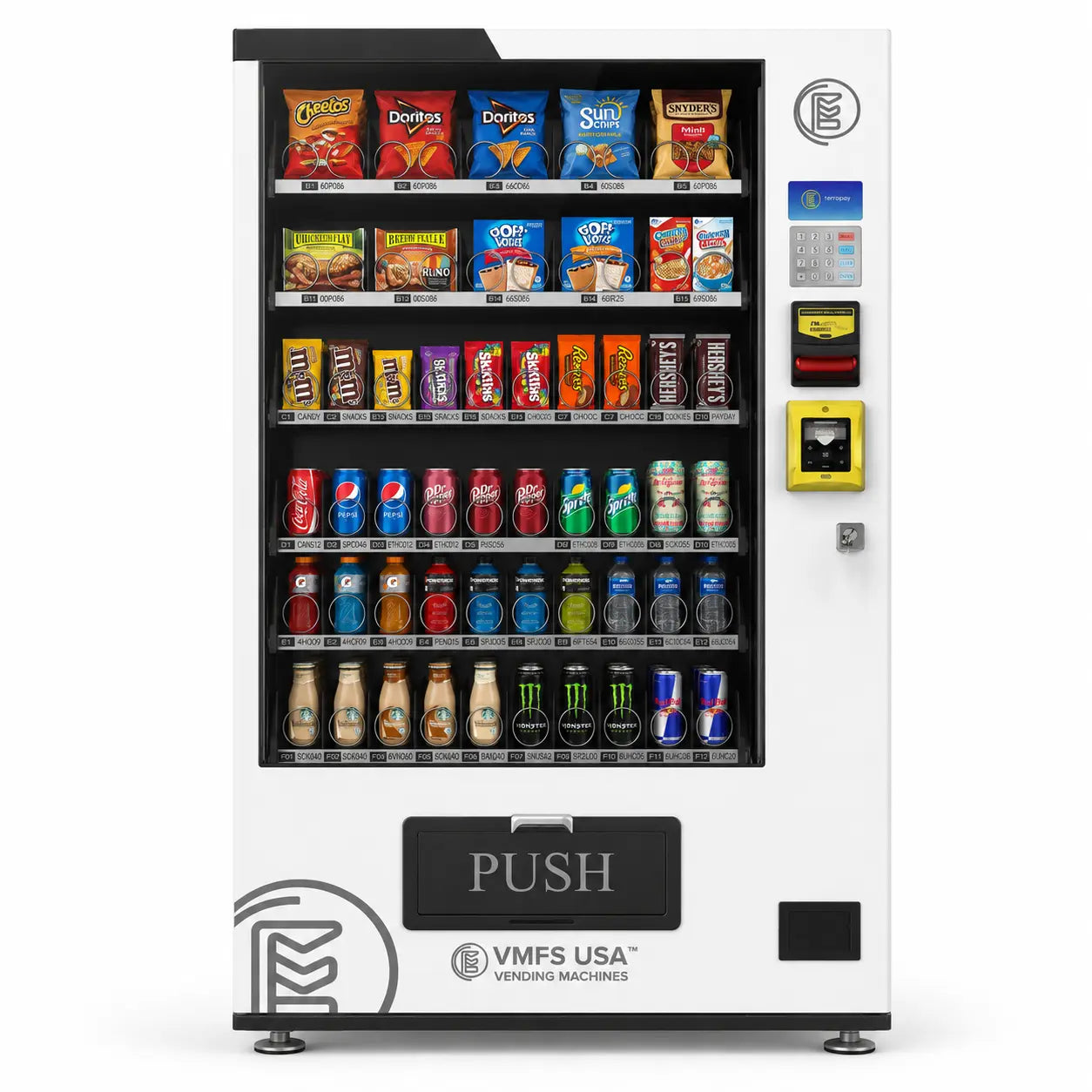
A big-item machine differs from a standard snack machine in delivery method, ticket size, security and software, and it costs more to buy. A snack machine is optimized to move many low-priced, light items through coils; a large-item machine is optimized to move fewer, higher-value items without damage and with a record of each transaction.
| Feature | Standard coil snack machine | Big-item machine |
|---|---|---|
| Delivery | Spiral coil, product drops to the bin | Elevator, conveyor, locker door or robotic picker |
| Typical items | Chips, candy, cans, bottles | Electronics, PPE, tools, apparel, kits, boxed goods |
| Ticket size | Low, a few dollars | Higher, often many times a snack |
| Access | Open to anyone with payment | Payment, badge, PIN, RFID or QR code |
| Tracking | Optional telemetry | Per-item, often per-user reporting |
| Returns | No | Possible with lockers |
| VMFS starting price | Build Your Snack Vending Machine, $3,595 | Electronics Vending Machine, $7,950 |
Payment is one of the clearest differences. Cantaloupe's 2026 Micropayment Trends Report found that 78% of vending sales were cashless in 2025 and that the average cashless transaction was $2.45 versus $1.57 for cash. If buyers already prefer cards for a two-dollar snack, a machine selling chargers or safety glasses needs card and mobile wallet acceptance from day one. VMFS lists card and mobile wallet acceptance on its elevator machines (see our guide to a cashless payment system), and touchscreen machines let customers read product details before they buy, which matters more for a $40 item than for a candy bar.
The economics also flip. A snack machine earns on volume, while a large-item machine earns on ticket size and ties up more inventory capital per slot. That makes product selection and demand forecasting more important, and it is where telemetry from VMFS Cloud pays off: you can see which slots sell, which sit, and when a high-value item is about to run out.
A large-item machine needs more security than a snack machine because each slot holds more value, so look for reinforced steel, multi-point locks, vend-verification sensors, controlled access and proper anchoring. VMFS lists a vandal-resistant, powder-coated steel cabinet with triple anchor locking on its electronics machine and a 3-point anti-vandal lock on the PRO XL Trading Card machine, and its elevator machines use photocell sensors that confirm delivery before a transaction closes.
Access control is the second layer. Retail machines take payment from anyone, but workplace and campus machines usually restrict who can vend. The Smart Elevator Vending Machine supports RFID and QR payments alongside cards and mobile wallets, and badge or PIN access can be specified on custom builds. Every transaction then lands in the cloud dashboard with a time stamp, which is what lets a safety manager answer "who took the last respirator" or an operator spot a slot that empties suspiciously fast. Internal cameras are an option worth pricing for unattended high-value sites.
Payment security is the third. The PCI Data Security Standard applies to any entity that stores, processes or transmits cardholder data, so use a PCI-compliant card reader and never collect card numbers outside the payment terminal. Our guide to card readers for vending machines compares the main options.
Physical safety matters more as cabinets get heavier. In 1995 the U.S. Consumer Product Safety Commission reported at least 37 deaths and 113 injuries since 1978 from people rocking or tilting vending machines, and the industry responded with "never rock or tilt" warning labels. With large-item cabinets weighing roughly 610 to 924 lb, place them on a firm, level floor, use the anchoring points where the site allows, and keep the warning label visible. Accessibility is the last check: the 2010 ADA Standards require at least one of each type of vending machine at a facility to meet the operable-parts rules, which include a reach range of 15 to 48 in, one-hand operation and no more than 5 lbf to operate. That affects where you put the payment reader, the pickup port and, on a locker bank, which doors are reachable.
A new large-item machine from VMFS costs $7,950 for the Electronics Vending Machine and $8,650 to $17,950 across the active elevator range, before freight, card processing, stock and any custom work. The configurable Build Your Elevator Vending Machine starts at $9,450, and the builder updates the price live as you add options.
Ongoing costs follow the same categories as any machine, with bigger numbers in a few places. Card processing typically runs a few percent of each sale; Vending.com cites 2% to 4%. Location commissions typically run about 5% to 25% of revenue, according to NerdWallet, and the rate depends on traffic and what the host expects. A 600 to 900 lb cabinet also needs freight with a liftgate or white glove service, which VMFS recommends on these models. Inventory is the cost new large-item operators underestimate most: every slot holds a higher-value item, so the first fill can tie up far more cash than a snack route. As an example, if you load 300 items with an average wholesale cost of $15, you have $4,500 of stock in the machine before the first sale.
Revenue depends on the product, the location and the model you run. Fastenal's target of under $1,000 to more than $3,000 in monthly sales per industrial device is a useful benchmark for free-issue industrial sites, but it is a distributor's sales figure, not operator profit. For retail placements, model your own numbers with the ROI calculator, using realistic sales per day and your actual product cost, and compare the result with our analysis of whether vending machines are profitable. VMFS also offers vending machine financing for operators who would rather keep cash for inventory.
Budget rule: For a large-item machine, plan the inventory budget alongside the machine budget. A cabinet you cannot afford to fill with the products that justify it will underperform a cheaper machine that is fully stocked.
A custom build makes sense when your item does not fit a standard chute or tray, when you need lockers or check-in returns, or when the machine must work with an employer's badge system, branding standards or a specific site. The VMFS custom vending machine program sizes tray spacing and delivery to the product, with drop, elevator, conveyor or sensor-based delivery, ambient, refrigerated or frozen configurations, wall-mounted or freestanding cabinets, outdoor-ready builds, and payment and age-verification options. Builder prices on that page start at $3,595 for a branded snack build and $9,450 for an elevator build.
Before you request a quote, read the custom vending machines buyer's guide to decide which features you actually need, check budget expectations in the custom vending machine cost guide, and review the custom vending machine development process so you know what happens between sign-off and delivery. Bring your largest product, its packaged dimensions and weight, the access method and the site photos; those four inputs settle most design questions in the first call.
Choose a large-item machine by starting from the product and the user, then working out the mechanism, the site and the budget. This checklist pulls the earlier sections together in the order most buyers settle them.
If you are still deciding between categories, browse the specialty vending machines collection, which includes the electronics, pharmacy and trading card machines alongside food-specific formats.
Have a product that does not fit a standard machine?
Send VMFS your item dimensions and site details and get a machine built around them.
Start a custom build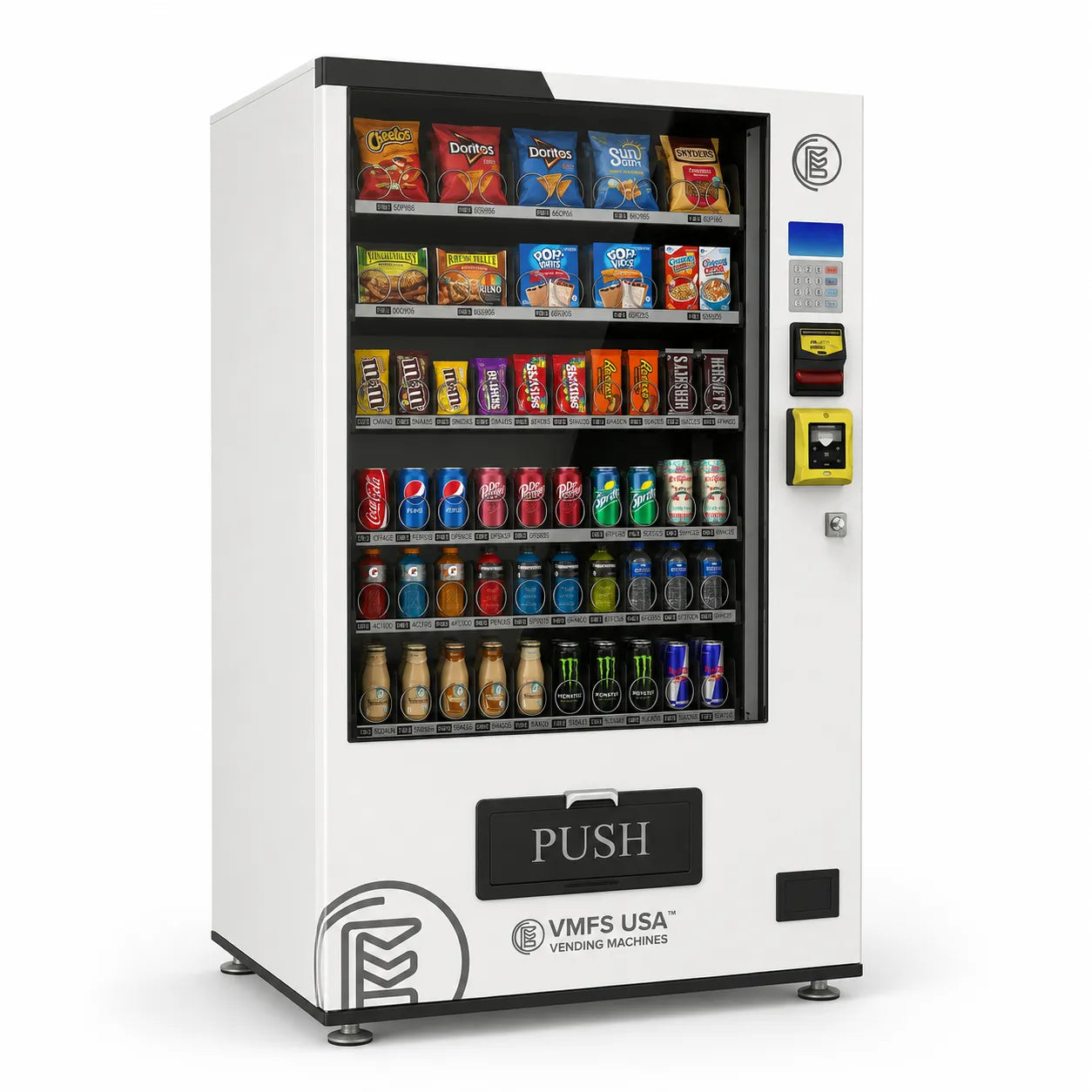
Share:
Vending Machines in Schools: Benefits, Rules and What to Stock
Vending Machines in Schools: Benefits, Rules and What to Stock