



Design the perfect vending solution for your location and customers.

Sales, inventory and alerts for your whole route, from one machine to a fleet.
Answer a few questions about your location, products and budget and get a shortlist.
Estimate revenue, payback period and margin before you buy.
Sales, setup help, warranty and parts from the VMFS USA team.
Join the VMFS newsletter and step into a thriving network dedicated to collective success.
One signup. Endless possibilities.
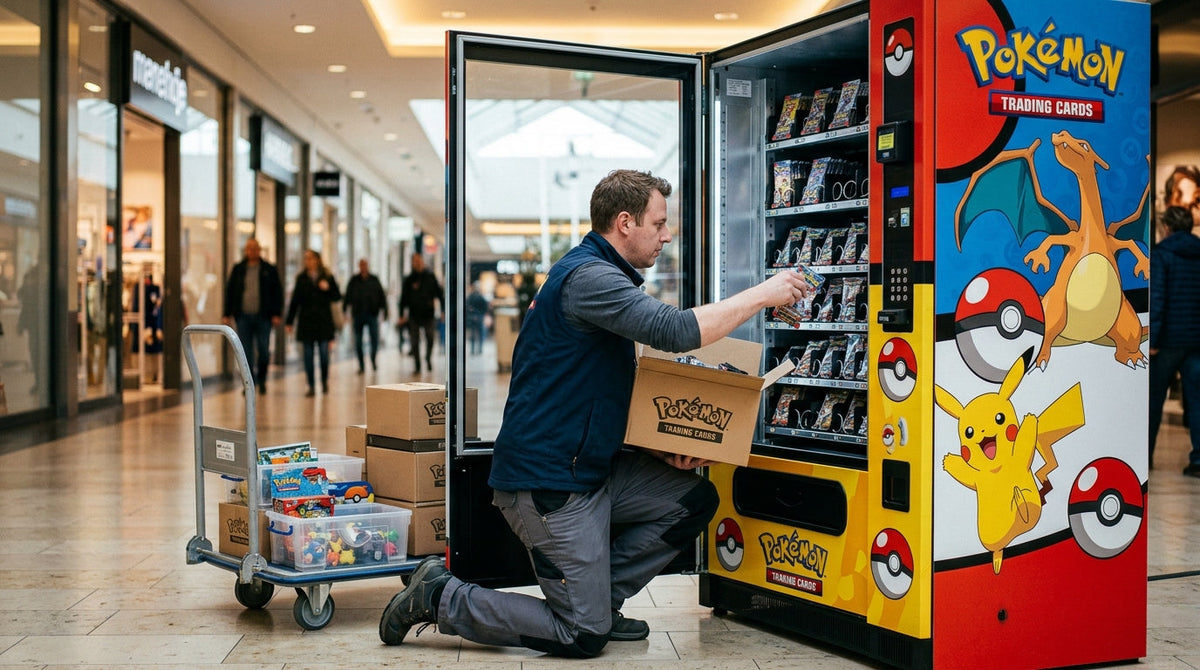
Pokémon vending machines typically restock every 1 to 5 days, with high-traffic locations refilled daily and low-traffic placements refilled weekly. Restock frequency depends on foot traffic, machine capacity, and whether the operator uses remote inventory monitoring. This guide breaks down exactly how restocking works, what signals a machine is due for a refill, and how both operators and collectors can track it.
Table of Contents
Vending machine restocking is the process of refilling a machine's product slots after inventory sells out or drops below a set threshold. For Pokémon vending machines specifically, restocking means replacing sold booster packs, sealed products, or single cards, and it happens on a tighter cycle than standard snack or drink vending because card products carry high resale demand and sell out faster per unit.
Restocking is different from maintenance. Maintenance covers mechanical servicing, payment system checks, and security inspections, while restocking is purely inventory replenishment. Operators managing a trading card vending machine generally treat the two as separate but related routines, since a machine that's mechanically sound but empty still generates zero revenue.
Restock frequency is driven directly by sell-through rate: the faster a location's foot traffic converts to sales, the more often the machine needs a refill. A machine in a busy mall food court sells through inventory in a fraction of the time it takes a laundromat unit to do the same, because exposure to buyers is the deciding variable, not the machine itself.
| Location Type | Typical Foot Traffic | Average Restock Frequency |
|---|---|---|
| Dedicated game/hobby store | High, repeat collector visits | Every 1–2 days |
| Mall or arcade | High, mixed casual foot traffic | Every 2–3 days |
| Entertainment venue (bowling, movie theater) | Moderate, weekend-heavy | Every 3–5 days |
| Laundromat or convenience location | Low to moderate, steady | Weekly |
| Low-traffic retail corner | Low | Every 7–10 days |
These ranges are general operator benchmarks rather than fixed rules, and actual frequency shifts around new set releases, holidays, and promotional drops, when sell-through can double or triple within hours.
Machine capacity sets the ceiling: a larger unit holds more inventory and buys the operator more days between visits, which is why many operators evaluating throughput compare a standard Pokémon card vending machine against a large trading card vending machine before committing to a location. Product mix matters too, since chase items and new-set booster packs sell out faster than older or lower-demand inventory, pulling the average restock date earlier than a slower-moving product line would.
Restocking follows a defined operational cycle: monitor inventory levels, prepare replacement product, physically refill the machine, then log and reconcile what was sold. Operators running multiple machines across several locations depend on this cycle staying consistent, because inconsistent restocking directly causes lost sales during empty periods.

Manual monitoring means an operator physically checks each machine on a fixed schedule, regardless of whether it actually needs a refill yet. This wastes site visits on machines that aren't empty and risks missing machines that sold out early. Remote inventory monitoring solves this by transmitting real-time slot-level data to the operator's phone or dashboard, so restocking happens based on actual demand rather than a calendar guess. This is why how Pokémon vending machines work at the hardware level directly affects how efficiently they can be restocked.
An operator receives a low-inventory alert or reaches a scheduled check-in date. They pull pre-packed replacement inventory, travel to the location, and open the machine's secured compartment using its locking access panel. Sold-out or low slots get refilled, damaged or expired packaging is removed, and the machine's inventory count is reset in the tracking system before the unit is locked and reactivated for sale.
A machine displaying multiple empty or "sold out" slots on its selection screen is the clearest signal, but visible depletion isn't the only indicator worth tracking. Sales velocity dropping sharply compared to a location's normal pattern often means the highest-demand slots emptied first, even if the machine still shows other products available. Operators using remote monitoring dashboards catch this shift before a customer ever sees an empty machine, while operators relying on manual checks typically discover it only on their next scheduled visit, by which point sales have already been lost.

Collectors chasing specific products don't need operator-level dashboards to time a visit well. Machines in high-traffic spots tend to restock on a predictable weekly rhythm tied to the location's peak foot-traffic days, so visiting shortly after a location's typical restock window improves the odds of full inventory.
Location-tracking directories that log active Pokémon vending machine placements by city and region are the fastest way to check inventory patterns without guessing. This Pokémon vending machine location directory tracks placements across the country, which helps collectors identify nearby machines and time visits around known restock activity. For readers still deciding what these machines actually are before hunting one down, it helps to start with what Pokémon vending machines are and how they differ from standard retail card displays.
High sell-through is good for revenue but creates real operational strain. The tighter the restock cycle, the more it costs in labor, travel, and inventory carrying costs, which means operators have to balance turnover speed against what they can realistically service.
Faster sell-through signals strong location demand and higher revenue per slot. Frequent restocking also keeps product current with new set releases, which sustains collector interest and repeat visits.
Frequent restocking increases labor and travel costs per machine. It also raises the risk of stockouts between visits if monitoring isn't remote, directly costing sales during the empty window.
Machine design directly determines how fast and how often a location needs servicing, because slot count and access design set the practical limits on restock efficiency. A machine with a wide product mix and larger slot count extends the interval between visits, while a compact unit trades restock frequency for a smaller footprint in tight retail corners.
| Machine Type | Slot Capacity | Restock Interval Impact | Best Fit |
|---|---|---|---|
| Trading Card Vending Machine | 20–60 slots | Shorter interval, faster turnover | Low-to-moderate traffic locations |
| Pokémon Card Vending Machine | Configurable, Pokémon-specific layout | Moderate interval | Dedicated Pokémon retail focus |
| Large Trading Card Vending Machine | 100+ slots | Longer interval, fewer visits needed | High-traffic malls, arcades, flagship locations |
Pricing is also part of the restocking equation, since carrying more inventory per machine means more upfront capital tied up in stock. Operators comparing unit cost against expected restock savings often reference a dedicated Pokémon vending machine price and cost guide before deciding on capacity.
Operators get the most consistent results by pairing remote inventory monitoring with a rotating restock route, rather than treating every machine on a fixed weekly schedule regardless of actual demand. Pre-packing replacement inventory in advance, based on each location's known product mix, cuts time spent on-site and reduces the chance of restocking the wrong products for a given location's demand pattern.
Use real-time slot-level data instead of calendar-based checks to catch depletion early.
Route high-traffic machines first since they deplete fastest and lose the most revenue when empty.
Prepare location-specific inventory bundles ahead of the visit to cut on-site restock time.
Sourcing both the machine and the product it dispenses from a single, reliable supply chain simplifies restocking logistics considerably. For sealed inventory to keep machines stocked, operators can source Pokémon booster boxes and bundles directly, pairing supply with hardware built for high-turnover dispensing.
Many operators running trading card vending routes also diversify into other high-margin vending categories to spread revenue across multiple product types and reduce dependency on card market cycles.
Most Pokémon vending machines are restocked every 1 to 5 days depending on location traffic and machine capacity. High-traffic locations like malls and dedicated card shops are typically refilled daily or every other day, while lower-traffic placements are restocked weekly.
Some machines display last-restock timestamps or live inventory counts on their selection screen. Where that's not available, checking a location directory or visiting shortly after a location's known peak traffic days is the most reliable way to estimate freshness.
This depends entirely on the operator. Some independently owned machines take direct requests, especially at dedicated hobby stores, while machines in malls or franchised locations typically follow a fixed restocking schedule set by the operator.
Yes. Sell-through increases sharply around new Pokémon TCG set launches, and operators typically shorten restock intervals during these windows to keep up with demand and avoid extended stockouts.
The machine simply shows the affected slots as sold out while remaining slots stay available for purchase. It continues operating normally until the operator's next restock visit, though a fully empty machine cannot process further sales until refilled.
Capacity depends on the machine model, ranging from roughly 20 to 60 slots on standard units up to 100 or more slots on large-format machines. Higher-capacity machines require less frequent restocking but carry more upfront inventory cost.
It's not strictly necessary but significantly improves efficiency. Remote monitoring alerts operators to low stock in real time, preventing stockouts and reducing wasted site visits to machines that don't yet need a refill.
A dedicated Pokémon vending machine location directory tracks active placements by region, making it easier to find nearby machines than searching store by store. Checking listings shortly after a location's typical high-traffic days improves the chances of finding a freshly stocked unit.
No. Restock schedules vary by operator, location traffic, and machine capacity, so two machines in different cities can be refilled at completely different intervals even if they're the same model.
Restocking refers strictly to refilling sold inventory, while maintenance covers mechanical servicing, payment system checks, and security inspections. Both are necessary, but a machine can need one without needing the other.

Compartir:
What Are Pokémon Vending Machines? The Real Story Behind 2026's Hottest Retail Trend
What Is a Smart Combo Vending Machine? The Complete Guide