



Design the perfect vending solution for your location and customers.

Sales, inventory and alerts for your whole route, from one machine to a fleet.
Answer a few questions about your location, products and budget and get a shortlist.
Estimate revenue, payback period and margin before you buy.
Sales, setup help, warranty and parts from the VMFS USA team.
Join the VMFS newsletter and step into a thriving network dedicated to collective success.
One signup. Endless possibilities.
Buying a Pokemon vending machine means selecting a machine type, sourcing genuine sealed Pokemon TCG product, securing a high-traffic location, and setting up the legal and tax structure before the unit ever powers on. Most operators spend between $3,000 and $12,000 on the machine itself, then add inventory, placement, and compliance costs on top. This guide walks through every decision point in that process, from choosing a supplier to keeping the machine legally stocked.
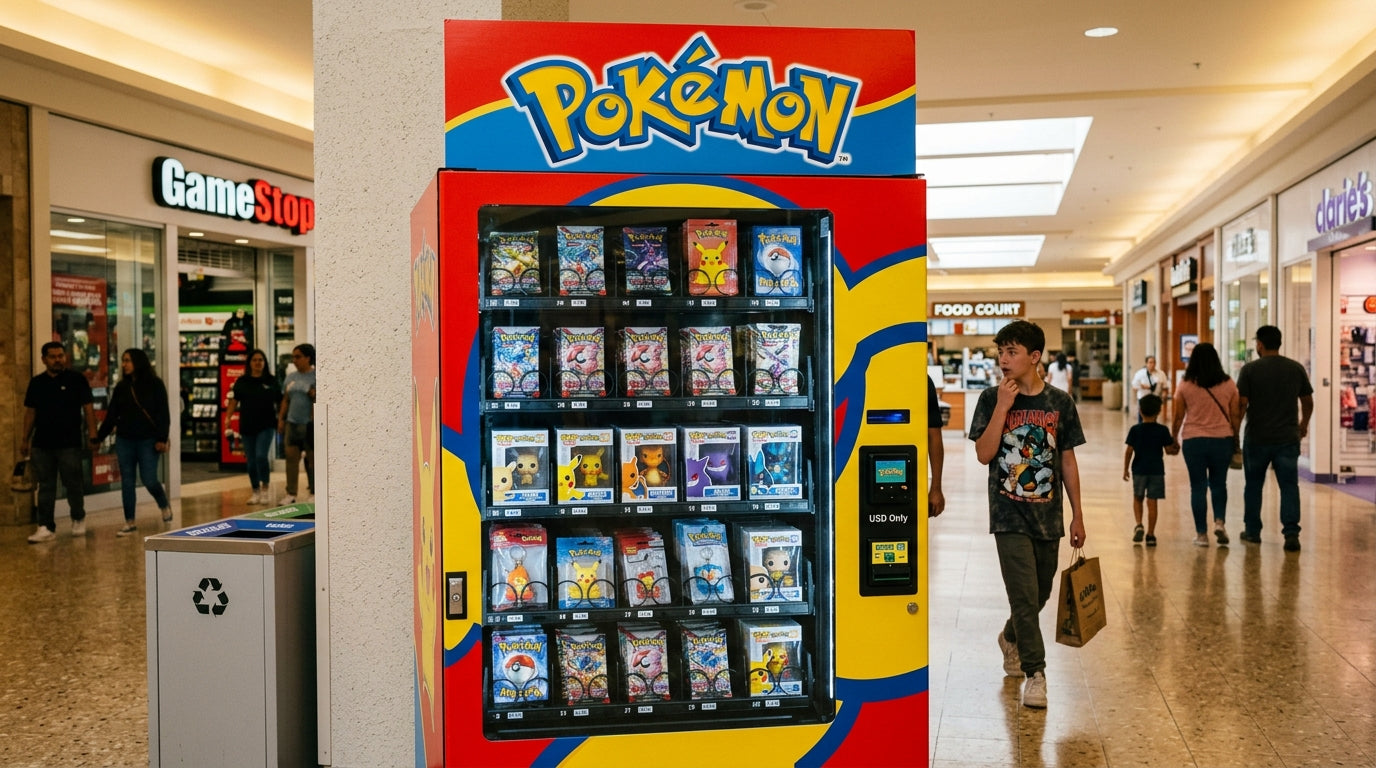
A Pokemon vending machine is a coin- or card-operated retail unit that dispenses sealed Pokemon Trading Card Game (TCG) products — booster packs, mini tins, or single-card slabs — directly to buyers without a cashier. Operators load the machine with genuine product, set price points per slot, and collect payment through cash, card readers, or mobile pay integrations. Because the machine automates the sale, it functions as a passive revenue channel once it's stocked and placed correctly. For a deeper technical breakdown of how these units operate internally, see this complete guide to how Pokemon vending machines work.
Pokemon TCG sales have surged because collectors and resellers want fast, low-friction access to sealed product outside of retail store hours. Vending removes the line at the register and the "sold out" excuse, which is why malls, game stores, and grocery chains keep adding units. If you want to understand the category itself before buying, this overview of what Pokemon vending machines are covers the format in full.
Buying a Pokemon vending machine happens in five sequential stages, and skipping a step almost always causes a costly correction later — usually a location falling through because the entity paperwork wasn't ready.
Decide whether you want a compact single-column unit for a small storefront or a large multi-slot machine for a mall or big-box retailer. Budget dictates format because larger machines cost more upfront but generate more revenue per location visit.
Buy directly from a manufacturer that builds vending hardware specifically for trading cards, rather than a repurposed snack machine. A dedicated trading card vending machine is engineered with card-safe slot spacing and tamper-resistant locks that generic vending hardware lacks.
Order sealed product from licensed distributors only. Counterfeit or resealed packs are the single biggest cause of chargebacks and location bans, so inventory sourcing deserves as much diligence as the machine purchase itself.
Register the business before signing any location agreement, because most retailers require a valid EIN and liability coverage in the contract. This step is covered in full under the legal section below.
Install the machine, run a test transaction cycle, and confirm the card reader and cash mechanism both settle correctly before opening it to customers.
Machine type determines both upfront cost and how much product you can hold between restocks. The table below compares the three formats most operators choose from.
| Machine Type | Best For | Typical Capacity | Approx. Price Range |
|---|---|---|---|
| Compact Single-Slot | Convenience stores, small retail corners | 40–80 packs | $2,800 – $5,500 |
| Standard Multi-Slot | Game stores, gyms, laundromats | 150–300 packs | $5,500 – $9,000 |
| Large Pokemon Vending Machine | Malls, grocery chains, high-traffic retail | 400+ packs, multiple product tiers | $9,000 – $14,000+ |
Total cost of buying a Pokemon vending machine includes hardware, shipping, initial inventory load, and ongoing restocking — not just the sticker price of the unit. Hardware alone typically runs $3,000 to $12,000 depending on size and features, while initial sealed-product inventory adds another $1,500 to $4,000 for a full first load. A detailed breakdown of every line item is available in this Pokemon vending machine prices and cost guide.
Beyond the initial purchase, expect monthly costs for location rent-share or commission, card processing fees, and periodic restocking trips. Machines placed in high-traffic retail locations sell through inventory faster, which raises restocking frequency but also raises revenue proportionally.
Location determines revenue more than any other single variable, because foot traffic converts directly into pack sales. Malls, grocery store entrances, game shops, and family entertainment centers consistently outperform low-traffic office locations. A ranked breakdown of location types is available in this guide to the best places for Pokemon vending machine placement.
Placement quality also affects discoverability — collectors actively search for nearby units, and machines listed on location-finder platforms see higher repeat traffic. If you're scouting a specific chain, this resource on finding a Kroger Pokemon vending machine shows how one major retailer handles listings, and this guide explains how to find Pokemon vending machines near you in general.
If you own retail or commercial space rather than a machine, you can list your location and get matched with vetted operators instead of sourcing a machine yourself. See the location-owner CTA at the end of this article.
For a full directory of currently active units, check this list of Pokemon vending machine locations before committing to a market that may already be saturated.
Restocking happens because sealed product sells fastest in the first 48–72 hours after a machine is refilled, then tapers until the next visit. Operators typically restock every 5 to 10 days depending on location traffic, tracking sell-through per slot so high performers get more inventory space over time. A full restocking workflow is outlined in this guide to Pokemon vending machine restocking, and daily operation steps — from unlocking the cabinet to reconciling cash — are covered in this walkthrough on how to use a Pokemon vending machine.
Stockouts happen because operators underestimate demand at new locations, so track sell-through weekly for the first month and adjust restock cadence accordingly. Shrinkage — missing product not tied to a sale — usually points to a lock or slot mechanism issue rather than theft, and should be inspected at every restock visit.
Legal setup happens because vending machine operators are treated as retail businesses in every U.S. state, which means sales tax registration, an EIN, and often a local vending permit are required before a machine can legally operate. Skipping this step exposes the operator to personal liability if a location dispute or tax audit arises.
Choosing the right entity — LLC, sole proprietorship, partnership, or corporation — determines your personal liability exposure and tax treatment. Most vending operators form an LLC specifically because it separates personal assets from machine-related liability while keeping tax filing simple.
| Entity Type | Liability Protection | Best Fit For |
|---|---|---|
| LLC | Strong (personal assets separated) | Solo or small-team operators |
| Sole Proprietorship | None | Single-machine testers only |
| Partnership | Limited | Two or more co-owners splitting revenue |
| Limited Partnership | Partial (for limited partners) | Investor-backed vending operations |
| S-Corporation | Strong | Operators scaling past a few machines |
| C-Corporation | Strong | Multi-location vending companies raising capital |
If your vending business will operate under a name different from your own, or you need a compliance point of contact in each state you place machines, a registered agent for a vending machine business keeps state filings and legal notices in order.
Every state that charges sales tax requires vending operators to register for a sales tax permit before the first transaction, because pack sales are treated as taxable retail goods. Set up your EIN, state sales tax registration, and vending-specific tax filing structure together during entity formation to avoid re-filing later.
Location agreements define commission splits, placement duration, and liability coverage between the operator and the property owner, and should always be in writing before a machine ships. Vendor and supplier contracts matter equally, since counterfeit product from an unverified supplier can void your location agreement entirely.
Pokemon's brand and logo are protected trademarks, so operators cannot legally reproduce the Pokemon logo on machine wraps or signage without a license. This distinction is explained fully in this guide on using the Pokemon logo on a TCG vending machine, and the broader legality of the business model itself is addressed in this resource on whether you can legally sell Pokemon in a vending machine.
For operators planning multiple machines across states, this 2026 Pokemon card vending machine operator guide walks through scaling considerations in more depth.
Get a durable, card-safe vending unit built specifically for sealed Pokemon TCG product.
Shop the Pokemon Card Vending MachineCombine sealed Pokemon packs with snacks or drinks in one high-traffic unit.
View MachineHigher-capacity unit built for malls, grocery chains, and high-volume retail.
View MachineList your location, get matched with vetted operators, and start earning from a Pokemon vending machine without buying one yourself.
List Your Location With VPlaced
Compartir:
How to Use a Pokémon Vending Machine: Step-by-Step Guide
How to Start and Operate a Pokemon Vending Machine: The Complete Guide