



Design the perfect vending solution for your location and customers.

Sales, inventory and alerts for your whole route, from one machine to a fleet.
Answer a few questions about your location, products and budget and get a shortlist.
Estimate revenue, payback period and margin before you buy.
Sales, setup help, warranty and parts from the VMFS USA team.
Join the VMFS newsletter and step into a thriving network dedicated to collective success.
One signup. Endless possibilities.
Machines & Economics | Personalised Print Vending | By the VMFS USA Team | September 2026
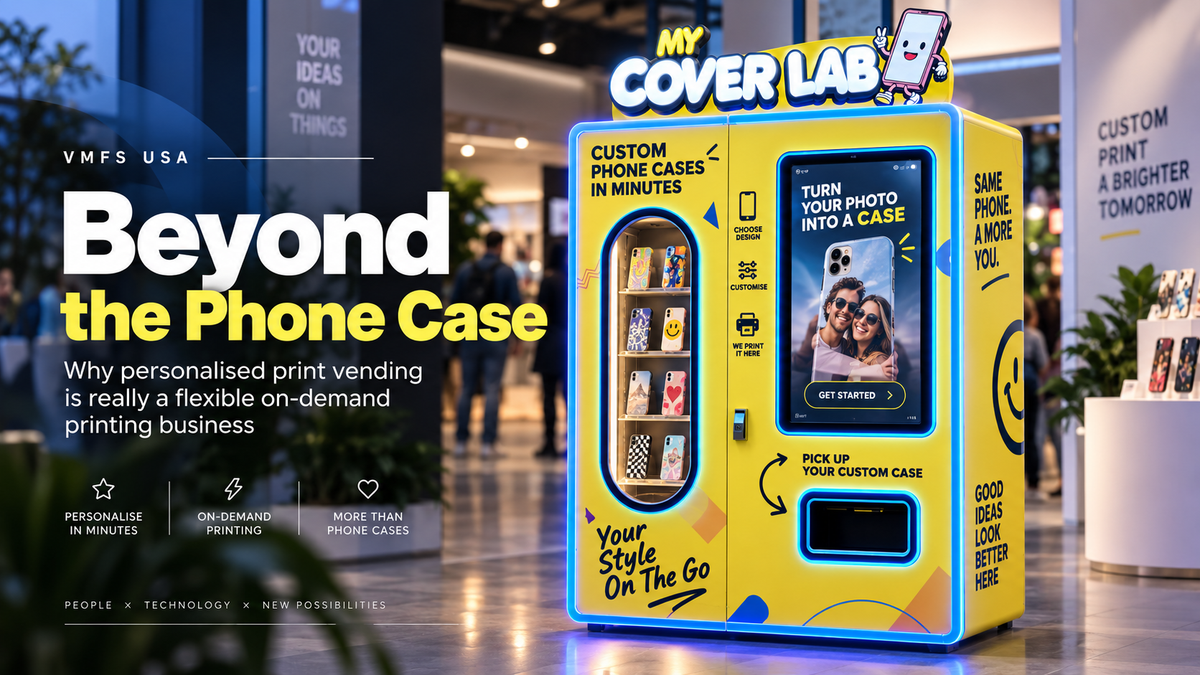
We have written before about phone case printing machines, and we framed them the way everybody frames them: a clever way to sell phone cases with no inventory. That framing was too small, and we worked out why while standing in front of a bank of them.
Beside the case machine was an identical looking unit doing exactly the same thing to a completely different object. Same screen, same QR code, same upload your photo from your phone, same wait. Except what came out the bottom was a jigsaw puzzle.
That is the whole insight, and it changes how an operator should think about this entire category. These are not phone case machines. They are printers with a payment terminal attached, and the thing being printed on is a variable.
Change the blank and you have changed the business, without changing the machine, the flow, the customer or anything about how the site works.
Where this comes from: we supply and operate vending machines across the United States, including print on demand and personalisation formats. The photographs here are our own from the show floor.

Break the machine down and there are four components, and three of them do not care what you are selling.
Once you see it that way, a question opens up that nobody in American vending is really asking. What else fits under that printer, and which of those things do people want enough to wait a few minutes for?
The structural point: every other machine in vending is defined by what it holds. This one is defined by what it can do, and the inventory is interchangeable. That is closer to owning a small manufacturing capability than to owning a retail cabinet, and it is why the same hardware can serve a phone shop, an aquarium and a wedding venue without modification.
We would go further than treating the puzzle as merely another option, because on several measures it is a stronger product and it reveals what to look for in any blank you consider.
That list is really a checklist for evaluating any personalisation product. Does it fit everybody, does the stock hold its value, is it bought as a gift, does it carry feeling, and does it forgive an imperfect source image.

The QR upload deserves more credit than it gets, because it solves a problem that made this category impossible for years.
Designing on a vending machine touchscreen is miserable. Small controls, a screen dozens of people have touched, and no access to anything the customer owns. The moment the design happens on the customer's own phone, all of that disappears. They are using a device they know, with their entire photo library already on it, at whatever pace suits them.
Look at the photographs again and notice they are not standing alone. Several machines side by side, lit as one installation, reading as a single destination rather than as separate cabinets.
That is a deliberate configuration and it works for reasons specific to this category.
This is the part we would press with operators looking at the category. Plan for a bank rather than a unit. The site conversation is barely harder, the footprint is manageable, and the difference in what the installation earns is not marginal.
Worth thinking about seriously, because the category is early enough in the United States that the obvious products are not yet taken.
| Blank | Why it works | Where |
|---|---|---|
| Jigsaw puzzles | Fits everybody, no obsolescence, bought as a gift | Attractions, malls, family venues |
| Phone cases | High perceived value, strong impulse | Malls, airports, campuses |
| Photo blocks and framed prints | Pure gift purchase, no fit issues at all | Tourist sites, zoos, aquariums |
| Luggage tags | Genuinely useful and bought at the exact moment of need | Airports, hotels, transit |
| Keyrings and small tokens | Low price point, easiest yes for a parent | Family venues, events |
| Drinkware and mugs | Established gift category with obvious use | Malls, campuses, workplaces |
Note how many of those suit venues that would never take a conventional machine. A zoo gift shop, a wedding venue, a stadium concourse. These sit alongside the rest of our specialty vending machines precisely because they solve problems standard cabinets cannot.

This is the calculation operators skip and it decides whether a site works. Every other machine in vending is limited by demand. This one is limited by physics.
Take the print time, add the time somebody spends choosing and cropping, and you have a cycle time per customer. Divide your peak trading window by that number and you have a hard ceiling on how many orders one machine can possibly take, regardless of how many people want one.
A worked example makes the point. Suppose a cycle takes six minutes end to end, and a venue has a genuine three hour peak when people are waiting.
Run that arithmetic for any site before committing, because it tells you immediately whether one unit can ever justify the placement or whether the site only works as a bank.
The specification questions that matter here are different from ordinary vending, and several of them are difficult to change afterwards.
That first question is the one we would press hardest, because the whole argument of this article is that the blank is the variable. A machine locked to one product is a much narrower business than one that can follow demand, and it is worth confirming through the machine customizer or a direct conversation rather than assuming flexibility that may not exist.
Choose the site before the product, because dwell time and audience determine which blank makes sense. An aquarium exit and an airport gate want different things from the same machine, and our partners at VPlaced screen specifically for the waiting behaviour this format needs.
Then plan for more than one unit. The throughput maths and the basket maths both point the same direction, and a bank is a materially better business than a machine.
On our side, personalisation units sit within the touch screen range and the wider shop. If you want a specific blank, a particular finish or a machine built around a venue, that is a custom build conversation and the machine customizer is the fastest way to see what is possible. Presentation matters unusually much on these, which is VMarketed territory, and once a machine is live, listing it on VendingFinder is worth doing because people genuinely search for these.
A machine that prints a customer's own photograph onto a blank product while they wait. The customer scans a QR code, uploads an image from their phone, positions it on screen and pays, and the machine produces the finished item in a few minutes. Phone cases and jigsaw puzzles are the two most common outputs.
The underlying capability is a printer plus an upload flow, and the blank is what determines the product. That is why a puzzle machine and a case machine look and behave almost identically. Which specific blanks a given unit accepts depends on its configuration, so it is worth specifying deliberately rather than assuming it will take anything.
Because printing takes minutes rather than seconds. A single unit at a busy site turns people away while it works, whereas a bank lets the next customer start immediately. Grouping also reads as a destination rather than a vending machine and lifts the basket, since somebody waiting for one item sees the machine beside it.
They avoid the two biggest problems with phone cases. There is no compatibility issue, since a puzzle fits everybody, and there is no obsolescence, since blanks do not lose value when a new handset launches. They are also bought as gifts rather than for oneself, which lifts both the occasion and the price people accept.
The printer. A print head fault takes the whole machine out of service and needs somebody with printer knowledge rather than vending knowledge, so agree your service arrangement before purchase. After that, the most common issue is customers uploading low resolution images and blaming the machine for a soft result.
A Machine That Makes the Product After You Pay
We supply personalisation and print on demand machines and build them around specific products and venues. Tell us what you want to print and where it is going.
Build a Custom Machine
Compartir:
Office Coffee Machine Power Consumption and Workplace Efficiency