



Design the perfect vending solution for your location and customers.

Sales, inventory and alerts for your whole route, from one machine to a fleet.
Answer a few questions about your location, products and budget and get a shortlist.
Estimate revenue, payback period and margin before you buy.
Sales, setup help, warranty and parts from the VMFS USA team.
Join the VMFS newsletter and step into a thriving network dedicated to collective success.
One signup. Endless possibilities.
Office coffee machine power consumption dictates a major share of utility overheads for modern workplaces, ranging anywhere from 500 to 1,800 watts depending on the underlying technology. Facility managers and business owners frequently overlook the operational draw of continuous heating elements, grinders, and digital user interfaces. Understanding these energy metrics allows companies to optimize operating expenses while scaling employee perks effectively. Selecting the proper equipment requires balancing office headcount, daily drink volume, and energy efficiency standards to prevent unexpected utility spikes.
Office coffee machine power consumption refers to the total electrical energy demanded by a commercial or corporate brewer during active extraction cycles, idle standby periods, and maintenance phases. When a machine actively heats water or runs its internal grinder, it draws peak wattage. Most standard workplace brewers operate within a bandwidth of 1,000 to 1,500 watts, though heavy-duty industrial units can scale higher.
The internal boiler mechanism consumes the vast majority of this electricity. Water must be kept at optimal brewing temperatures, usually between 195°F and 205°F, or reheated rapidly on demand via thermal block systems. Grinders add a brief, high-amp surge during the bean-to-cup milling process, lasting only 5 to 10 seconds per cup. Digital touchscreens, telemetry modules, and internal lighting draw minimal baseline power, typically under 5 watts continuously.
Evaluating equipment options involves reviewing comprehensive assessments like the ultimate guide to office coffee machines to align performance specs with electrical infrastructure. Modern workplace systems balance raw heating capacity with intelligent power-saving firmware to suppress idle draw. Evaluating this dynamic helps managers prepare adequate circuit loads, preventing tripped breakers in shared breakroom environments.
Different brewing technologies exhibit distinct power profiles based on how they heat water and automate the extraction sequence. Capsule systems, bean-to-cup units, and traditional pumped espresso makers draw varying loads depending on their structural design and boiler capacity.

Bean-to-cup systems dominate modern office settings due to their streamlined operation and comprehensive capabilities outlined in the guide to purchase office coffee machine. While their peak wattage is high, smart energy profiles mean they only draw full power when processing an order. Conversely, traditional machines with hot plates maintain high standby energy losses because heating elements cycle continuously to keep carafes warm.
Facility planners must weigh these metrics alongside daily foot traffic patterns. Reviewing insights from the best office coffee machines ensures that chosen units match the structural capacity of the breakroom. Selecting energy-rated equipment directly suppresses long-term utility overhead without compromising beverage quality or team productivity.
Calculating exact power expenses requires translating wattage and runtime into kilowatt-hours (kWh) and multiplying that figure by local utility rates. A machine operating at 1,500 watts for a total cumulative runtime of one hour per day consumes 1.5 kWh of electricity daily. Over a standard 30-day billing cycle, this totals 45 kWh. At an average commercial electricity rate of $0.12 per kWh, the monthly energy cost equals $5.40.
Standby power consumption significantly alters this equation for machines left powered on 24/7. If a brewer draws 20 watts during its 14 idle hours, that accounts for an additional 280 watt-hours daily, or 8.4 kWh monthly. Real-world consumption scales dynamically with office size, beverage popularity, and whether employees remember to activate sleep modes.
| Daily Operational Hours | Average Wattage | Monthly kWh Usage | Estimated Cost ($0.12/kWh) |
| 0.5 Hours (Low Volume) | 1,200W | 18 kWh | $2.16 |
| 1.5 Hours (Medium Volume) | 1,400W | 63 kWh | $7.56 |
| 3.0 Hours (High Volume) | 1,800W | 162 kWh | $19.44 |
Understanding these formulas helps organizations budget accurately for facility overheads. For deeper financial projections regarding workplace amenities, business owners frequently consult resources like the coffee vending machine price guide. Accurate forecasting prevents unexpected utility budget variances across large corporate campuses.
Selecting the correct physical unit ensures that power consumption matches actual workplace demand rather than wasting energy on oversized infrastructure. Small offices with fewer than twenty employees benefit immensely from compact setups that eliminate continuous boiler heating. Reviewing specifications for compact units via the best coffee machines for home office provides viable alternatives for tight spaces.
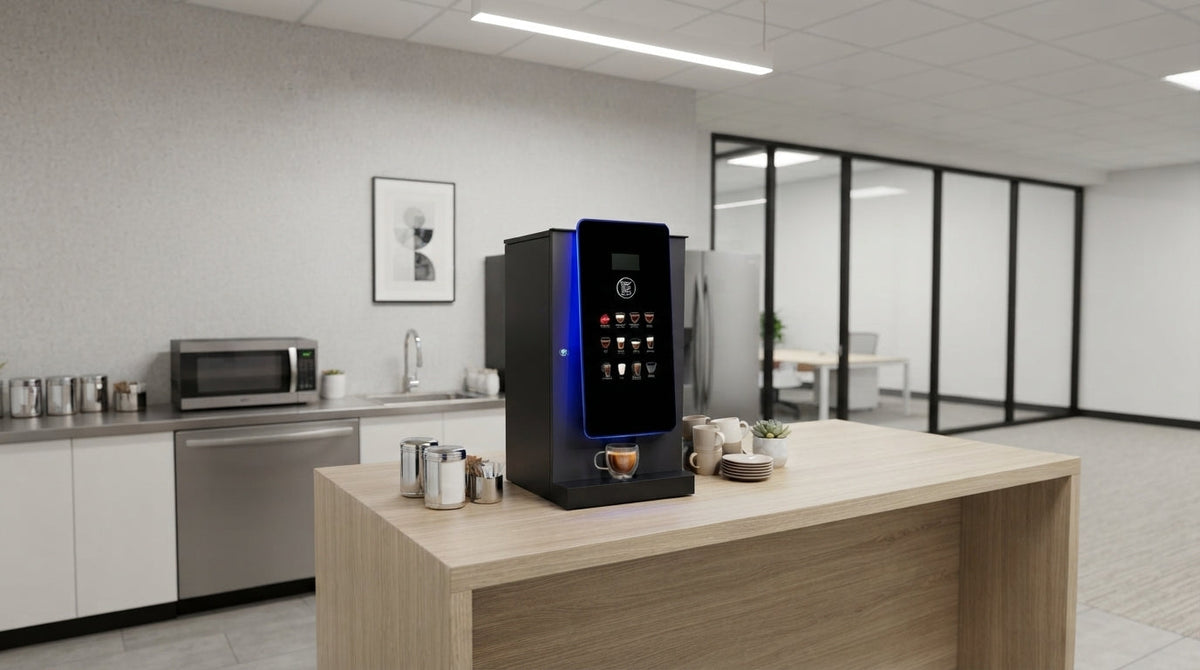
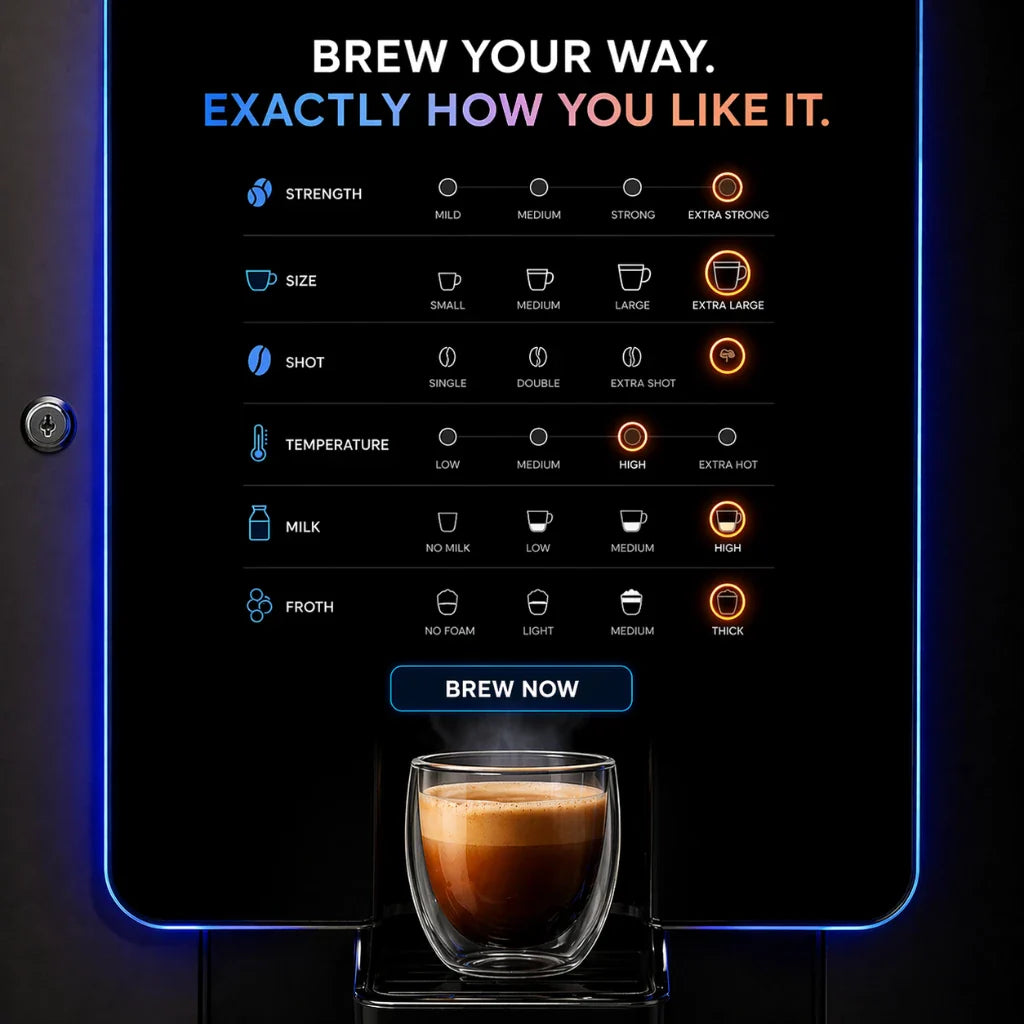
For small corporate footprints, the premium countertop touch screen coffee machine delivers exceptional bean-to-cup quality while minimizing electrical draw during low-traffic hours. Its intelligent heating architecture targets only the exact water volume required for a single cup, drastically cutting idle waste.

Medium-sized workspaces require robust scaling to handle concurrent morning rushes without dropping water temperature or tripping circuit breakers. The pro coffee vended system balances speed, multi-drink capability, and optimized power management. For large enterprise hubs experiencing round-the-clock shift work, high-capacity units like the corepro coffee vending machine provide heavy-duty durability. These larger units utilize insulated dual boilers that retain heat efficiently, preventing excessive cycling throughout long operational windows.
Explore the complete selection at the coffee vending machines collection to find models matching specific workspace requirements. Matching unit capacity to headcount prevents both underpowered strain and excessive electrical waste.
Several operational variables cause office coffee machine power consumption to fluctuate beyond baseline manufacturer estimates. Ambient room temperature plays a major role; breakrooms located in cooler areas or near drafty windows force internal boilers to work harder to maintain target brew temperatures. Hard water scale buildup inside heating elements acts as an insulator, forcing the machine to draw more power and run longer cycles to heat water.
User behavior heavily impacts overall energy expenditure as well. Leaving rinse cycles running unnecessarily, brewing single cups consecutively rather than utilizing batch features, and disabling auto-shutoff timers inflate monthly utility bills. Maintenance routines directly combat these spikes. Implementing descaling schedules found in the coffee vending machine cleaning and maintenance guide restores thermal conductivity and keeps electrical draw within nominal specifications.
Furthermore, machine placement dictates operating efficiency. Poorly ventilated breakroom corners trap ambient heat around the appliance chassis, reducing cooling efficiency for internal refrigeration or electronic components. Reviewing layout principles through the best location to place office coffee machine ensures optimal airflow, protecting electrical components from thermal fatigue and premature failure.
Optimizing breakroom energy efficiency requires a combination of automated settings, smart hardware placement, and routine upkeep. Modern commercial brewers feature programmable sleep modes that drop boiler temperatures during off-peak evening and weekend hours. Activating these sleep windows cuts idle energy loss by up to seventy percent over the course of a month.

Implementing these steps safeguards equipment longevity while keeping utility expenditures predictable. For entrepreneurs looking to scale commercial operations or establish automated beverage routes, structured educational frameworks like the coffee vending business course resources offer complete operational roadmaps. Managing utility overhead successfully enhances profit margins across both managed office services and independent vending routes.
Most commercial office coffee machines consume between 1,000 and 1,800 watts during active brewing and heating cycles. Standby power draw generally ranges from 5 to 30 watts depending on display features and boiler insulation.
Leaving a machine powered on continuously incurs notable idle energy costs due to the heating element cycling to maintain water temperature. Utilizing programmable sleep modes or auto-shutoff features reduces this waste significantly.
Monthly operating costs typically range from $5.00 to $20.00 depending on local electricity rates, machine wattage, daily cup volume, and the total duration the machine remains powered on.
Bean-to-cup machines generally consume slightly more peak power (1,200W to 1,800W) than basic pod units due to integrated grinders, though their advanced thermal management often offsets this during idle periods.
Severe limescale accumulation inside the internal boiler acts as a thermal barrier, forcing the heating element to draw maximum power for longer durations to reach brewing temperatures.
Enabling built-in power-saving sleep schedules, descaling the boiler elements quarterly, and ensuring adequate ventilation around the unit chassis successfully lowers overall energy consumption.
High-draw commercial units rated above 1,500 watts often require a dedicated 15-amp or 20-amp circuit to prevent voltage drops and avoid tripping breakers during simultaneous heating and grinding cycles.
Placing coffee machines in poorly ventilated enclosures traps heat, forcing internal cooling fans and temperature regulators to work harder, which subtly increases overall electrical draw.
Yes, certain commercial and bean-to-cup manufacturers provide energy-certified models featuring low-power standby modes and insulated dual-boiler systems designed to minimize workplace utility overhead.
Evaluating modern specifications via the best coffee machine for office review highlights models optimized for both rapid drink delivery and efficient power scaling.

Compartir:
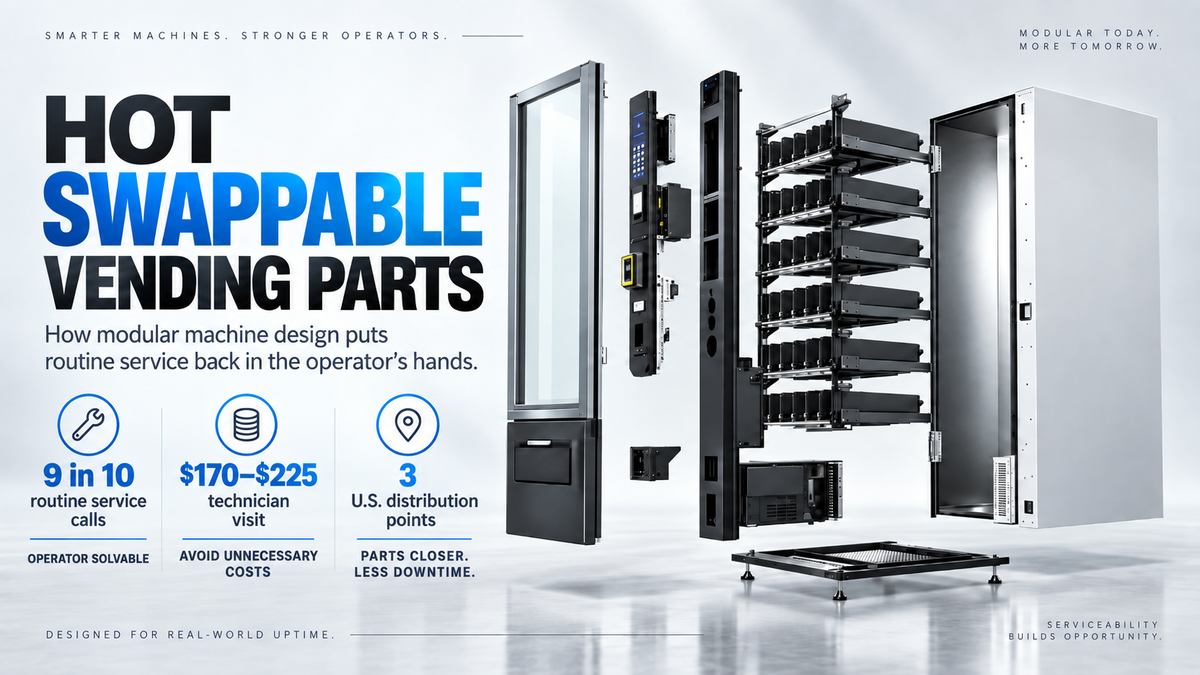
Hot Swappable Vending Machine Parts: The VMFS USA Development Program