



Design the perfect vending solution for your location and customers.

Sales, inventory and alerts for your whole route, from one machine to a fleet.
Answer a few questions about your location, products and budget and get a shortlist.
Estimate revenue, payback period and margin before you buy.
Sales, setup help, warranty and parts from the VMFS USA team.
Join the VMFS newsletter and step into a thriving network dedicated to collective success.
One signup. Endless possibilities.
Miami, Florida | September 14, 2026
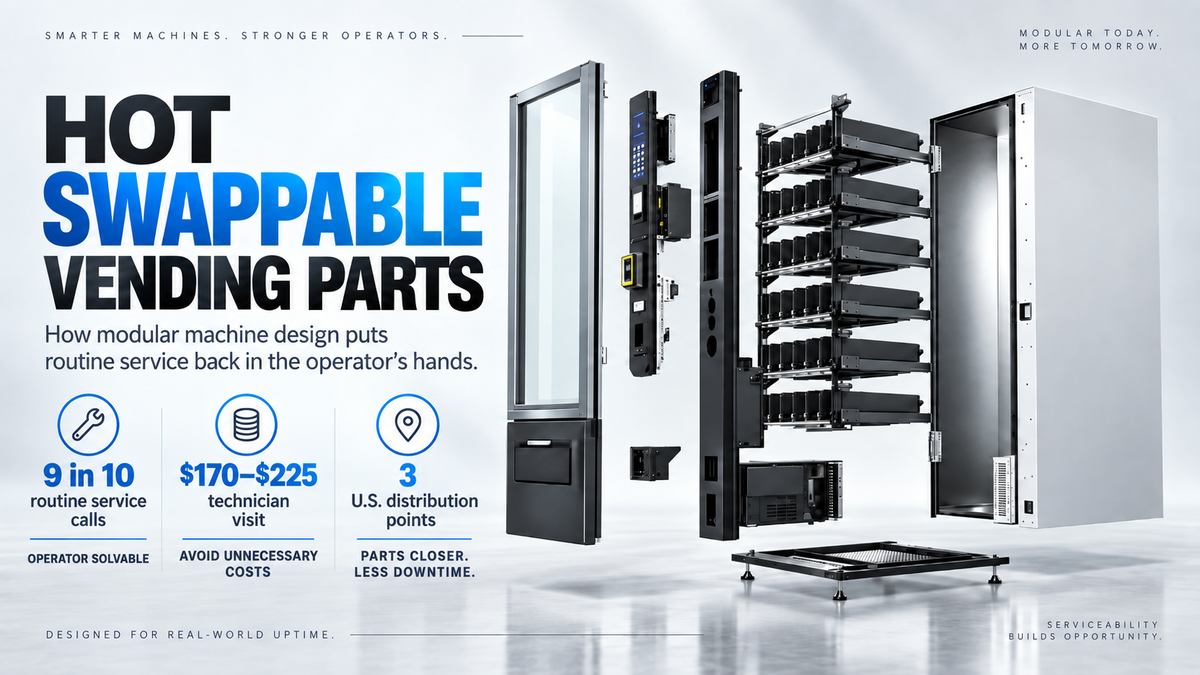
VMFS USA is actively developing hot swappable vending machine parts as a standard across its catalog, working with its manufacturing partners and building on replacement parts already stocked at three coordinated United States distribution points in Miami, Los Angeles and Atlanta. The goal is simple: put routine service back in the hands of the operator instead of a technician's calendar.
The direction for VMFS USA vending machines is straightforward. When a component needs changing, it should come out on a labelled connector and a new one should go straight back in, handled by the operator, with no certified technician and no specialized tooling.
The work is focused on the components behind close to nine out of ten routine vending service calls: the payment module, vend motors and coils, fans, sensors, lighting, the delivery mechanism, the power supply and the control board.
We come at this from the operator side rather than the factory side, and the operator's real enemy has never been a broken part. It is waiting. If the fix is already in your van, on a visit you were making anyway, you get back the most expensive thing you own. Jose Perez, Chief Executive Officer, VMFS USA
Four things are shaping the work. Serviceable, hot swappable vending machine parts are something we push for in what we specify with our manufacturing partners. Parts are stocked inside the country. They are labelled and documented so a swap is obvious instead of intimidating. And the machine tells you what needs attention before you get in the van.
We are actively working to widen this across every format in the catalog. Below is a realistic picture of which vending machine parts are in scope, which are not, and why it changes route economics more than anything on a spec sheet.
The nine in ten figure describes where the work is focused rather than a fixed count on any one machine, and it comes from where routine vending service calls actually land. Across the industry, service work clusters heavily in a small number of subsystems, and almost every one of them is a module rather than a structural part.
| Component group | What it covers | Swap approach |
|---|---|---|
| Payment hardware | Card reader, tap unit, bill acceptor and coin mech as one removable assembly | True hot swap, a few minutes |
| Motors and coils | The most common cause of a dead selection, seated on a labelled plug | Hot plug, around 10 minutes |
| Main control board | Board on a service tray, settings and planogram restored from the cloud | Field replaceable, around 20 minutes |
| Touchscreen and keypad | Interface hardware kept separate from the controller | Hot plug, around 15 minutes |
| Delivery mechanism | Elevator or conveyor assembly out as one unit with its own drive and sensors | Field replaceable, around 25 minutes |
| Fans and airflow | Evaporator and condenser fans on quick release mounts | True hot swap, a few minutes |
| Power supply | A discrete unit on a standard connector rather than built into the board | Field replaceable, around 15 minutes |
| Sensors, locks, lighting | Drop sensors, door switches, lighting and locks kept common across models | Hot swap to field replaceable, around 10 minutes |
Times are indicative targets rather than fixed figures, and configurations differ between models. The point is the shape of the work, not a stopwatch.
Some things stay professional, for reasons that are legal or structural rather than commercial. Sealed refrigeration work falls under federal certification requirements, so compressors, condensers and refrigerant handling belong with certified professionals. The cabinet, frame and tempered glass are not modules by definition. A small group of calibration dependent parts arrive factory set so a swap cannot quietly put your machine out of tolerance.

The part comes out and goes back in while the machine stays powered and keeps selling. Payment hardware, cooling fans, lighting and some sensors sit here.
The part changes on a live machine but wants a release step first, usually a quick pass through the service menu so the board recognizes the new unit. Motors, coils, keypads and touchscreens sit here.
The machine comes off the outlet for a few minutes, but you need nothing more exotic than a Phillips head screwdriver and a guide on your phone. Control boards, delivery mechanisms, power supplies and door hardware sit here.
Independent vending technicians in 2026 commonly bill $95 to $150 an hour, and most add a service call fee of around $75 just to arrive. One visit is often $170 to $225 before anyone touches a screw.
The part itself is usually the cheapest thing in the event. A vend motor is often $15 to $40 and takes twenty minutes. A thermostat is commonly $30 to $80. What you are really paying for is labor, travel and scheduling.
A machine doing $2,000 a month with a dead card reader loses roughly $67 a day, so four days down costs about $268 in sales on top of the repair bill. That is before the customer who finds an out of service sign twice and stops checking a third time.
A swappable part is only half the answer. If you still drive out to work out which component needs changing, then drive back with it, you have replaced one problem with a cheaper version of the same problem.
VMFS Cloud is our remote monitoring service at $7.99 per machine per month. It reports sales, stock levels and machine alerts, so a fault reaches you as a notification instead of a call from an unhappy property manager. Pointing that alert at a component group is what turns a swappable part into a same day fix.
| Stage | Conventional service call | With hot swappable parts |
|---|---|---|
| Fault found | Location partner calls, often a day after it stopped selling | Alert can reach you before anyone at the site notices |
| Diagnosis | Technician visit just to identify what failed | Fault usually points to a component group before you leave |
| Who repairs it | Certified technician, on their schedule | You, on the next restock visit |
| Tools | Technician toolkit, sometimes model specific | Usually one standard screwdriver, sometimes nothing |
| Labor cost | Service call fee plus hourly rate | Often none, inside a visit you were making anyway |
| Days of lost sales | Commonly three to seven | Frequently under a day |
Serviceability is decided long before a machine reaches a location. These are the four requirements we put in front of our manufacturing partners, and what we check for in Miami before a machine goes out.
Our vending machine parts support already runs on phone, chat and screen share. This is meant to make those calls shorter, not longer.

The hardest part of field repair has never been the screwdriver. It is the wait. A component you can change in eight minutes is worth nothing if it is three weeks out on a container ship.
Our warehouses in Los Angeles and Atlanta stock the majority of products, replacement parts and components. With the Miami campus, which handles customization, quality assurance, assembly and order processing in house, that is three coordinated distribution points covering both coasts and the southeast.
Our by appointment Demo Showroom in Miami runs a revolving inventory, so as this work progresses you can open a machine up and pull a part out with your own hands rather than taking a spec sheet's word for it.
The win is motors and coils. A combo carries the highest count of individual selections in the catalog, so a dead row on a busy combo vending machines route is the most common revenue leak in vending.
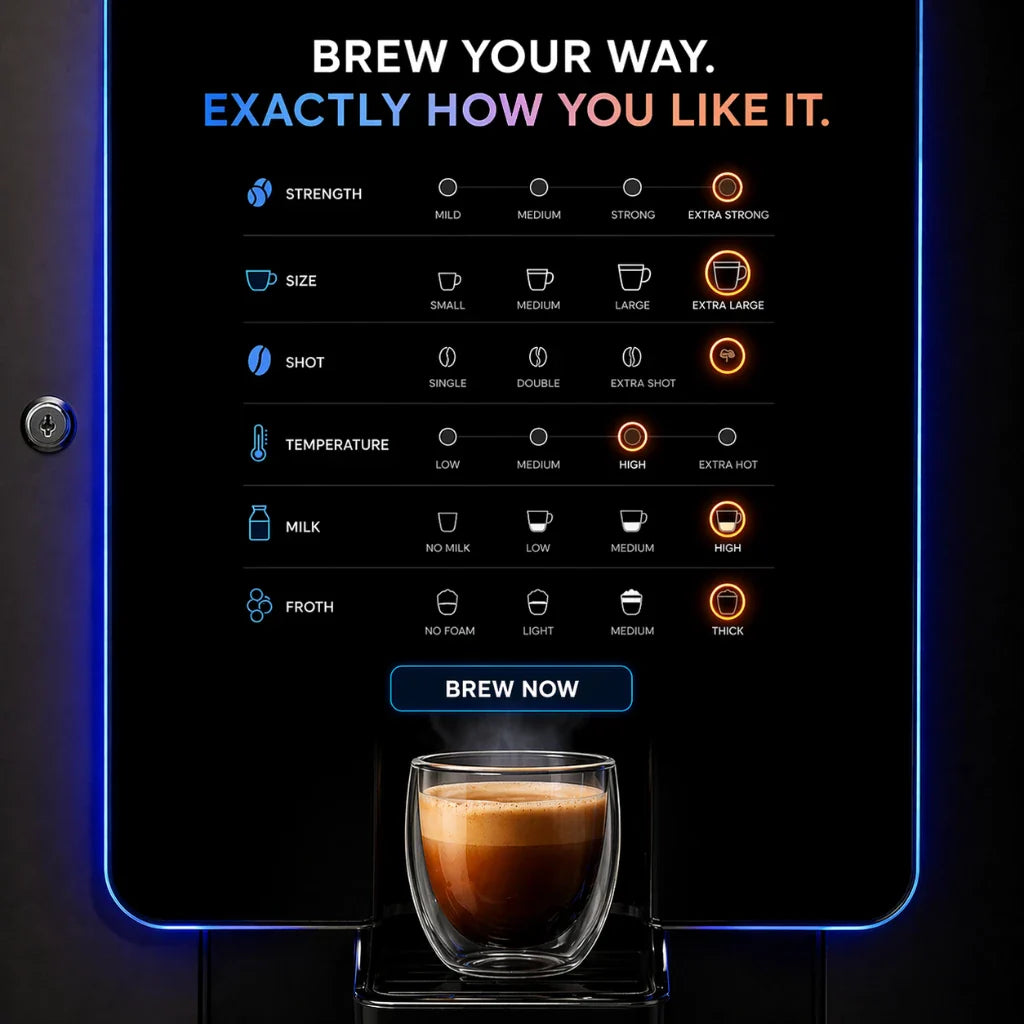
Pressure sits on the brew path and the heating side, where duty cycles are heavy. A machine that stops pouring in an office loses its audience the same morning, which makes same day recovery worth more on coffee vending machines than almost anywhere else.
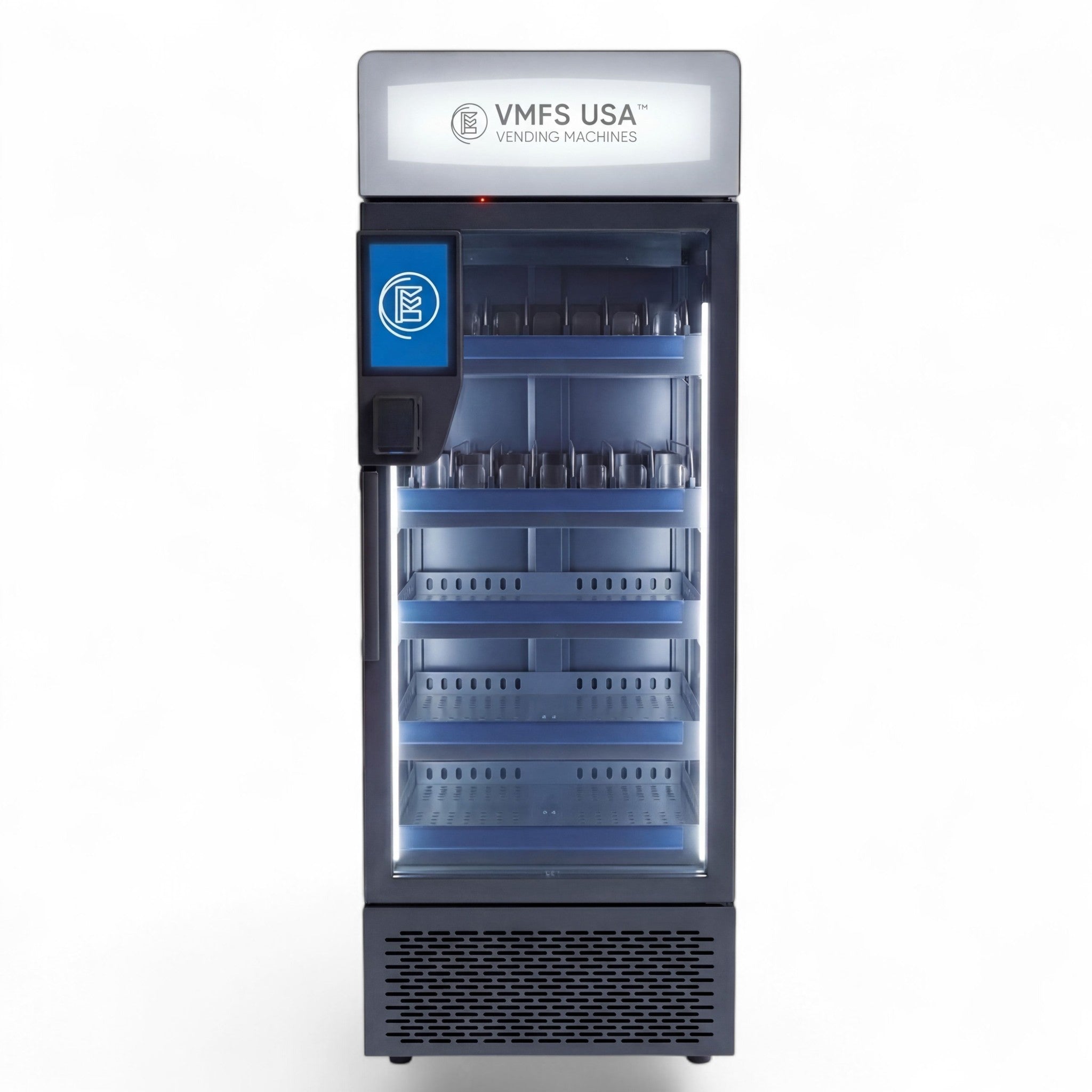
The sealed cooling circuit stays professional, but fans, door hardware, sensors, lighting and payment modules are the parts that see the most service on fridge vending machines, and exactly the parts an operator should be able to handle.
A wall mount vending machine often sits where a technician cannot easily reach with a cart. And across mini vending machines, plenty of owners run one or two units alongside another job and were never going to build a relationship with a technician over a single machine.
The coil based mechanics and straightforward keypad interface on Seaga vending machines have always been among the easiest things in the catalog to work on, which is part of why they keep earning their place with route operators.

Placement feeds into this, because a machine at a high traffic site loses far more per hour than one in a quiet lobby. Our team at VPlaced works on exactly that question, and consumers searching for a machine near them find operators through VendingFinder, which makes uptime a discoverability issue as well as a revenue one.
According to NAMA, convenience services contributes more than $41 billion to the American economy and supports over 171,000 employees. The industry is adding machines faster than it is adding qualified technicians, and travel time between sites quietly eats whatever service capacity exists.
That leaves two options. Accept longer downtime as a cost of growth, or build the catalog so a technician is not required for routine service.
VMFS runs US pilot programs across protein shake, smoothie, custom print, outdoor and hot food machines, placed across different American climates and site types. Gulf coast humidity, a Midwest winter loading dock and an outdoor unit in Arizona sun are three different problems wearing the same cabinet.
Those sites are now doing double duty here, because the only meaningful test of a field serviceable part is a real operator servicing it on a real restock schedule. If you run a demanding site, an extreme climate or an unusual duty cycle, we want to hear from you. Compliance questions around new site types run through VAdviced, and if a pilot turns into a story worth telling, VMarketed handles the marketing side.
The people who know which part fails in month fourteen, and which connector is awkward with cold hands on a January loading dock, are not sitting in an office. They are on routes. Tell us, and it goes into the next conversation with our partners. When you are ready to look at hardware, browse all vending machines for sale or book a slot at the Miami showroom and open one up yourself.
VMFS USA supplies, customizes and supports automated retail hardware for operators across the United States and Latin America, with more than 1,200 machines deployed. The company operates a Miami campus handling customization, quality assurance, assembly and order processing, a by appointment Demo Showroom, and shipping warehouses in Los Angeles and Atlanta stocking the majority of products, replacement parts and components.
VMFS USA sits at the center of a connected group of operator services: VPlaced for machine placement, VAdviced for legal and compliance support, VMarketed for marketing, VendingFinder for consumer discovery, and VMFS Cloud for remote machine monitoring. All machines are new, sold for purchase, with financing available through registered outside partners.
Machines and configurations can be viewed at vmfsusa.com. For media enquiries, pilot site applications or showroom appointments, contact VMFS USA at info@vmfsusa.com or (305) 395-3997.

Compartir:
Branded Vending Machines: The Only Retail Space You Can Actually Own