




Design the perfect vending solution for your location and customers.

Join the VMFS newsletter and step into a thriving network dedicated to collective success.
One signup. Endless possibilities.
A vape vending machine business places cashless, age-verifying machines in venues that admit only adults 21 and older, stocks them with products that are legal to sell in that state, and splits a share of each sale with the venue. Federal law allows vending sales of e-cigarettes and other covered tobacco products only in facilities where no one under 21 is present or permitted to enter at any time, so the venue decides whether the business is legal before the machine does.
This guide covers the federal and state rules, what age verification hardware does and does not prove, how to source authorized products, which venues qualify, current VMFS machine prices from $1,950 to $14,800, and per-sale margin math built from published figures rather than guesses.
A vape vending machine business is an unattended retail route: an operator owns age-verifying machines, places them inside adult-only venues, keeps them stocked with legal nicotine products, and pays the venue a share of sales for the space. The operator controls pricing, inventory and compliance records; the venue supplies a wall or floor spot, a power outlet and a door policy that keeps under-21s out at all times.
A sale works in a fixed sequence. The customer picks a product on the touchscreen, scans a government ID, pays by card or phone, and the machine releases the item through a controlled drop. If the ID check fails, the payment step never opens. For a closer look at the hardware sequence, see our explainer on how vape vending machines work.
The demand side is concentrated in exactly the age band these venues serve. CDC's National Center for Health Statistics reports that adult e-cigarette use rose from 4.5% in 2019 to 6.5% in 2023, and that adults aged 21 to 24 were the most likely users at 15.5%, followed by 12.6% of adults aged 25 to 34 and 7.3% of those aged 35 to 49. That is why bars, nightclubs and lounges with a young-adult crowd are the core placement for this category, and why a machine in a mixed-age venue fails twice: it breaks the law and it misses the buyer.
Compared with a snack or drink route, the economics change because each sale carries a higher ticket, the products are shelf-stable and the machines run ambient, so there is no spoilage or refrigeration load. Compared with a storefront, there is no counter staff and no retail lease. In exchange, this is the most regulated corner of vending: one wrong venue, one unauthorized product or one disabled scanner can cost you the placement, your license or both.
Selling e-cigarettes through a machine trades labor and overhead for regulatory work. The trade-off is worth stating plainly before you buy anything.
Advantages
Limitations
Federal law sets a single floor for every state: you may not sell e-cigarettes or other tobacco products to anyone under 21, and you may not sell them through a vending machine unless the machine sits in a facility where no person under 21 is present, or permitted to enter, at any time. Everything else in this business is built on those two rules.
The federal minimum age of 21 was signed into law on December 20, 2019 and took effect immediately, according to FDA. It covers electronic nicotine delivery systems (ENDS), including e-cigarettes and e-liquids, along with cigarettes, cigars and other tobacco products. FDA's retailer guidance tells sellers to check the photo ID of anyone under age 30, and the regulation requires photographic ID verification for buyers who are not over 29. A machine that scans every buyer exceeds that requirement, which is the simplest way to comply.
For e-cigarettes and other covered tobacco products, 21 CFR 1140.14(b)(3) says a retailer may not sell with the help of any electronic or mechanical device, such as a vending machine, except in facilities where the retailer ensures that no person younger than 21 is present, or permitted to enter, at any time. A parallel rule for cigarettes and smokeless tobacco sits in 21 CFR 1140.16(c), which bans vending machines and self-service displays except in facilities with the same under-21 exclusion. FDA's own retailer checklist states the general rule bluntly: do not sell e-cigarettes, e-liquids or other ENDS in a vending machine. The adult-only facility is the only exception.
Two words in that rule decide most placements. "Present" means a bar that admits families for lunch fails even if the machine is switched off during the day. "At any time" means all-ages events, brunch service and daytime access all count. An ID scanner on the machine does not convert an all-ages space into a qualifying facility; it is a second layer on top of the venue's door policy, not a replacement for it.
Nicotine pouches such as ZYN sit under the same federal tobacco framework: FDA describes its January 2025 ZYN authorizations as products that may be legally marketed to adults 21 and older. Treat pouches exactly like vapes for placement and age checks. Packages of covered tobacco products must also carry the nicotine warning required by 21 CFR 1143.3 ("WARNING: This product contains nicotine. Nicotine is an addictive chemical.") on at least 30 percent of each of the two principal display panels, so a missing warning is a quick sign that a supplier's stock is not compliant.
The federal PACT Act matters for sourcing rather than for the vend itself. ATF describes the Act as generally banning the mailing of cigarettes, smokeless tobacco and ENDS, and as requiring anyone who sells, transfers or ships these products into a taxing jurisdiction to register with ATF and with state and local tobacco tax administrators. A sale completed at your machine inside a venue is an in-person sale, but if you ever plan to ship nicotine products to customers, take online orders for delivery, or buy from an out-of-state seller, those transactions fall under PACT Act shipping, registration and age-verification rules. Buy from licensed distributors who handle that compliance and keep their invoices.
Not legal advice: This guide summarizes federal rules and published state data as of October 2026 for planning purposes. Laws change and local ordinances add requirements, so confirm your plan with your state tobacco licensing agency or an attorney before you sign a venue or buy inventory.
States and cities add licensing, taxes and product restrictions on top of the federal floor, and these layers decide whether a market is worth entering at all. Before you pitch a single venue, find out which license your state requires to sell vapor products, whether vending is restricted further than federal law, what excise tax applies and which flavors are banned.
Excise taxes have the biggest effect on margins. The Tax Foundation reports that as of June 2024, 32 states and the District of Columbia levied an excise tax on vaping products. Methods differ: some states tax a percentage of the wholesale or retail price, others tax per milliliter of liquid or per cartridge, and some set separate rates for open and closed systems. At the high end, Minnesota taxed 95 percent of wholesale and Vermont 92 percent, while Maryland's retail tax reached 60 percent for closed systems and Connecticut charged $0.40 per milliliter for closed systems. When the tax is built into your wholesale cost, it comes straight out of your per-sale margin, which is why the same machine can earn very different amounts in two neighboring states.
Flavor laws limit what you can stock. California is the clearest example: California's tax agency notes that after voters upheld the state law with Proposition 31, retailers had to stop selling flavored e-cigarettes and vape devices, flavored e-liquids and pods, and tobacco product flavor enhancers, regardless of nicotine content, by December 21, 2022 at the latest. A planogram that works in one state can be illegal across the border.
Licensing usually means a state tobacco or vapor retail license for each location, a sales tax permit, a local business license and sometimes a separate vending or placement approval. We cover the details state by state in dedicated guides, and the broader question of whether vape vending machines are legal in our legality overview. For entity setup, read whether you need an LLC. Our sister company VAdviced helps operators with licensing and contracts.
| State | Read our state guide |
|---|---|
| Texas | Are vape vending machines legal in Texas? |
| California | Owning and operating vape vending machines in California |
| New York | Owning and operating vape vending machines in New York |
| Washington | Owning and operating vape vending machines in Washington |
| Alabama | Vape and ZYN vending machines in Alabama |
| Alaska | Vape vending machines in Alaska |
| Arizona | Vape and ZYN vending machines in Arizona |
| Arkansas | Vape vending machines in Arkansas |
Age verification hardware confirms that the ID presented belongs to someone 21 or older before the machine accepts payment; it does not, on its own, prove the person holding the ID is its owner, and it does not make an all-ages venue legal. Knowing that limit tells you which verification level each location needs.
On VMFS machines the standard method is a barcode ID scanner. According to our age verification methods page, it reads the PDF417 barcode on the back of US and Canadian driver's licenses, checks that the ID is valid and that the birth date meets the age you set, and completes in under two seconds. It is included with the machine, with no per-scan fee, and it can verify locally if the internet drops, although payments and cloud logging still need a connection.
Because a barcode scan cannot detect a borrowed license, VMFS offers biometric identity assurance as an optional upgrade. The customer scans the ID and takes a live selfie; facial recognition compares the selfie with the ID photo and checks databases for IDs reported stolen, fake or expired. The page lists the cost at $0.30 per verified vend, billed to the operator, and recommends it for unattended or street-facing locations. In a busy 21+ bar with a carded door, the standard scanner plus the venue's own ID check is usually the right pairing; in a lounge with a loose door policy, the biometric layer is cheap insurance.
The verification system requires an active VMFS Cloud subscription, listed at $7.99 per month, and every scan, approved or denied, is logged with when and why it failed. That log is your evidence if an inspector or venue ever asks how you prevent underage sales. VMFS Cloud also lets you schedule verification by day and time per location; for vapes and pouches, leave it on at all hours. If you sell age-restricted and general products from different machines, our age verification vending machines collection shows every model with built-in ID support, and our guide to ID scanners for business compares scanner types in more depth.
You can place a vape vending machine only in a facility that keeps everyone under 21 out at all times, which in practice means 21+ bars, nightclubs, adult-only gaming floors, cigar and hookah lounges, and vape or smoke shops that never admit minors. Location is also the biggest driver of sales, so the legal filter and the commercial filter point to the same short list.
| Venue type | Qualifies? | What to confirm before signing |
|---|---|---|
| Bar, pub or nightclub | Yes, if 21+ at all hours | No family dining, brunch service or all-ages events at any time |
| Casino or gaming venue | Often | The space around the machine excludes under-21s; minimum gaming ages are not the same everywhere |
| Cigar or hookah lounge | Usually | Written 21+ entry policy; overlap with what the lounge already sells |
| Vape or smoke shop | Usually | Shop never admits under-21s, including accompanied minors; after-hours access stays adult-only |
| Liquor store | Only if 21+ entry | Many admit minors with a parent, which disqualifies the store |
| Gas station, convenience store, mall, gym, hotel lobby, restaurant | No | Under-21s can enter, so federal law does not allow vending sales |
Bars are the most common placement, and we break down the details in can you put a vape vending machine in a bar. Fuel stations come up often and usually fail the facility test; read vape vending machines for gas stations before you pitch one.
Inside a qualifying venue, put the machine where people stand and wait: beside the main bar, near the restrooms, on the route to a smoking patio, or at the coat check. A machine in a back hallway is invisible during peak hours, and staff cannot see it if a customer needs help. Visibility from the bar also helps staff spot anyone trying to pass an ID to a friend.
Venue owners respond to their own problem first: when a customer needs a vape and the venue cannot supply one, the customer leaves, often with friends who stop buying drinks. Lead with that, then explain that the operator owns, stocks and services the machine and pays the venue a share of gross sales. BuzzBot Vending's published profit guide models that share at 15 percent of gross, which is a reasonable starting point for negotiation. Put the commission, service schedule, access hours, who pays for damage, and the exit terms in writing, and add a clause that the venue must notify you if its age policy ever changes. Our guide on how to scout and pitch a vending machine location covers the conversation in detail, and VMFS location matching or our sister site VPlaced can connect you with venues if you have no contacts yet.
Compare Vape Machines Built for 21+ Venues
Wall-mount, countertop and floor models with built-in ID scanning, cashless payments and VMFS Cloud reporting.
Shop Vape Vending MachinesYou may stock only products that are both federally authorized and legal in your state, bought from licensed distributors who give you invoices. That rule removes a large share of the disposables you will see offered at wholesale, and it is the area where new operators most often take on risk without realizing it.
FDA maintains a public list of e-cigarettes it has authorized, and the page states that "these are the only e-cigarettes that may be lawfully sold in the United States." As of October 2026, that list shows 48 authorized e-cigarette products from Glas, JUUL Labs, Logic Technology Development, NJOY and R.J. Reynolds Vapor Company. Many flavored disposables sold through wholesale channels are not on it. Check every SKU against the FDA list before it goes into a coil, and keep a copy of the check with the distributor invoice. For pouches, FDA authorized 20 ZYN nicotine pouch products on January 16, 2025, the first nicotine pouches it had authorized; FDA notes that authorization does not mean a product is safe or "FDA approved." Our ZYN vending machine business guide covers pouch-specific merchandising.
Licensed distributors only
Buy on invoice from distributors licensed in your state. The invoice is your proof of origin, tax paid and product identity.
Check the FDA list
Match each SKU to FDA's authorized e-cigarette list or a marketing order before stocking it, and recheck when the list changes.
Apply state flavor rules
Confirm flavor and nicotine limits in each state you operate. A legal SKU in one state can be banned in the next.
Inspect packaging
Every package should carry the federal nicotine warning. Missing or foreign-language warnings are a red flag for gray-market stock.
Start with a narrow menu of proven, compliant SKUs and expand only when sales data shows demand. Map coil sizes to package dimensions before ordering; the VMFS planogram tool helps you lay out rows so slim pods, standard devices and pouch tins each sit in a coil that fits. Our guide to loading and stocking a vending machine covers coil pitch, front-facing and par levels.
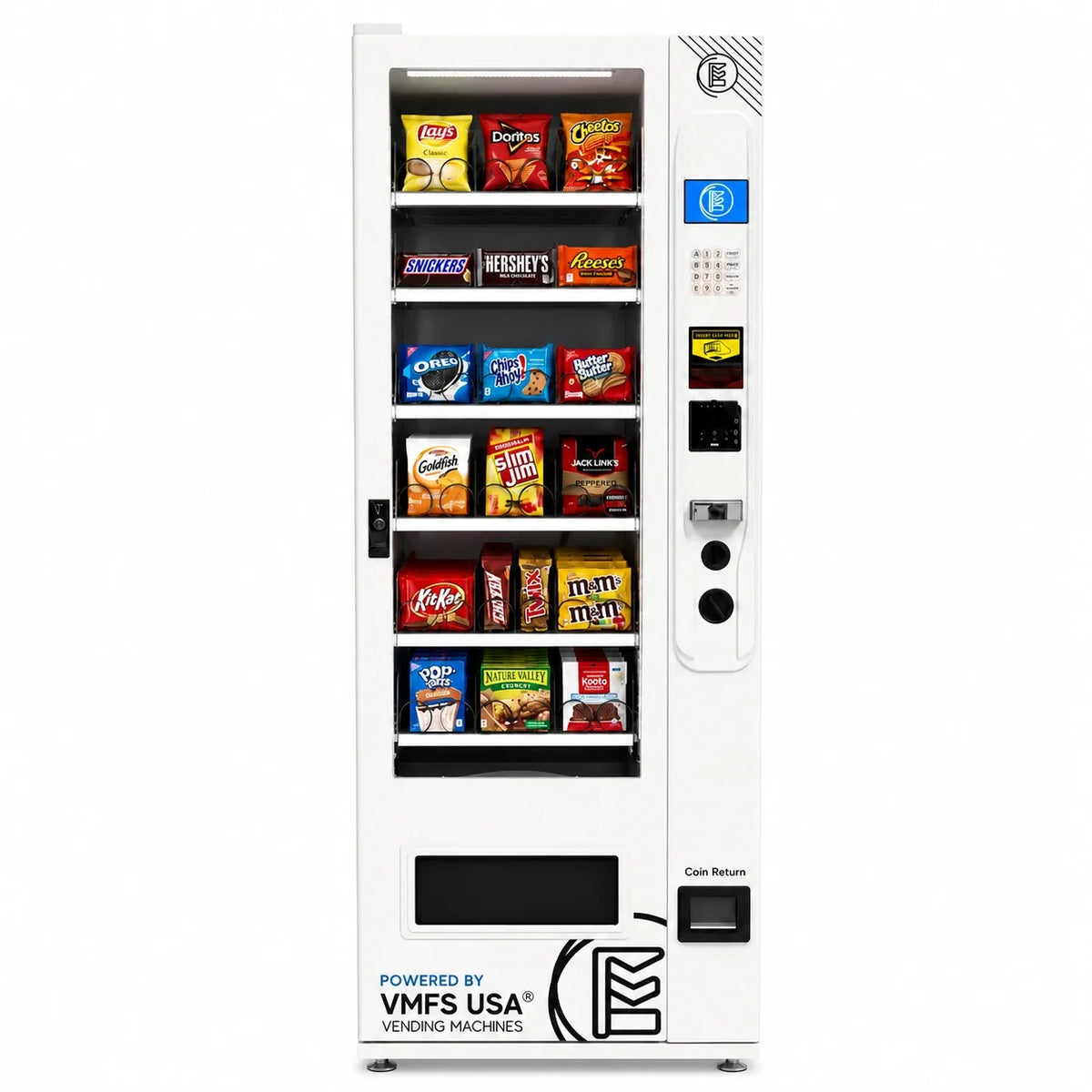
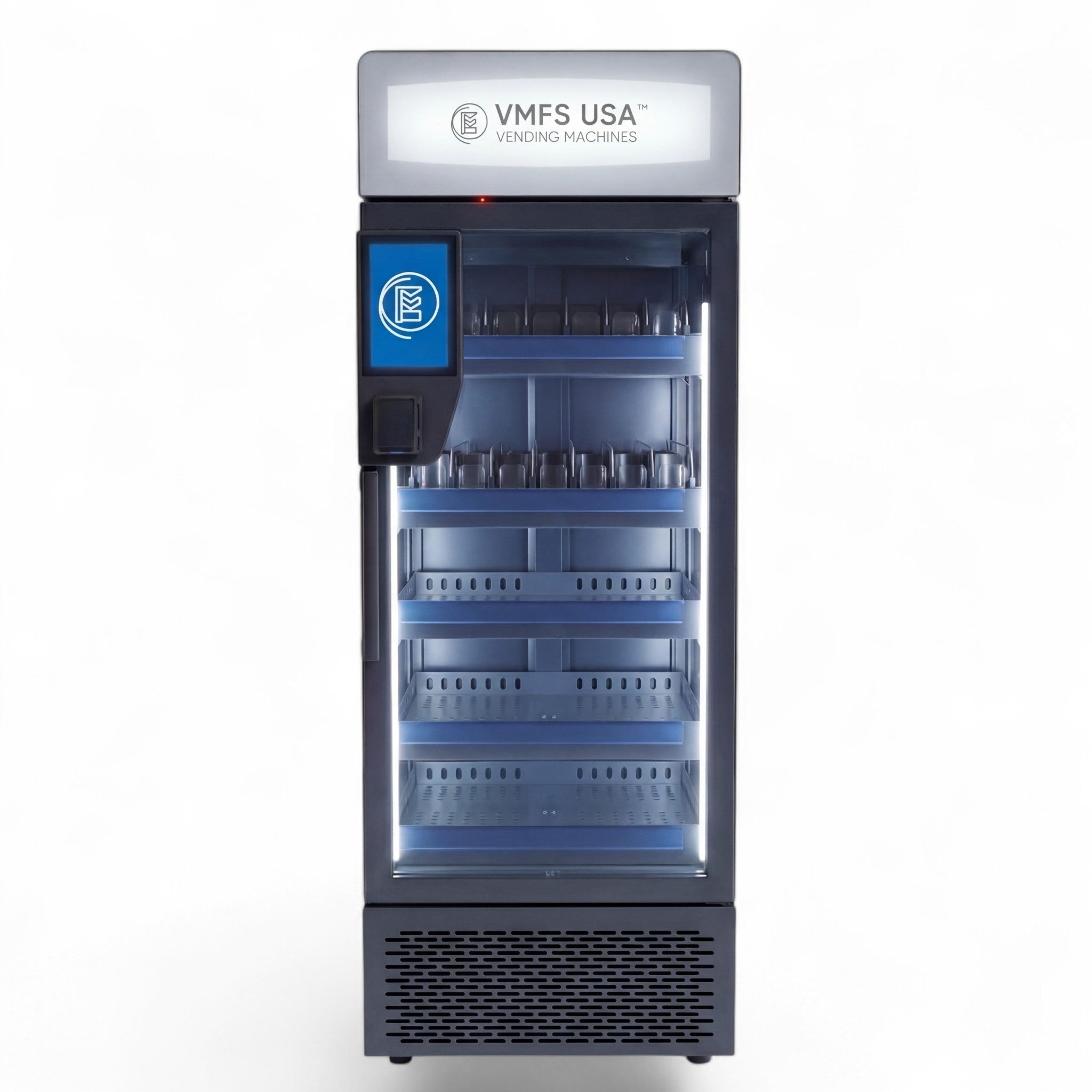
Choose the machine by venue space first and menu size second: wall-mount and countertop units suit bars and lounges with no spare floor, tall floor units suit high-volume nightclubs and gaming venues, and large-screen models add advertising revenue in busy corridors. The prices below are the current listed prices of active VMFS products as of October 13, 2026.
| Model | Format | Listed price |
|---|---|---|
| CounterCompact | Counter or wall, 18.5-inch touchscreen, integrated ID verification | $1,950 |
| Slim Wall Mounted Vape Vending Machine | Wall-mount, 32-inch touchscreen | $3,000 |
| Wall Vape Vending Machine | Wall-mount, 32-inch touchscreen | $3,350 |
| Mini Countertop Vape Vending Machine | Countertop, coil trays, ambient | $3,450 |
| WallMount | Wall-mount, 32-inch touchscreen, 15 slots, about 150 units | $3,450 to $3,850 |
| Tall Vape Vending Machine | Floor, 32-inch touchscreen, adjustable coil trays | $4,400 |
| TallPro | Floor, 32-inch touchscreen, ID verification support | $4,950 |
| Full Screen Vape Vending Machine | Floor, full-size 32-inch touchscreen | $6,100 |
| Vape & Cigarette Vending Machine | High capacity, vapes plus tobacco products | $7,875 |
| Big Vape Vending Machine | Floor, 50-inch touchscreen | $12,375 |
| AdScreen | Floor, 50-inch touchscreen, integrated ID verification | $14,800 |
Whatever the format, confirm five features before you order: an ID scanner on the unit, cashless payments with a processor that accepts nicotine merchants, cellular or reliable Wi-Fi connectivity, a steel cabinet with controlled drop delivery, and coil sizes matched to your packaging. The WallMount, for example, lists adjustable coils from 22mm to 55mm. Venues that also allow cigarettes may suit the combined vape and tobacco unit or one of our cigarette vending machines, which follow the same adult-only facility rule. Our buying guide on how to choose the best vape vending machine compares formats by venue, and custom vending machine wraps help a unit look like part of the venue. Large-screen models can also run paid screen ads between sales.
Cashless is the default for this category because it removes cash handling and ties every sale to a logged transaction. One practical caution is that some payment processors restrict nicotine merchants, so confirm acceptance before the machine ships rather than after it is on the wall.
A first machine costs the hardware price plus payment setup, first inventory, licenses and small monthly software and reader fees; for a full model-by-model breakdown, see our guide to how much a vape vending machine costs. The table below uses only figures published on VMFS product and service pages.
| Item | Cost | Notes |
|---|---|---|
| Machine | $1,950 to $14,800 | Active VMFS listings, October 2026 |
| Card reader hardware | $450 (Nayax or Cantaloupe), $500 to $650 (PAX) | VMFS payment system page |
| Card reader monthly fee | $7.95 to $14.95 (Nayax), about $9.95 to $18.95 (Cantaloupe) | Per device, depends on plan |
| Processing | About 5.95% or about 2.5% + $0.10 (Nayax); about 5% to 5.95% (Cantaloupe) | Per transaction |
| VMFS Cloud Basic | $7.99 per month | Required for age verification |
| Biometric verification (optional) | $0.30 per verified vend | Recommended for loose-door venues |
| Licenses and permits | Varies by state and city | Price your state before buying |
| First inventory | Depends on capacity and SKUs | Price from your distributor's invoice |
| Venue share | Negotiated percentage of gross | Ongoing, paid from sales |
Cash is not the only path. VMFS lists financing through PayPal, Klarna and ClickLease, with terms the page describes as typically ranging from 6 to 48 months. Financing lets the machine generate sales while you pay it off, but run conservative numbers first, because the payment is due whether or not the venue performs. Budget for general and product liability insurance as well; our vending machine insurance guide explains the coverage types.
A vape vending machine is profitable when the per-sale margin, after product cost, venue share, card fees and taxes, multiplied by real daily sales, covers the machine and your time within a payback period you can accept. The per-sale margin is fairly predictable; daily sales volume is the unknown, and it depends almost entirely on the venue.
BuzzBot Vending's profit guide models a $30 retail price, a $9 wholesale cost and a 15 percent venue share, and describes $20 to $30 products as the typical range. Using those inputs with a conservative $10 wholesale cost and a 5.95% card processing rate from the reader plans above gives the worked example below. It is an illustration of the arithmetic, not a forecast; replace each line with your own distributor invoice, venue agreement and processor statement.
| Per-sale line item | Worked example |
|---|---|
| Vend price | $30.00 |
| Wholesale product cost | -$10.00 |
| Venue share (15% of gross) | -$4.50 |
| Card processing (5.95%) | -$1.79 |
| Contribution per sale, before excise tax, sales tax and monthly fees | $13.71 |
Volume turns that figure into a monthly result. At one sale a day, 30 sales earn about $411 a month before fixed fees; at two a day, about $823; at four a day, about $1,645. Subtract the $7.99 VMFS Cloud subscription and a reader service fee, then divide your machine cost by what remains. On a $4,400 Tall Vape Vending Machine, that works out to roughly 11 months at one sale a day, under 6 months at two, and under 3 months at four. The spread is the point: the same hardware can pay back in a season or take a year, depending on the venue you choose.
Taxes can move the result more than any other line. If you vend in a state that taxes 95 percent of wholesale, as Minnesota did in the Tax Foundation's 2024 data, and that tax is built into a $10 wholesale cost, the product line becomes $19.50 and the example contribution falls to about $4.21 per sale. Sales tax also matters: if your posted price includes sales tax, the tax comes out of the $30. Run each state's numbers separately. For deeper revenue scenarios, read our guide to vape vending profit, test your inputs in the ROI calculator, and put the results into a vape vending machine business plan before you buy.
Day-to-day operation comes down to restocking on data instead of a fixed calendar, testing the age check on every visit, and keeping the records an inspector would ask for. Done consistently, that routine keeps placements safe and sales steady.
VMFS Cloud Basic shows live slot-level stock, real-time sales with margin, and fault and low-stock alerts by SMS, email or dashboard, so you visit a machine when it needs product rather than on a guess. Upper tiers add remote pricing, screen ads and advanced analytics. Group machines by neighborhood to keep drive time down, and plan each run from the alert list.
On every service visit, run a test scan with an expired or under-21 test credential if your system supports it, confirm the decline appears in the log, test card and phone payments, and clean the scanner window and touchscreen. A scanner that lets a sale through without a valid check is a compliance failure regardless of intent. Clean coils and check cabinet locks and the reader housing on the same visit.
Once a quarter, run a self-audit: confirm each venue is still adult-only at all hours, that every license and sales tax permit is current, that each SKU is still on FDA's authorized list and legal under your state's flavor rules, and that insurance renewals are scheduled. Keep digital copies of permits, distributor invoices, venue agreements and verification logs in one folder per location.
Scale by repeating what works. When one venue type produces steady sales, look for venues with the same crowd and hours rather than testing a new category with each machine. Standardize your agreement, menu and service routine, and add financed machines only when existing placements cover their own costs. Our general vending machines catalog covers other categories you can add to the same adult venues later.
Start a vape vending machine business in this order: confirm the law, then the venue, then the product, then the machine. Buying hardware first is the most common and most expensive mistake.
Run Your Numbers Before You Buy
Enter your vend price, product cost, venue share and expected daily sales to see payback for any VMFS machine.
Open the ROI Calculator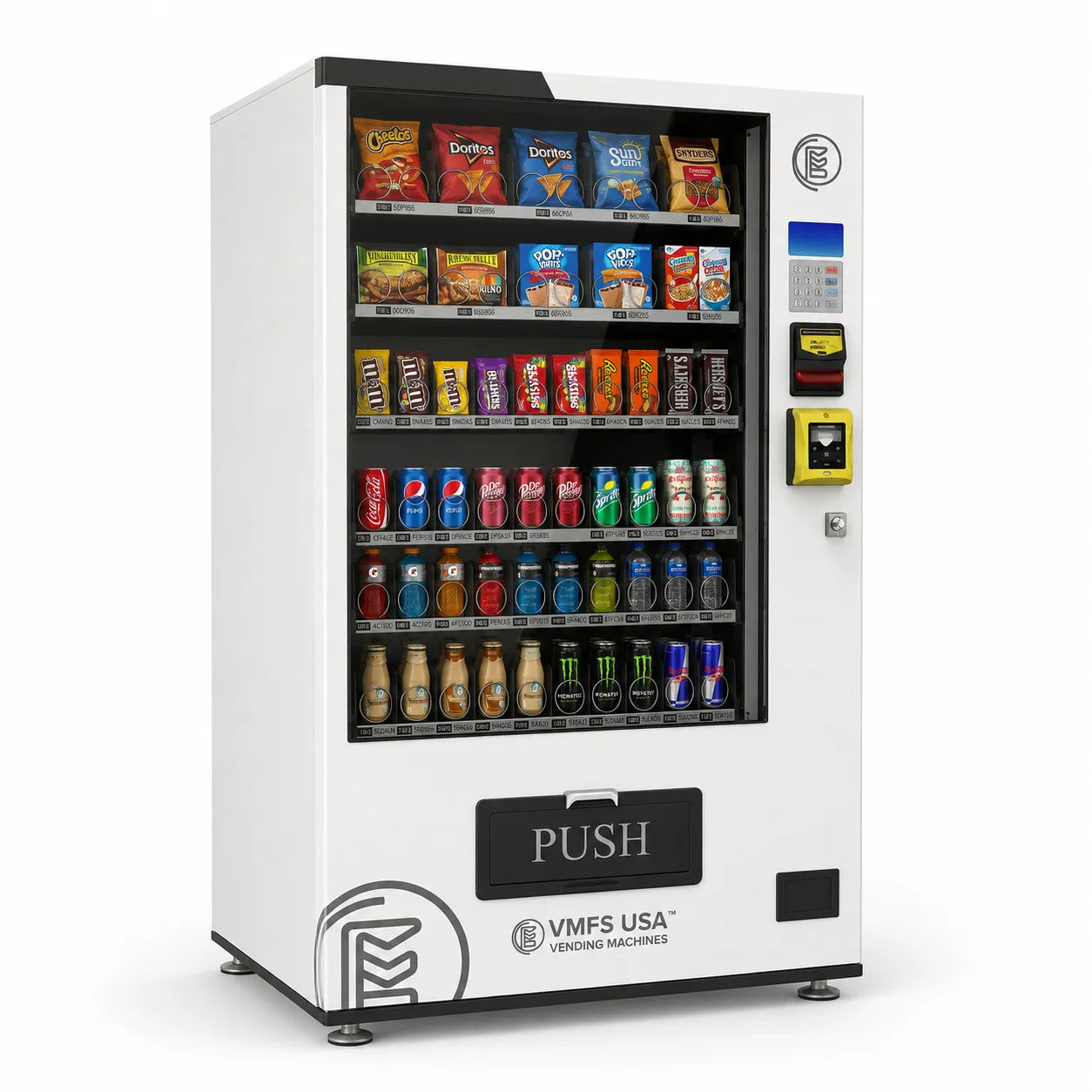
Share:
AI Vending Machine Price: Complete Cost Guide for Operators
Are Vending Machines Profitable? 2026 Profit, Income and ROI Guide