


A new coffee vending machine costs $4,470 to $11,950 in the VMFS USA catalog in October 2026, and refurbished fresh-brew and freeze-dried machines from US dealers start at about $4,300. The ingredients and cup for a plain 8 oz coffee from a bean-to-cup machine come to roughly 22 to 41 cents.
This guide prices every common machine type, compares new, used and refurbished equipment, and adds the costs that come after the sticker: payment hardware, water filtration, cups, beans, electricity and cleaning. It ends with cost-per-cup and payback math you can rerun for your own location.
How Much Does a Coffee Vending Machine Cost?
A coffee vending machine costs about $4,300 to $12,000 for commercial equipment you can put in front of paying customers, whether you buy a refurbished fresh-brew unit or a new bean-to-cup model. In the VMFS USA catalog, the seven active coffee models run from $4,470 for a configurable bean-to-cup build to $11,950 for an iced coffee machine with its own ice maker. A Texas dealer we checked lists new bean-to-cup machines from $4,695 to $11,995 and refurbished Crane fresh-brew units from $4,295, so the wider market sits in the same band.
The spread comes from what happens inside the cabinet. A machine that mixes soluble powder with hot water needs a boiler, canisters and mixers. A bean-to-cup machine adds a burr grinder and a pressurized brew group, and an iced model adds refrigeration and ice production on top of that. Each system adds parts, service needs and cost, which is why two machines that both "make coffee" can sit $7,000 apart.
Cheaper coffee machines exist, mostly as consumer or import listings, but they rarely include commercial payment hardware, food-contact parts built for all-day use or a US service network. For a route or a paid office placement, budget from the commercial band and treat anything far below it as a different class of equipment. If you are comparing coffee against snack, drink or AI cooler equipment, the broader vending machine cost guide prices every category side by side.
Short answer: plan on $4,470 to $4,950 for a compact new bean-to-cup machine, $7,450 to $8,950 for a full-size commercial model, and close to $12,000 for iced coffee or a coffee and snack combo. Add a few hundred dollars for a card reader if the model does not include one.
Coffee Vending Machine Prices by Type
Coffee vending machine prices by type range from about $2,000 for a basic new instant-powder machine to roughly $12,000 for iced and combination machines. The table pairs live VMFS list prices with dealer listings so you can see real equipment at each level rather than survey averages.
| Machine type | How it makes coffee | Price seen (Oct 2026) | Example |
|---|---|---|---|
| Instant / powder (freeze-dried) | Soluble coffee mixed with hot water | About $2,000 to $5,000 new (buyer guides); $4,895 refurbished | USI Geneva 3205, refurbished, Vending Concepts |
| Fresh brew | Ground coffee brewed per cup through a filter | $4,295 to $5,845 refurbished | Crane National 673 and 605D, Vending Concepts |
| Countertop bean-to-cup | Integrated grinder and espresso group on a counter footprint | $4,550 to $4,850 | Premium Countertop Touch Screen |
| Configurable bean-to-cup | Burr grinder, menu and cup sizes set to the site | $4,470 | Build Your Coffee Vending Machine |
| Compact freestanding bean-to-cup | Grinder, aluminum boiler, powder canisters | $4,950 | CorePro |
| Full-size bean-to-cup | Grinder plus multiple soluble canisters and larger menus | $7,450 to $8,950 | Pro, Coffee and Hot Beverage |
| Iced and hot coffee | Bean-to-cup brewing plus built-in ice production | $11,950 (VMFS); $11,995 (dealer) | Iced Coffee Vending Machine |
| Coffee and snack combo | Coffee module plus a snack or cold drink section | $11,650 to $11,950 | Coffee & Snack |

Instant and powder machines
Instant machines are the cheapest coffee vending option because they skip the grinder and brew group. Buyer guides we reviewed put new instant units at roughly $2,000 to $5,000, and a refurbished freeze-dried USI Geneva lists at $4,895 with a Texas dealer. They suit low-traffic break rooms where speed and low ingredient cost matter more than taste. The trade-off is perception: customers who already buy café drinks often skip a powder machine, which caps what you can charge per cup. Our guide to coffee powder for vending machines covers the soluble products these machines run on.
Fresh brew machines
Fresh brew machines meter ground coffee and brew each cup through a filter, a format long associated with Crane National models. Most units for sale today are refurbished; the dealer listings we checked ran $4,295 for a Crane 673 and $5,845 for a Crane 605D. They make sense when you want brewed coffee at a lower price than a new espresso-style machine and you have a technician who knows the platform.
Bean-to-cup machines
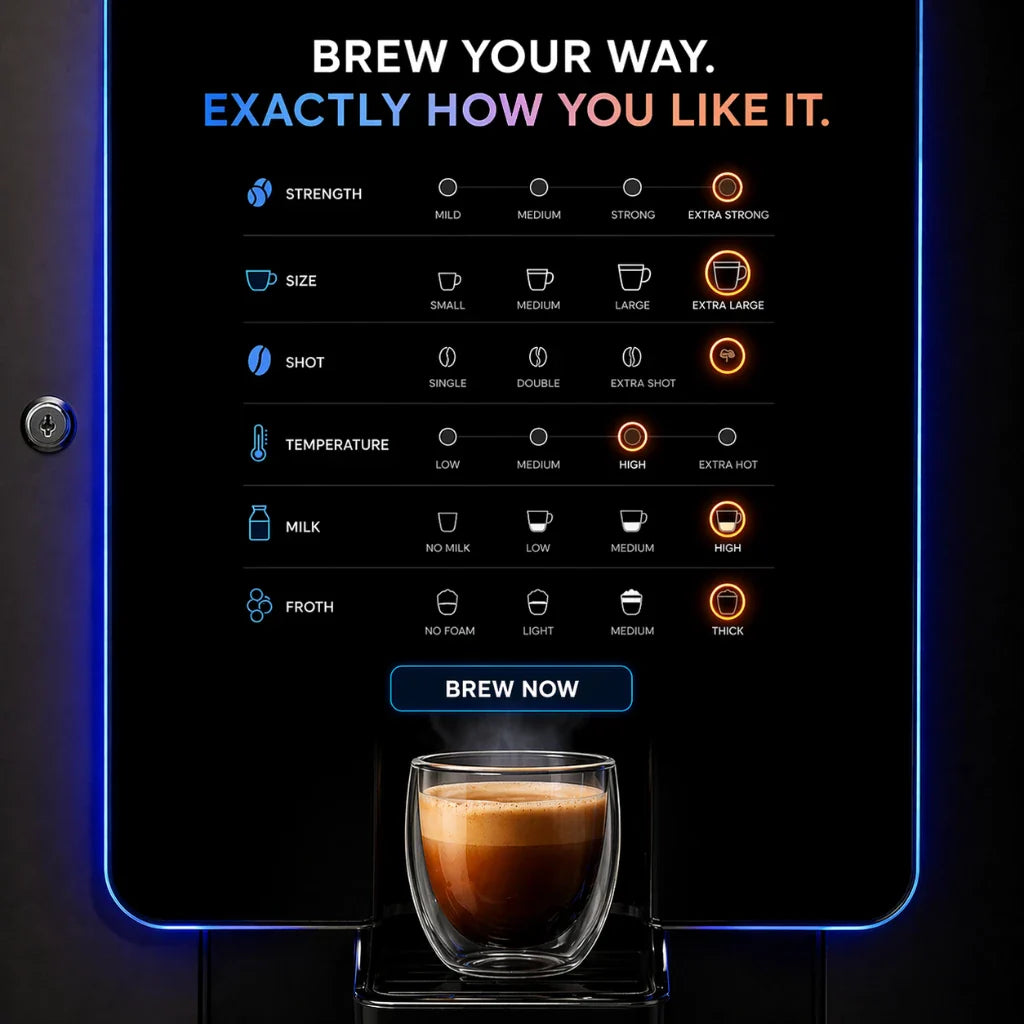
Bean-to-cup machines grind whole beans for every order and extract under pressure, so they can serve espresso, americano, cappuccino and latte from one menu. Every active VMFS coffee model is bean-to-cup. Prices run from $4,470 for a configurable build to $8,950 for the Coffee and Hot Beverage machine, which uses a Swiss flat burr grinder rated for more than 750,000 grinding cycles, brews at 9 bar and holds enough for up to 160 cups per refill. The Pro model at $7,450 carries one bean hopper and five soluble canisters for 18 or more direct selections, with drink capacity of roughly 300 to 400 cups.
Countertop machines
Countertop coffee machines put a bean-to-cup system on a counter instead of in a freestanding cabinet. The VMFS Premium Countertop model costs $4,550 with a keypad or $4,850 with a 10.1-inch touchscreen, measures 30.2 by 16.4 by 18.2 inches and serves up to 150 drinks per fill. A card reader and bill acceptor are optional on this model, so price the payment hardware into the budget if the machine will sell drinks rather than serve free office coffee. For workplace setups specifically, browse the office coffee machines collection.
Iced and cold coffee machines
Iced coffee machines cost the most because they combine a full bean-to-cup brewer with refrigeration and ice making. The VMFS Iced Coffee Vending Machine is $11,950 and holds up to 180 cups with a 1.5 kg bean hopper and six ingredient canisters, serving a drink in about 60 seconds. A dealer's iced and hot model lists at $11,995, which shows how consistently this tier is priced. The extra cost pays off where cold drinks sell through warm months or all year, such as campuses, gyms and Sun Belt offices.
Coffee and snack combos
Combination machines pair a coffee module with snacks or cold drinks in one cabinet, at $11,650 to $11,950 for the VMFS Coffee & Snack model. You pay for two vending systems in one footprint, which helps where a property will only approve one machine.
What Pushes the Price Up or Down
Coffee vending machine price rises with brewing complexity, capacity, refrigeration, drink variety, payment hardware and remote management, and it falls when a machine drops any of them. Knowing which of these you actually need is the fastest way to avoid paying for features a location will never use.
Brewing technology
A burr grinder and pressurized brew group cost more to build and service than a powder mixer, so bean-to-cup sits above instant at every level.
Capacity per refill
Larger hoppers and canisters cost more but cut service visits. VMFS models range from 150 drinks per fill on the countertop unit to 300 to 400 on the Pro.
Refrigeration and ice
Iced drinks add a compressor and ice maker, the main reason iced machines sit near $12,000.
Drink variety
Each extra drink family needs another canister, mixer or milk system. More options lift price and ingredient inventory.
Payment hardware
Machines with built-in card and mobile pay cost more up front; machines without it need a separate reader.
Telemetry and support
Remote monitoring, warranty terms and parts availability raise the sticker but lower the cost of each breakdown.
Two factors are easy to underrate. The first is payment: the countertop and CorePro models accept add-on payment hardware, while the Iced and Coffee and Hot Beverage machines list card and mobile payment support (check whether the $450 credit card reader upgrade is needed for your configuration), so compare models with the reader cost included. The second is software. Machines that report stock levels, drink counts and faults through VMFS Cloud let you plan refills and service calls instead of discovering an empty hopper on a scheduled visit. For the mechanics behind these systems, see how coffee vending machines work.
Compare Live Coffee Machine Prices
See every active VMFS coffee model with specs, drink menus and current pricing.
Shop Coffee MachinesNew vs Used vs Refurbished Coffee Machines
New coffee vending machines cost the most but come with warranty and current payment technology, refurbished machines from dealers cost about the same as entry-level new equipment, and as-is used machines are cheapest but carry the most risk. The surprise for many buyers is that refurbished coffee equipment is not much cheaper than a new compact bean-to-cup machine.
| Condition | Price seen | What you usually get | Main risk |
|---|---|---|---|
| New bean-to-cup | $4,470 to $11,950 (VMFS); $4,695 to $11,995 (dealer) | Warranty, current payments, telemetry options | More capital at stake on an unproven site |
| Dealer refurbished | $4,295 to $5,845 (Vending Concepts); $4,399.95 (eBay seller listing) | Cleaned, tested unit, often financing; older platform | Wear on boiler, pumps and brew parts; older payment setup |
| Used, as-is | Used vending machines generally $1,200 to $3,000 (all categories) | Whatever the seller provides | Unknown hours, scale buildup, missing parts |
General small-business guides put secondhand vending machines at $1,200 to $3,000 and new machines at $3,000 to $10,000 across all categories. Coffee equipment sits at the upper end of both ranges because it carries boilers, pumps and food-contact parts. The refurbished coffee listings we checked all started above $4,000, close to the $4,470 to $4,950 entry point for new VMFS bean-to-cup machines.
Why buy new
- Warranty; the Coffee and Hot Beverage model carries one year on parts and labor
- Current card, mobile wallet and telemetry support
- No hidden wear on the grinder, boiler or brew group
- Known capacity and drink menu from day one
Why consider refurbished or used
- Lower cash outlay for testing a new location
- Proven platforms with parts known to local technicians
- Financing offered by some dealers
- Risk: older payment setups may need a reader or upgrade kit
Cheap and older coffee machines
Cheap coffee machines usually save money at purchase and lose it in service. Low-cost units tend to be instant-only with few drink choices and no remote alerts, so you learn about a jam or an empty canister when a customer complains or a sale is lost. Older machines lose value fastest once replacement boilers, control boards or brew groups stop being made for the model, because each repair then costs more relative to what the machine is worth. Before buying any machine more than a few years old, confirm that parts are still available; our coffee vending machine parts guide lists the components that wear first.
What to check before buying used
- Ask for the vend or cycle counter reading and service records, the coffee equivalent of odometer mileage.
- Run several hot drinks and check temperature, crema, grind consistency and leaks under the brew group.
- Look for scale in the boiler and water lines; heavy scale means descaling or part replacement soon.
- Confirm the payment setup works with a current card reader and your processor.
- Get delivery, warranty and return terms in writing.
The full inspection process is in our guide to buying a used vending machine.
Add-Ons and Setup Costs
Add-ons and setup can add several hundred dollars to a coffee machine before it sells a cup, mainly for payment hardware, water filtration, delivery and the first fill of beans, powders and cups. Pricing them up front keeps a cheaper machine from looking better on paper than it is.
Payment hardware. If a model does not ship with cashless payment, a reader such as Cantaloupe's Engage Combo Gen 2 costs $329, with service plans of $9.95 or $12.95 a month, a 5.95% processing rate and a 12-month commitment. Readers matter more for coffee than for snacks because a freshly made drink is exactly the kind of purchase people make with a phone or card. Our breakdown of cashless payment systems for coffee vending machines compares the main options.
Water supply and filtration. Most commercial coffee machines run best on a plumbed line with a filter. The VMFS countertop model connects to a water line, and a standalone 25-liter water kit is available for sites without plumbing. A commercial cartridge such as the Everpure Claris S costs $173.16, is rated for 450 gallons on coffee equipment, and should be replaced at least once a year or sooner if that capacity is reached. If the site needs a new line run by a plumber, get that quote before you commit to the location.
Delivery and installation. Full-size coffee machines ship by freight and need a level floor, a nearby outlet and clearance for the door to open. The coffee vending machine installation guide walks through power, water and placement requirements so there are no surprise trades on install day.
First fill. Budget for a full load of beans, milk and chocolate powders, sugar, cups, lids and stirrers. The VMFS countertop machine, for example, holds 1,845 g of beans (about 264 servings), 1,536 g of milk powder and 1,242 g of chocolate powder. VMFS also sells matched coffee vending supplies from its Miami warehouse on a quote basis.
Running Costs: Beans, Cups, Water and Cleaning
Running costs for a coffee vending machine come mostly from coffee beans and cups, followed by water filtration, cleaning supplies, payment fees and electricity. Coffee machines take more servicing than snack machines because they handle food-contact ingredients and hot water every day, so the operating budget deserves as much attention as the purchase price.

Coffee beans and ingredients
Coffee is the biggest ingredient cost, and it has risen fast. The Bureau of Labor Statistics average US retail price for ground roast coffee was $9.30 per pound in August 2026, up from $6.31 in August 2024, an increase of about 47% in two years. The VMFS Iced Coffee machine's grinder doses 7 to 16 grams of coffee per cup, so at that retail price the coffee alone costs about 14 cents for a light 7 g dose and 33 cents for a strong 16 g dose. Operators buying wholesale beans by the case will usually pay a different rate, so plug in your own supplier price; the point is that the dose setting moves cost per cup as much as the bean price does. Milk powder, chocolate, sugar and flavorings add more for specialty drinks.
Cups, lids and stirrers
Standard 8 oz paper hot cups cost about 5 cents each when bought by the 1,000-count case; we found cases listed at $46.30 and $53.40. Lids, sleeves and stirrers add to that, and larger cups cost more per unit. Cup size also has to match the dispenser: the CorePro and Pro support cups up to 8 oz, while the configurable VMFS build handles 8 to 20 oz. Our guide to coffee vending machine cups covers sizes and materials.
Water filtration and descaling
Filtration and descaling protect the boiler and keep taste consistent, and they cost far less than the repairs they prevent. Spreading a $173.16 Everpure Claris S cartridge over its 450-gallon coffee rating works out to about 2.4 cents per 8 oz cup if the machine uses the full capacity within the year; a quieter site pays the same cartridge cost over fewer cups. Cartridges of this type also adjust carbonate hardness to reduce scale. VMFS machines use aluminum boilers with encapsulated heating elements and automatic cleaning cycles, which limit scale buildup and daily manual work, but the water still needs filtering and the brew path still needs periodic descaling. Follow the schedule in our coffee vending machine cleaning and maintenance guide.
Electricity
Electricity is a small cost per cup. Heating 8 oz of water from tap temperature to the 92°C brewing temperature used by the VMFS Coffee and Hot Beverage machine takes roughly 0.02 kWh, about a third of a cent at the July 2026 US average commercial rate of 14.53 cents per kWh reported by the Energy Information Administration. Standby heat, lighting and screens add to the bill, which is why machines with low-power idle modes are worth asking about. Power ratings differ widely by model, from 1,150 W on the VMFS countertop unit to 3,000 W of heating power on the Coffee and Hot Beverage machine. See coffee vending machine electricity consumption for monthly estimates.
Cleaning, parts and service
Cleaning tablets, descaler, brushes and wear parts such as seals and grinder burrs belong in the annual budget, along with your own route time. The overview of coffee vending machine supplies lists the consumables to keep on the truck.
Cost Per Cup: The Math to Run
A plain 8 oz bean-to-cup coffee costs roughly 22 to 41 cents in coffee, cup, water filtration and brewing energy, based on the sourced inputs above. Milk, sugar, lids, payment fees and location commission come on top, and they decide whether a cup is profitable at your vend price.
| Cost line (8 oz black coffee) | Light dose, 7 g | Mid dose, 10 g | Strong dose, 16 g | Basis |
|---|---|---|---|---|
| Coffee | $0.14 | $0.21 | $0.33 | BLS $9.30/lb, Aug 2026 |
| 8 oz paper cup | $0.05 | $0.05 | $0.05 | 1,000-count case, $46 to $53 |
| Water filtration | $0.024 | $0.024 | $0.024 | $173.16 cartridge over 450 gal |
| Brewing energy | $0.003 | $0.003 | $0.003 | About 0.02 kWh at 14.53¢/kWh |
| Subtotal | $0.22 | $0.29 | $0.41 | Before milk, sugar, lids |
Variable costs that scale with the selling price come next. A card reader on a 5.95% plan takes about 12 cents from a $2.00 sale. Location commissions on vending typically run 5% to 25% of revenue, so a 10% agreement takes another 20 cents at that price. Using the mid dose, a $2.00 black coffee leaves about $1.39 before milk, sugar, lids, labor, repairs and taxes. Each extra gram of coffee in the recipe costs about 2 cents per cup at the BLS retail price, so dial in the dose before you set the price.
Worked example, not a forecast: $2.00 vend price minus $0.29 for coffee and cup, $0.12 card processing and $0.20 commission leaves $1.39 contribution per cup. Replace each number with your own quote, supplier price and commission agreement.
Pricing strategy matters as much as cost control. Out-of-home coffee is a daily habit for many Americans: the National Coffee Association's fall 2026 data shows 66% of US adults had coffee in the past day, and 38% of those past-day drinkers had coffee away from home. A machine that serves café-style espresso drinks can usually justify a higher price than a powder unit, which is one reason bean-to-cup equipment leads new placements. The VMFS ROI calculator lets you test your own prices and volumes.
How Long a Coffee Machine Takes to Pay Back
A coffee vending machine pays back when its monthly contribution covers the equipment cost, so payback time depends almost entirely on cups sold per day at your price. The table applies the worked example above to a CorePro at $4,950 plus a $329 card reader, 22 serving days a month and a $9.95 monthly reader plan.
| Cups per serving day | Cups per month | Monthly contribution | Months to recover $5,279 |
|---|---|---|---|
| 15 | 330 | $449 | About 12 |
| 30 | 660 | $907 | About 6 |
| 60 | 1,320 | $1,825 | About 3 |
These figures are before milk and sugar, labor, repairs and income tax, so treat them as the best case for each volume and stress-test them before you sign a lease or buy. The pattern is the useful part: at low volume a $5,000 machine takes about a year to recover, while at high volume even a $12,000 iced machine can earn back its price within months. That is why matching machine price to realistic cup volume matters more than finding the cheapest unit. For volume benchmarks, location types and margins in more depth, read our analysis of coffee vending profitability, and for route planning see coffee vending routes and operations.
Buy, Finance, Rent or Lease
Buying a coffee vending machine outright gives the lowest total cost, financing spreads that cost over monthly payments, and renting or leasing trades ownership for lower upfront cash. The right choice depends on how much capital you want tied up and how sure you are about the location.
Financing is common at this price level. Dealer financing we saw ran from about $107 a month on a refurbished fresh-brew machine to $300 a month on a new iced and hot model, and VMFS offers flexible financing on its machines. Financing makes the most sense when the machine's monthly contribution comfortably exceeds the payment from the first month; on a slow site it simply turns a cash problem into a monthly one.
Renting and leasing work differently. Leases usually run fixed terms and may include a buyout, while rentals suit events, trials and short contracts. Our guide to renting or leasing a coffee vending machine compares the terms and monthly costs. Tax treatment also differs: a purchased machine is business equipment, and the IRS has made 100% bonus depreciation permanent for qualifying property acquired after January 19, 2025, which can let a buyer deduct the full cost in the first year. Ask your tax advisor how it applies to you.
Where to Buy a Coffee Vending Machine
You can buy coffee vending machines from specialized commercial suppliers, refurbished equipment dealers, online marketplaces and direct importers. A specialized supplier often costs about the same once you add support, financing and payment setup to the cheaper options, and it removes most of the risk a first-time buyer takes on.
- Commercial vending suppliers. New machines with warranty, configured payments and setup help. VMFS ships from Miami, configures machines before delivery and offers financing.
- Refurbished dealers. Tested older platforms, often financed, with shorter warranties.
- Marketplaces and auctions. Lowest prices and the least protection; inspect in person if you can.
- Direct import. Factory pricing, but you handle freight, customs, US payment integration and parts.
Whichever channel you choose, compare the same things: total delivered price, payment hardware included, warranty length, parts availability, who answers the phone when the machine faults, and whether supplies are available for the exact machine. Our checklist for choosing a coffee vending machine supplier covers the questions to ask. To browse current models and prices, see VMFS coffee vending machines, and if you are still deciding between espresso-style and simpler machines, the espresso vending machine buyer's guide compares them.
Matching Budget to Location
The best coffee machine for your budget is the least expensive one that can serve the location's realistic daily volume and drink preferences without running out between visits. Oversizing ties up capital, and undersizing loses sales to empty hoppers and lines.
Small office or front desk
A countertop bean-to-cup unit at $4,550 to $4,850, with payment hardware only if the coffee is sold rather than provided free.
Mid-size workplace or clinic
The CorePro at $4,950 or a configurable build at $4,470, sized to the cup and menu your users want.
Busy lobby, campus or hotel
A full-size machine at $7,450 to $8,950 with larger capacity, more selections and stronger build.
Cold-drink demand
The Iced Coffee machine at $11,950, or the Coffee & Snack combo where one machine must cover snacks too.
If you are opening your first coffee placement, our guide on how to start a coffee vending machine business covers licensing, location pitches and supply ordering. For anything outside coffee, every other vending machine category is on the VMFS USA homepage.
Spread the Cost of Your Coffee Machine
Ask about financing on any VMFS coffee vending machine and keep your cash for stock and placement.
See Financing OptionsFrequently Asked Questions
Sources
- Vending Concepts: coffee machines and brewers catalog (new and refurbished prices, financing)
- eBay: Crane Voce Media Model 605 coffee vending machine, seller-refurbished listing
- U.S. Bureau of Labor Statistics: average price, coffee, 100% ground roast, per lb (APU0000717311)
- Walmart: Karat 8 oz paper hot cups, 1,000 count
- GoFoodservice: Boardwalk 8 oz paper hot cups, 1,000 per case
- Everpure Claris S replacement cartridge: capacity and replacement interval
- U.S. Energy Information Administration: Electric Power Monthly, Table 5.6.A
- Cantaloupe Store: Engage Combo Gen 2 pricing and service plans
- NerdWallet: how to start a vending machine business (machine prices, location commissions)
- National Coffee Association: National Coffee Data Trends
- IRS: business provisions, 100% bonus depreciation
- Start a Vending Machine Business: coffee vending machine costs by type
Share:
How Coffee Vending Machines Work — A Complete Technical & Operator Guide
How to Choose a Coffee Vending Machine Supplier: A Practical 2026 Guide