


Coffee Powder for Vending Machine: Learn how to choose best product
Coffee powder for vending machine use must match the auger's flow tolerance and dissolve fully in near-boiling water within seconds, because powder that's too fine clumps and jams the delivery mechanism, while powder that's too coarse leaves undissolved grit in the finished cup. This guide compares instant, freeze-dried, and 3-in-1 blends by particle size, dissolution speed, and storage behavior, giving operators a direct framework for choosing the right powder for their machine and customer base.
Table of Contents
- Why Coffee Powder Choice Matters
- Instant vs Freeze-Dried Coffee Powder
- 3-in-1 and Pre-Mixed Blends
- Particle Size and Dissolution Explained
- Coffee Powder Comparison Table
- Storage and Shelf Life
- Bulk Powder vs Single-Serve Sachets
- Matching Powder to Your Machine Type
- How Powder Quality Affects Customer Retention
- Frequently Asked Questions
Why Coffee Powder Choice Matters
Coffee powder choice matters because it directly determines both taste consistency and mechanical reliability, since the auger dispensing the powder is calibrated to a specific particle size and flow rate. Powder that's too fine compacts under its own weight in humid hoppers, while overly coarse grounds fail to dissolve fully, leaving a gritty texture that customers notice immediately.
This decision connects directly to the broader consumables strategy in the coffee vending machine supplies guide, and to fault prevention in the troubleshooting guide, where clumped hoppers and auger jams are identified as a leading cause of "hot water only" dispensing complaints.
Dissolution Speed
Powder must fully dissolve within the machine's brief mixing cycle to avoid gritty residue.
Flow Consistency
Particle size must match auger tolerance to prevent clumping and dosing inaccuracy.
Shelf Stability
Low moisture content protects powder from clumping during storage and transport.
Taste Uniformity
Consistent powder formulation keeps every cup tasting the same across a full route.
Instant vs Freeze-Dried Coffee Powder
Instant and freeze-dried coffee powders both dissolve in hot water without brewing, but they're produced through different processes that affect flavor retention and cost. Instant coffee is spray-dried at high heat, which is faster and cheaper but degrades some volatile aromatic compounds in the process.
Spray-Dried Instant Coffee
Spray-dried coffee forms small, uniform granules through rapid high-heat evaporation. It dissolves quickly and costs less to produce, making it the standard choice for high-volume, price-sensitive vending placements.
Freeze-Dried Coffee
Freeze-dried coffee is processed at low temperature under vacuum, preserving more of the original aromatic oils and producing a noticeably closer flavor to fresh-brewed coffee. It costs more than spray-dried instant but suits premium placements where taste differentiation justifies the price.
3-in-1 and Pre-Mixed Blends
3-in-1 blends combine coffee powder, creamer, and sugar into a single pre-measured mix, simplifying both inventory and dispensing since the machine handles one ingredient stream instead of three separate hoppers. This format suits high-turnover locations prioritizing speed and simplicity over customization.
- Standard 3-in-1: Coffee, non-dairy creamer, and sugar in a fixed ratio, typically packaged in single-serve sachets.
- Low-sugar or sugar-free variants: Same coffee-creamer base with reduced or substitute sweetener for health-conscious placements.
- Specialty flavor blends: Mocha, caramel, or vanilla variants that add perceived value without requiring separate flavor syrup dispensers.
Trade-off to consider: 3-in-1 blends reduce customization, since customers can't adjust sugar or creamer ratio independently — a factor worth weighing against the operational simplicity gained.
Particle Size and Dissolution Explained
Particle size determines how quickly coffee powder dissolves because smaller particles expose more surface area to hot water, accelerating dissolution but increasing the risk of clumping under humidity. Larger particles resist clumping better but require longer mixing time to dissolve fully, which some machines' mixing cycles aren't calibrated to provide.
This is why powder formulated for one machine brand doesn't always perform identically in another — mixing chamber design, water temperature, and cycle duration all interact with particle size to determine the final cup quality. Operators troubleshooting gritty or undissolved drinks should reference the mixing and dispensing components covered in the coffee vending machine parts guide, since a worn mixing paddle compounds any particle-size mismatch.
Coffee Powder Comparison Table
This comparison summarizes the core tradeoffs between the main coffee powder formats used in commercial vending machines.
| Powder Type | Dissolution Speed | Flavor Quality | Relative Cost |
|---|---|---|---|
| Spray-dried instant | Fast | Good | Low |
| Freeze-dried | Fast | Very good, closer to fresh-brewed | Moderate to high |
| 3-in-1 blend | Fast | Good, consistent | Low to moderate |
| Specialty flavored blend | Fast | Good, enhanced perceived value | Moderate |
Storage and Shelf Life
Coffee powder shelf life depends primarily on moisture exposure, since even sealed packaging allows gradual humidity absorption over months of storage, which causes clumping and slows dissolution once loaded into the hopper. Unopened powder typically holds quality for 12–18 months in cool, dry storage, while opened hoppers should be used within 4–6 weeks to avoid staleness affecting taste.
These storage principles align directly with the broader supply handling covered in the supplies guide, where airtight, moisture-controlled storage is identified as the single biggest factor in preventing powder-related dispensing faults.
Bulk Powder vs Single-Serve Sachets
Choosing between bulk powder and single-serve sachets affects both cost efficiency and hopper maintenance requirements. Bulk powder suits machines with internal hoppers and augers, while sachets suit simpler pour-and-brew systems without automated dispensing mechanisms.
Bulk Powder — Advantages
- Lower cost per serving at scale
- Compatible with automated hopper-and-auger dispensing systems
- Fewer packaging units to manage during restocking
Bulk Powder — Limitations
- Higher clumping risk once hopper is opened and exposed to air
- Requires precise auger calibration to avoid dosing errors
Single-Serve Sachets — Advantages
- Each portion sealed until use, minimizing clumping risk
- Simple to restock without calibration adjustments
Single-Serve Sachets — Limitations
- Higher cost per serving than bulk powder
- Generates more packaging waste per transaction
Operators running high-volume machines on a coffee vending route typically favor bulk powder for cost efficiency, while lower-volume placements — small offices or break rooms — often do better with sachets to avoid clumping from infrequent hopper turnover.
Matching Powder to Your Machine Type
Matching powder to machine type starts with confirming whether the unit is a bean-to-cup grinder, an instant powder hopper system, or a sachet-fed unit, since each mechanism has entirely different ingredient requirements. Bean-to-cup machines, covered in the how coffee vending machines work explainer, don't use powder at all — they grind whole beans on demand instead.
Instant hopper systems require manufacturer-approved particle size specifications, and deviating from those specs — even with a seemingly similar generic powder — risks the same auger clumping faults covered in the cleaning and maintenance guide. Confirming compatibility before bulk ordering avoids costly waste on powder that doesn't perform correctly in a specific machine.
How Powder Quality Affects Customer Retention
Powder quality directly affects customer retention because taste inconsistency is one of the fastest ways a vending location loses repeat business — a single bad cup can outweigh several good ones in a customer's perception of the machine overall. Machines using higher-quality freeze-dried powder or well-formulated 3-in-1 blends see more consistent repeat usage than those on the cheapest available spray-dried option.
This taste consistency factor ties directly into the profitability analysis covered in whether coffee vending machines are profitable: ingredient cost savings from cheaper powder can be offset entirely by lost repeat transactions if taste quality drops noticeably.
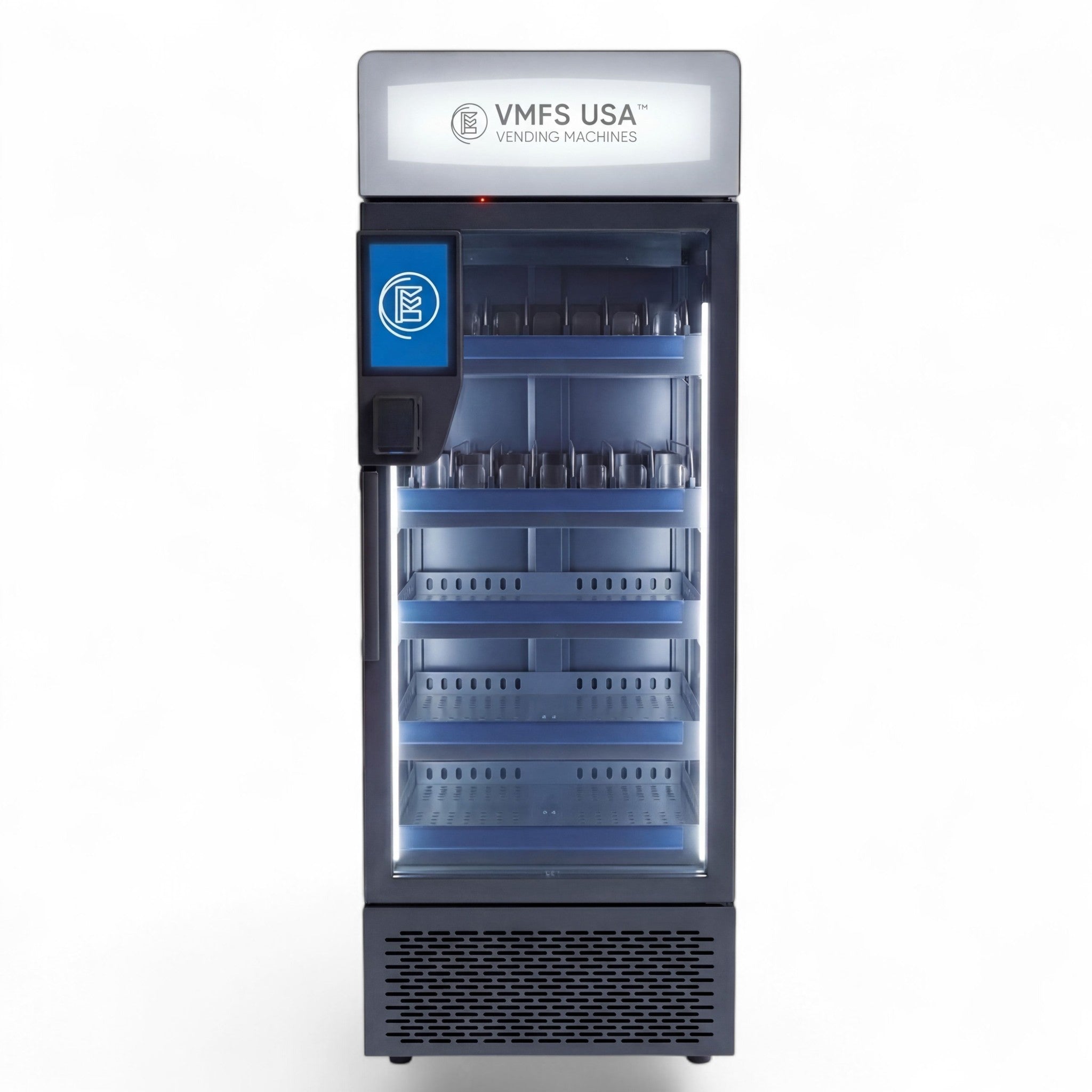
Need a Coffee Vending Machine Built for Consistent Powder Dispensing?
Browse VMFS USA's commercial coffee vending machine lineup — engineered for reliable hopper performance and consistent cup quality.
Shop Coffee Vending Machines


Share:
Cups for Coffee Vending Machine: The Complete Guide
Industrial Coffee Vending Machine: The Complete Guide